ARTIS Zoo Amsterdam: What We Loved, What We Didn’t & Is It Worth It
Whenever we visit a new city, we tend to check a few things before we even arrive. Somewhere near the top of that list is whether the city has a zoo. And, more importantly, whether that zoo has penguins. Amsterdam ticked both boxes. Right in the city, ARTIS Amsterdam Royal Zoo promised a mix of wildlife, history and, yes, penguins. That was enough to put it on our Amsterdam itinerary. But ARTIS isn’t simply another city zoo. Open since 1838, it has been part of Amsterdam for generations, with animal enclosures, historic buildings and gardens tucked into the Plantage district. So, naturally, we went to see it for ourselves. We wanted to find out what a day at ARTIS is actually like, what there is to see beyond the penguins, and whether Amsterdam’s historic zoo deserves a spot on your own itinerary.
- ARTIS Amsterdam Royal Zoo: Quick Facts
- A Zoo in the Middle of Amsterdam
- How to Get to ARTIS Zoo Amsterdam
- ARTIS Zoo Tickets & Opening Hours: What You Need to Know
- Facilities & Amenities at ARTIS Zoo
- Our Waddle Through ARTIS Zoo
- How Long Do You Need at ARTIS Zoo
- What We Liked About ARTIS and What Could Be Better
- When Is the Best Time to Visit ARTIS Zoo
- Is ARTIS Zoo Worth Visiting in Amsterdam
ARTIS Amsterdam Royal Zoo: Quick Facts
- Location: Plantage Kerklaan 38–40, Amsterdam, Netherlands
- Founded: 1838, making it the oldest zoo in the Netherlands and one of the five oldest zoos in the world.
- Opening Hours: Daily, 9:00 AM–6:00 PM from March through October; winter closing is generally at 5:00 PM.
- Tickets: Adults (13+) from €29.50 online / €32.50 at the gate; children 3–12 from €25.50 online / €27.50 at the gate; under 3s enter free. Prices can vary by date.
- Animals: Around 300 animal species.
- Known For: Historic zoo grounds, monumental buildings, botanical gardens, Planetarium and Aquarium.
- Included With Zoo Ticket: Planetarium and ARTIS Aquarium.
- Also at ARTIS: Micropia and the Groote Museum, which require separate or combination tickets.
- Getting There: Tram 7 or 14 stops directly by ARTIS; Waterlooplein metro station is around a 15-minute walk away.
A Zoo in the Middle of Amsterdam
What strikes you about ARTIS before you even see an animal is where it sits. Many European zoos require a trip beyond the historic center, but ARTIS feels very much part of Amsterdam itself. It sits in the Plantage neighborhood, surrounded by residential streets, canals, museums, and some of the city’s older architecture.
That connection continues once you walk through the gates. ARTIS dates back to 1838, and parts of that history remain visible across the grounds. Historic buildings sit alongside newer animal habitats, mature trees shade the paths, and gardens fill many of the spaces between enclosures. At times, it feels closer to walking through an old city park than navigating a modern zoo.
The grounds are also larger than they initially appear. Paths split in different directions, buildings interrupt the usual enclosure-to-enclosure rhythm, and there are plenty of quieter corners away from the main routes. You can still sense Amsterdam around you, but the traffic and busy streets quickly fade into the background.
It makes for an unusual first impression: ARTIS doesn’t feel like a zoo built outside Amsterdam and later absorbed by the city. It feels like a piece of Amsterdam that happens to have a zoo inside it.

How to Get to ARTIS Zoo Amsterdam
Getting to ARTIS Zoo by public transport is straightforward. Tram 14 is the most convenient option, stopping at ARTIS, just a short walk from the entrance. Tram 7 stops at Plantage Lepellaan, also nearby. We took the tram using the 72-hour GVB ticket we had purchased for our Amsterdam stay, so the journey was already covered. If you’re coming by metro, Waterlooplein is the closest station, around a 10–15 minute walk from ARTIS. From Amsterdam Centraal, Tram 14 is one of the easiest options and takes you directly toward the zoo.
ARTIS Zoo Tickets & Opening Hours: What You Need to Know
ARTIS is the kind of place where it pays to leave yourself a few hours rather than squeeze it between two other Amsterdam stops. We planned it as a proper part of our day, which gave us time to explore without constantly checking the clock. Tickets are also cheaper when purchased online, so this is one attraction where a little planning ahead can save you some money.
Opening Hours
ARTIS is open daily, generally 9:00 AM–6:00 PM from March to October and 9:00 AM–5:00 PM from November to February.
Admission
- Adult Tickets (13+): From €29.50 online or €32.50 at the entrance.
- Children (3–12): From €25.50 online or €27.50 at the entrance.
- Children under 3: free entry
- Plushies: free entry
Book Ahead: Online tickets are generally cheaper, and prices can vary by date.
Opening hours, ticket prices, and what’s included can change, so always check the official ARTIS website before your visit.
Facilities & Amenities at ARTIS Zoo
- Food & Drinks. Several cafés, restaurants and kiosks are spread throughout ARTIS, with indoor and outdoor seating available.
- Toilets & Baby Facilities. Toilets are available at several points around the zoo, including accessible toilets and baby-changing facilities.
- Accessibility. Most of ARTIS is wheelchair accessible, and you can borrow wheelchairs at the entrance, subject to availability. Accessible toilets are also available around the grounds.
- Other Facilities. You’ll find lockers, a gift shop, free Wi-Fi and plenty of benches and seating areas throughout the zoo.
Our Waddle Through ARTIS Zoo
First Impressions: A Zoo That Feels Part of Amsterdam
Getting to ARTIS was easy. One moment we were riding the tram through Amsterdam, and not long after, we were standing at the entrance. There was no long journey to the outskirts and no real sense that we had left the city behind.
Waddling through the gates felt less like entering a traditional zoo and more like stepping into another of Amsterdam’s parks. Trees line the paths, greenery fills the spaces between enclosures, and older buildings appear throughout the grounds. Even with the animals around you, the setting never feels completely separated from the neighborhood outside.
That became one of our first impressions of ARTIS: the zoo feels woven into Amsterdam rather than added onto it. You can slow down, follow whichever path catches your attention, and waddle through the grounds, with the city still feeling surprisingly close.


Finding Our Way Around ARTIS
ARTIS is easy enough to navigate, with a clear map showing the different enclosures, facilities and attractions across the grounds. You could absolutely use it to plot an efficient route through the zoo. We did not.
We really only needed to establish one location first: the penguins. Once we knew where they were, we winged the rest of the plan. Quite literally.
Instead of following a fixed route, we took whichever path looked interesting, occasionally checking the map when we wanted to find something specific. ARTIS lends itself well to this wandering. Paths branch off between trees and old buildings, enclosures appear around corners, and getting slightly lost often means stumbling across an animal you weren’t actually looking for.
The zoo is also bigger than it initially feels from the entrance, but not so sprawling that wandering becomes frustrating. Signs are posted throughout the grounds, and whenever we needed to get our bearings, it was easy to figure out where we were.
For us, that was part of the fun. Find the penguins first. Wing the rest.
The Penguin Stop We Were Waiting For
There was never much suspense about our first animal stop at ARTIS. Map checked, direction established, straight to the penguins.
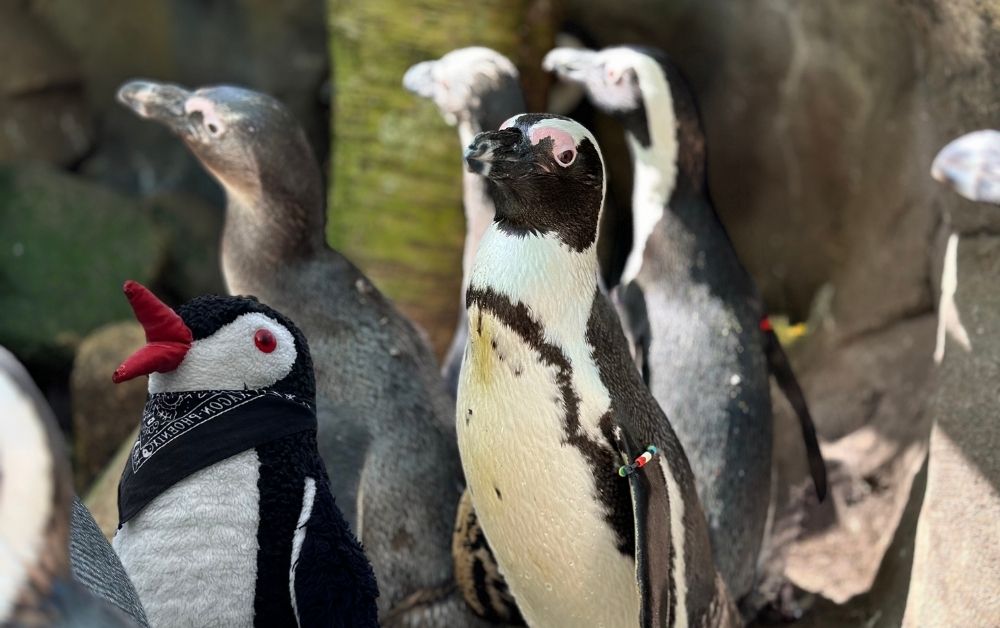
ARTIS is home to a colony of African penguins, the species found naturally along the coasts of South Africa and Namibia. They are smaller than the Antarctic penguins many people picture first, with the distinctive black band across the chest and individual patterns of black spots. They are also, unfortunately, critically endangered in the wild, which gives this particular stop a more serious story beyond their obvious ability to keep us standing beside an enclosure for far too long.


The penguin enclosure itself gave us plenty of reason to stay. It is quite spacious, with a large amount of the habitat dedicated to water, so we could watch the African penguins switch between waddling around on land and doing what they do considerably more gracefully: swimming.
There was also one section where we could get surprisingly close to them. No distant penguin spotting required here. We stood right beside them, watching them shuffle past and inspecting us with what seemed like equal curiosity. Perhaps a little too much curiosity.
Someone in our group got close enough for one penguin to decide that a quick bite was apparently an appropriate introduction. Nothing serious, but certainly memorable. We came to ARTIS hoping for a good penguin encounter. We hadn’t expected it to get that interactive.
Needless to say, this was not a quick stop on our waddle through ARTIS. We watched them swim, wander around the enclosure, and generally went nowhere until we had spent an entirely unreasonable amount of time with them. Worth coming to ARTIS for the penguins? For us, absolutely. Just keep your fingers to yourself.


The Animals That Actually Made Us Stop
Once we eventually pulled ourselves away from the penguins, ARTIS started to reveal just how varied its collection is. The zoo has around 300 animal species, but we never felt the need to tick them off a list. We kept walking and stopped whenever something caught our attention.
Some of the larger residents are difficult to walk past. Asian elephants and reticulated giraffes occupy some of the more open sections of the zoo, and the giraffes in particular are the kind of animals that make you stop even when you have seen them plenty of times before. ARTIS is currently also home to two young elephant calves, which makes the elephant habitat an especially popular stop.
Then there are the big cats. Lions and jaguars are among the animals you can see here, although, as always with cats, whether they intend to cooperate with your visit is entirely up to them. The lions now have a large, hilly habitat inspired by the African savannah, with different areas where they can climb, hide, or disappear from view when they have had enough of humans staring at them.


Elsewhere, the experience changes again. The Gorilla House is home to western lowland gorillas alongside Diana monkeys, meerkats and giant tortoises. At the same time, another part of ARTIS brings together ring-tailed lemurs, red ruffed lemurs and radiated tortoises. This variety makes wandering without a strict route work particularly well. One minute you are watching a giraffe reach for leaves; a few paths later, you are standing in front of a gorilla.
You can also expect red pandas, chimpanzees, wolves, flamingos, sea lions, wallabies, tapirs, otters, gibbons, reptiles, and plenty of birds, among many others.
And that was largely how we experienced ARTIS. We didn’t race between the headline animals or worry about seeing absolutely everything. We wandered, stopped when something made us stop, watched for a while, and then waddled on. For a zoo that feels so much like a park, that turned out to be a much better way to explore it.


What We Thought About the Animal Enclosures
Waddling around ARTIS, we found ourselves paying almost as much attention to the enclosures as to the animals inside them. For a zoo sitting in the middle of Amsterdam, space is inevitably part of the conversation, and the habitats vary considerably as you move around the grounds.
Some worked particularly well for us. The larger outdoor habitats felt green and gave the animals different areas to move between, while several enclosures were designed so that animals could retreat from view rather than constantly being on display. That occasionally meant staring into an apparently empty habitat, but we would much rather wait for an animal to appear than have nowhere for it to hide.
At the same time, you can tell that ARTIS is a historic city zoo. Some sections feel older and more confined than the newer habitats, and at times we wished certain animals had more space.
The same process is still happening elsewhere. ARTIS is preparing a new habitat for its African penguins because, although their current pool gives them room to swim, it is not deep enough for extensive diving. The new enclosure will provide deeper water, enrichment features, and more opportunities for natural behavior.
That perhaps sums up our impression best. ARTIS is a zoo caught between its history and what a modern zoo needs to be. Not every enclosure felt equally successful to us, but we could also see older spaces being gradually reconsidered rather than preserved simply because they have always been there.


We Stepped Inside the Planetarium
The Planetarium was one of those stops we hadn’t planned particularly carefully. We walked in just before a show was about to begin, found our seats beneath the huge dome, and suddenly swapped animals and greenery for a journey through space.
Shows are projected across the 360-degree dome, covering subjects ranging from the solar system to life on Earth and beyond. Most last around 25–30 minutes, although some programs run closer to 45 minutes, so it is an easy addition to a day at ARTIS rather than something that takes over your visit.
For us, it also worked as a welcome change of pace. After spending so much time walking outside, sitting down in the dark for half an hour felt surprisingly well timed.
Good to know: Planetarium admission is included with your regular ARTIS Zoo ticket, and shows run throughout the day. Some are in Dutch, while English-language shows are also scheduled, so check the daily program when you arrive if you want to catch a particular one.


The Aquarium, Micropia and Groote Museum
ARTIS could easily stretch beyond a zoo visit. The complex also includes the Aquarium, Micropia, and Groote Museum, but we decided not to add them to our day and focused on the zoo itself.
The Aquarium is included with a regular zoo ticket and is particularly worth considering now: it reopened in June 2026 after a five-year restoration. Micropia, meanwhile, takes you into the microscopic world of microbes, while the Groote Museum explores the connections between humans and the rest of nature. Both museums require separate admission, although discounted combination tickets with the zoo are available.
We skipped them simply because ARTIS already gave us enough to fill our visit. But if you have a full day to spare, particularly on a rainy Amsterdam day, adding one of the museums could turn a few hours at the zoo into a much broader day at ARTIS.
How Long Do You Need at ARTIS Zoo
ARTIS is not enormous, but it is also not a two-hour tick-the-box attraction if you actually want to enjoy it. Between stopping at the animal enclosures, inevitably lingering with the penguins, wandering through the grounds, and catching a Planetarium show, the hours disappear quickly.
We would recommend allowing around 4 hours for ARTIS Zoo. That gives you enough time to wander without rushing, stop when an animal catches your attention, and take a break along the way. If you want to see the main animals, 2–3 hours can work, while a slower visit with the Aquarium, Planetarium, lunch, and plenty of stops could easily stretch to 5 hours or more. The Aquarium and Planetarium are both included in regular zoo admission. We don’t recommend over-planning the route. Give ARTIS a decent chunk of your day, find the penguins, and then wing the rest.

What We Liked About ARTIS and What Could Be Better
ARTIS does a great job creating a zoo that still feels connected to Amsterdam. We loved the greenery, the older architecture, and the fact that you can wander rather than follow a rigid route from enclosure to enclosure. Some of the larger habitats gave animals plenty of room to move and retreat from view, while the Planetarium added something completely different to the day. And, unsurprisingly, the African penguins were our highlight, especially because we could get so close to them. The central location and easy tram connection also make ARTIS remarkably convenient for a major zoo.
The main drawback comes from the same thing that gives ARTIS much of its character: its age and limited city-center space. Some of the older enclosures felt smaller and more dated than the newer habitats, and in places we would have liked more room for the animals. At around €30 for an adult ticket, it is also not a cheap Amsterdam attraction, particularly if you only have a couple of hours to spare. We wouldn’t call either issue a reason to skip ARTIS, but they are worth considering when deciding whether it fits your Amsterdam itinerary.
When Is the Best Time to Visit ARTIS Zoo
We arrived at ARTIS at around 2:00 PM, when the zoo was already busy. Plenty of people were around, especially near the more popular animals, but it never felt overcrowded. We could still get close to the enclosures, wander at our own pace, and find quieter stretches of the grounds without much effort.
If we visited again, however, we would probably choose the morning. Arriving close to opening gives you a few hours before the afternoon crowds build and generally gives you a better chance of catching animals when they are more active. That said, our afternoon visit worked perfectly well, so there is no need to avoid ARTIS later in the day if that fits your Amsterdam itinerary better. Spring and early autumn would be our seasonal picks, when spending several hours walking outside is generally more comfortable than during the hottest summer days.
Is ARTIS Zoo Worth Visiting in Amsterdam
For us, ARTIS Zoo was worth visiting, although we will freely admit that the penguins had something to do with that verdict. We always look for zoos when we travel, and finding a colony of African penguins in the middle of Amsterdam made ARTIS an easy addition to our itinerary. Beyond them, we enjoyed the greenery, the mix of historic buildings and animal habitats, and the feeling of spending a few hours somewhere completely different from the canals and museums that had filled much of the rest of our trip.
But we wouldn’t automatically recommend ARTIS to everyone visiting Amsterdam. If you only have one or two days in the city, we would probably prioritize Amsterdam’s historic center, canals, and major museums, particularly if this is your first visit. A proper ARTIS visit takes several hours, and with tickets around €30, it is a significant commitment of both time and budget.
If you have three or more days, are returning to Amsterdam, are traveling with children or love animals, ARTIS becomes much easier to recommend. And if, like us, checking the local penguin population is somehow an essential part of planning every holiday, then you probably didn’t need us to convince you in the first place.
Buy Us a Ko-fi

It started, as it often does for us, with a simple search: Does Amsterdam have a zoo? And does that zoo have penguins? A few clicks later, ARTIS was on the itinerary. After several hours of wandering, one unexpected Planetarium show, and plenty of animals, it was still the penguins we talked about on the way out. Although perhaps not for the reason we expected. After all, not every zoo visit ends with someone getting bitten by a penguin. This one will be difficult to forget.
Travel Bold. Eat Well. Waddle Wild.

This post contains affiliate links. If you click and buy, I might earn a tiny commission, enough to help a penguin keep up its globe-trotting lifestyle. No extra cost to you, just more fish for me. Thank you for supporting the adventure!