Skopje Weekend Guide: What to See in 2 Days
We came to Skopje, North Macedonia, for a longer weekend, arriving on Thursday and flying back home on Monday. That gave us Friday, Saturday, and Sunday to explore, although we didn’t spend all three days only in the city. We also squeezed in a few adventures around Skopje because, well, apparently relaxing for an entire weekend is still not our thing. In this itinerary, though, we’re focusing mainly on Skopje itself and the places we actually saw, ate at, and enjoyed during our stay. When we add up the time we spent waddling around the city, it comes to roughly two days, which we think is a great amount of time for a first visit. From Macedonia Square and its seemingly endless collection of statues to the colorful Old Bazaar, Skopje Fortress, city views, and plenty of food stops, here’s how we spent our days in Skopje and surrounding areas based on our own longer weekend there.
- Our Weekend in Skopje at a Glance
- Is 2 Days in Skopje Enough
- Our Skopje Itinerary at a Glance
- Day 1: First Waddle Through Skopje
- Day 2: Matka Canyon & More of Skopje
- Day 3: Kosovo, Skopje Aqueduct & One Last Waddle
- Go Statue Hunting
- What We Didn’t Manage to See in Skopje
- What We Would Skip in Skopje
- Where to Stay for a Weekend in Skopje
- Is 3 Days in Skopje Enough
- Is Skopje Worth Visiting for a Weekend
- Best Day Trips From Skopje
- Skopje Itinerary: Save It for Later
- Skopje Map: Points of Interest
Our Weekend in Skopje at a Glance
- Time in Skopje: Around 2 days of sightseeing
- Trip: Thursday to Monday
- Getting around: Mostly waddling
- Best for: City sights, food, history & a little chaos
- Our highlight: Old Bazaar
Is 2 Days in Skopje Enough
Although our trip ran from Thursday to Monday, we spent about one and a half to two days actually exploring Skopje, with the rest of our time spent on trips outside the city. So, is two days enough? For us, definitely. Skopje is compact and very walkable, and two days gives you plenty of time to see the main sights at a relaxed pace, wander through the Old Bazaar, stop for food, hunt down some of those endless statues, and still have time to sit down for a coffee without feeling guilty about it. Of course, it depends on how many museums and attractions you want to visit, but for a first trip focused on the main highlights, two days in Skopje felt just right.
Our Skopje Itinerary at a Glance
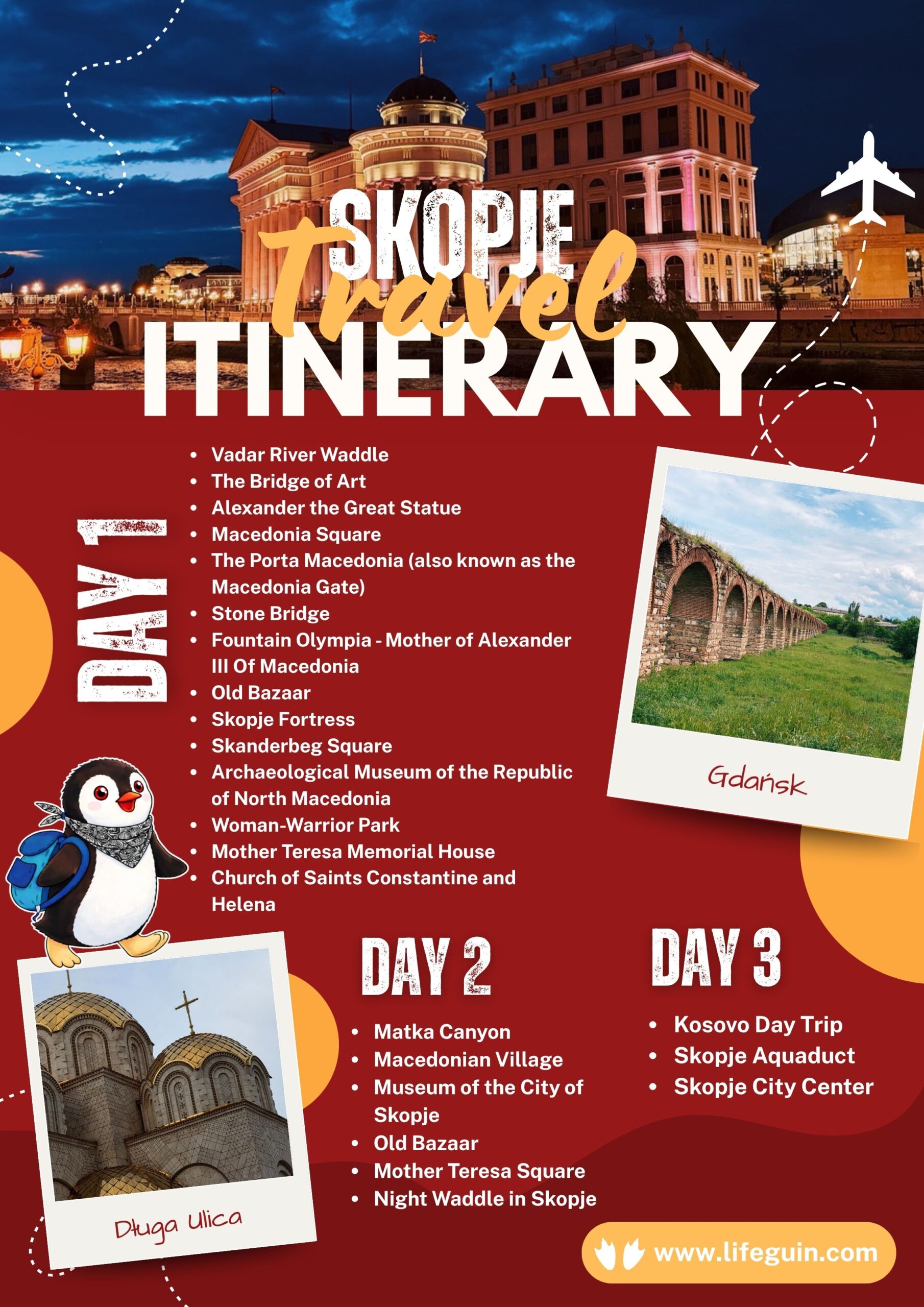
- Day 1: Skopje City Center, Old Bazaar & Skopje Fortress
- Day 2: Matka Canyon, Macedonian Village & Night Waddle in Skopje
- Day 3: Kosovo Day Trip, Skopje Aqueduct & City Center
Day 1: First Waddle Through Skopje
We arrived in Skopje around lunchtime, which meant we only had half a day for our first proper city waddle. Somehow, that half day became very busy. Looking at the list below, it might seem like we were sprinting around Skopje with a checklist in hand, but we really weren’t. Central Skopje is incredibly compact and walkable, and many of these sights are only a few minutes apart. We started waddling and kept finding something else around the next corner. Here’s everything we managed to squeeze into our first afternoon.
Vardar River Waddle
We started our first afternoon in Skopje with a waddle along the Vardar River, which runs straight through the city’s heart. It was a great way to get our first proper look at Skopje because so many of the city’s grand buildings, monuments and bridges sit right along the river. The Vardar is the longest river in North Macedonia, stretching about 388 km in total, with roughly 301 km flowing through the country. It begins near the village of Vrutok, close to Gostivar, flows through the Skopje Valley and eventually crosses into Greece, where it is known as the Axios and empties into the Aegean Sea near Thessaloniki. Around 51 km of the river runs through the wider Skopje Valley, so it is a pretty important part of the city’s landscape. We didn’t really have a strict route at this point. We followed the river, crossed whichever bridge caught our attention, and let Skopje introduce itself.


The Bridge of Art
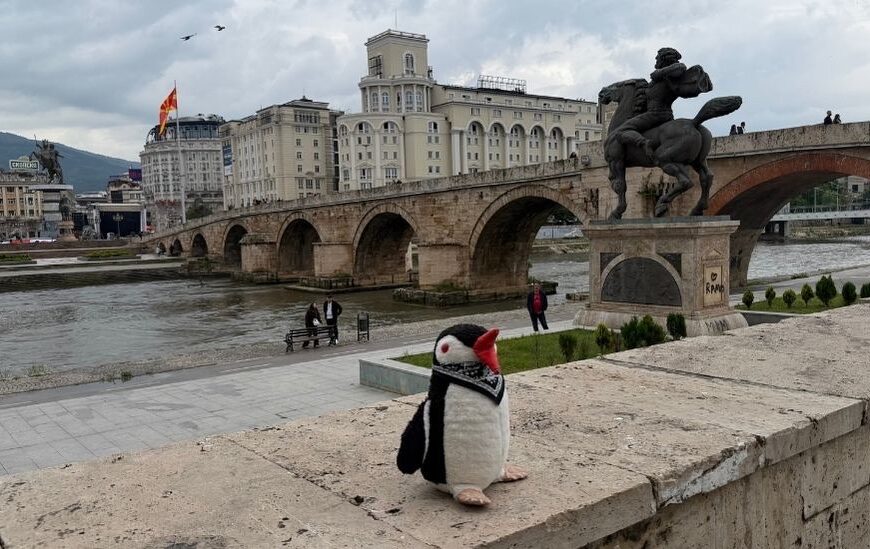
The Bridge of Art was one of our first signs that Skopje really loves its statues. Built as part of the Skopje 2014 project, the pedestrian bridge is lined with dozens of sculptures representing Macedonian artists, writers, musicians, and other cultural figures. It is a lot to take in, but that is also what makes it such a fun and unusual stop while waddling along the Vardar River.
Macedonia Square & Alexander the Great Statue
Macedonia Square is the heart of Skopje, and sooner or later, your waddle through the city will bring you here. At around 18,500 square meters, it is the largest square in North Macedonia, surrounded by cafés, shops, grand buildings, and, of course, plenty of statues. The star of the show is the enormous Warrior on a Horse monument, associated with Alexander the Great, which stands in the middle of a huge fountain. We spent quite a bit of time simply looking around because there is honestly a lot happening in every direction. Fun fact: the square also has an important connection to Mother Teresa, who was born in Skopje in 1910, with her birthplace located close to today’s square. It is grand, slightly over the top, and very Skopje.


The Porta Macedonia
The Porta Macedonia, also known as the Macedonia Gate, is Skopje’s very own triumphal arch, because apparently the statues alone weren’t dramatic enough. It stands 21 meters tall and was officially opened in 2012 as part of the Skopje 2014 project. The outside is covered with reliefs showing scenes from Macedonian history and culture, while inside there are exhibition spaces and a rooftop terrace. It is definitely one of those landmarks that makes you stop, look up, and think, yep, this is very Skopje.


Stone Bridge
The Stone Bridge is one of Skopje’s most recognizable landmarks and has been connecting the two sides of the Vardar River for centuries. The bridge we see today is generally dated to the 15th century and the reign of Ottoman Sultan Mehmed II, although some sources suggest an earlier bridge stood here. At around 214 meters long, its stone arches lead you straight from Macedonia Square towards the Old Bazaar. For us, crossing it was more than just another sightseeing stop. It felt like walking from one version of Skopje into another, with the modern city behind us and the completely different atmosphere of Čaršija waiting on the other side.

Fountain Olympia
Just across the Stone Bridge, we stopped at the Fountain Olympia, dedicated to Olympias, the mother of Alexander the Great. The fountain was unveiled in 2012 and features a large bronze statue of Olympias surrounded by several smaller sculptures, including figures showing her with young Alexander. It is another one of those very grand Skopje monuments where there is almost too much to look at, but that quickly became part of the fun of exploring the city.


Old Bazaar
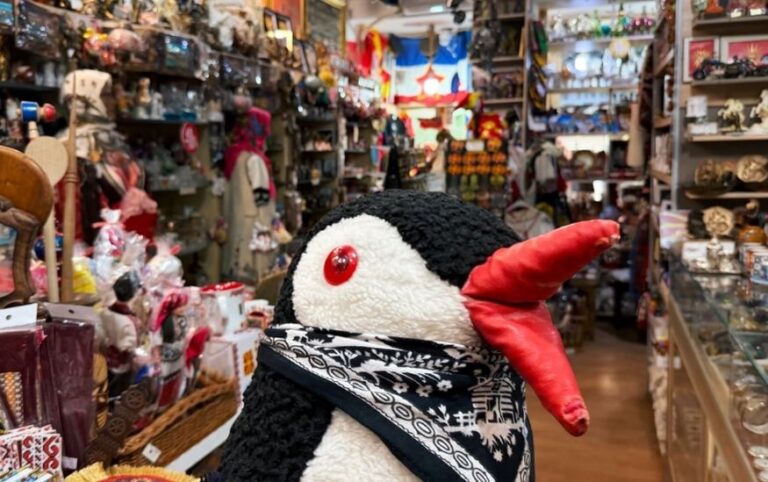
The Old Bazaar, or Stara Čaršija, was easily one of our favorite stops in Skopje. The moment we crossed the Stone Bridge, it felt like we had waddled into a completely different city, with narrow cobblestone streets, little shops, mosques, cafés, and the smell of grilled food and baklava following us around. The bazaar has been an important center of trade for centuries and grew significantly during the Ottoman period from the 15th century onward. Today, it is still one of the largest historic bazaars in the Balkans. Our advice? Don’t worry too much about the map. Pick a little street, start waddling, and see where the food smells take you.


Skopje Fortress
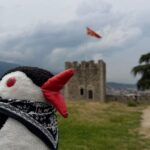
From the Old Bazaar, we waddled uphill to Skopje Fortress, also known as Kale Fortress, one of the city’s oldest landmarks. The fortress sits on a hill overlooking the Vardar River, and archaeological finds show people lived around this spot as far back as the 4th millennium BC. Today, there isn’t actually that much to see inside, but you can wander along the walls, climb the accessible towers and enjoy some of the best views over Skopje. Entrance is free, so if you’re already exploring the bazaar, we think the short waddle uphill is definitely worth it.
Skanderbeg Square
Skanderbeg Square brings yet another side of Skopje into the mix. The large square sits beside the Old Bazaar and is dominated by an equestrian statue of Skanderbeg, the 15th-century Albanian military leader and national hero. The monument was erected in 2006, while the square around it was later significantly redeveloped. Skanderbeg has a strong connection to the region, and the square is particularly important to Skopje’s Albanian community. We mostly enjoyed it as another little detour on our waddle, and yes, by this point seeing another giant statue felt completely normal.


Archaeological Museum of the Republic of North Macedonia
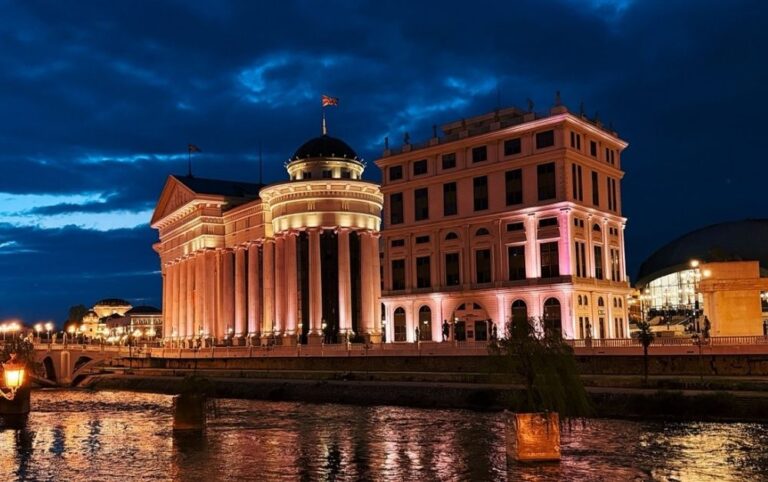
Sitting right on the Vardar River, the Archaeological Museum of the Republic of North Macedonia is pretty hard to miss thanks to its huge neoclassical facade and columns. The museum opened in 2014 and houses thousands of archaeological objects covering the region’s history from prehistoric times through the medieval period. Even if you don’t go inside, the building itself is worth a look, especially from across the river. By this point in our waddle, we were starting to realize that in central Skopje, even museums apparently need to look like palaces.
Woman-Warrior Park
Woman-Warrior Park is a small green space just across from the Parliament building and, unsurprisingly for Skopje, it comes with even more statues. The park was redesigned as part of the Skopje 2014 project and is filled with monuments dedicated to important figures and moments from Macedonian history. Despite all the grand statues, we liked that it also gave us a little patch of greenery during our city waddle. By this point, though, we had definitely accepted one important rule of Skopje: if you see a space, there is probably a statue waiting to be placed there.


Mother Teresa Memorial House
The Mother Teresa Memorial House is one of Skopje’s most personal landmarks, as Mother Teresa was born here in 1910 as Anjezë Gonxhe Bojaxhiu. The memorial opened in 2009, close to the site where the Catholic church in which she was baptized once stood before the 1963 earthquake destroyed it. Inside, you can learn about her life, see photographs, documents and personal items, and visit a small chapel upstairs. It is free to enter, doesn’t take very long to explore, and gives you a completely different break from Skopje’s seemingly endless parade of giant statues.


Church of Saints Constantine and Helena
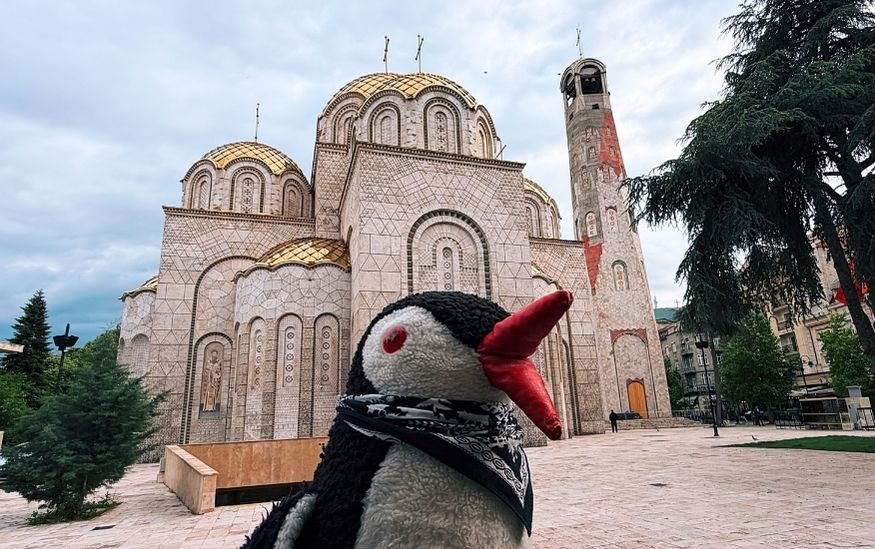
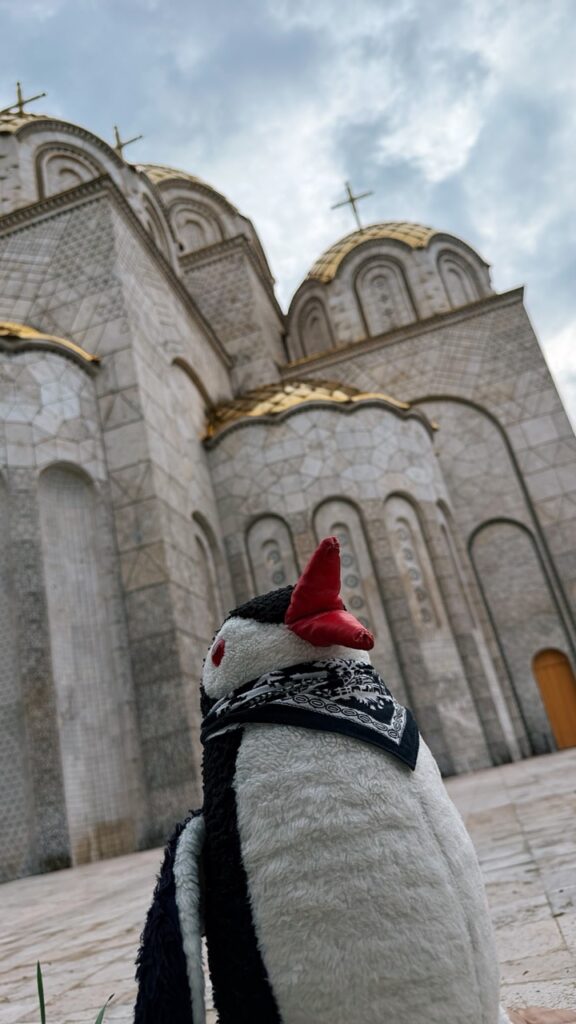
The Church of Saints Constantine and Helena was honestly one of the places that surprised us most in Skopje. Even from the outside, the church is beautiful, with its detailed facade, domes, and very grand appearance, but then we stepped inside and had another wow- okay, we weren’t expecting this moment. The interior is filled with golden details, icons, and colorful religious artwork, making it feel incredibly rich compared with the modern city surrounding it. The current church is relatively new, but it stands near the site of an earlier church damaged in the 1963 Skopje earthquake. Definitely don’t just take a photo from outside. Waddle in and have a look.




Day 2: Matka Canyon & More of Skopje
On our second day, we left Skopje for the first half of the day and headed to Matka Canyon, one of the easiest and most popular trips from the city. We spent the morning exploring the canyon before heading back to Skopje, stopping at the Macedonian Village along the way. The rest of the day was much more relaxed.
Museum of the City of Skopje
The Museum of the City of Skopje is housed inside the city’s former railway station, and the building itself tells one of Skopje’s most powerful stories. During the devastating 1963 earthquake, much of the station was destroyed, but part of the facade survived. Look up at the clock, and you’ll notice it is still frozen at 5:17, the time the earthquake struck on July 26, 1963. Inside, the museum takes you through Skopje’s history, but even if you don’t have time to explore every exhibition, the building and that frozen clock alone are worth waddling over to see.


Mother Teresa Square
Mother Teresa Square is another small reminder of just how connected Mother Teresa is to Skopje. Located in the city center, it is named after Mother Teresa, who was born in Skopje in 1910 as Anjezë Gonxhe Bojaxhiu. It is not a place you need to plan a long stop for. Still, it fits naturally into a city waddle and is worth passing through, especially if you are also visiting the nearby Mother Teresa Memorial House. For us, it was one of those quick stops that added another little piece to the Skopje puzzle.


Night Waddle in Skopje
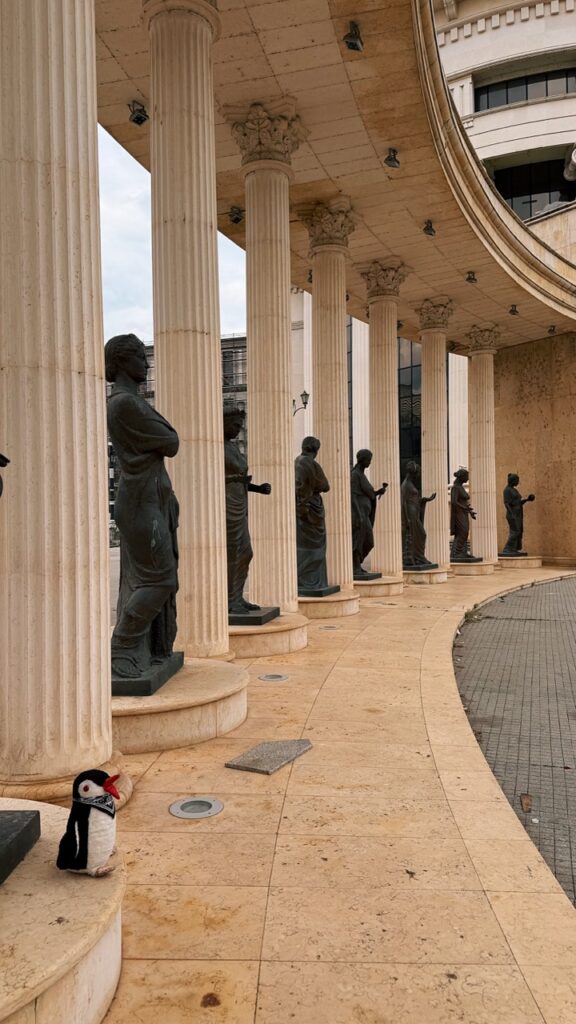
We definitely recommend saving some energy for a night waddle through Skopje, because the city feels completely different once the sun goes down. Many of the grand buildings, bridges, fountains and statues around the Vardar River are beautifully illuminated, and suddenly all that slightly over-the-top architecture makes a lot more sense. We loved waddling around Macedonia Square and along the river again, seeing the reflections of the lights on the water and noticing buildings we had already passed during the day in a completely different way. Skopje certainly isn’t shy during daylight, but at night it gets even more dramatic, and somehow, it works. It again feels like a different city.


Day 3: Kosovo, Skopje Aqueduct & One Last Waddle
Our third day took us outside North Macedonia for a day trip to Kosovo, giving us a completely different adventure before returning to Skopje. Once back, we still had a little exploring left in us, so we stopped at the Skopje Aqueduct and then headed back into the city center for one final waddle. By this point, the streets, bridges, and endless statues were starting to feel familiar.
Skopje Aqueduct
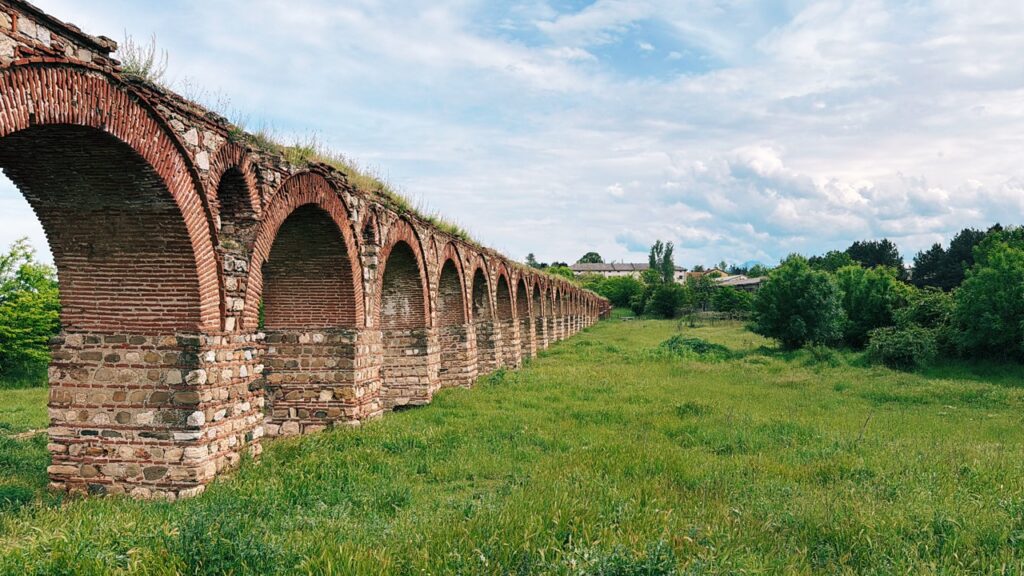
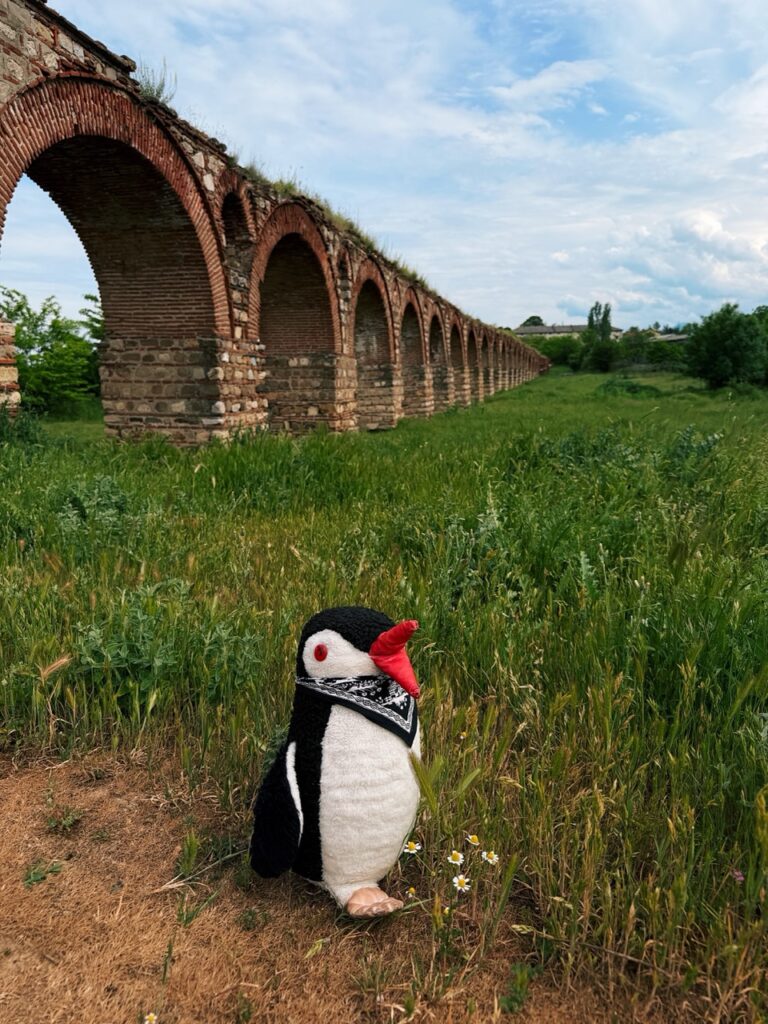
The Skopje Aqueduct is one of the city’s more mysterious landmarks because nobody knows exactly when it was built. Some theories date its origins to the Roman or Byzantine periods, while others suggest the surviving structure was built during the Ottoman era, possibly in the 15th or 16th century. Around 55 stone arches still survive today, making it a pretty impressive sight once you finally get there. And finally is the important word here. We found the surrounding area quite neglected, with rubbish scattered around and an access route that wasn’t exactly welcoming. It honestly feels like such a shame because this fascinating historical structure deserves a much better setting and easier access. Still, if you enjoy hunting down unusual, slightly forgotten places as we do, it is definitely an interesting detour from central Skopje.

One Last Waddle Through Skopje
Before calling it a night, we headed back into Skopje city center for one last waddle. This time, we had no sightseeing checklist. We walked around the familiar streets, passed Macedonia Square and the Vardar River, and enjoyed the city without worrying about what we still needed to see. After a busy few days, it was actually nice to slow down and wander. Sometimes the best way to finish a city trip is to stop trying to explore everything and enjoy being there.
Go Statue Hunting
This wasn’t officially on our itinerary, but in Skopje, statue hunting basically happens whether you plan it or not. The exact number is difficult to pin down, but the city gained well over 100 statues and monuments during the Skopje 2014 transformation alone, on top of monuments that were already there. Walk around the center for a few minutes, and you’ll understand what we mean. They are on squares, bridges, in parks, and sometimes in places where you really weren’t expecting another statue. So if you want to make your Skopje waddle a little more fun, turn it into a statue hunt and see how many you can spot. We gave up counting pretty quickly.


What We Didn’t Manage to See in Skopje
Even with our very busy waddling schedule, there were still a few places we didn’t manage to squeeze in. If we had more time, these would definitely make the list:
- Museum of the Macedonian Struggle. History of Macedonia’s struggle for independence and statehood.
- Museum of Contemporary Art. Modern art plus some great views over Skopje.
- Museum of Macedonia. A deeper look into the country’s history, archaeology and traditions.
- Mustafa Pasha Mosque. Beautiful 15th-century Ottoman mosque overlooking the Old Bazaar.
- Church of the Ascension of Jesus. Small historic church known for its impressive carved iconostasis.
- Sultan Murad Mosque. One of Skopje’s oldest surviving Ottoman buildings, dating back to 1463.
- Millennium Cross. The huge cross on Mount Vodno, with panoramic views over Skopje.
- Vodno Cable Car. Something we would definitely add next time for the ride and views alone.
What We Would Skip in Skopje
If we only had two days, we’d probably leave a few attractions for a longer visit. Skopje Zoo might be fun if you are traveling with kids, but it wouldn’t be high on our list for a short city break. Still, because of the penguins, we might consider it. We would also skip East Gate Mall and Skopje City Mall unless you really want to shop, since there are more interesting ways to spend limited time in the city. Boris Trajkovski Sports Center is another place we wouldn’t specifically add unless you are attending an event there. And while Gazi Baba Park gives you a more local green escape, we would choose the Old Bazaar, Matka Canyon or a trip up Mount Vodno first. With only a couple of days, we think Skopje is much more about its historic center, food, views, and slightly chaotic city waddles than trying to see absolutely everything.
Hotel search from Trip.comShows Trip.com’s own box, which can set Trip.com cookies.Search hotels on Trip.comTrip.com’s box can’t load on this device (an ad blocker often stops it). This opens Trip.com’s own hotel search.Open Trip.com
Where to Stay for a Weekend in Skopje
For a first visit to Skopje, we recommend staying somewhere around the city center and Macedonia Square. Skopje is very walkable, and from here you can easily reach the Stone Bridge, Old Bazaar, Mother Teresa Memorial House, Vardar River, and many of the main attractions without relying on public transport.
We stayed at Hotel Senigallia, probably one of the most unusual places to stay in Skopje, because the hotel is designed like a ship sitting directly on the Vardar River. The location was a big plus for us, Macedonia Square and the Stone Bridge are only about a three-minute waddle away.
Some of the best areas to consider are:
- Macedonia Square & City Centre: Best for first-time visitors who want to walk to most of Skopje’s main attractions. A good example is Hotel Macedonia Square, located right in the heart of the city.
- Old Bazaar: Best if you want to stay among Skopje’s historic streets, Ottoman architecture, traditional restaurants, and shops. One option is Hotel Old Konak, right in the Old Bazaar area.
- Debar Maalo: Great for restaurants, cafés, nightlife, and experiencing a more local side of Skopje while still being close to the center.
- City Park Area: A good choice if you prefer somewhere a little greener and quieter while remaining within walking distance of central Skopje. Hotel City Park is a well-located option here.
For a short city break or your first time in Skopje, we’d personally choose the city center again. Being able to walk almost everywhere made exploring the city incredibly easy.
Is 3 Days in Skopje Enough
We think three days in Skopje is more than enough, especially if you want to explore at a relaxed pace and still have time for an adventure outside the city. The center itself is compact and very walkable, so you can comfortably cover the main sights in around two days without turning your weekend into a sightseeing marathon. With a third day, you have room to add Matka Canyon, Mount Vodno or another nearby trip, or spend more time eating your way through the Old Bazaar. If you have even longer, you could venture further to Tetovo, Kosovo or Lake Ohrid, although we would definitely give Ohrid more than a rushed day trip. For us, three days gave us a great mix of Skopje, nature and exploring beyond the city, without needing a holiday after the holiday.
Buy Us a Ko-fi

Is Skopje Worth Visiting for a Weekend
For us, Skopje is worth visiting for a weekend, especially if you enjoy cities that are a little different and don’t take themselves too seriously. We loved the contrast between the grand, statue-filled city center and the narrow, colorful streets of the Old Bazaar, and the food was a great reason to keep waddling. Skopje Fortress gave us some great views, Matka Canyon added a bit of nature, and there always seemed to be something slightly unexpected around the next corner. That said, Skopje isn’t perfectly polished. We noticed rubbish in several places, some historical sites could definitely use more care, and parts of the city feel a little chaotic. But somehow, that mix is also what made Skopje memorable for us. Two to three days feels just right for a weekend, giving you enough time to explore without rushing and still stop for that second baklava. Because apparently one is never enough.
Best Day Trips From Skopje
One thing we really liked about using Skopje as our base is that you don’t have to stay in the city the whole time. Skopje offers great day trips, whether you want mountains, lakes, history, or even another country. If you have an extra day or two, these are some of the places we would consider adding:
- Matka Canyon. Only around 15 km from Skopje and perfect for hiking, boat rides, caves, and a bit of nature. We did this one ourselves and would definitely recommend it.
- Mount Vodno. An easy half-day escape where you can take the cable car up towards the Millennium Cross and enjoy views over Skopje.
- Tetovo. About 45 km from Skopje, best known for the incredibly colorful Painted Mosque.
- Pristina, Kosovo. Roughly 90 km away, making Kosovo surprisingly easy to add to a Skopje trip.
- Prizren, Kosovo. A beautiful historic city with Ottoman architecture, mosques, cobblestone streets and a fortress overlooking the city.
- Kokino. A Bronze Age archaeological site and a good choice if you prefer something a little more unusual.
- Ohrid. One of North Macedonia’s most famous destinations. You can technically visit on a long day trip, but we would rather stay overnight and give Ohrid the time it deserves.
For a first trip, Matka Canyon would be our number-one choice, especially because it is so close to Skopje. If you have a full extra day and don’t mind crossing the border, Kosovo also makes for a very different adventure.
Skopje Itinerary: Save It for Later
Skopje Map: Points of Interest
Our weekend in Skopje turned out to be much more interesting than we expected. It is a city of contrasts, sometimes within just a few minutes’ walk. One moment, enormous statues and grand buildings surround you; the next, you’re waddling through the narrow streets of the Old Bazaar with the smell of coffee, grilled food and baklava in the air. We loved the food, the views, the bazaar and just how easy it was to explore on foot. Skopje can also feel a little chaotic and rough around the edges, with some places that could definitely use more care, but somehow that became part of the experience too. Add Matka Canyon, a few adventures outside the city, and more statues than we could ever count, and our longer weekend was packed without ever feeling like we needed to rush. Skopje might not be the prettiest or most polished European capital we have visited, but it has personality, and that is exactly why we will remember our waddle here.
Travel Bold. Eat Well. Waddle Wild.

This post contains affiliate links. If you click and buy, I might earn a tiny commission, enough to help a penguin keep up its globe-trotting lifestyle. No extra cost to you, just more fish for me. Thank you for supporting the adventure!