A Day Trip to Sigulda: Castles, Nature and the Gauja Valley
Sigulda makes an easy escape from Riga, with forests, castles, and the Gauja Valley waiting just beyond the city. During our time in Latvia, we hopped on a train and spent a day exploring the area. We wandered through Sigulda, visited its main sights, and took in the surrounding landscape, getting a glimpse of why this small town is one of Latvia’s most popular day-trip destinations.
- Our Sigulda Day Trip
- From Riga to Sigulda
- Practical Train Information
- Waddling from the Train Station into Sigulda
- Latvia’s Gateway to the Gauja Valley
- Riding the Sigulda Cable Car Across the Gauja Valley
- Floating Above the Gauja Valley
- Sigulda Cable Car Quick Facts
- Discovering the Ruins of Krimulda Castle
- Gutman’s Cave: A Natural Archive in the Gauja Valley
- Castle of the Livonian Order in Sigulda
- From the Medieval Castle to Sigulda New Castle
- Avēnija Nr. 9: Lunch at Gastrobārs “9. Pils”
- What We Didn’t Manage to See
- What We Managed to See in One Day
- Our Sigulda Day Trip in a Nutshell
- How to Do This Sigulda Day Trip Yourself
- What We Would Do Differently
- When Is the Best Time to Visit Sigulda
Our Sigulda Day Trip
- Starting Point: Riga, Latvia.
- Transportation: Train from Riga to Sigulda and back.
- Duration: One day
- Main Stops: Sigulda town, Sigulda Castle, Gauja Valley, Gutmanis Cave
- Getting Around: mostly waddling, with additional local transportation where needed
- Difficulty: easy to moderate, depending on how much of the area you explore on food
After spending time exploring Riga, we wanted to see a little more of Latvia beyond the capital. We decided to hop on a train and head to Sigulda for the day, trading the city streets for castles, forests, and the landscapes of the Gauja Valley. With only one day to explore, we set off without trying to see everything, simply enjoying the chance to wander, discover a different side of Latvia, and see where the day would take us.

We leave Riga in the morning, trading the capital’s streets for the quieter landscapes beyond the city. For our day trip to Sigulda, the train feels like the natural choice. No need to worry about parking or navigating unfamiliar roads. We find our seats, settle in, and watch Riga slowly disappear behind us.
The journey takes about an hour and a half, and the scenery grows increasingly rural as we travel toward Sigulda. By the time we arrive, the city feels a world away. We step off the train and into a different Latvia, one of forests, rolling hills, and the Gauja Valley, with a full day of exploring ahead of us.
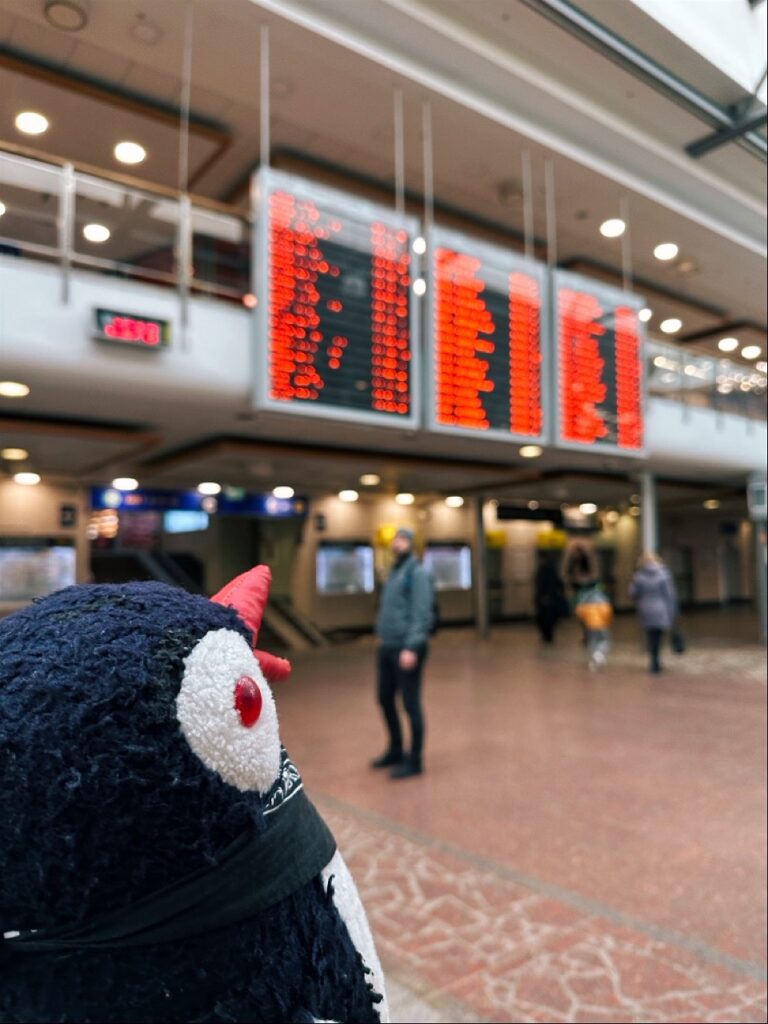
From Riga to Sigulda
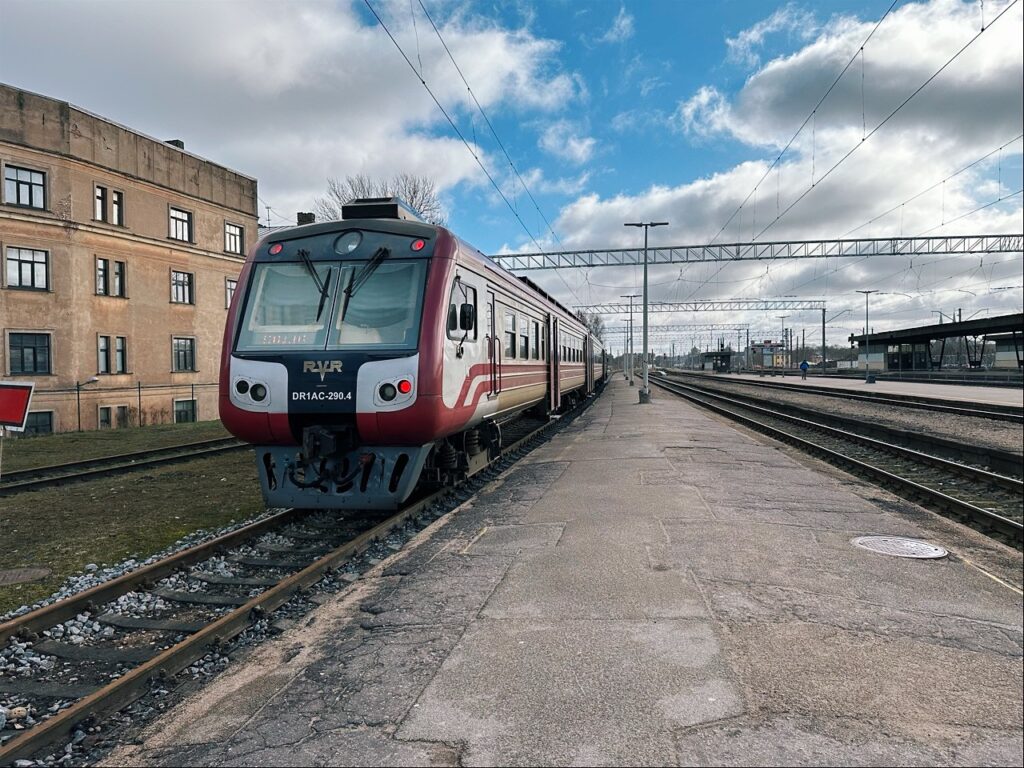
Getting to Sigulda from Riga is much easier than we expected. We board the morning train and settle in, expecting a longer journey, but the ride passes by before we have time to notice. The train moves quickly through the Latvian countryside, and before long, we are already pulling into Sigulda. For a day trip, the short journey makes the town feel especially accessible.
Practical Train Information
- Train operator: Vivi
- Route: Riga Central Station → Sigulda.
- Journey time: Around 1 hour, depending on the service.
- Frequency: Multiple trains run each day in both directions
- Tickets: You can buy tickets through the Vivi website, the Vivi Latvia mobile app (Google Play or App Store), or at the station ticket office
- Buying on board: You can also buy a ticket from the conductor, but a €1 surcharge applies if the ticket office was open when you boarded.
- Ticket price: The fare depends on the railway zone. Current standard single fares range from €1.30 to €3.80, with the applicable fare for Sigulda shown when you search the journey.
- Seat reservations: Tickets aren’t for specific seats, so you can take any available seat
Then we step outside the station, and Sigulda immediately gives us something to look at. We love the little railway station itself, with its cheerful orange-and-white colors, but the surprises do not stop at the doors. Right outside, a large S! marks Sigulda, along with oversized flowers and a statue, all adding a playful touch to the entrance. We have barely arrived and already have our cameras out. If this is the welcome, we have a feeling we are going to enjoy exploring Sigulda.
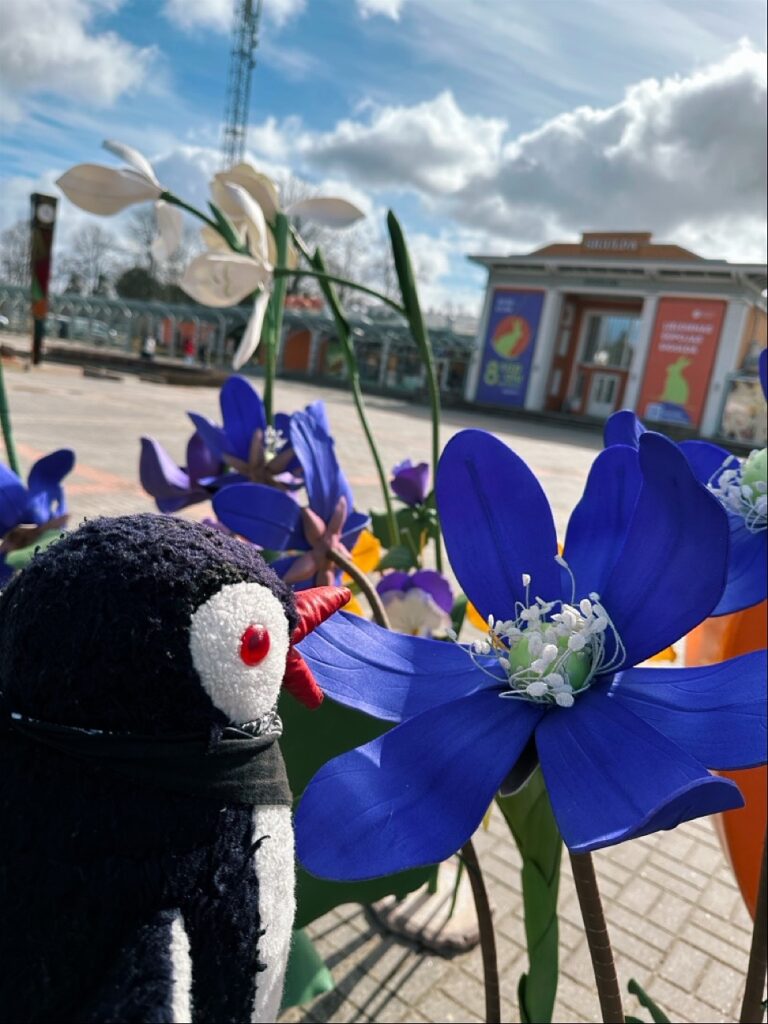
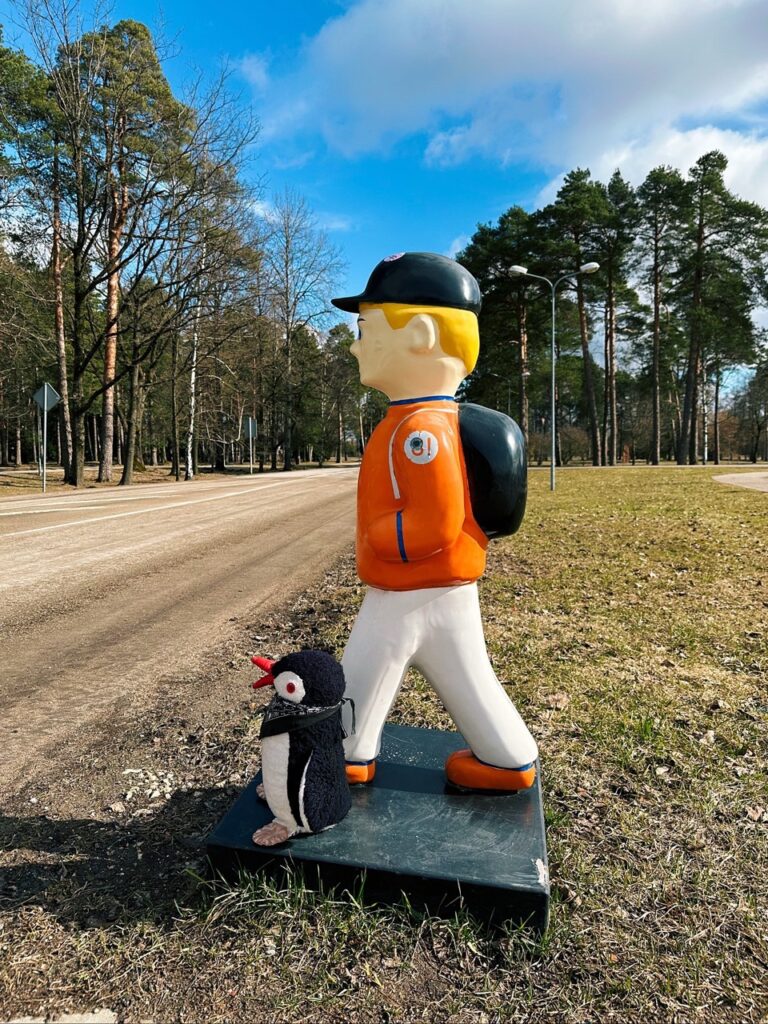
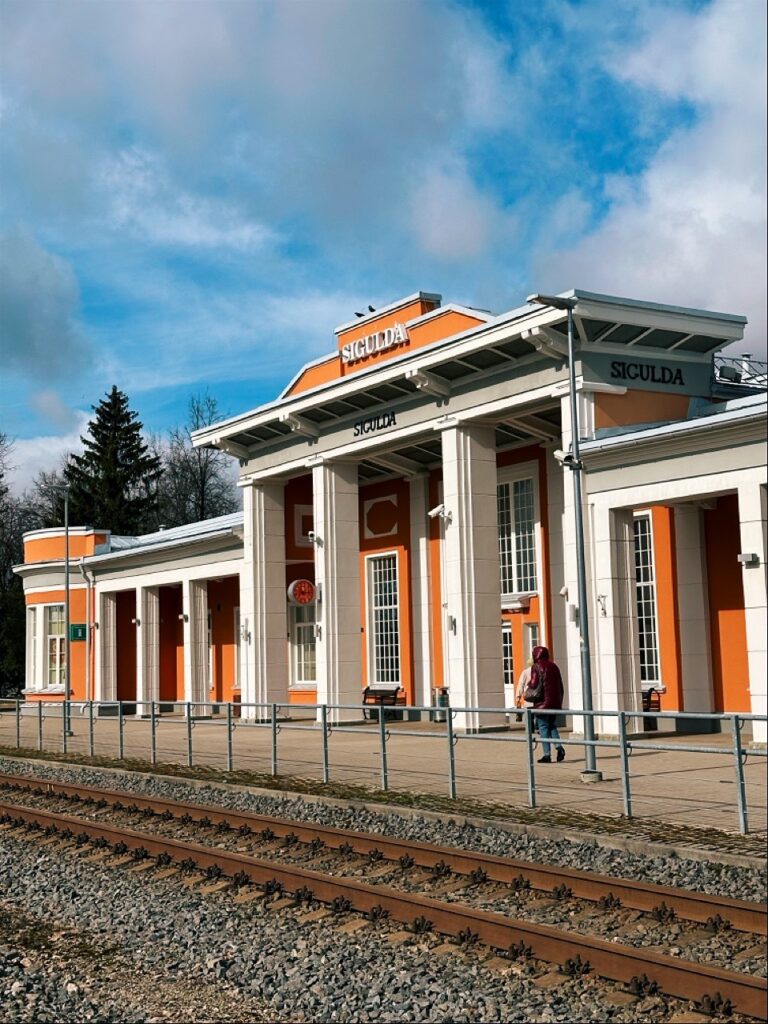
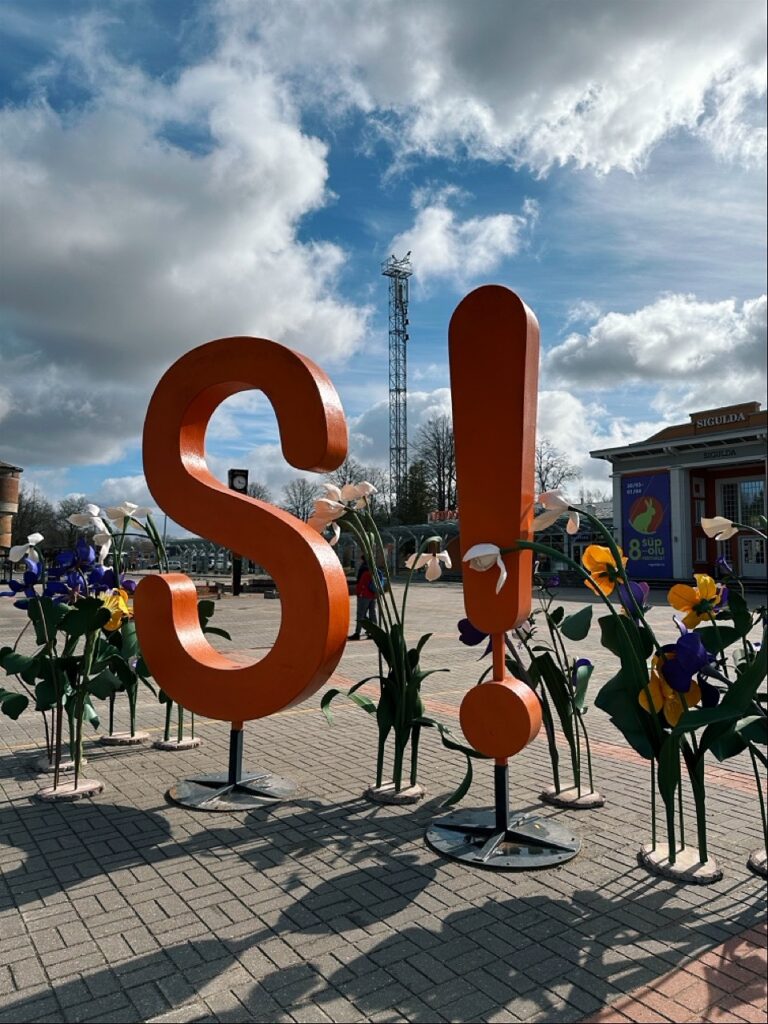
Waddling from the Train Station into Sigulda
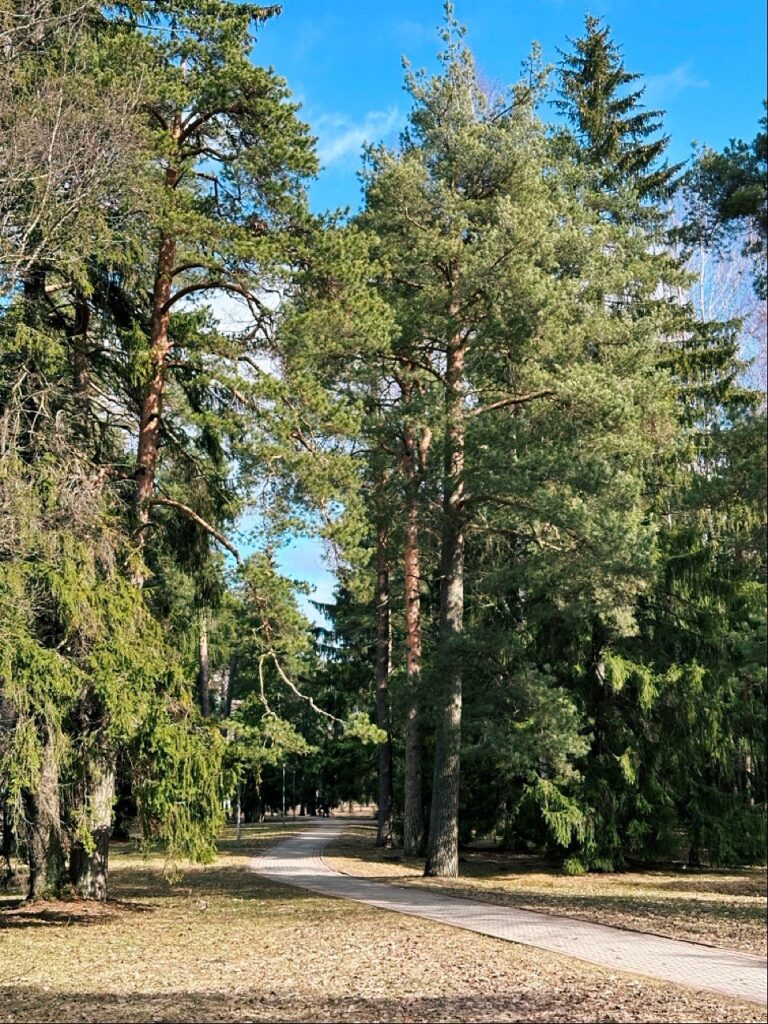
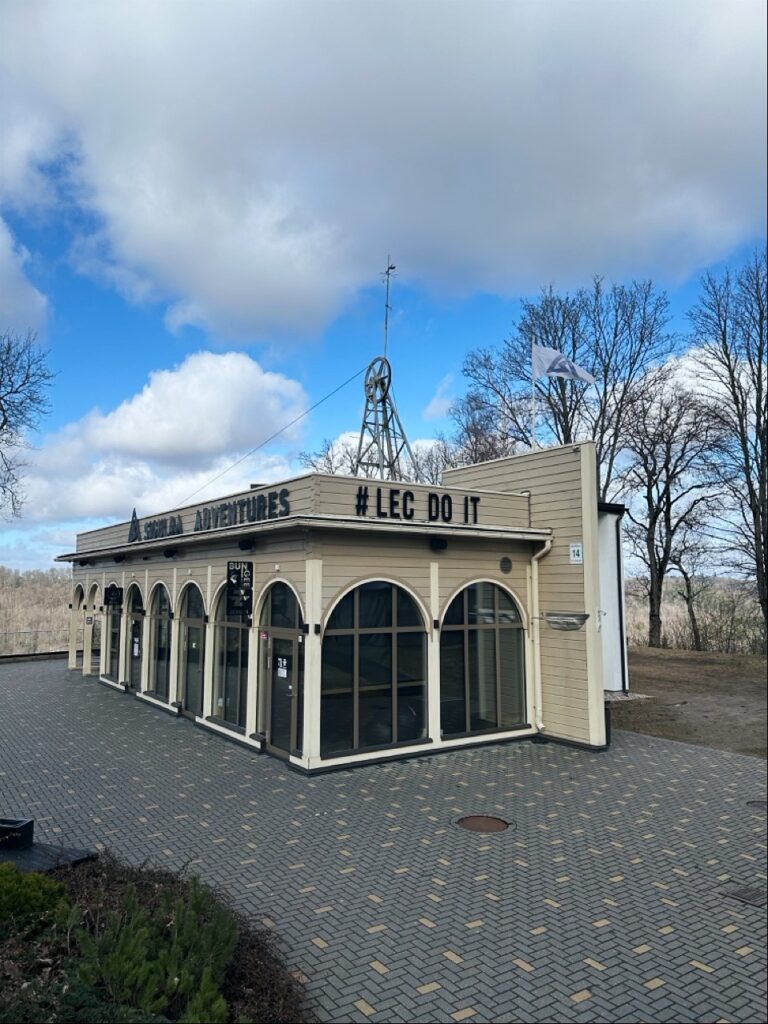
From the train station, we head towards the Sigulda Cable Car Station, following the road into town. It is an easy way to start getting a feel for Sigulda before reaching any of the big sights. Along the way, the town gradually opens up around us, with green spaces, colorful details, and glimpses of the surrounding landscape.
We are not in any rush. Part of the appeal is simply walking through Sigulda and soaking up its atmosphere. The closer we got to the cable car station, the more the town revealed itself, and it already felt clear that Sigulda is as much about the journey between its sights as the attractions themselves.
Latvia’s Gateway to the Gauja Valley
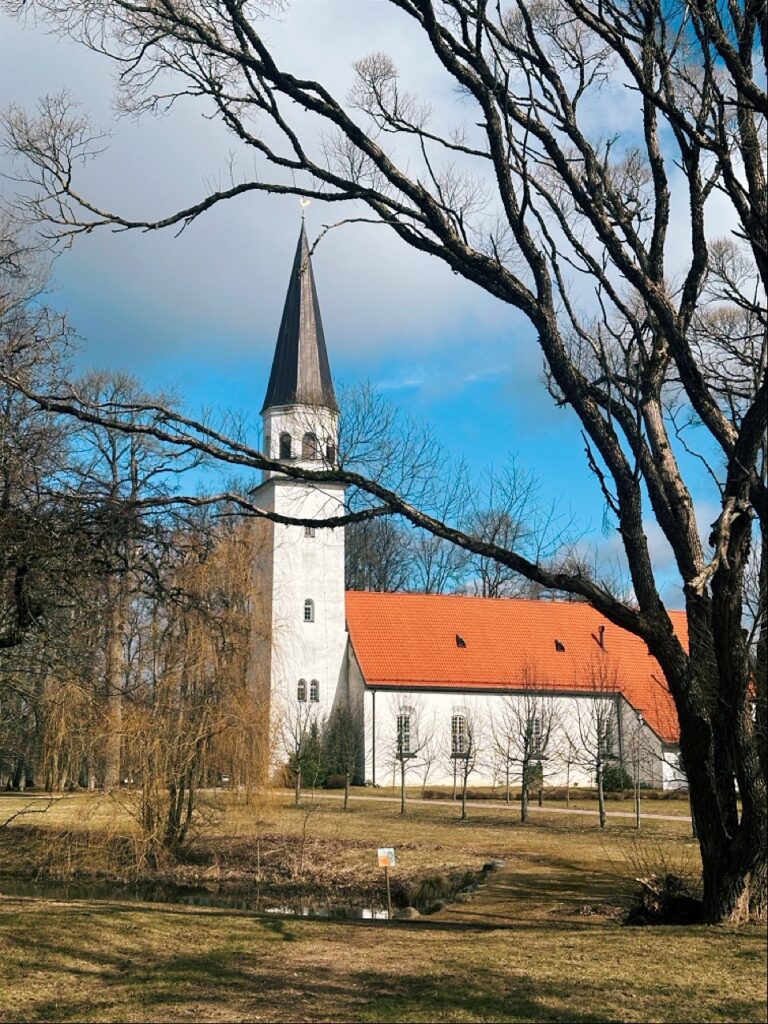
Sigulda is more than a pretty stop outside Riga. In the heart of the Gauja Valley, the town has long been shaped by the surrounding landscape, with forests, steep valley sides, and the Gauja River creating a setting that feels surprisingly dramatic for Latvia. Sigulda is a small town of around 19,000 people and one of the main gateways to Gauja National Park.
Its history runs deep. In the Middle Ages, Sigulda stood on the border between the lands of the Riga Archbishopric and the Livonian Order, and people built the first stone castle here in the early 13th century. Across the valley, Turaida and Krimulda developed as two other important medieval centers, creating the historic landscape we came to explore.
But modern Sigulda feels far from being a town frozen in the past. Alongside castle ruins and historic buildings, there are adventure parks, hiking trails, a cable car crossing the Gauja Valley, and even a bobsleigh and luge track. This mix of history, nature, and outdoor adventure gives Sigulda its particular character.
And as we make our way through town, that combination starts to make sense. Sigulda doesn’t feel like somewhere you arrive, tick off a few sights, and leave. The landscape is always there in the background, and even an ordinary walk towards the next attraction becomes part of the experience.
Hotel search from Trip.comShows Trip.com’s own box, which can set Trip.com cookies.
Riding the Sigulda Cable Car Across the Gauja Valley
When we reach the Sigulda Cable Car Station, we have to wait for the car to return from the other side of the Gauja Valley. This gives us a little extra time to explore the area around the station and see what is on offer. We buy our tickets directly from the shop at the station, where we also pick up a few souvenirs before settling in to wait. Then, finally, the cable car appears on the opposite side and glides towards us. As the doors open, we step inside, ready to cross the valley and see Sigulda from above.
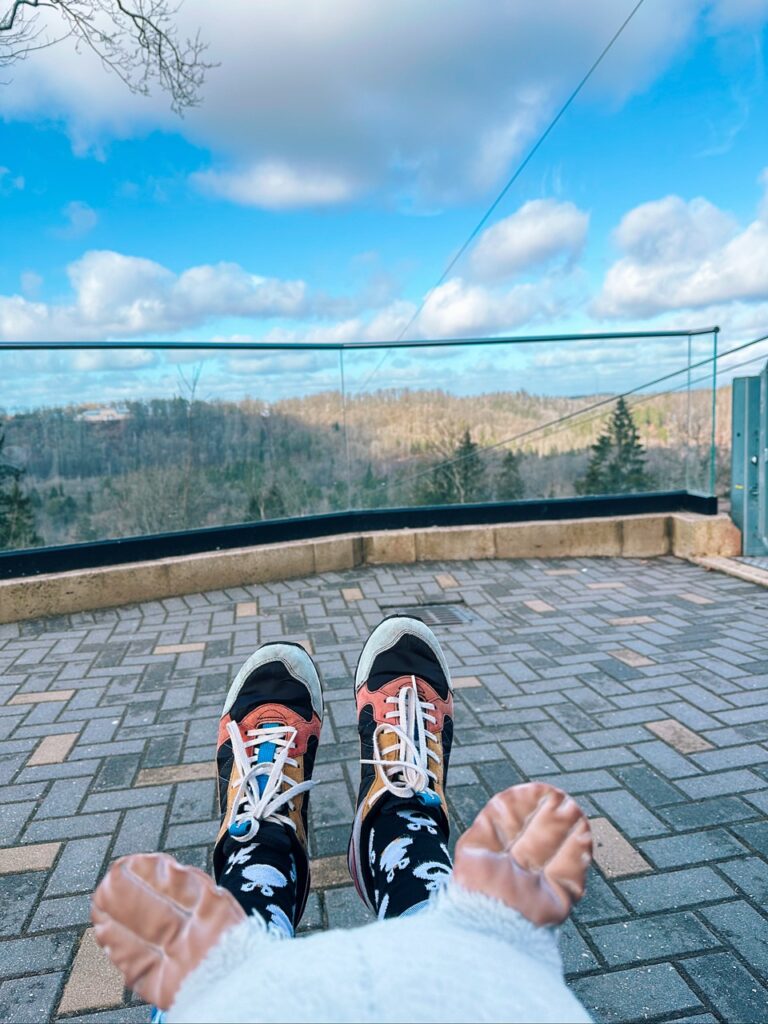
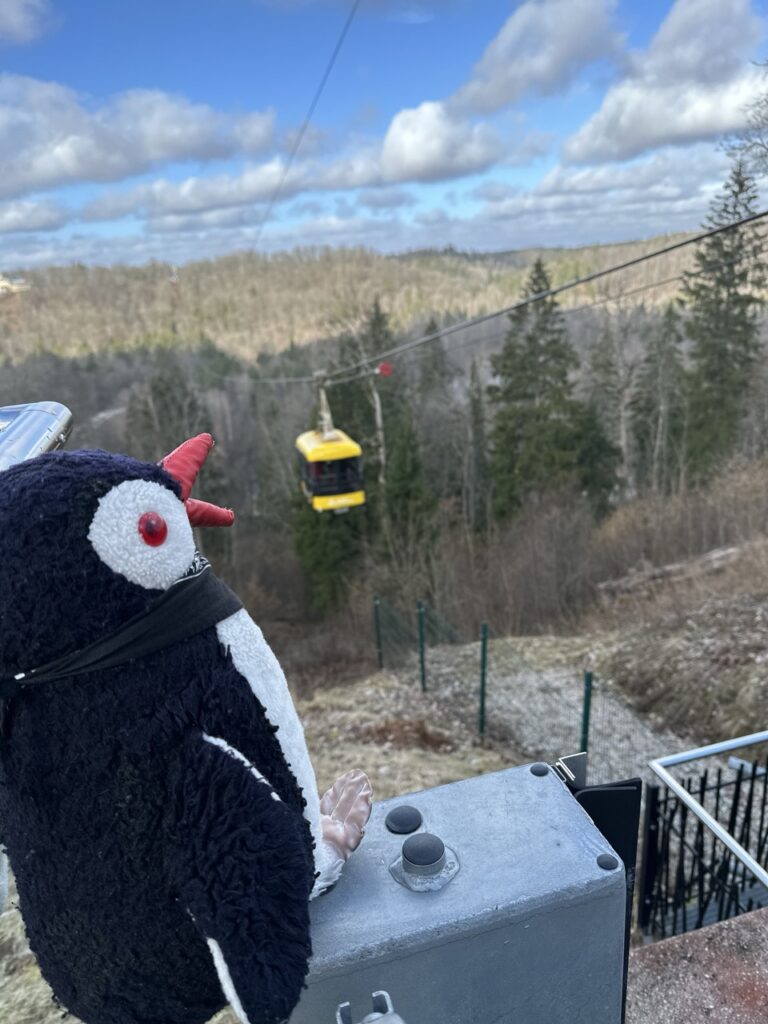
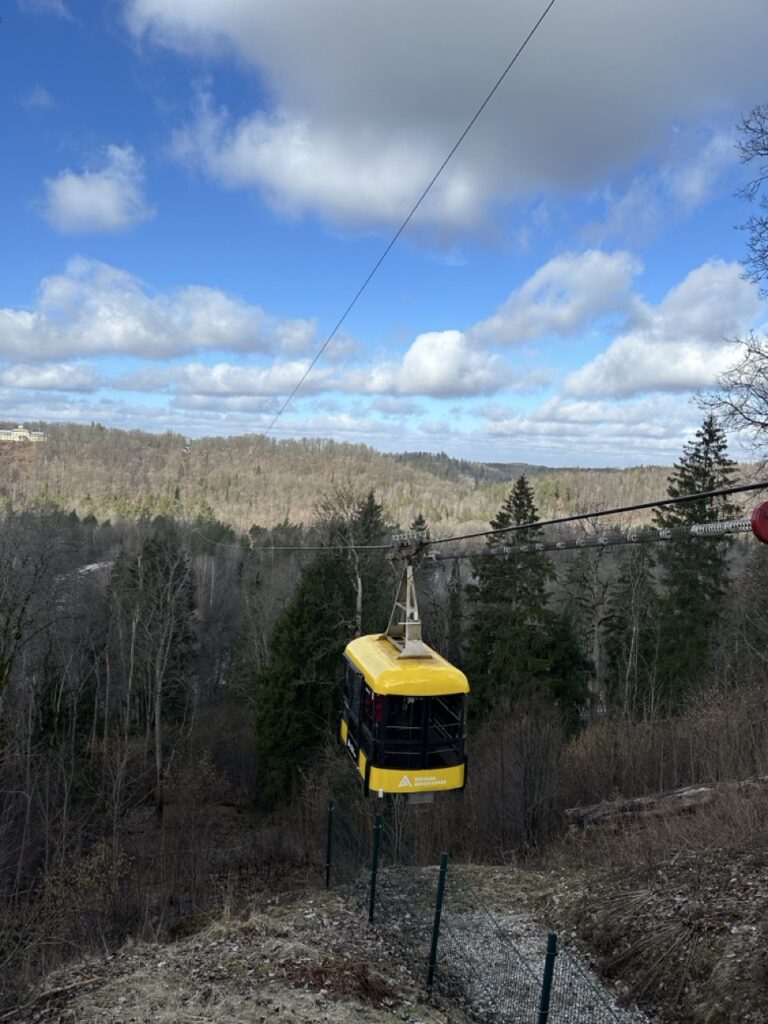
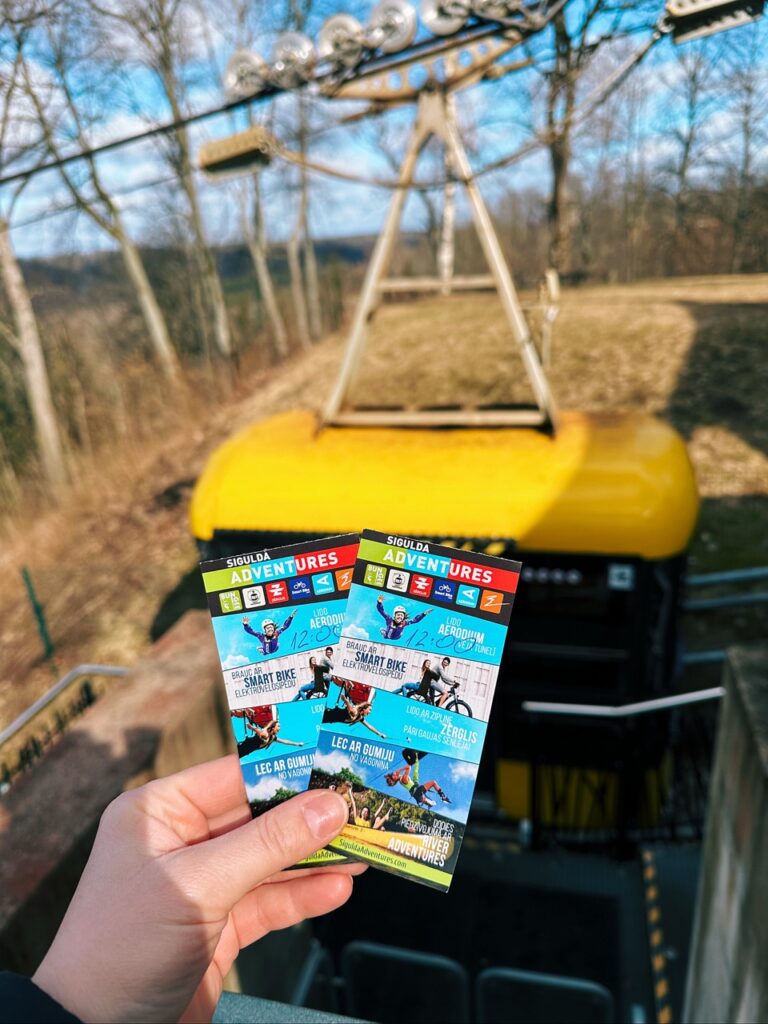
Floating Above the Gauja Valley
We are lucky. When the cable car doors close, it is just the two of us inside. No crowd, no strangers squeezed against the windows, just the quiet hum of the car as it begins to move away from the station. Even better, the cabin is decorated with Christmas ornaments, adding an unexpected touch of magic to the ride.
As we glide higher above the Gauja Valley, Sigulda slowly falls away beneath us. Trees stretch across the landscape, the river winds through the valley below, and forested hills roll toward the horizon. Through the windows, everything looks wonderfully still.
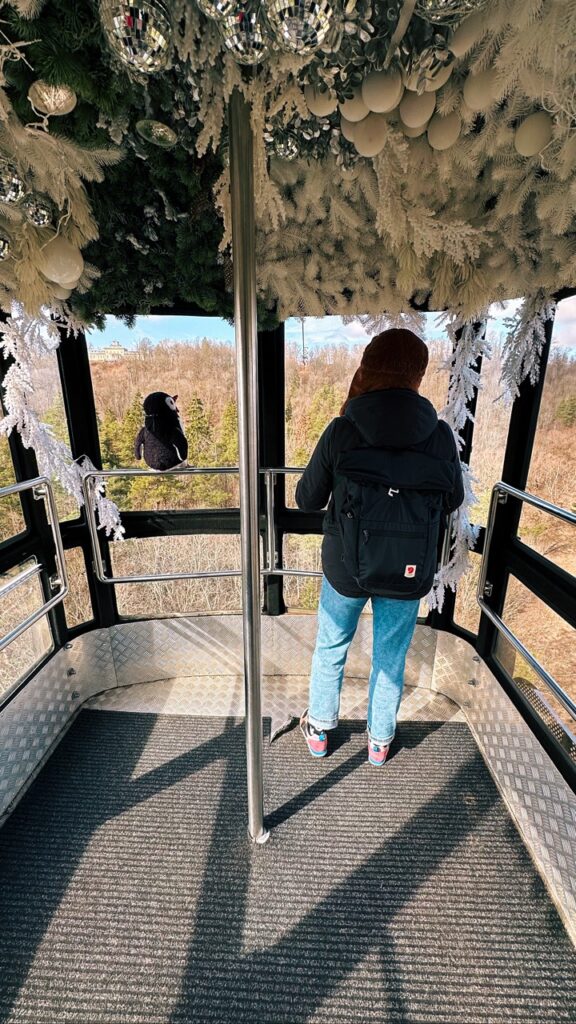
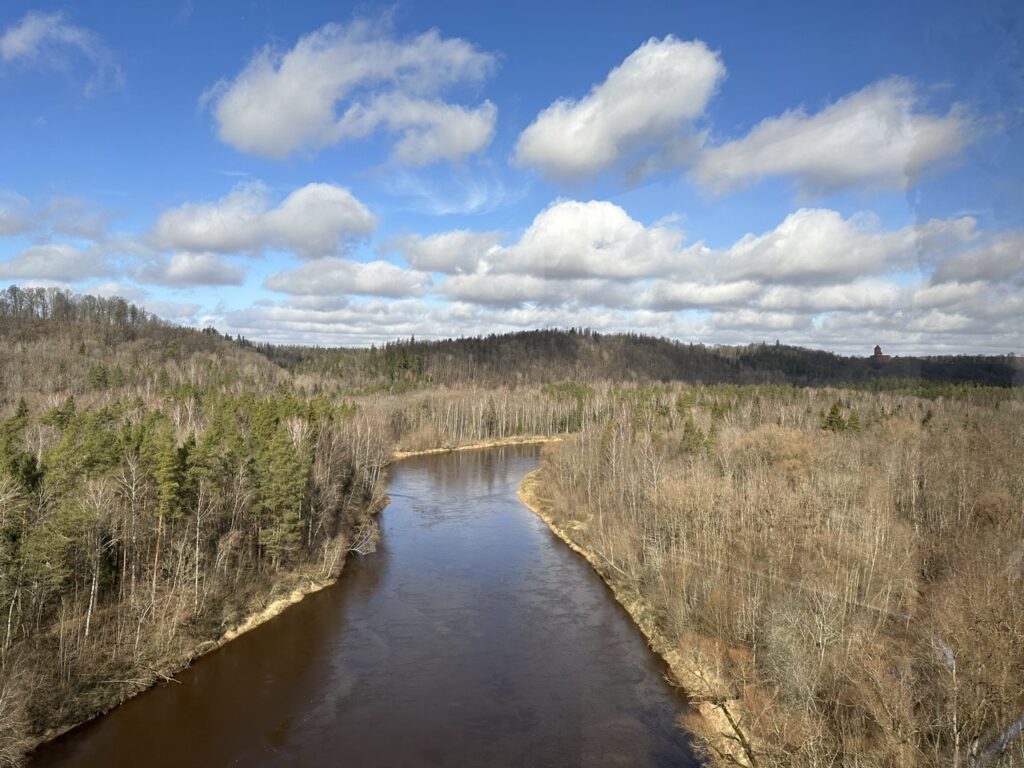
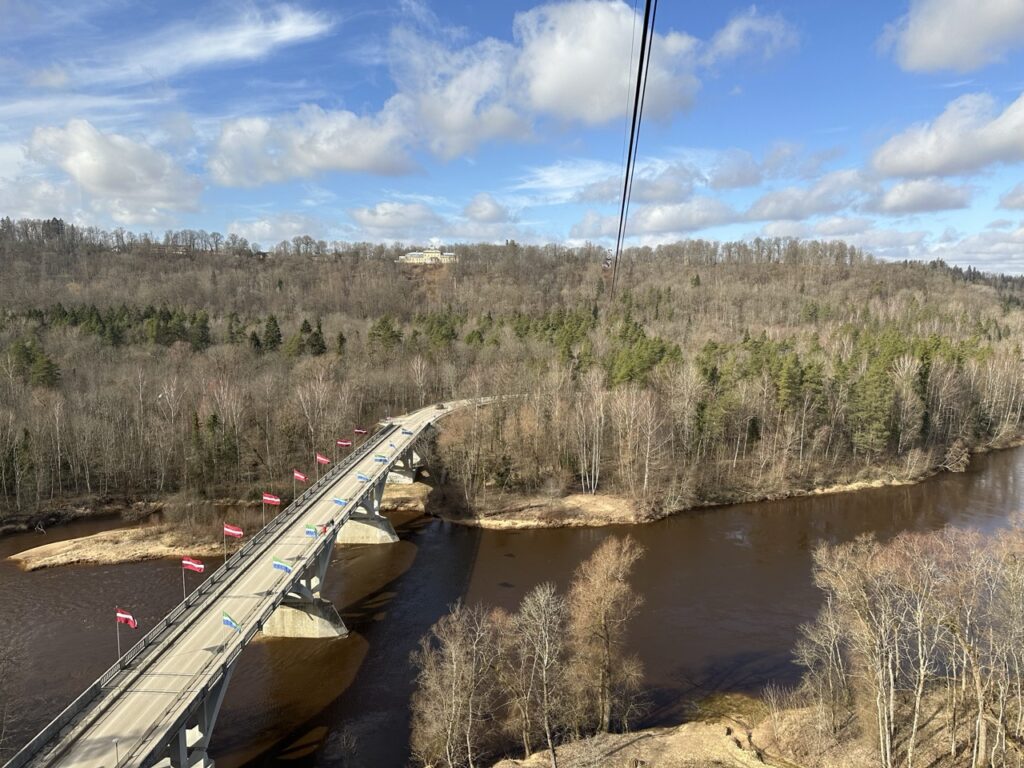
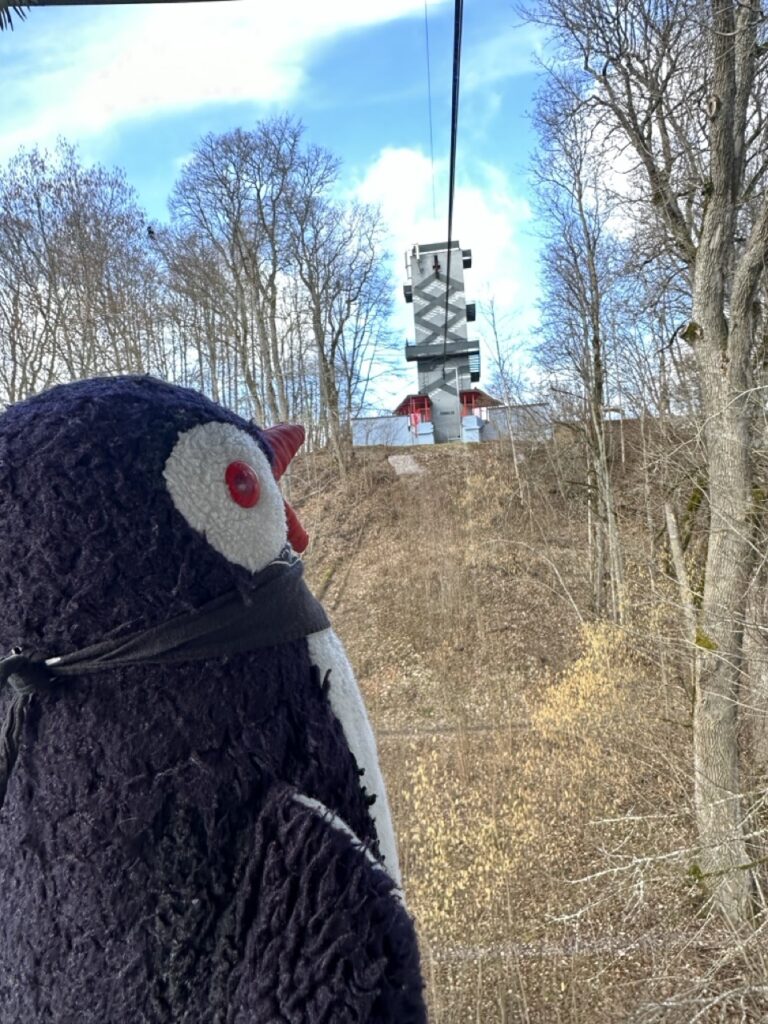
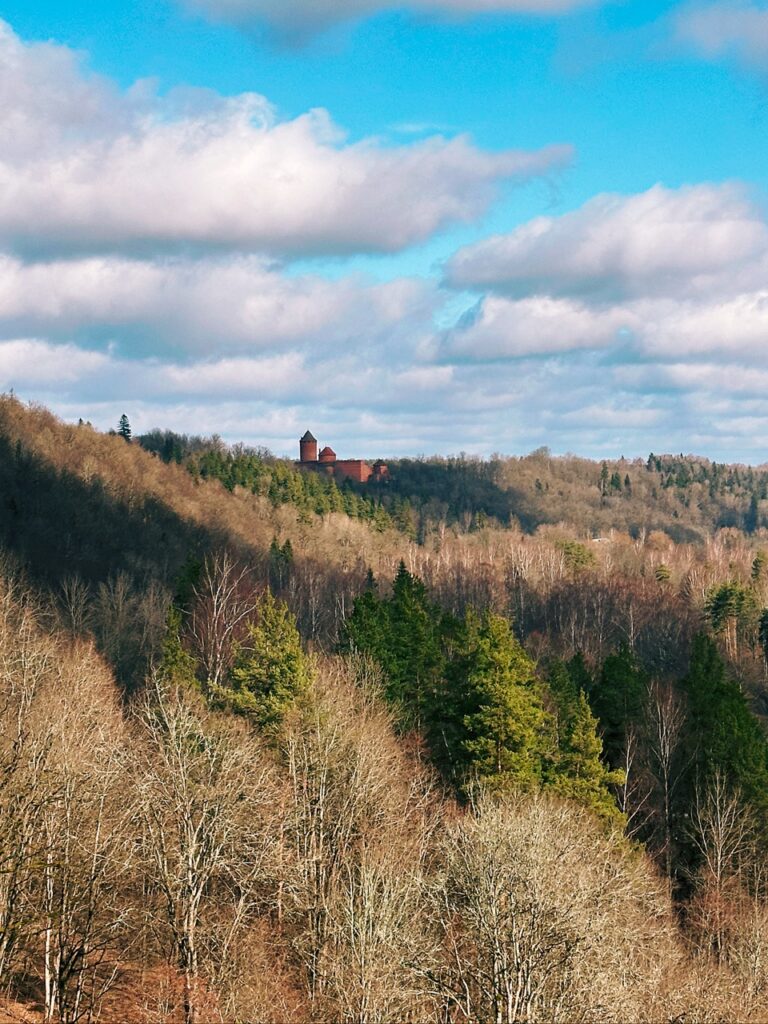
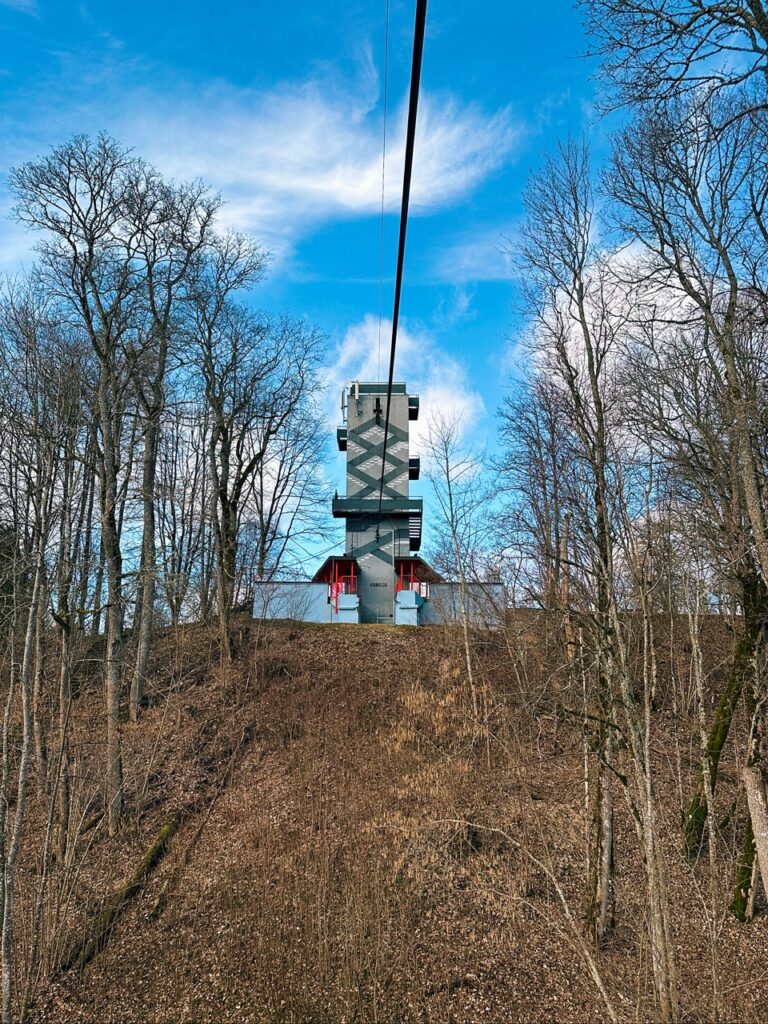
For a few minutes, there is nowhere to be and nothing to do but watch the landscape pass beneath our feet. With the Christmas decorations catching the light inside the cabin, the whole crossing feels almost dreamlike.
Sigulda Cable Car Quick Facts
- Provider: Sigulda Adventures
- Website: Sigulda Adventures Cable Car
- Route: Sigulda to Krimulda across the Gauja Valley
- Distance: 1,020 meters
- Ride Time: approximately 7 minutes one way.
- Height: up to 43 meters above the Gauja River.
- Frequency: departures approximately every 20–30 minutes.
- Adult Ticket: €15 one way or €22 return (plushies ride for free)
- Opening Hours: ~ 10:00–18:20, although hours vary seasonally and on some holidays, so check the official website before visiting.
- Tickets: Available directly at the Sigulda or Krimulda station ticket offices.
Discovering the Ruins of Krimulda Castle
Once we step out of the cable car, we finally have time to wander and explore the other side of the Gauja Valley. Our first stop is Krimulda Castle, or rather, what remains of it. Hidden among the trees, the medieval ruins quietly contrast with the bustle of Sigulda across the valley.
Krimulda Castle dates back to the medieval period and once belonged to the Riga Archbishopric. Its position was anything but accidental. Perched high above the Gauja and protected on other sides by the steep Vikmeste River valley, the castle was naturally difficult to attack. The walls were built from enormous fieldstones, with the outer wall reaching around two meters thick at foundation level.
The castle’s story eventually took a darker turn. In 1601, during the Swedish-Polish War, Swedish forces captured Krimulda. Later that same year, as Polish troops approached, the castle was deliberately burned so the enemy could not take it. It was never rebuilt, leaving the ruins we see today.
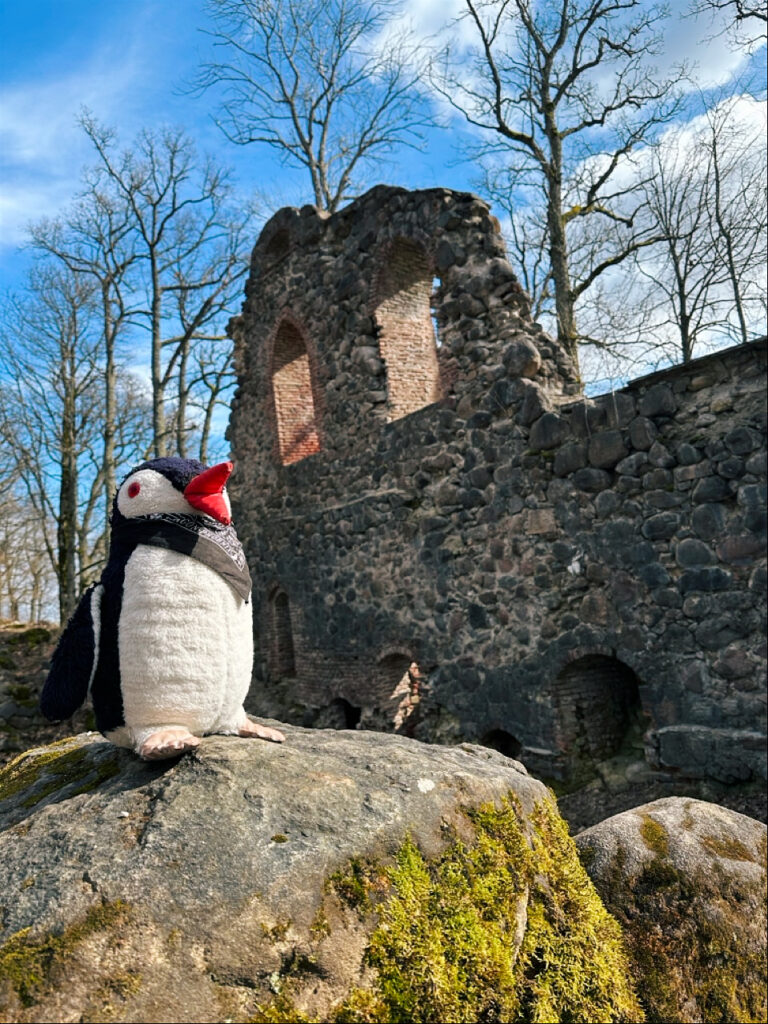
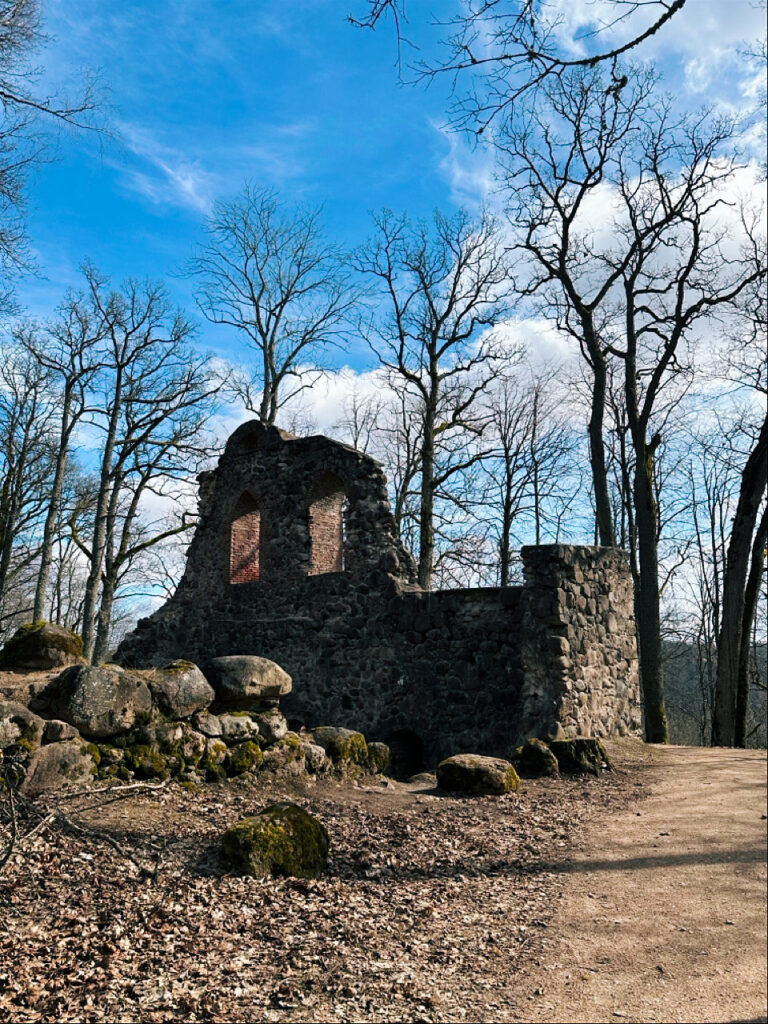
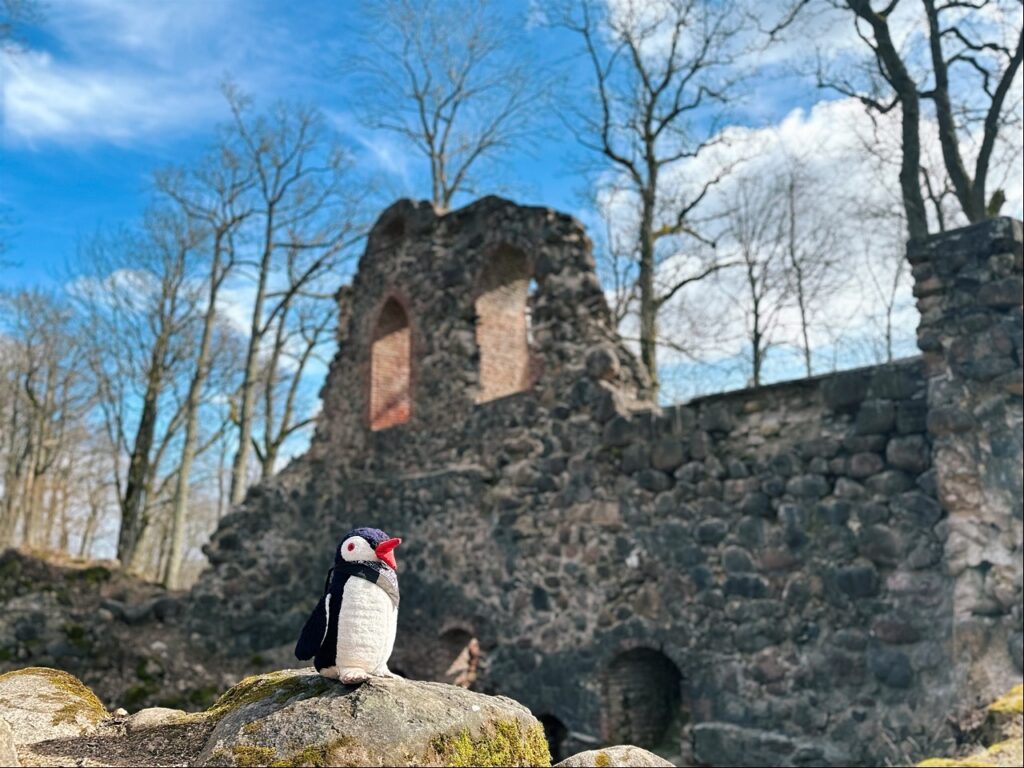
Waddling among the remaining walls, it is easy to imagine how different this quiet corner of the Gauja Valley must have looked centuries ago. Greenery and walking paths surround the ruins, with the dramatic landscape doing much of the storytelling.
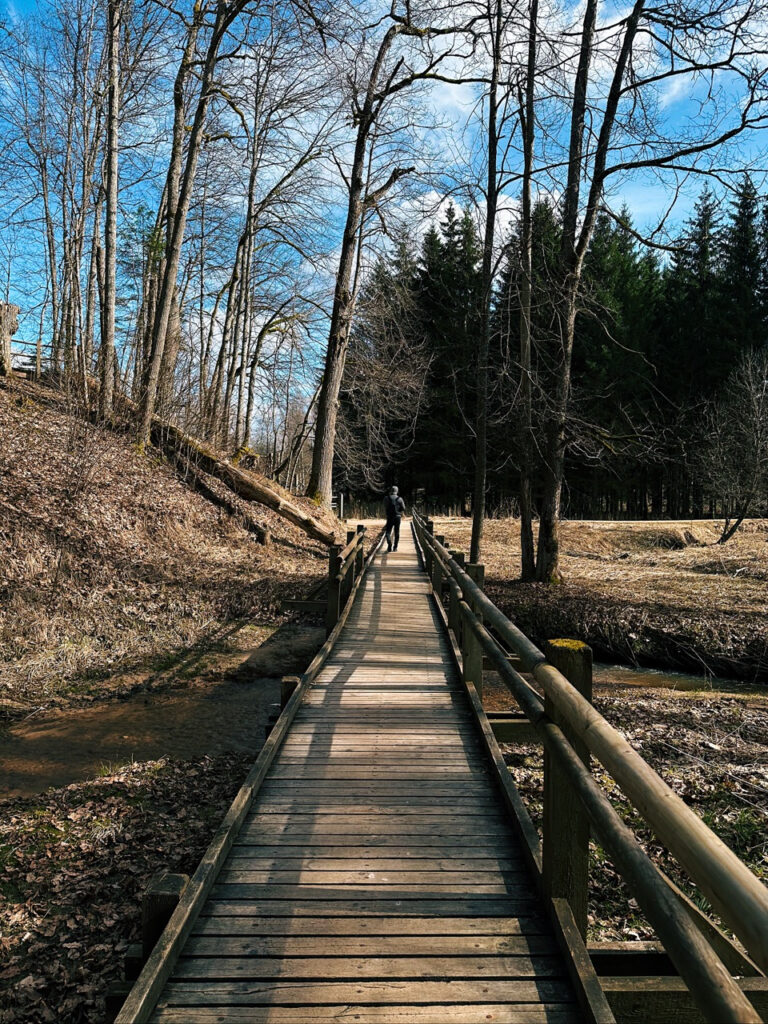
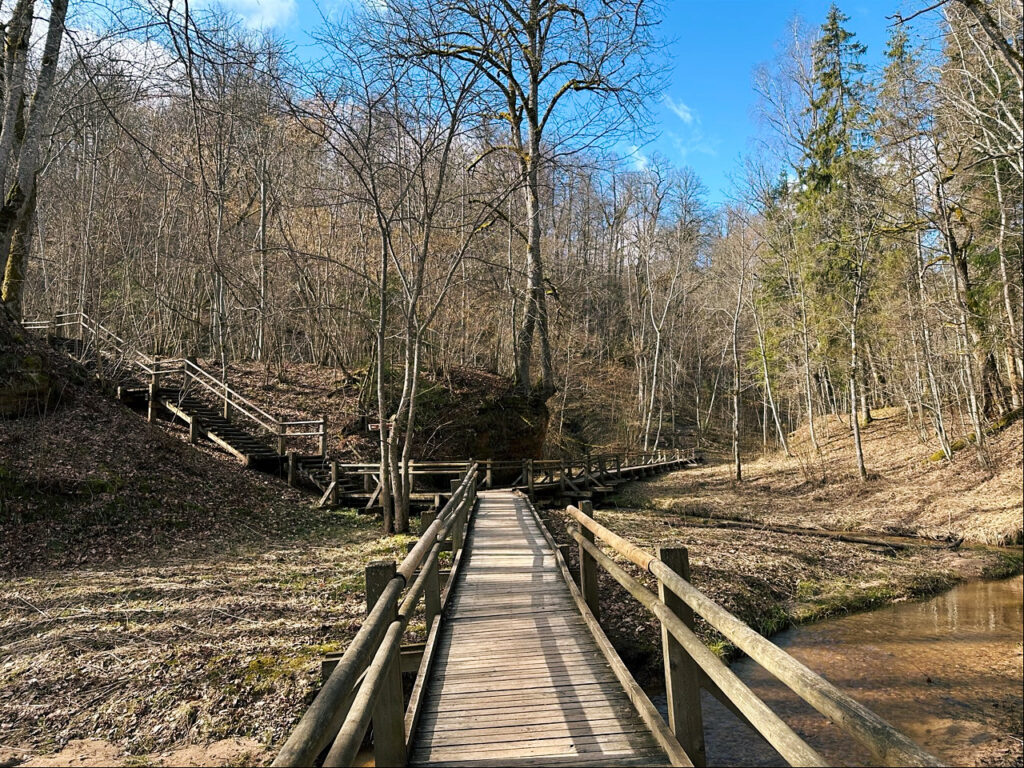
Leaving the ruins of Krimulda Castle behind, we continue on foot towards Gutman’s Cave, and the waddle itself becomes part of the experience. Wooden pathways wind through the forest, making it easy to wander without feeling like we are simply moving from one attraction to another. We visit in late March, when the trees are still mostly bare, and the landscape has a quiet, early-spring feel. Even so, we can already imagine how beautiful these paths must be when the forest is green and full in summer, with the valley looking completely transformed.
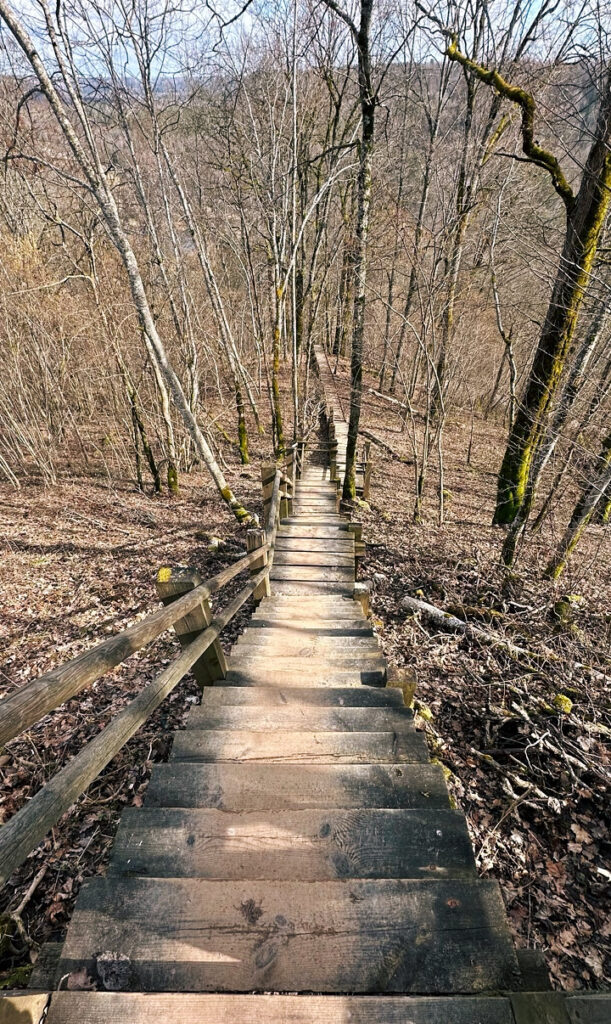
Gutman’s Cave: A Natural Archive in the Gauja Valley
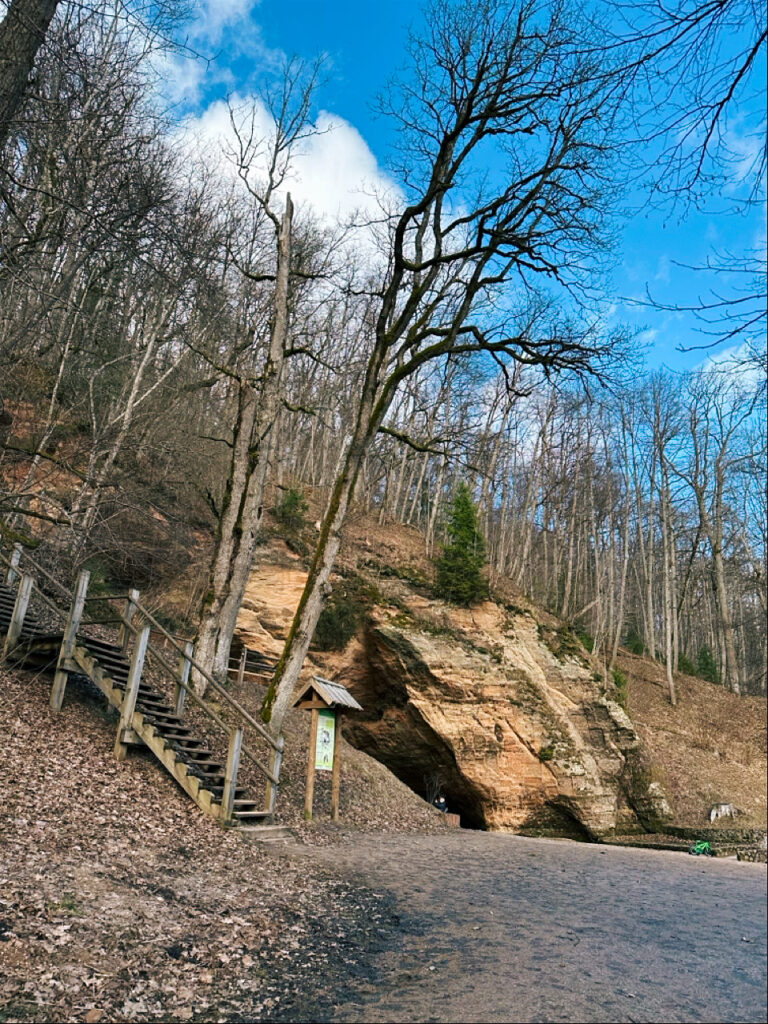
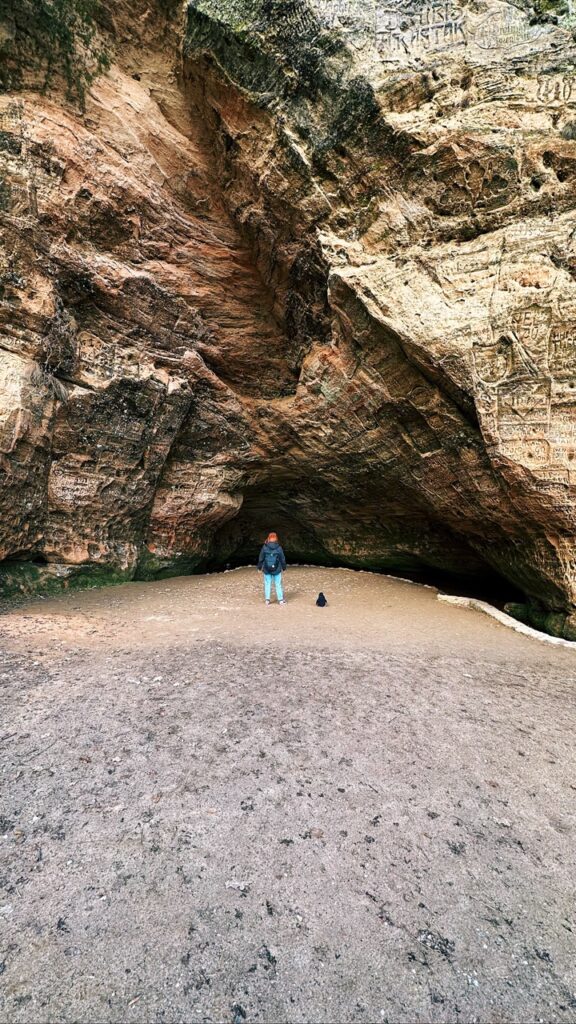
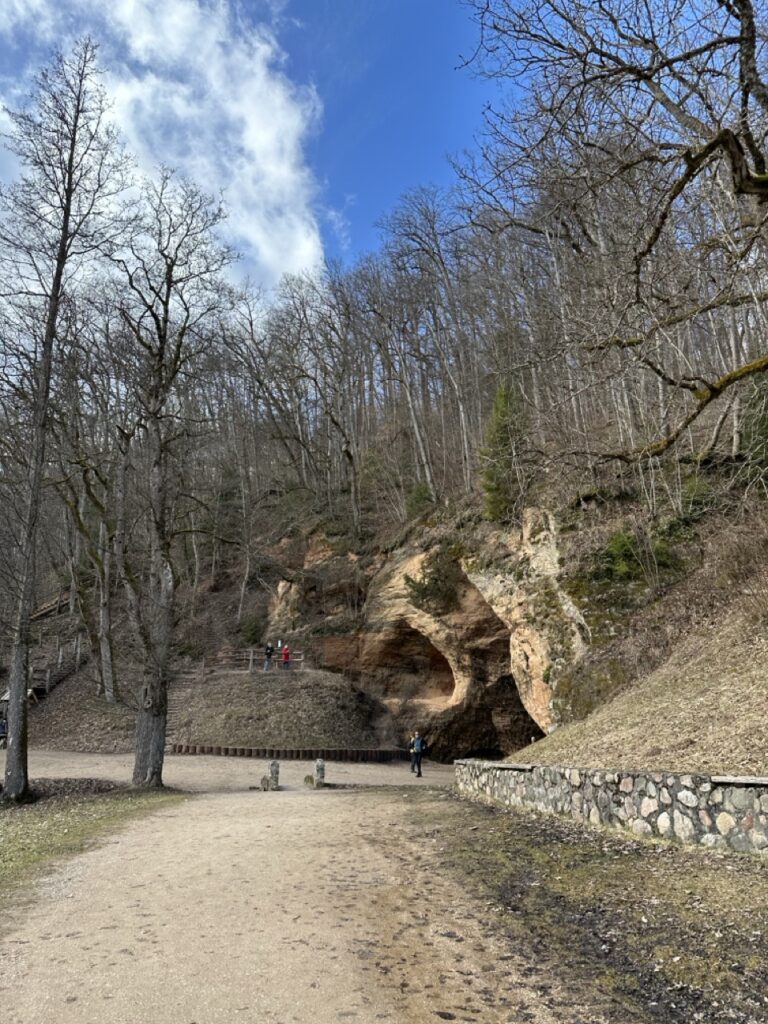
From the castle ruins, we continue towards one of Sigulda’s most famous sights, Gutman’s Cave. Calling it a cave almost undersells it. This enormous sandstone grotto stretches 18.8 meters deep, 12 meters wide, and up to 10 meters high, making it the widest and highest cave in the Baltic States. It began forming thousands of years ago as the Gauja River and an underground spring slowly worked on the sandstone, shaping the dramatic opening we see today.
Interesting Fact: Gutman’s Cave is considered Latvia’s oldest tourist attraction, with inscriptions on its walls dating back to the 17th century.
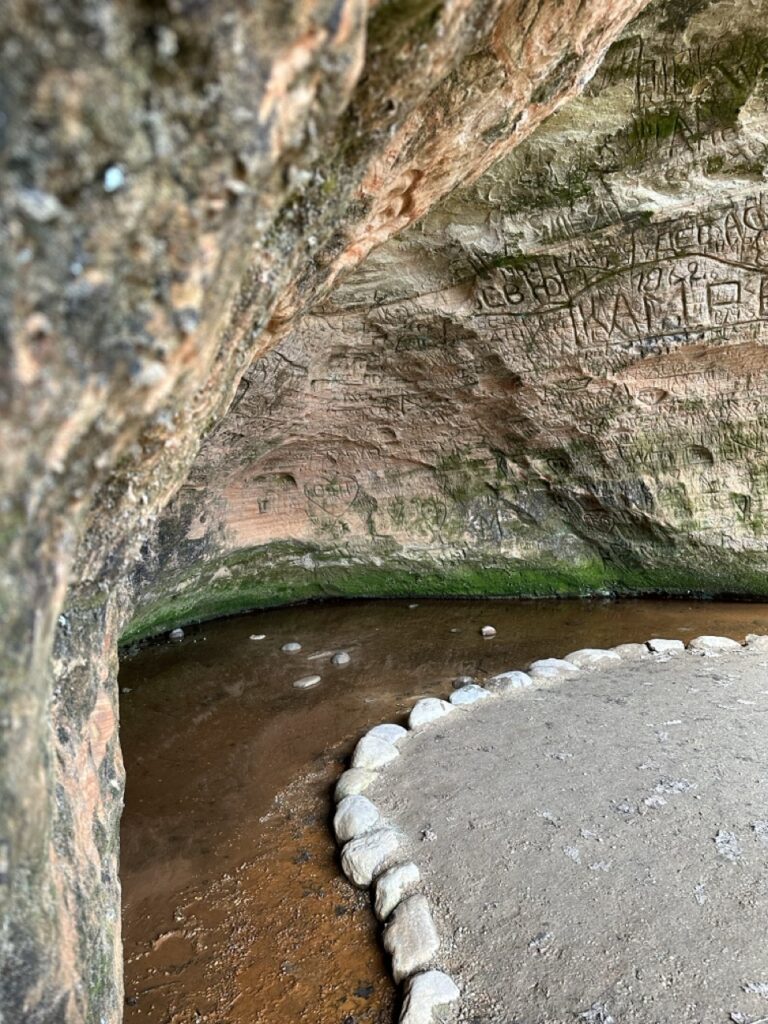
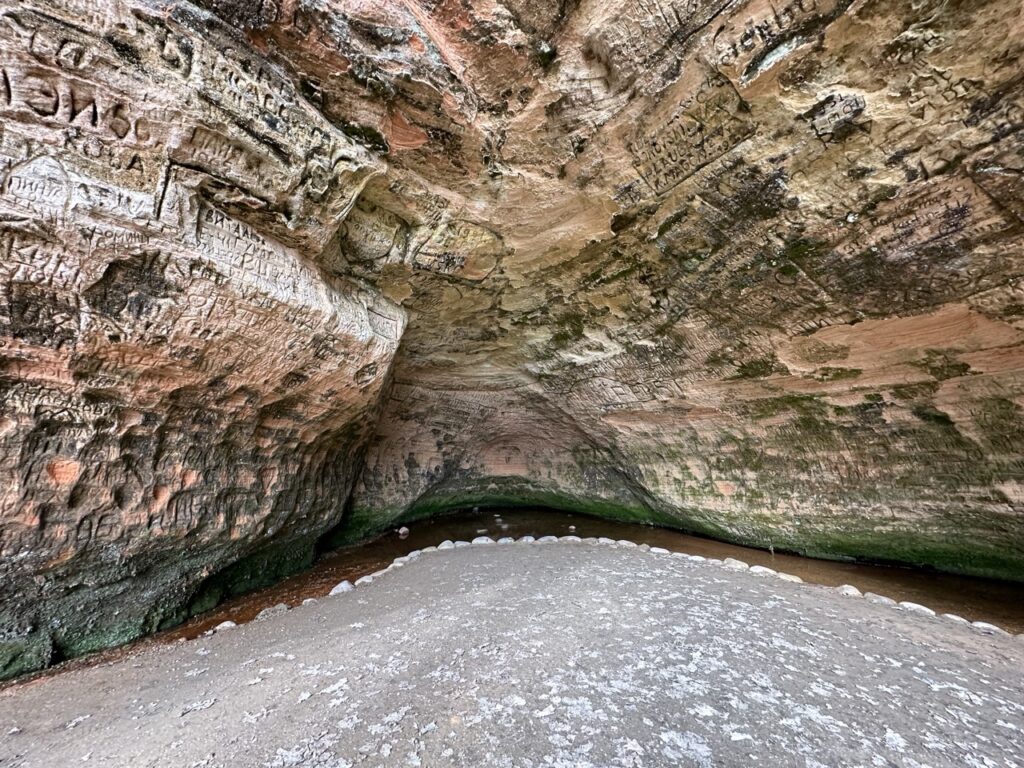
We step inside, and the scale becomes much more impressive than it looks from the outside. The cave opens into a broad, cool space, with the rough sandstone walls rising above us. Then we start noticing the writing.
Names, dates, coats of arms, and other markings cover parts of the rock, creating what feels like a centuries-old guestbook carved directly into the cave. Some of the earliest inscriptions were made by wealthy visitors who even hired artisans to engrave their names and coats of arms. Today, of course, adding your own is prohibited because the cave is a protected geological and archaeological monument.
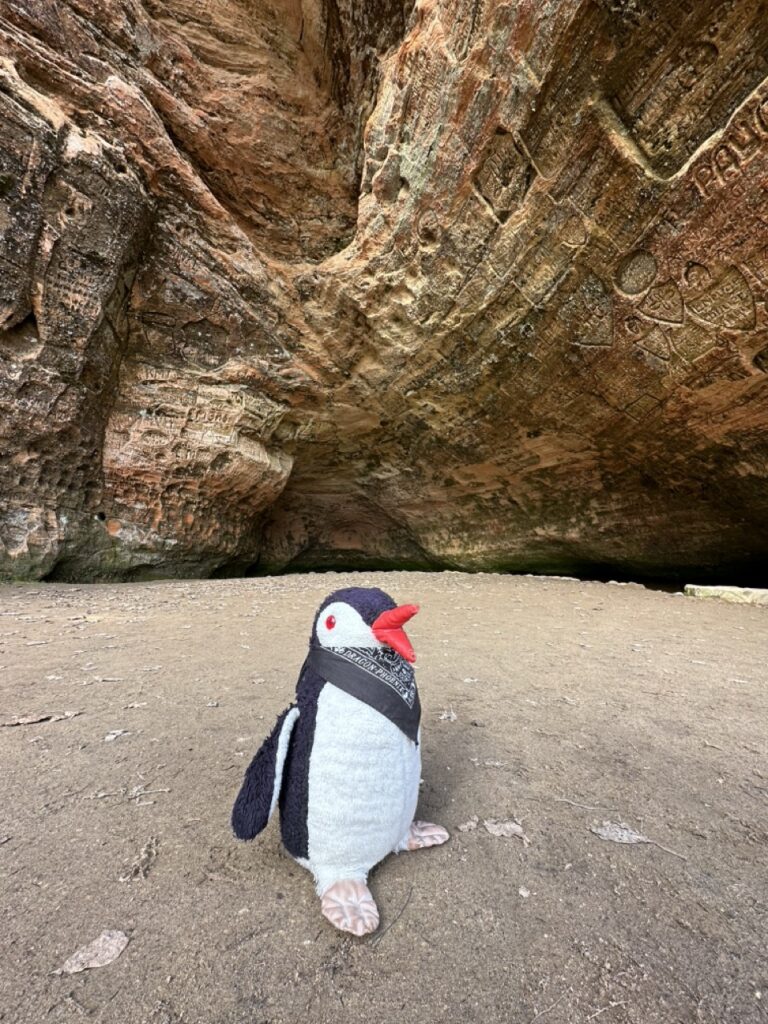
Why Is It Called Gutman’s Cave
The name Gutman’s Cave comes from a local legend surrounding the spring that flows from the cave. According to the story, a kind-hearted man named Gutman lived nearby and was known for helping people. People believed the spring water had healing powers, so they came to drink it or bathe in it. The name therefore became associated with “good man”, reflecting the character at the heart of the legend.
The cave also has a darker story woven into its history. Local folklore connects it with the Rose of Turaida, a young woman named Maija whose tragic story has become one of the best-known legends of the Gauja Valley. According to the tale, Maija met her lover, Viktor, near Gutman’s Cave, and the events that followed ultimately led to her death. Today, the cave is not only a remarkable natural formation but also a place where Latvia’s landscape, history, and folklore come together.
Back Across the Gauja Valley
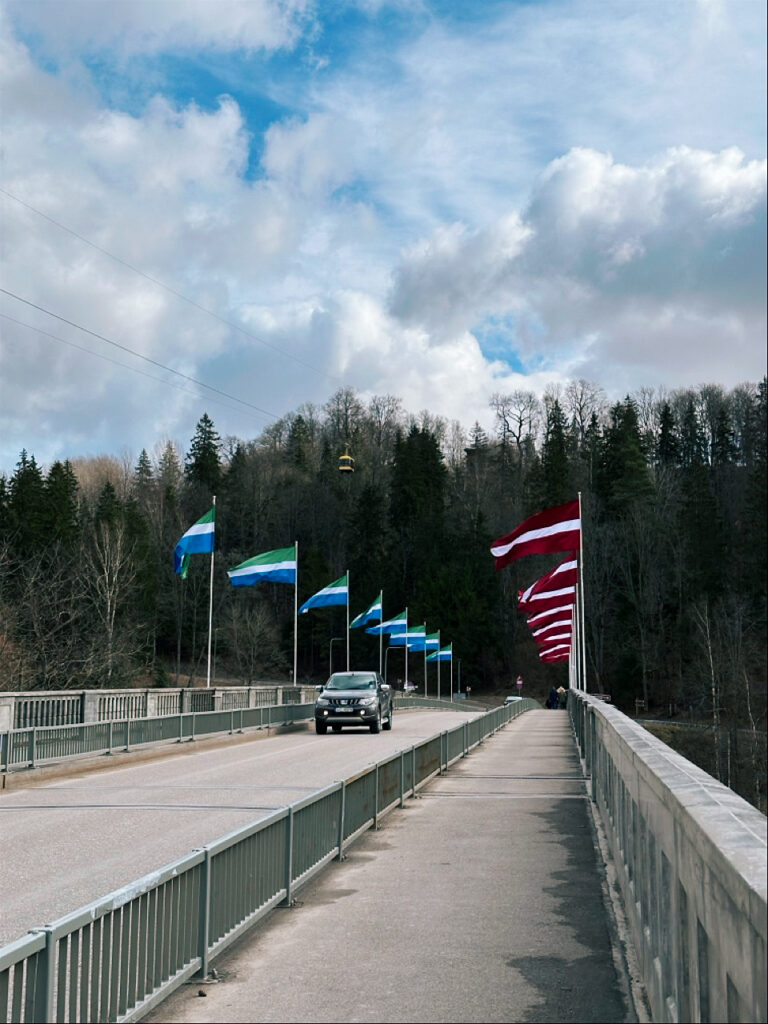
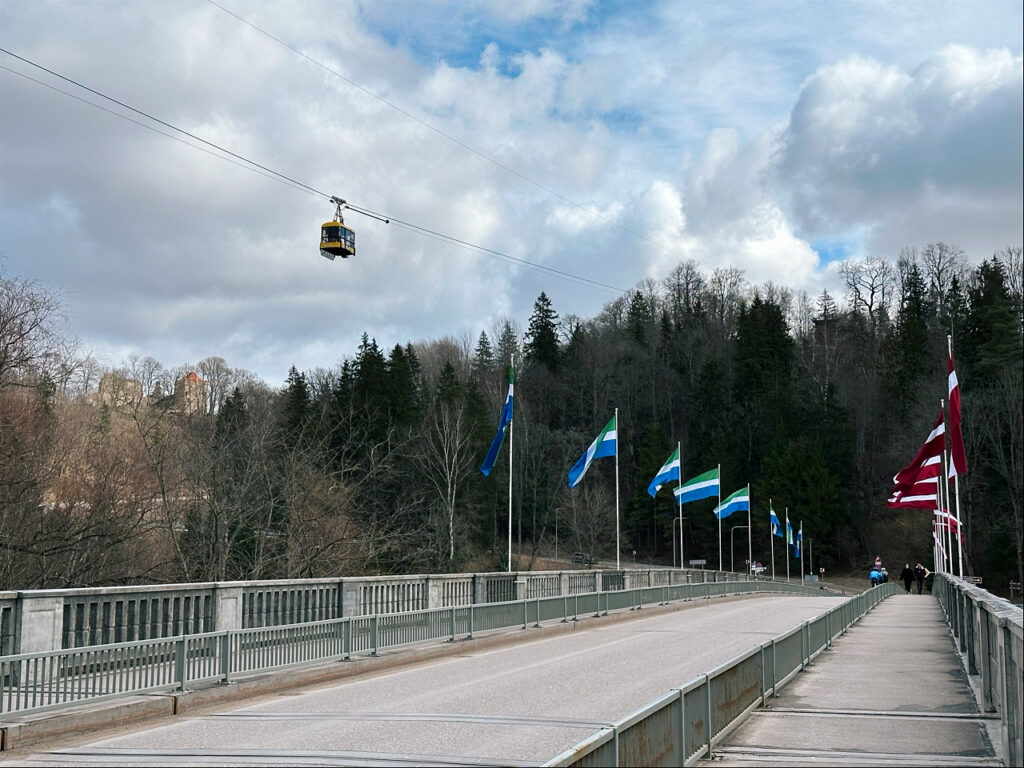
After exploring Gutman’s Cave, we waddled back across the bridge, retracing our route through the Gauja Valley towards the two castles still waiting on our itinerary. From here, the landscape’s scale becomes even more apparent. The Gauja Valley stretches for more than 90 kilometers through Gauja National Park, carved by the Gauja River and framed by forests, sandstone cliffs and rolling hills.
As we make our way back, the valley feels almost oversized compared with the quiet towns scattered around it. The river winds far below, the forests stretch in every direction, and for a moment it is easy to forget that Riga is only a train ride away. With two more castles ahead of us, we keep waddling, curious to see what the other side of the valley has in store.
Castle of the Livonian Order in Sigulda
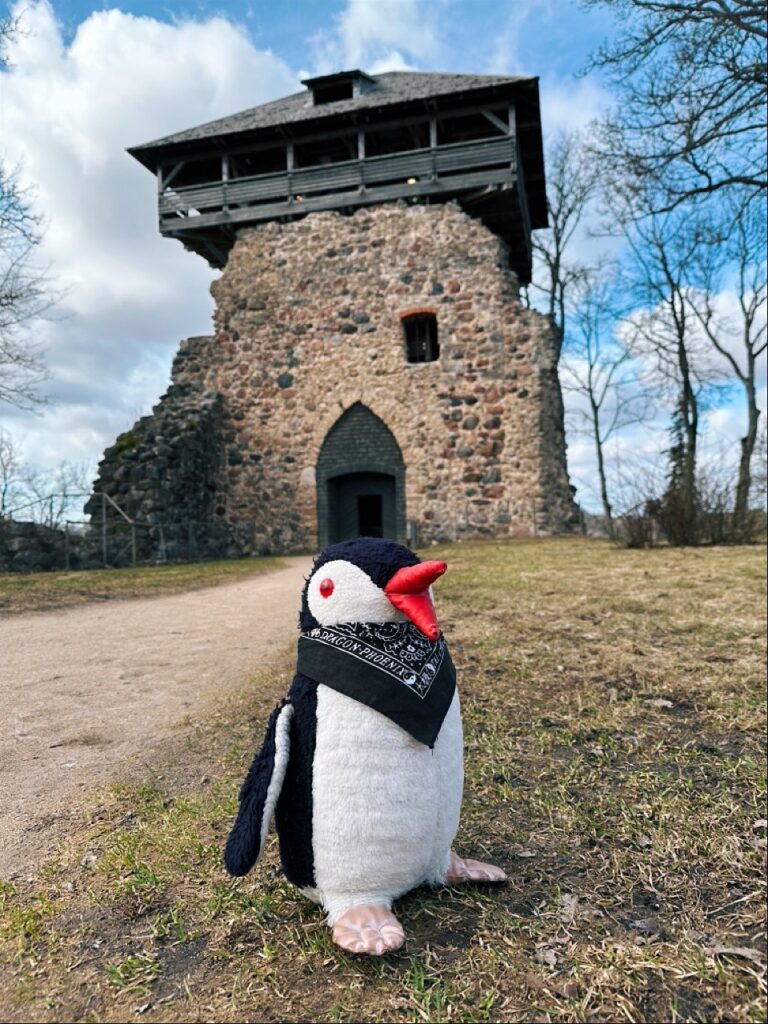
Our next stop is the Castle of the Livonian Order in Sigulda, and we approach it from below, following the uphill paths toward the ruins. Even before reaching the entrance, the walk has its little rewards. Of course, we manage to hide a few penguin stones along the way, because apparently no journey is complete without one.
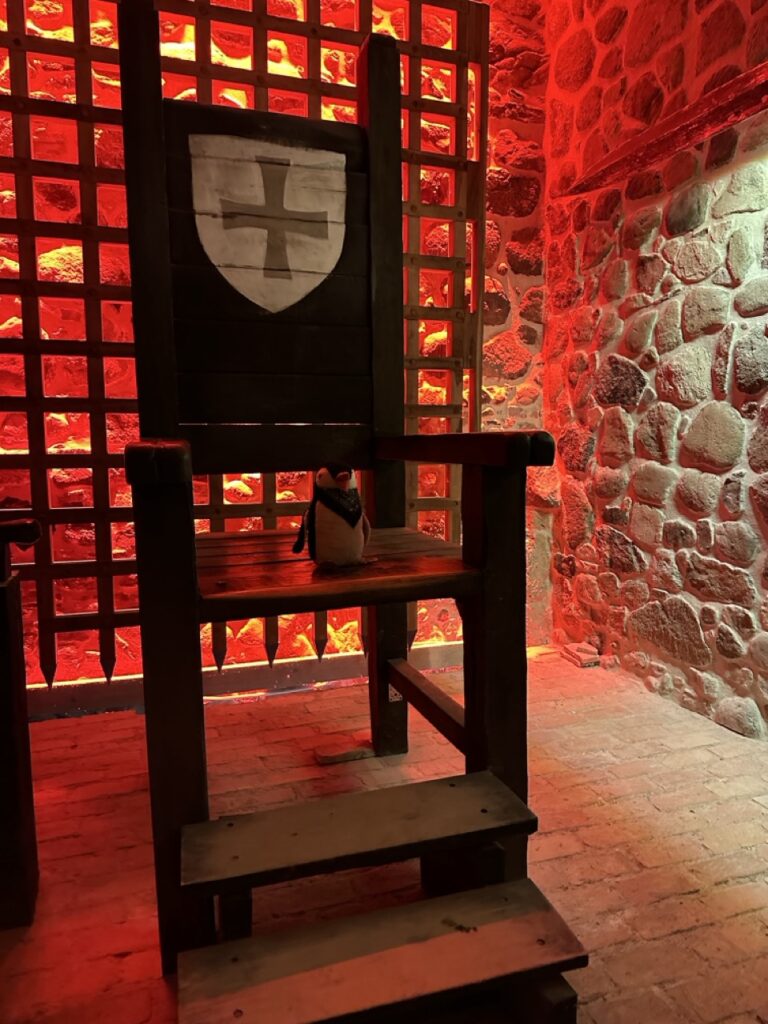
The castle soon rises above us, its weathered stone walls giving us the first proper glimpse of medieval Sigulda. Built in 1207, it is the oldest of the three medieval castles in the area and was originally constructed by the Livonian Brothers of the Sword. The fortress later passed to the Livonian Order. It was expanded from its original castellum design into a much larger convent-style castle with an inner courtyard, defensive walls, and towers.
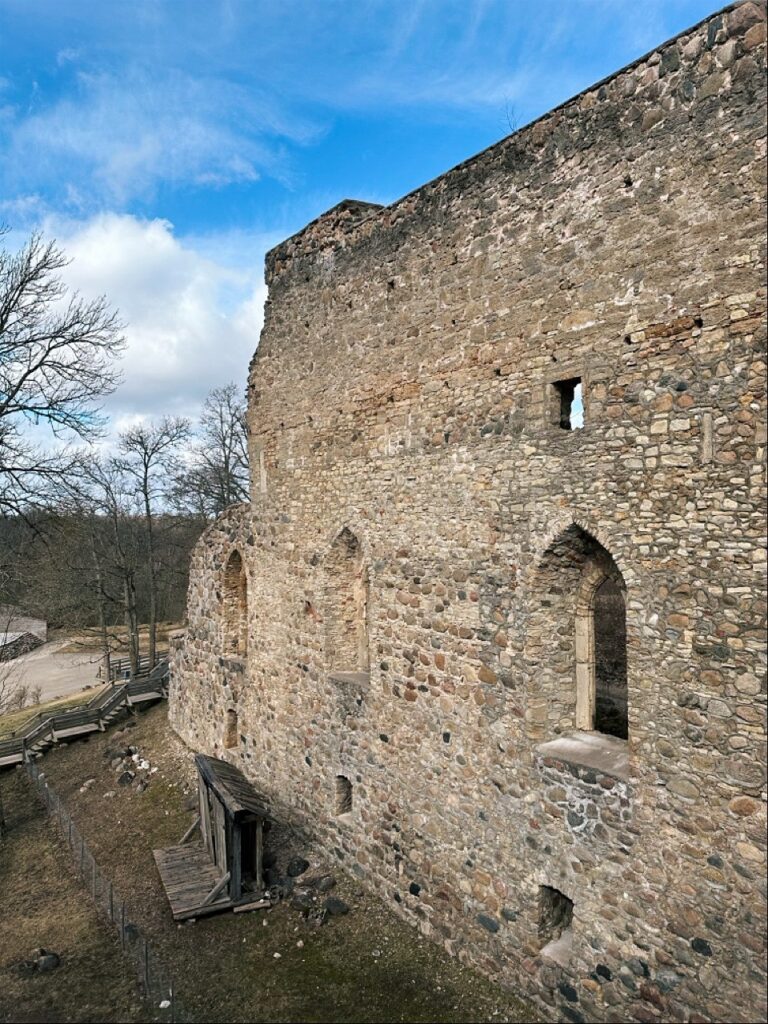
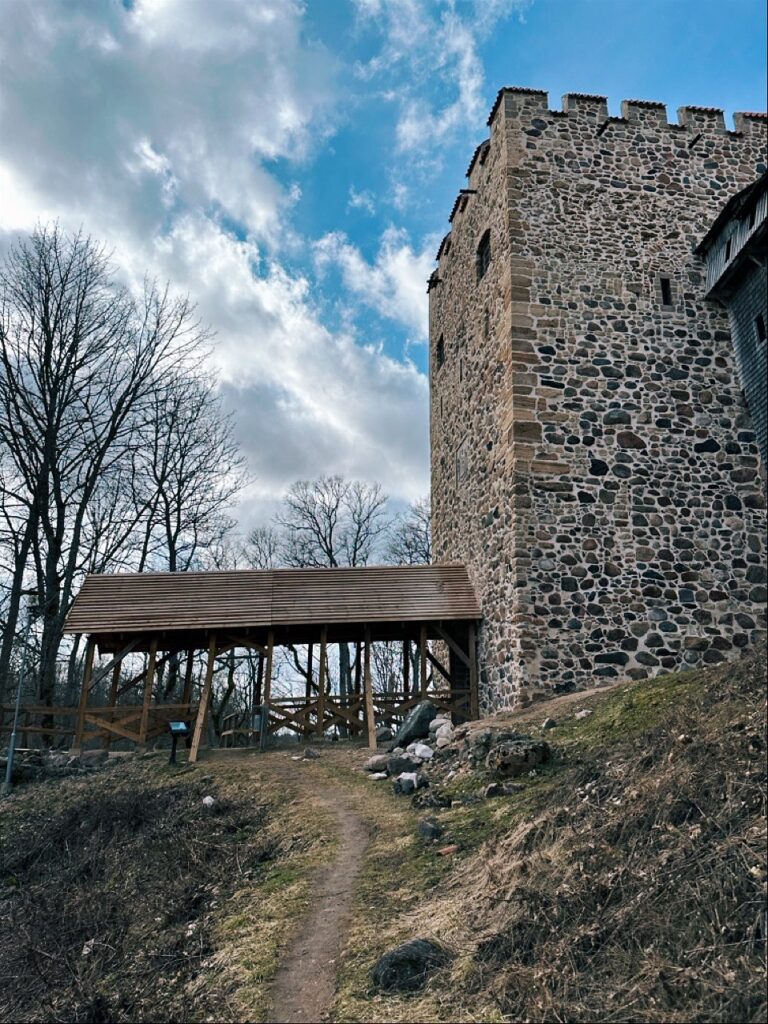
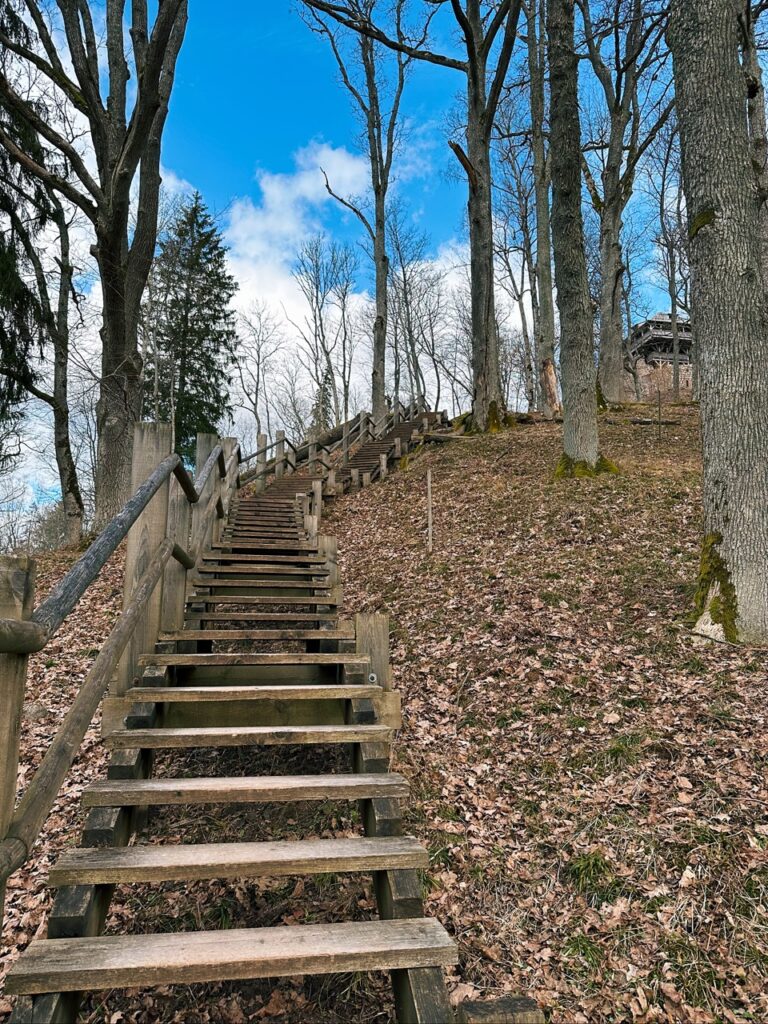
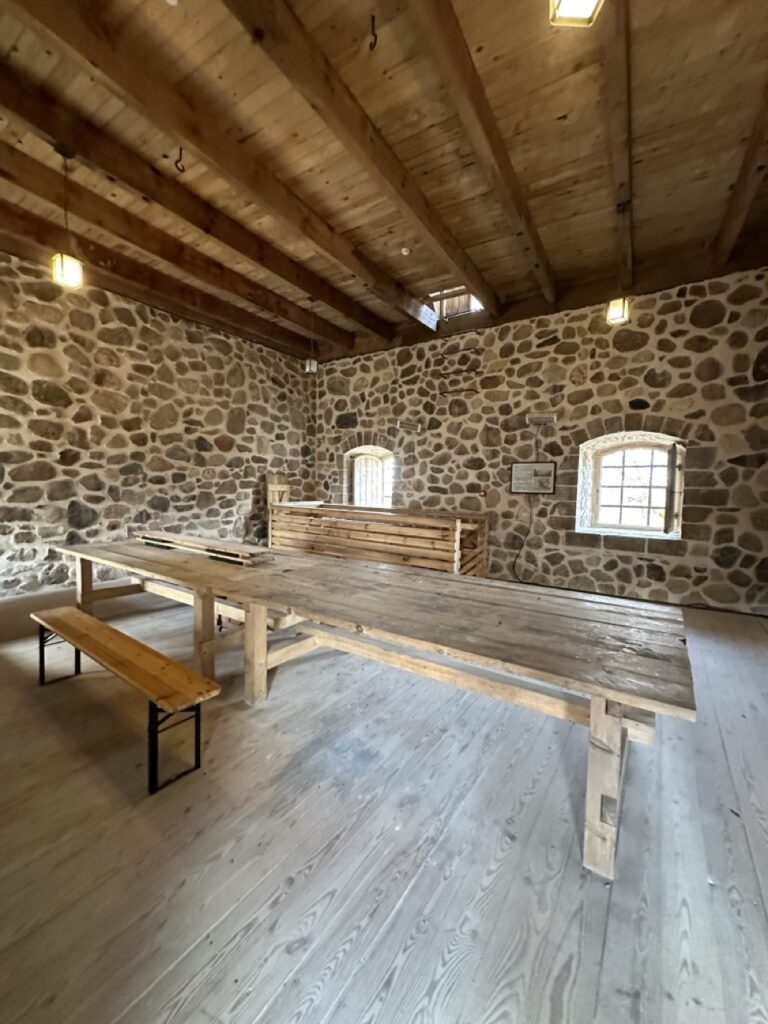
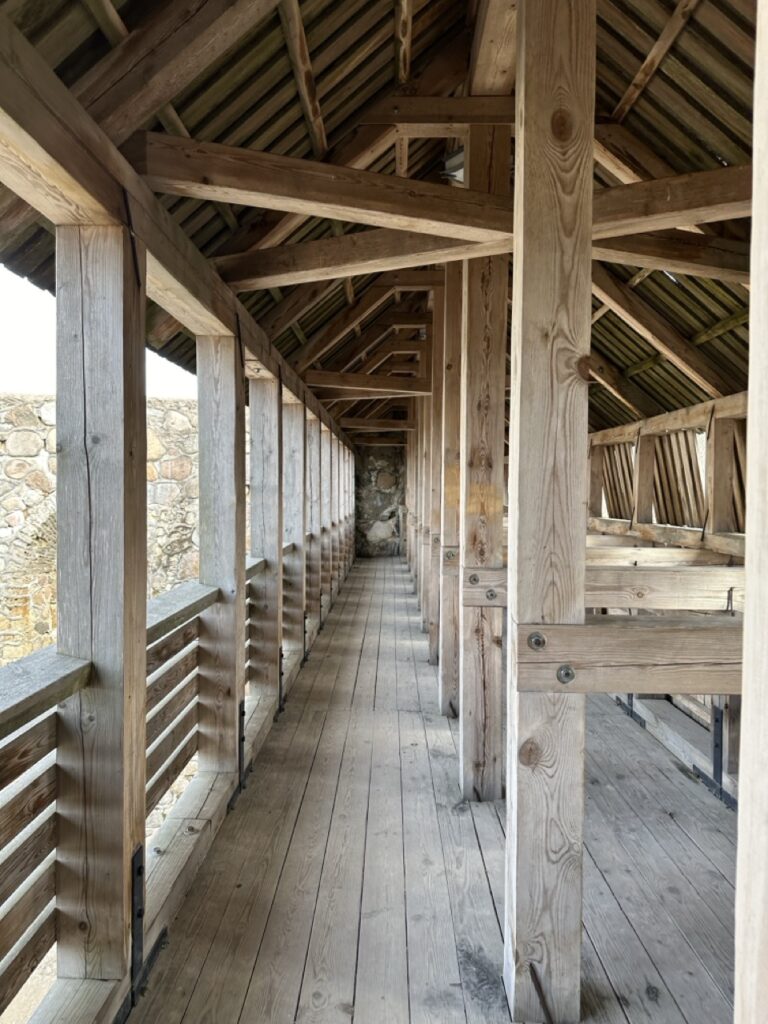
Once inside, there is plenty of space to wander. The castle ruins are not the kind of place where you stand outside and take a photograph before moving on. We can waddle through the former castle grounds, follow the old walls and climb into the reconstructed tower. From higher up, the reward is a wonderful view over Sigulda and the surrounding Gauja Valley, the same landscape that once made this such a strategically important location.
Standing among the ruins, it is easy to imagine the castle as it once was. The first fortress was built to control the Gauja waterways and protect the Livonian Order’s territory. At the same time, its position on a highland surrounded by steep slopes provided a natural defensive advantage. Over the centuries, the castle was expanded and adapted as warfare changed. Its walls were strengthened, towers added, and the complex eventually became a substantial medieval stronghold.
A Castle Shaped by Centuries of Conflict
- 1207. The Livonian Brothers of the Sword began construction of the first Sigulda fortress.
- 13th century. The castle was expanded and transformed from a castellum-type fortress into a convent-style castle surrounding an inner courtyard.
- 14th century. The complex developed into a substantial fortified residence with defensive walls, towers, and additional buildings.
- 15th century. The fortifications were adapted as firearms became increasingly important in warfare.
- 16th century. The castle suffered damage during the Livonian War and later came under Polish control.
- 17th century. Further destruction during the Polish-Swedish conflicts left the castle increasingly abandoned.
- 18th century. During the Great Northern War, the castle was destroyed and never rebuilt as a functioning fortress.
- 19th century. The ruins became a romantic landmark, admired as picturesque medieval remains rather than a military stronghold.
- Today. The restored ruins are open to visitors and also serve as a venue for concerts, festivals, and other events.
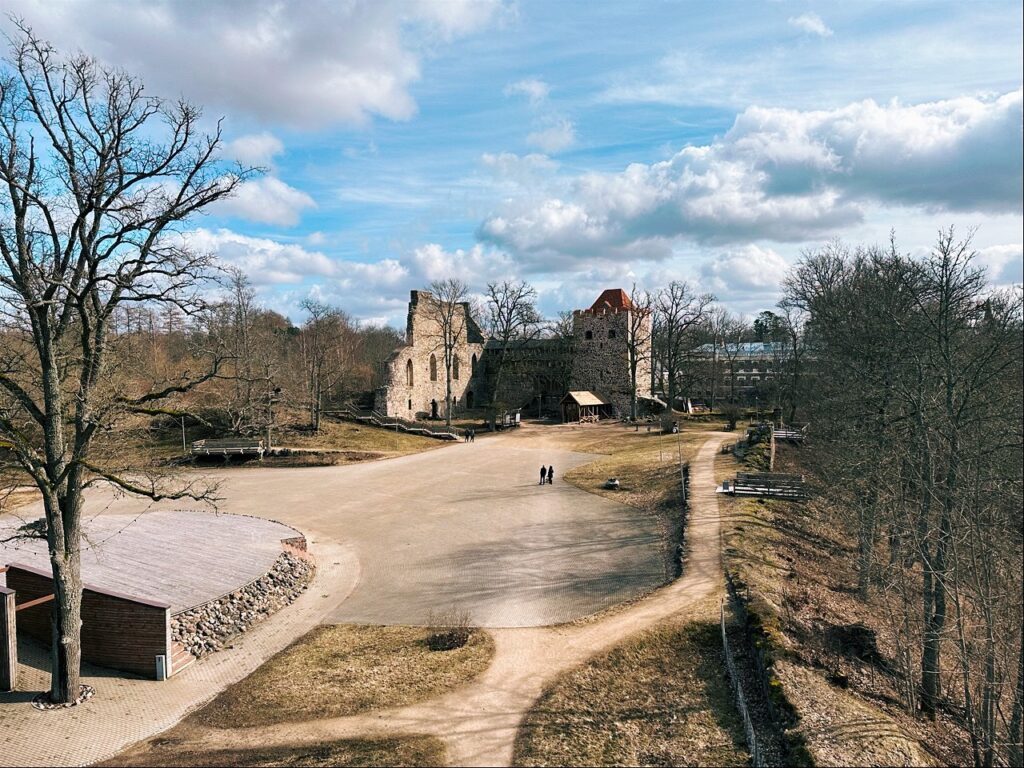
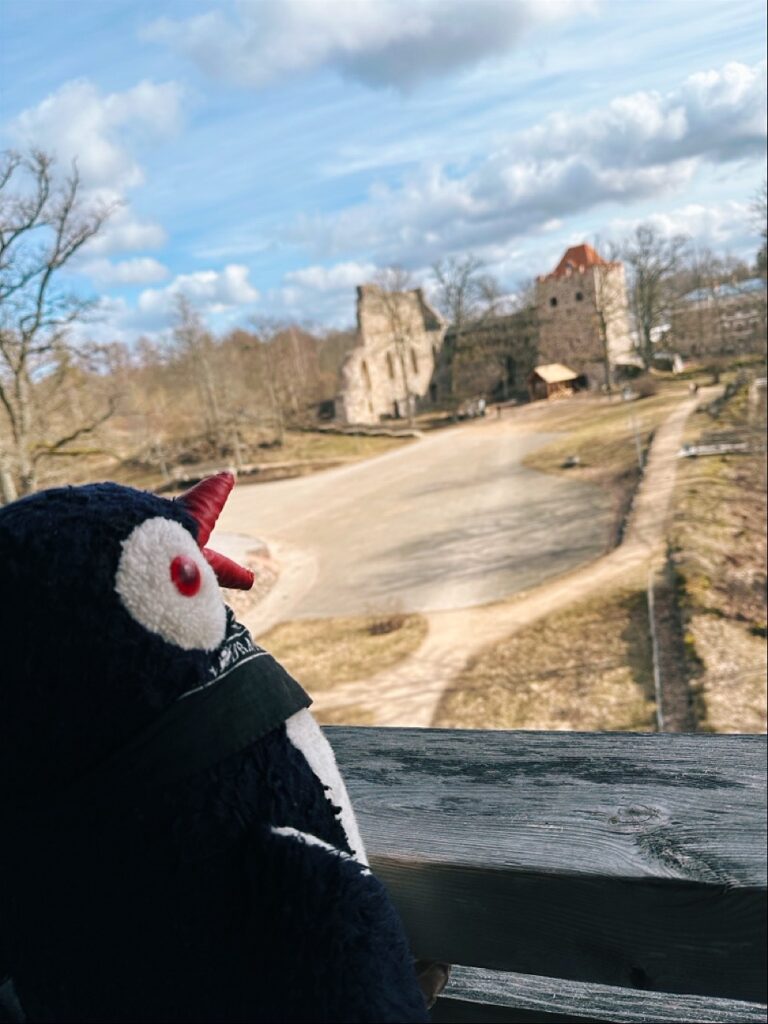
What makes the visit particularly enjoyable is that the ruins do not feel overly polished. You can still read the place’s age in the stone, climb the tower, and wander through the spaces where people lived, fought, and worked centuries ago. And then, from the top, the view pulls you back into the present: forests spread across the Gauja Valley, while modern Sigulda sits beyond the old walls. It is a place where the history and landscape really do belong together.
From the Medieval Castle to Sigulda New Castle
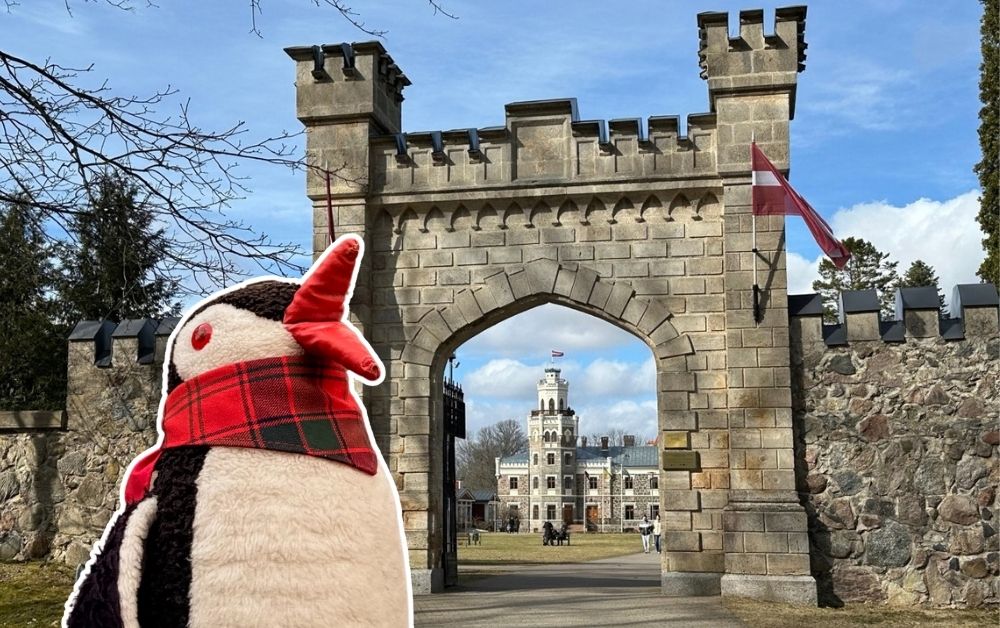
From the medieval ruins, we wander across the castle grounds towards Sigulda New Castle, and the change in atmosphere is immediate. Instead of crumbling medieval walls and defensive towers, we find a handsome neo-Gothic manor house, built for the Kropotkin family between 1878 and 1881. It was intended as their summer residence, built on the site of an earlier 17th-century structure, with materials from the old building reused in its construction.
The castle feels less like a fortress and more like a grand country retreat. Its stone façade, Gothic details, and carefully kept grounds give it a completely different character from the medieval castle next door. And the location was clearly part of the appeal. From the castle, the views open towards the Gauja Valley and the ruins of Sigulda Castle, with Krimulda and Turaida visible farther across the landscape.
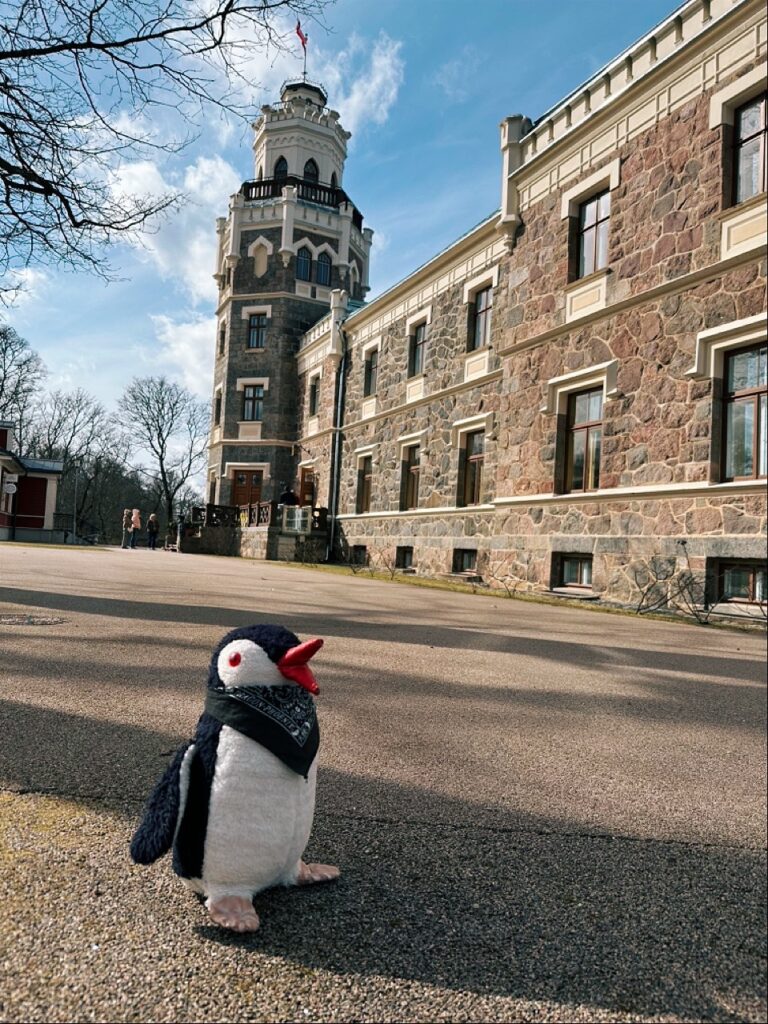
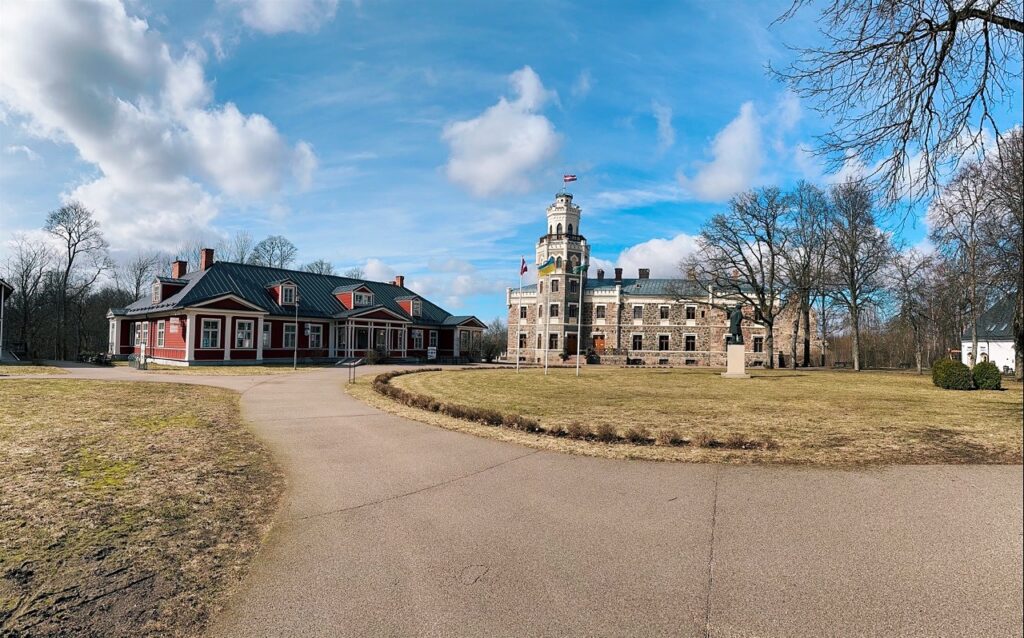
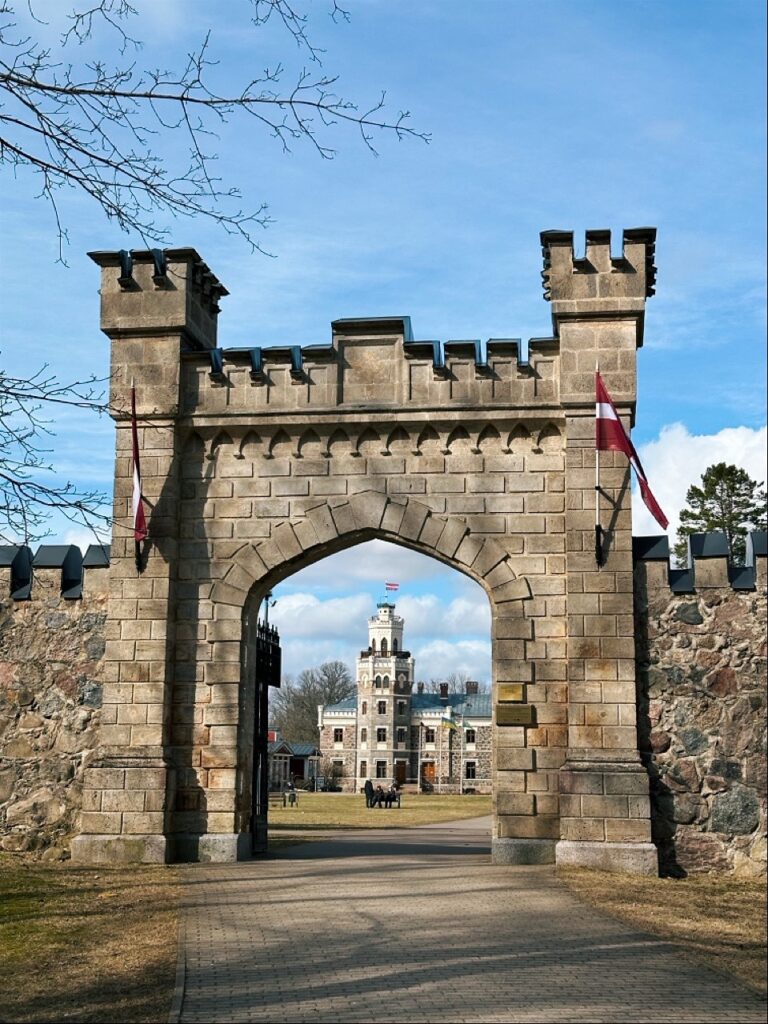
But the building has had quite a life since the Kropotkins left. During the First World War, it was badly damaged. In 1922, it became known as the Writers’ Castle after the Latvian Union of Writers and Journalists took over. A major reconstruction followed in the 1930s, transforming the interior into an important example of Latvian national romanticism, with artists and designers contributing to the new interiors.
Today, the castle is part of the Sigulda Castle Quarter, where the historic manor buildings have been brought back to life with workshops, artists and craftsmen. The New Castle itself has also undergone reconstruction, so what you can access can vary depending on the current restoration work. The official tourism information says visitors can see the castle’s interiors and exhibitions and, when open, climb the tower.
What we love about this part of Sigulda is how effortlessly the two castles sit side by side. One tells the story of medieval fortifications and warfare; the other belongs to a much later era of aristocratic summer residences, tourism, and culture. In just a few steps, we move from the Middle Ages into 19th-century Latvia, with the Gauja Valley tying the two stories together.
Avēnija Nr. 9: Lunch at Gastrobārs “9. Pils”
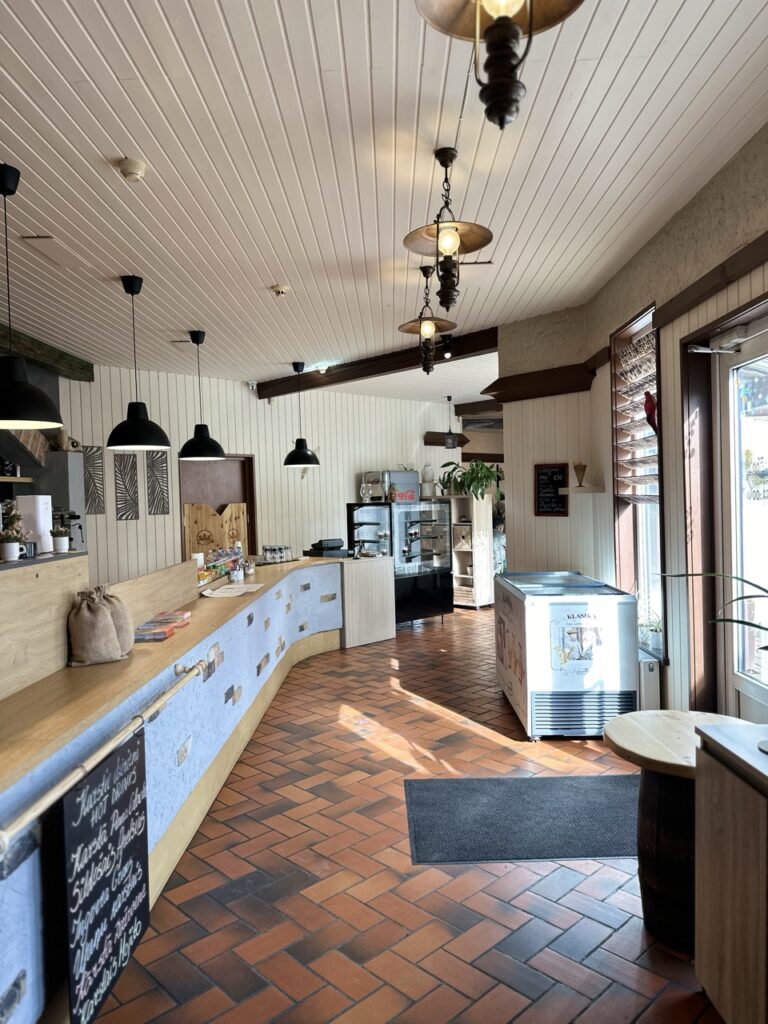
After exploring Sigulda New Castle, we slowly make our way back toward the train station. Before leaving town, though, we decide it is time for lunch and stop at Avēnija Nr. 9, Gastrobārs “9. Pils”. After a morning of waddling, we are more than ready to sit down and recharge.
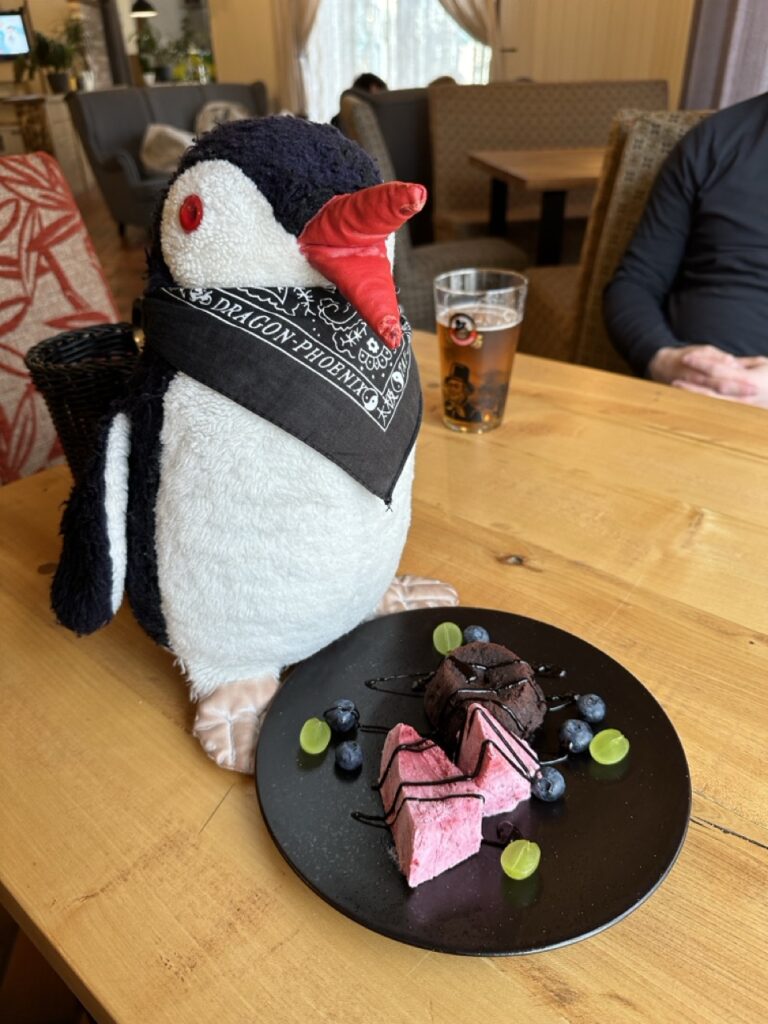
We order two beers, a burger, and a pizza, and somehow still find room for dessert. The food does the job, and we certainly do not leave hungry, but overall, the meal is fairly average. Nothing is particularly wrong with it, but nothing makes us want to plan another lunch trip to Sigulda. For us, it is simply a convenient stop to refuel before continuing towards the train station.



Back to the Train Station
With lunch behind us, we make our way back through Sigulda towards the railway station. The afternoon is beginning to wind down, and after a full day of walking, castles, caves, and valley views, we are more than ready to sit down and let someone else do the traveling for a while. We arrive at the station with enough time to catch our train, leaving Sigulda behind as we settle in for the journey back to Riga. It has been a day packed with more than we expected, and exactly the kind of escape we were looking for when we boarded the train that morning.
What We Didn’t Manage to See
Even with a full day in Sigulda, there was still more waiting beyond our route. The biggest omission was Turaida Castle, sitting a little farther from the center and across the Gauja Valley. Its unmistakable red-brick tower is hard to miss from the surrounding viewpoints, rising above the treetops like a medieval beacon. Construction began in 1214, and its main tower reaches more than 38 meters high. After a fire in 1776, the castle fell into ruins, but archaeological work and restoration have brought much of the complex back to life.
Turaida was not the only thing we left for another visit. We also didn’t have time for Krimulda Manor, the hiking trails and viewpoints around the Gauja Valley, or the Sigulda bobsleigh and luge track, where visitors can experience it themselves.
And perhaps that is the nice thing about Sigulda. You can pack a full day without seeing everything. We came for a taste of the Gauja Valley, wandered through castles and ruins, crossed the valley by cable car, and still left with a few reasons to come back.
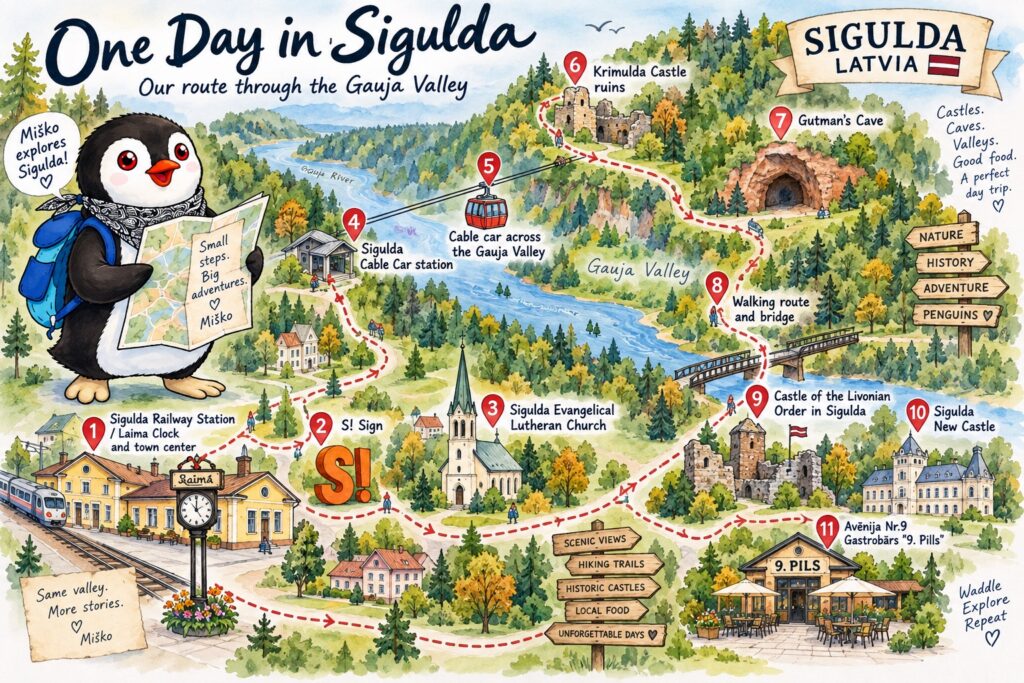
What We Managed to See in One Day
- Laima Clock
- S! Sign
- Sigulda Evangelical Lutheran Church
- Sigulda Cable Car
- Krimulda Castle
- Gutman’s Cave
- The Bridge
- Gauja Valley Waddle
- Castle Of The Livonian Order In Sigulda
- Sigulda New Castle
- Avēnija Nr.9 Gastrobārs “9. Pils”
Our Sigulda day trip involved plenty of waddling, especially after we took the cable car across the Gauja Valley. We waddled between the main sights, followed wooden paths through the forest, explored the castle ruins, and made our way back towards the town and train station. It was certainly a full day, but it never felt overwhelmingly rushed. We had enough time to stop, look around, and enjoy the places we visited rather than simply ticking them off a list.
That said, with a few more hours, we would have slowed the pace and explored more of the Gauja Valley. Turaida Castle would be at the top of our list, followed by more of the surrounding trails and viewpoints. There is plenty to see around Sigulda to easily spend another day exploring, especially if you want to combine the main sights with a longer walk through the countryside.
Our Sigulda Day Trip in a Nutshell
How to Do This Sigulda Day Trip Yourself
Our route is easy to recreate, especially if you are traveling from Riga without a car. The train gets you to Sigulda quickly, and once there, a combination of walking and the cable car lets you cover quite a lot of the area in one day.
Getting There
- From Riga: Take the train from Riga Central Station to Sigulda.
- Journey time: Around 1–1.5 hours, depending on the service.
- Tickets: Buy them at the station, on the official Vivi website, or in the Vivi app.
- Return: Check the return timetable before setting off so you know when you need to be back at the station.
Getting Around
- Waddling: You can explore much of the route on foot, but expect hills, stairs, and uneven paths.
- Cable car: Take the Sigulda Cable Car across the Gauja Valley to reach the Krimulda side.
- Local transport: Useful if you want to add sights that are farther away, particularly Turaida Castle.
How Long Do You Need
- One day: Enough for a good selection of Sigulda’s main sights, as our itinerary shows.
- One day + early start: Gives you more time for stops, lunch, and photography.
- Two days: A better option if you want to explore Turaida, Krimulda, and more of the Gauja National Park without rushing.
What to Bring
- Comfortable walking shoes: You will cover plenty of ground.
- Water: Especially if you plan to follow the forest paths.
- Layers: Weather can change quickly, particularly around the valley.
- Camera: Plenty of viewpoints along the route.
- A little extra time: Sigulda is the kind of place where you will probably stop more often than planned.
What We Would Do Differently
Looking back, we would definitely start earlier and allow more time for Turaida Castle. The striking red-brick castle sits a little farther away from the main Sigulda sights, and trying to fit everything into one day meant that we had to leave it for another visit. We also would not rush the walk through the Gauja Valley. There is enough scenery along the way to make slowing down worthwhile.
If we returned, Turaida Castle would be our priority. We would give ourselves several hours to explore the castle complex properly, climb the tower, take in the views, and spend more time around the surrounding grounds. We would also leave more room for the hiking trails and viewpoints rather than trying to squeeze in as many individual sights as possible. One day works well for getting a taste of Sigulda, but a few more hours would make the experience much more relaxed.
Buy Us a Ko-fi

When Is the Best Time to Visit Sigulda
We visited Sigulda in late March, which gave the town and the Gauja Valley a quiet, early-spring atmosphere. The trees were still mostly bare, the paths were calm, and the air still had a definite chill. It had its own charm, but if we were planning the trip again, we would probably come a little later, around late April or early May, when the landscape is beginning to turn green. Autumn, though, would be our other choice. With Sigulda surrounded by forests, we can only imagine how spectacular the Gauja Valley must look when the leaves turn golden, orange, and red.

Sigulda gave us a glimpse of Latvia far beyond Riga, where medieval castles, quiet forests, and the Gauja Valley come together in one easy day trip. We only scratched the surface, but that may be the best part. With Turaida Castle and more of the valley still waiting, Sigulda has given us a good reason to come back.
Travel Bold. Eat Well. Waddle Wild.

This post contains affiliate links. If you click and buy, I might earn a tiny commission, enough to help a penguin keep up its globe-trotting lifestyle. No extra cost to you, just more fish for me. Thank you for supporting the adventure!