Inside the Anne Frank House: A Story That Feels Different Here
Some places make it onto an itinerary before you have even figured out what else you are doing in a city. For us, the Anne Frank House was that place in Amsterdam. The moment we knew we were going, it became the first thing on our list. We had both read Anne Frank’s diary and knew her story, but standing inside the house where she, her family, and four others hid for more than two years is something a book can never quite prepare you for. This was never going to be just another museum stop on our itinerary. As we stepped inside, Amsterdam suddenly felt connected to a much bigger and much darker piece of history.
- Anne Frank House Quick Facts
- Why the Anne Frank House Was First on Our Amsterdam List
- Before You Visit: The Story Behind the House
- Getting to the Anne Frank House
- Getting Anne Frank House Tickets Is Part of the Planning
- Our Visit to the Anne Frank House
- How Long Do You Need at the Anne Frank House
- What to Know Before You Go
- Is the Anne Frank House Worth Visiting
- Who Should Visit the Anne Frank House
- What to See Near the Anne Frank House
Anne Frank House Quick Facts
📍 Location: Prinsengracht 263–267, Amsterdam. The visitor entrance is around the corner at Westermarkt 20
🕐 Opening Hours: Daily, 09:00–22:00
💶 Ticket Price: €16.50 adults | €7 ages 10–17 | €1 ages 0–9, including the €1 booking fee
🎟️ How to Book: Online only. Tickets are released every Tuesday at 10:00 CEST for visits six weeks later and are tied to a specific time slot. No tickets are sold at the door
⏱️ Time Needed: Around 1 hour on average, although there is no set limit once you are inside
🎧 Audio Guide: Included with admission and available in nine languages, including English
📸 Photography: Not allowed inside
🎒 Bags & Cloakroom: A cloakroom is available, but only bags smaller than A4 size can be carried through the museum. Large backpacks and suitcases cannot be stored, so leave them at your hotel or another luggage facility
♿ Accessibility: The historic house and Secret Annex contain steep stairs and high steps and are not wheelchair accessible. Parts of the modern museum are accessible by lift with staff assistance
🌐 Official Website: Anne Frank House
Why the Anne Frank House Was First on Our Amsterdam List
Amsterdam has enough museums and attractions to fill several trips, but we put the Anne Frank House first on our itinerary. Before canal cruises, cheese tastings, or figuring out which museums we could realistically squeeze into our days, this one was already decided.
We had both read Anne Frank’s diary and knew her story long before coming to Amsterdam. But there is a difference between knowing what happened and standing in the actual place where it happened. We wanted to see the rooms we had previously imagined only through Anne’s words and better understand the reality behind a story familiar to millions.
For us, this was never about ticking off another famous Amsterdam attraction. It was simply somewhere we felt we needed to see while we were here.

Before You Visit: The Story Behind the House
Before there was a museum, there was a girl with a diary. Anne Frank was born in Frankfurt, Germany, in 1929, into a Jewish family with her parents, Otto and Edith, and her older sister, Margot. When the Nazis came to power, the family left Germany for Amsterdam, hoping to build a safer life in the Netherlands.
That safety did not last. Nazi Germany occupied the Netherlands in 1940, and increasingly restrictive measures were imposed on Jewish people. In July 1942, after Margot received a call-up notice for a German labor camp, the Frank family went into hiding in rooms behind Otto Frank’s business premises on Prinsengracht. They were eventually joined by the Van Pels family and Fritz Pfeffer, bringing the number of people living in what became known as the Secret Annex to eight.
For more than two years, they lived hidden from the world outside. During that time, Anne wrote about daily life, arguments, fear, relationships, dreams, and what it was like to grow up while confined to a handful of rooms. In August 1944, the eight people in hiding were discovered and arrested. Anne and Margot later died in Bergen-Belsen concentration camp. Of the eight people who had hidden in the Annex, Otto Frank was the only one to survive the Holocaust.
When Otto returned to Amsterdam, Miep Gies and Bep Voskuijl gave him Anne’s writings, which they had saved after the arrest. Anne had dreamed of becoming a writer, and in 1947, Otto published her diary. It would eventually become one of the most widely read accounts of the Holocaust.
And that is what makes visiting the Anne Frank House so different from simply knowing the story. The building at Prinsengracht 263 is not a reconstruction of where these events happened. It is the place itself. Behind the bookcase are the rooms where eight people disappeared from public life for more than two years, and where a teenage girl wrote words that would eventually travel far beyond those walls.


Getting to the Anne Frank House
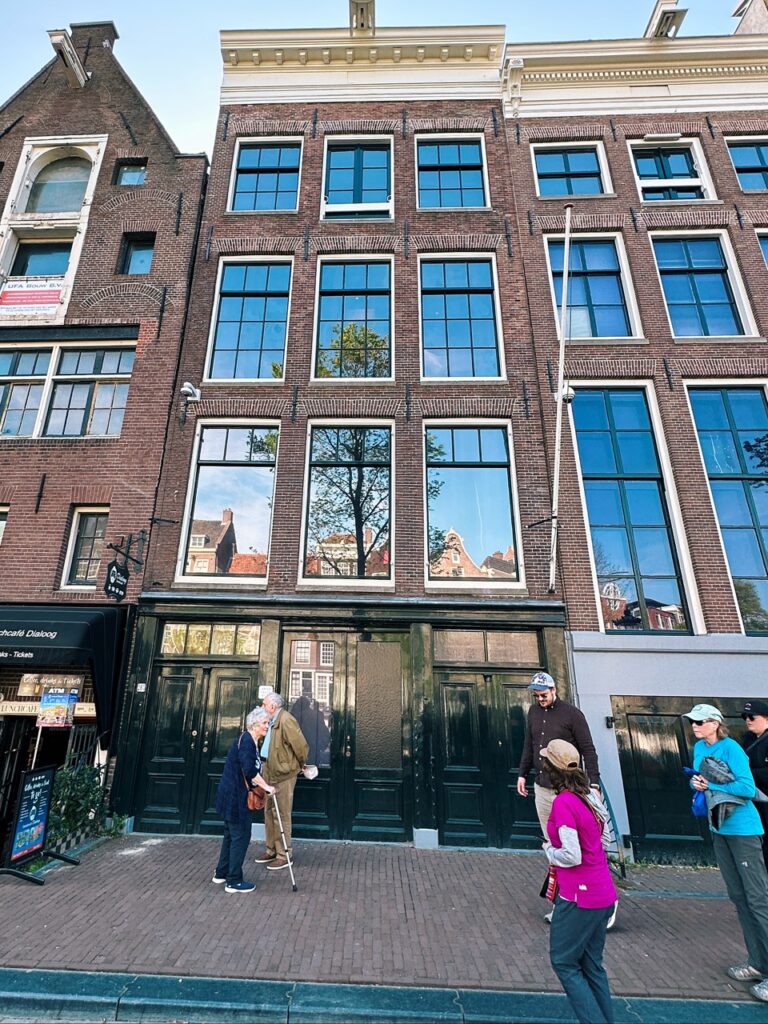
The Anne Frank House sits right in central Amsterdam, along the Prinsengracht canal. The historic address is Prinsengracht 263–267, but the museum entrance is around the corner at Westermarkt 20, so we recommend using that address for navigation.
If you are coming from Amsterdam Centraal, waddling is actually one of the easiest options and takes around 20 minutes. From Dam Square, it is roughly a 10-minute walk. Normally Westermarkt is also served by trams, but due to temporary works, trams won’t run to the Westermarkt stop from February 2025 until February 2028. For now, taking public transport toward Dam Square and waddling the remaining 10 minutes is a simple alternative.
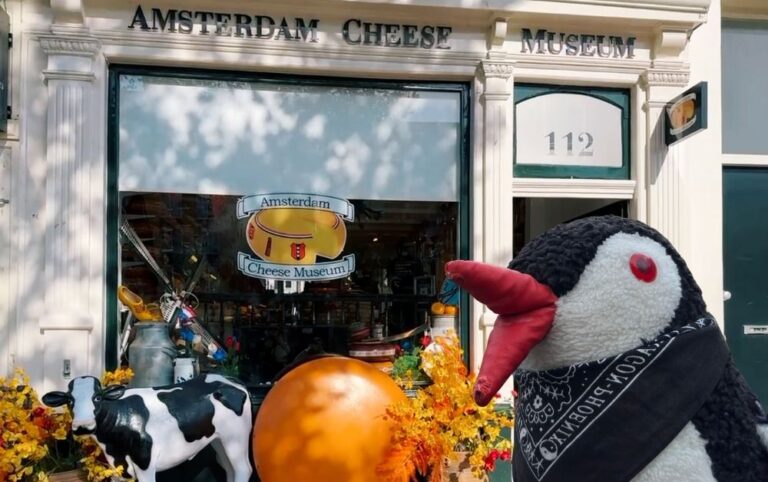
We did what we tend to do in Amsterdam and waddled there instead. We had just finished our visit to the Amsterdam Cheese Museum, which is also on Prinsengracht, so getting to the Anne Frank House meant continuing along the canal. It made for a very Amsterdam transition: from tasting our way through Dutch cheese to one of the most historically significant stops of our entire trip.
Getting Anne Frank House Tickets Is Part of the Planning
If there is one part of visiting the Anne Frank House that you should not leave until you arrive in Amsterdam, it is buying your ticket. Tickets are sold exclusively online for a specific date and time, with new tickets released every Tuesday at 10:00 CEST for visits six weeks later. No tickets are available at the door, so a little planning is essential.
We took that advice very seriously. When our Tuesday arrived, we were ready on our phones and computers at 10:00, prepared for what we imagined would be a frantic race against thousands of other Amsterdam visitors. In reality, the preparation was considerably more stressful than the booking itself. Tickets didn’t disappear within seconds, and we had enough time to choose our slot and complete the booking without the dramatic ticket-buying battle we had prepared for. That doesn’t mean you should get too relaxed, though. Popular dates and times can sell out, and once a time slot is gone, there is no guarantee another will appear.
One important thing to understand is that tickets released on Tuesday are not only available for that week. The booking calendar works on a rolling basis, with tickets generally available up to around six weeks ahead. As dates get closer, however, popular slots gradually book out. We recommend planning at least a month ahead if the Anne Frank House is a must on your Amsterdam itinerary, rather than relying on whatever is left a few days before your visit.
How Much Do Anne Frank House Tickets Cost
Compared with some of Amsterdam’s larger museums, visiting the Anne Frank House is relatively affordable.
-
- Adults: €16.50
- Children aged 10–17: €7
- Children aged 0–9: €1
- Museumkaart: €1 booking fee
- Plushies: free entry
These prices already include the €1 online booking fee, and even visitors with a Museumkaart must reserve a specific time slot and pay that €1 fee. The I amsterdam City Card does not include free admission to the Anne Frank House.
When booking, you can also choose a ticket with a 30-minute introductory program for an additional €7 per person. It takes place immediately before your museum visit and gives you more background on Anne Frank, the Second World War, and the persecution of Jewish people.
We also chose to add the 30-minute introductory program, which you can book together with your museum ticket for an additional €7 per person. Although we had both read Anne Frank’s diary and already knew her story, we wanted as much context as possible before entering the house. The program takes place just before your museum visit and gives you more background on Anne Frank, the Second World War, and the persecution of Jewish people. For us, it was a worthwhile addition and helped set the historical context before we stepped inside the museum itself.
Hotel search from Trip.comShows Trip.com’s own box, which can set Trip.com cookies.Search hotels on Trip.comTrip.com’s box can’t load on this device (an ad blocker often stops it). This opens Trip.com’s own hotel search.Open Trip.com
Our Visit to the Anne Frank House
We had the tickets. We had our time slot. We had spent weeks making sure this part of our Amsterdam itinerary was properly planned. Now came the part we had actually traveled here for.
From this point, there was nothing left to organize. We waddled through the doors and began following Anne Frank’s story through the place where so much of it actually happened.
Arriving at Prinsengracht 263
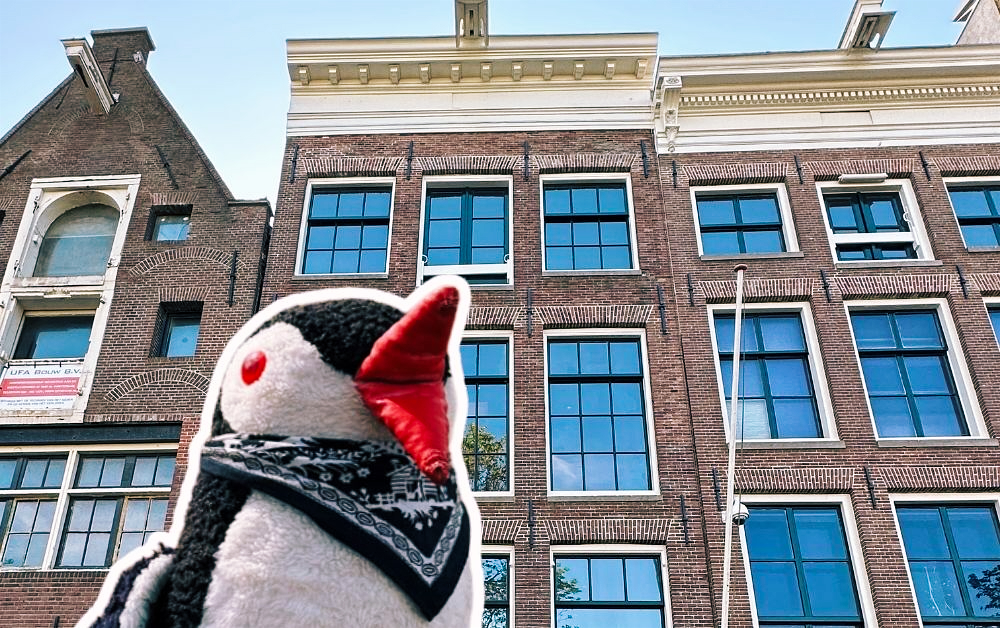
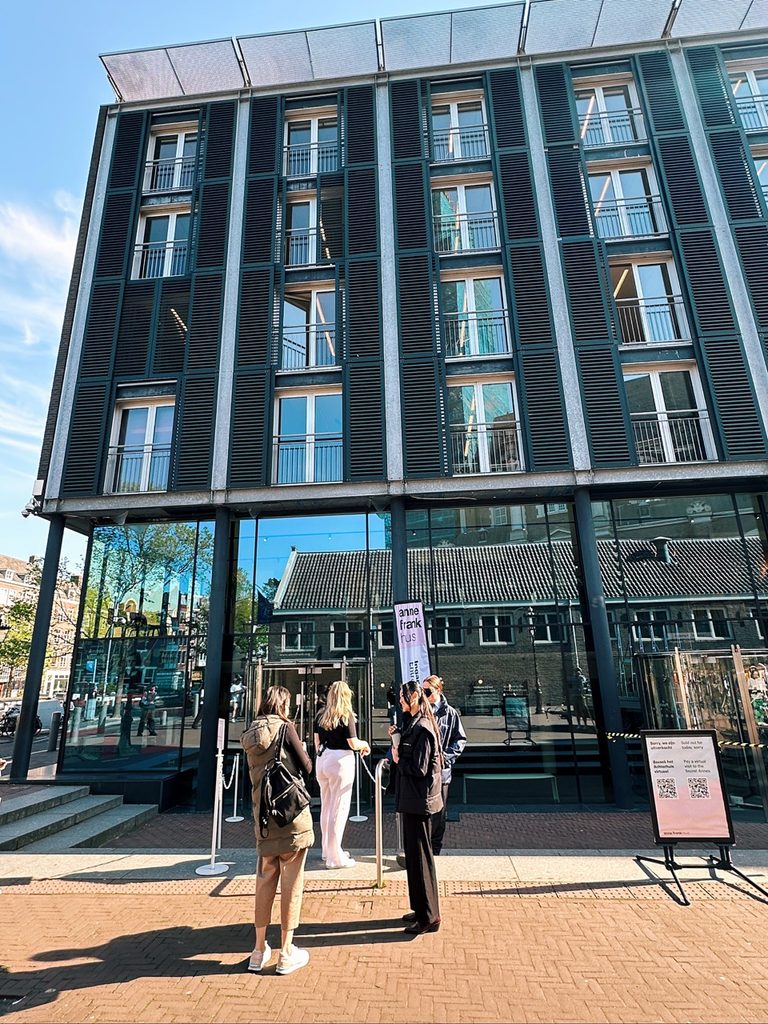
One thing that can be confusing when you first arrive is where the Anne Frank House actually is. The historic building connected to Anne’s story is at Prinsengracht 263, but this is not where you enter the museum today. The modern visitor entrance is around the corner at Westermarkt 20, while the original canal house sits a little farther along Prinsengracht. So if you arrive expecting to waddle straight through the front door of the famous narrow house, you might initially wonder whether you are in the right place.
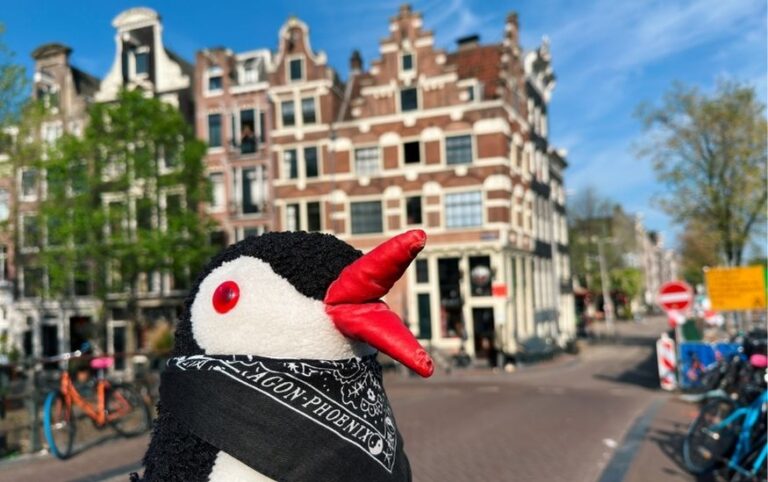
It is worth waddling over to see the historic façade before or after your visit. From the canal, Prinsengracht 263 looks remarkably ordinary among the surrounding Amsterdam buildings. No dramatic exterior announces what happened behind those walls. Boats pass along the canal, bicycles roll by, and people continue walking through the neighborhood.
Something about that normality makes seeing it in person interesting. You have probably seen photographs of the house before, but standing across the canal and placing it within the streets, houses, and everyday life of Amsterdam gives the story a different geographical context.
And even if you don’t have tickets to go inside, we think it is still worth waddling past Prinsengracht 263 while exploring this part of Amsterdam. You cannot see the Secret Annex from the street, of course, but simply seeing the house from outside and understanding where Anne’s story unfolded gives this stretch of the canal a completely different meaning.
Before the Secret Annex: Putting Anne’s Story Into Context
Our visit did not begin with the Secret Annex itself. We first joined the 30-minute introductory program, an optional extra we had added when booking our tickets, and in retrospect, we are very glad we did.
The program takes place in a separate room where you can sit down and listen before starting the museum route. Our guide walked us through Anne Frank’s story, the German occupation of the Netherlands, the persecution of Jewish people, and the circumstances that eventually forced the Frank family into hiding. She was incredibly knowledgeable, and what made the introduction work particularly well was that it didn’t feel like someone simply repeating a timeline we already knew. She added details and context, brought Anne’s story into Amsterdam’s wider history, and gave us time to look more closely at the photographs displayed around the room.
There was also space for questions before we continued, and our guide took the time to answer them rather than rushing everyone toward the museum entrance. Even though we had both read Anne’s diary and already knew her story, there were facts and details here that were new to us. If you are debating whether the introductory program is worth the additional time and cost, we would highly recommend it.


Once the presentation ended, we didn’t have to leave the room immediately. We had time to return to the photographs our guide referenced during her talk, look more closely at the objects and historical material displayed around the room, and take in details at our own pace. There was also a guest book where visitors could leave a message before continuing.
We appreciated having those few extra minutes. During the presentation, your attention naturally follows the guide and the story she tells, so being able to walk around afterward gave us a chance to return to things that caught our attention. Only then did we leave the introductory area and continue into the museum itself.
Walking Behind the Bookcase
At the end of the introductory program, our guide handed us the audio sets, and from that point we continued through the museum independently, slowly making our way toward the Secret Annex.
Then you reach the bookcase. It is a strange moment, precisely because there is nothing theatrical about it. You have seen this bookcase in photographs, read about it in Anne’s diary, and known for years what was hidden behind it. Now it is physically in front of you. You are no longer looking at an image in a book or on a screen. You are standing in the same building, about to pass through the concealed entrance that separated eight people from the outside world.
We walked behind it and into the Secret Annex. And from there, the visit becomes something quite different.
Inside the Secret Annex
Reading about the Secret Annex is one thing. Standing inside it changes the story’s scale completely. Until this point, we knew the facts. We had read Anne’s diary, seen photographs, listened to the introductory program, and followed the museum’s exhibits. But waddling through the rooms where eight people actually lived in hiding for more than two years makes those facts suddenly physical. These are the stairs they climbed. These are the walls they lived between. This is how close the rooms are to one another. And outside those windows, Amsterdam carried on while the people inside could not step out into it.


The rooms themselves are almost empty, and that is intentional. After the war, Otto Frank decided that the Secret Annex should not be refurnished. Rather than recreating the hiding place with replacement furniture, the museum preserved the rooms as they were.
At first, the emptiness makes it hard to understand how much once fit into these spaces. But look down, and you can see outlines indicating where pieces of furniture once stood, helping you reconstruct the rooms in your mind. Suddenly, an empty floor becomes a bed, a table, a chair, and the narrow spaces people had to move between.
Anne’s room stayed with us the most. This was the room where she sat and wrote the diary we had both read years later. Some of the pictures and images she attached to the walls are still there, small details that make the room feel connected to the teenage girl behind a story that has become part of world history.
And perhaps that was the biggest shift for us inside the Annex. Anne Frank’s story is so widely known that it can sometimes feel like something that belongs entirely in history books. Standing there removes that distance. You are looking at the walls she looked at and moving through the rooms she described. This was not simply the setting of a story we had read. It was a real home in hiding, occupied by real people, and suddenly the diary had a physical place.


What Surprised Us Most
The biggest surprise was the size of the Secret Annex itself. From reading Anne’s diary and hearing about eight people living in hiding for more than two years, we had always pictured something much smaller, almost a handful of tiny rooms squeezed behind a wall.
In reality, the Annex is more spacious than we expected, with several separate rooms spread across multiple levels. Of course, “spacious” needs some perspective here. Eight people were still sharing this space without being able to leave it, often having to remain quiet during working hours. But physically walking through it challenged the image we had carried with us for years. There was simply more to the Annex than we had imagined.
Then there are the stairs. Photographs and floor plans cannot quite communicate them. They are extremely steep and narrow, and you climb several sets as you move through the hiding place. It immediately makes you think differently about everyday life here and how often the people in hiding would have moved between these levels.
We arrived thinking we had a fairly clear picture of the Secret Annex from Anne’s diary. Walking through it showed us how much of that picture we had constructed ourselves. The real space was different, and understanding its actual size, layout, and number of rooms became one of the most interesting parts of the visit.
How Long Do You Need at the Anne Frank House
We recommend at least 1 to 1.5 hours for the museum itself. We never felt rushed during our visit and took our time with the audio guide, photographs, exhibits, and, of course, the Secret Annex rather than simply moving from room to room.
If you book the 30-minute introductory program, as we did, add that time on top. In that case, we would set aside around two hours in total. That gives you enough breathing room for the introduction, the museum, and the Annex without constantly checking the clock.
What to Know Before You Go
- Book well ahead. Tickets are released on a rolling basis up to around six weeks in advance. If the Anne Frank House is a priority for your trip, we recommend booking four to six weeks ahead rather than waiting until you are in Amsterdam.
- Tickets are online only. You need a ticket for a specific date and time. You cannot buy one at the museum entrance.
- Arrive for your designated time. Your ticket is tied to a time slot, so plan to be in the area a little before your scheduled entry rather than rushing across Amsterdam at the last minute.
- Travel light. The museum has a cloakroom, but it cannot store suitcases, large backpacks, or other large items. Leave those at your accommodation or a luggage-storage facility.
- Only small bags can come inside. Bags you carry through the museum must be smaller than A4 size.
- Be prepared for steep stairs. This is an original historic building, and the route through the Secret Annex includes several narrow and very steep staircases. This is especially important if you have mobility difficulties.
- The audio tour is included. You do not need to pay extra for it. We found it useful for following the story as we moved independently through the museum.
- Photography and filming are not allowed. You cannot take photos inside the Anne Frank House or Secret Annex. Save your photographs for the exterior along Prinsengracht.
- The museum is cashless. If you plan to buy something in the museum shop or stop at the café, bring a debit or credit card, as cash is not accepted.
- Consider the introductory program. It costs extra and adds around 30 minutes to your visit, but we were very glad we booked it. Even after reading Anne’s diary and knowing her story, we learned details we hadn’t known before.
Facilities and Amenities at the Anne Frank House
- Café: The museum café lets you stop for drinks and something to eat. It is only accessible to museum visitors.
- Museum Shop: The shop sells books, postcards and other items connected to Anne Frank’s story. We bought a replica of Anne’s diary here.
- Free Cloakroom: A cloakroom is available for coats, umbrellas and small bags. You cannot store large bags or suitcases.
- Toilets: Restrooms are available inside the museum.
- Audio Guide: The audio tour is included with your admission ticket and available in several languages.
- Accessibility: The modern part of the museum is partly accessible, but the historic house and Secret Annex are not wheelchair accessible due to the steep stairs and high steps.
- Cashless Payments: The café and museum shop accept card payments only.
- Free Wi-Fi: Wi-Fi is available for museum visitors.
Is the Anne Frank House Worth Visiting
Yes, the Anne Frank House is absolutely worth visiting, but not because it is another famous Amsterdam attraction to tick off your list.
We had both read Anne’s diary and knew her story, yet standing inside the actual Secret Annex changed how we understood it. Walking behind the bookcase, climbing the steep stairs, and seeing the rooms where eight people lived in hiding gives the story a physical scale that a book simply cannot.
You also don’t need to have read The Diary of a Young Girl beforehand. The museum provides plenty of historical context, and we particularly recommend the introductory program if you want to understand more before entering the Annex. For us, this was easily one of the most meaningful visits of our time in Amsterdam.
Who Should Visit the Anne Frank House
The Anne Frank House is particularly worth considering for:
- First-time visitors to Amsterdam. It adds an important historical perspective to a city otherwise often associated with canals, art, and architecture.
- Anyone who has read Anne Frank’s diary. Seeing the Secret Annex gives a physical context to places and moments you previously only imagined.
- Travelers interested in WWII history. The museum places Anne’s story within the wider history of Nazi occupation and the persecution of Jewish people in the Netherlands.
- Families with older children. The museum currently recommends a minimum age of 10 and considers the experience unsuitable for younger children due to its subject matter.
- Visitors with limited mobility. This requires some planning. The historic house and Secret Annex contain several steep, narrow staircases and a high step, and the Annex itself is not wheelchair accessible.
You don’t need extensive knowledge of Anne Frank before visiting. The museum provides plenty of context, particularly if you combine your visit with the 30-minute introductory program, as we did.
What to See Near the Anne Frank House
The Anne Frank House sits in a part of Amsterdam where you can easily continue exploring on foot. A few nearby stops worth adding include:
- Westerkerk. Right beside the Anne Frank House, this church and its tower are closely connected to Anne’s story. She wrote about hearing the Westerkerk bells from the Secret Annex.
- Jordaan. Cross into the Jordaan for canals, narrow streets, cafés and small shops. It is an easy area to explore without much of a plan.
- Amsterdam Cheese Museum. Going directly from the Anne Frank House to eating free Gouda might sound like a strange itinerary transition, but the Amsterdam Cheese Museum is only a short walk away on Prinsengracht. Interestingly, we actually did these two stops in reverse, visiting the Cheese Museum first.
- The Nine Streets. Continue along the canals toward De Negen Straatjes, a compact area filled with independent shops, cafés and some of Amsterdam’s most photogenic canal streets.
- Amsterdam Canal Cruise. Several canal cruises depart from the wider city center, making this a good point to swap walking for the water. Seeing the canal houses from below gives you a completely different perspective on Amsterdam.
You can comfortably combine several of these stops without relying on public transport. This is one part of Amsterdam where simply continuing to waddle along the canals works remarkably well.
Buy Us a Ko-fi

The Anne Frank House was part of our Amsterdam plans before almost anything else, and visiting it only confirmed why we wanted to come.
We already knew Anne’s story, but standing inside the Secret Annex made it feel different. The steep stairs, the pictures still on Anne’s wall, and the rooms themselves turned something we had read about into a physical place.
On the way out, we stopped at the museum shop, where you can find Anne’s diary alongside other books and souvenirs. We bought a replica of her diary, which felt like the right souvenir to take home from this visit. For us, the Anne Frank House is a museum we would highly recommend making time for in Amsterdam.
Travel Bold. Eat Well. Waddle Wild.

This post contains affiliate links. If you click and buy, I might earn a tiny commission, enough to help a penguin keep up its globe-trotting lifestyle. No extra cost to you, just more fish for me. Thank you for supporting the adventure!