Visiting Fabrique des Lumières Amsterdam: Everything You Need to Know
Our rainy day in Amsterdam continued, so we were happy to find another excuse to spend time indoors and hide from the rain. Fabrique des Lumières had already caught our attention before the trip, especially because we had visited teamLab in Tokyo, Japan, and absolutely loved the experience. We were curious to see how Amsterdam’s take on immersive digital art would compare, and to give our feet a little break from waddling through the wet streets. So, we booked our tickets, escaped the rain, and stepped inside. Here’s how it went.
- Fabrique des Lumières Amsterdam Quick Facts
- What Exactly Is Fabrique des Lumières
- How to Get to Fabrique des Lumières
- Fabrique des Lumières Tickets: How Much Do They Cost?
- Fabrique des Lumières Opening Hours
- Facilities & Amenities at Fabrique des Lumières
- Stepping Inside: Our Fabrique des Lumières Experience
- How Long Do You Need at Fabrique des Lumières
- How Long Do You Need at Fabrique des Lumières
- Is Fabrique des Lumières Good for People Who Don’t Love Traditional Museums
- Can You Take Photos Inside
- What We Liked and What Could Have Been Better
- Is Fabrique des Lumières Worth It? Our Verdict
Fabrique des Lumières Amsterdam Quick Facts
📍 Location: Pazzanistraat 37, 1014 DB Amsterdam, in the Westergas cultural complex
🕐 Opening Hours: Open 7 days a week, but hours vary depending on the exhibition, so check the schedule before visiting
🎟️ Adult Ticket: €18 (plushies: free entry)
⏱️ Time Needed: Around 1 hour for the experience
📅 Booking: Online tickets come with a reserved time slot; on-site tickets are available depending on capacity
📸 Photography: Photos and videos are allowed, but no flash
🧥 Lockers: A guarded cloakroom with lockers is available; suitcases are not permitted
♿ Accessibility: Most exhibition areas are accessible for visitors with reduced mobility, though there are some limitations
☕ Café: There is no café inside, but Westergas has several places to eat and drink nearby
🌐 Tickets & Current Exhibitions: Fabrique des Lumières official website
What Exactly Is Fabrique des Lumières
Fabrique des Lumières is not a museum where you quietly move from painting to painting. Instead, art takes over the entire space. Images are projected across the walls and floors, accompanied by music and animation, so you can walk through the artwork, sit down and watch it unfold around you, or stay in one spot and take it all in. Scale is a big part of the experience: the center uses around 100 projectors, with projections covering roughly 3,800 m² and walls reaching up to 17 meters high.
The setting also has its own story. Fabrique des Lumières occupies the Zuiveringshal of the former Westergasfabriek, part of a coal-gas complex built in the 1880s to produce gas for Amsterdam’s street lighting. This hall had a practical job: it purified gas using large boilers, sand, and chemicals. The gasworks eventually closed in the late 1960s, and the industrial site later began its transformation into the cultural Westergas area we know today.
The building found its latest purpose on 22 April 2022, when Fabrique des Lumières opened its doors with immersive exhibitions dedicated to Gustav Klimt and Friedensreich Hundertwasser. Today, the center hosts rotating programs featuring classical, modern, and contemporary art, using digital projection and sound to reinterpret the works rather than display reproductions.
Inside, the experience is divided between two main exhibition spaces: the Hall and the Studio. The Hall is the star of the show, covering around 1,230 m², while the much smaller 110 m² Studio provides a separate space for other digital creations. Together, they make the old industrial building feel less like a traditional gallery and more like one enormous moving canvas.
How to Get to Fabrique des Lumières
We used Amsterdam’s public transport to get there, using the multi-day transport tickets we already had, and took the tram. The most convenient tram option is Tram 5 to Van Hallstraat/Westergasfabriek, from where it is only about a five-minute walk to Fabrique des Lumières. Another option is Tram 3 to Frederik Hendrikplantsoen, followed by an 18-minute walk. From Amsterdam Centraal, you can also take Bus 21 towards Geuzenveld to Van Hallstraat, again leaving you about five minutes away on foot.
Fabrique des Lumières Tickets: How Much Do They Cost?
Tickets for Fabrique des Lumières are tied to a specific time slot, so while you can buy them at the entrance, booking online is the safer option, especially during weekends and busy periods.
- Adults: €18
- Students: €14
- Youth (5–17 years): €14
- Children under 5: Free
- Plushies: Free entry, of course 🐧
Should You Book Fabrique des Lumières in Advance
We actually didn’t book our tickets in advance and got lucky. When we arrived, there was still space available in the next time slot, so we could buy our tickets and head inside without much waiting. However, don’t rely on this, especially if Fabrique des Lumières is high on your Amsterdam list. Booking online in advance guarantees you a specific time slot and makes it much easier to plan the rest of your day. If you are a little late, the venue generally allows entry up to 30 minutes after your booked time, with some exceptions for the final slots and certain performances.
Ticket prices, exhibitions, and schedules can change, so always check the official Fabrique des Lumières website for the latest information before your visit.
Fabrique des Lumières Opening Hours
Fabrique des Lumières is open seven days a week, but no single schedule applies to every exhibition. Different shows run at different times throughout the day, and the program changes during the year. Before visiting, check the schedule for the specific exhibition you want to see, especially if you are planning your Amsterdam itinerary around it. You can find the latest times on the official Fabrique des Lumières website.
Facilities & Amenities at Fabrique des Lumières
- Toilets: Available inside the venue.
- Lockers & Cloakroom: A free guarded cloakroom with lockers is available for coats, backpacks, and smaller belongings.
- Luggage: Large bags and suitcases are not permitted and cannot be stored at the venue.
- Souvenir Shop: A shop where you can browse art-inspired gifts, books, and souvenirs after the exhibition.
- Café: There is no café or restaurant inside, but you’ll find several cafés, bars and restaurants around the wider Westergas complex.
- Accessibility: The main exhibition areas are accessible to visitors with reduced mobility, although some parts have limitations.
- Seating: There is some seating within the exhibition space, but don’t expect traditional museum benches throughout.
- Photography: Photography and short videos are allowed for personal use, without flash or tripods.


Stepping Inside: Our Fabrique des Lumières Experience
We had heard about Fabrique des Lumières before coming to Amsterdam, but it wasn’t one of those attractions we planned our entire day around. Then came the rain. With the weather showing little sign of improving, visiting suddenly made perfect sense, and we decided to see whether we could get in without a reservation. Luckily, an upcoming time slot still had space. Tickets in hand, we left the grey Amsterdam afternoon behind and walked inside, not entirely sure what awaited us beyond the entrance.
Arriving at Fabrique des Lumières
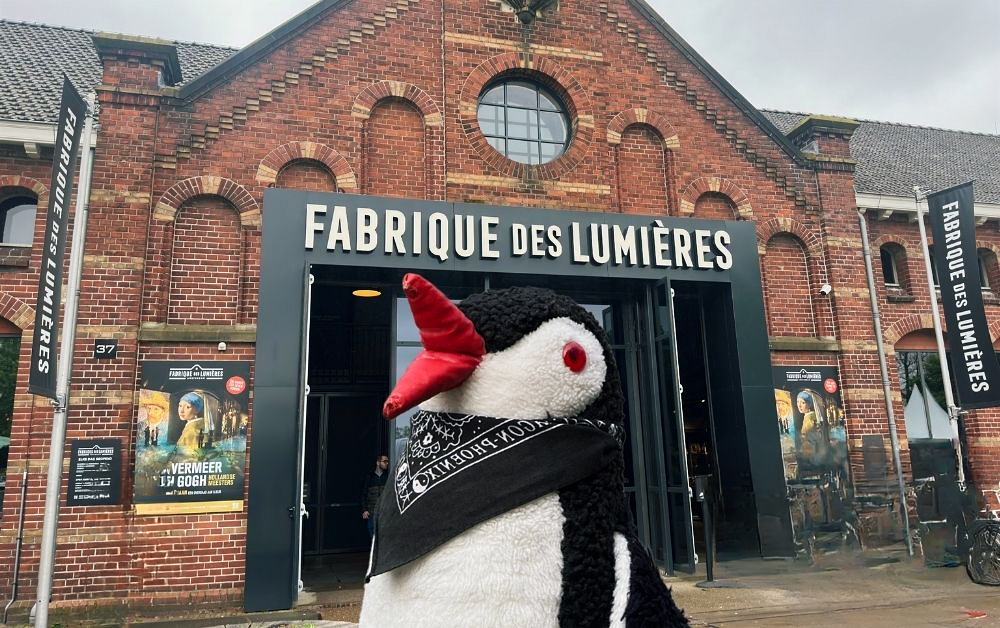
Getting to Westergas takes a little more effort than reaching Amsterdam’s central attractions, but public transport makes the journey straightforward. From our stop, we still had a short waddle ahead of us, and that was when the setting first caught our attention. The large brick industrial building looks impressive before you even know what is happening inside, and our first impression was already a good one.


Once through the doors, everything felt well organized. Since we hadn’t booked anything online, our first stop was the ticket counter, where we were lucky enough to get tickets for an upcoming time slot without waiting long. From there, we headed to the lockers, dropped off our extra layers and belongings, and continued to the ticket-scanning point.
The whole arrival was easy and surprisingly quick. Outside, you have this old industrial building with its brick façade and history; inside, everything is set up for a modern digital experience. And once our tickets were scanned, it was finally time to see what was waiting in the dark exhibition halls.
Stepping Inside: Our First Impression
You can already hear the music before you enter, but it doesn’t prepare you for the moment you step into the main hall. Suddenly, you are right in the middle of it. The space is huge, the music surrounds you, and moving projections cover almost every surface you can see. They climb the walls, stretch high above you, and spill across the floor beneath your feet. The hall itself is dark, but never uncomfortably so. As the projections change, so does the light around you, revealing the building for a moment before another image takes over.
What we loved was the space’s freedom. No prescribed route tells you where to go next, and no line of visitors slowly moves from one artwork to another. You wander. Some people waddle around following the projections, while others sit directly on the floor and watch everything move around them. That actually makes the enormous industrial hall feel surprisingly cozy. We found ourselves doing a bit of both, moving whenever something caught our attention and then finding a spot to sit when we wanted to watch. Within minutes, you stop thinking about where you are supposed to go and start looking around, above you and even beneath your feet, because here, the art can appear anywhere.


What Was Showing During Our Visit
During our visit, the main exhibition was From Vermeer to Van Gogh: Dutch Masters, a journey through Dutch art that brings together more than 325 works by around 50 painters. It starts with the 17th-century Dutch Masters, including Vermeer and Rembrandt, then gradually moves toward Vincent van Gogh, where the colors grow brighter, and projections eventually surround you with his landscapes, wheat fields, and the unmistakable Starry Night. The main show lasts around 34 minutes, but it was paired with a shorter 14-minute Mondriaan: An Abundance of Color exhibition, so there was more to see than a single projection cycle. What makes it particularly interesting is that you don’t look at 325 paintings one by one. They blend, move, and transform across the walls and floor, turning several centuries of Dutch art into one continuous visual story.


We basically waddled around with no particular plan, stopping whenever a projection caught our attention and sitting down whenever we found a good spot. There were quite a lot of people inside, but somehow it never felt like we were fighting for space. We always managed to find somewhere to sit and enjoy the show, whether on one of the benches, on the floor, or inside one of the smaller spaces tucked around the main hall, where you can step away from the center of the action and chill for a while. What we really liked was that there was no pressure to keep moving and no prescribed amount of time you could stay. Despite the experience taking place largely within one enormous hall, we ended up spending more than two hours inside. We wandered, sat, watched parts of the projections again, and changed our viewpoint several times. Somehow, we completely lost track of time, and those two hours flew by.


Our Favorite Part of the Exhibition
Our favorite part wasn’t necessarily one particular painting or projection, but how completely the exhibition pulled us in. You sit down thinking you’ll watch for a few minutes, then the music changes, the walls transform, another artwork starts moving across the floor, and suddenly you want to see what comes next. We kept moving between different spots, sitting down again and noticing details we had missed the first time. It is genuinely immersive in the sense that you stop paying attention to time altogether. We walked in expecting to spend around an hour there and eventually realized that more than two hours had passed. For us, the best part was switching off from everything outside and getting lost in the art.


What made the experience feel immersive was how the visuals and music worked together. The music was loud enough to fill the enormous hall and pull your attention into what was happening around you, but never so loud that you couldn’t speak to the person sitting next to you. The funny thing is, we didn’t feel the need to talk much. We sat there quietly, watching the projections move across the walls and beneath our feet as the soundtrack changed with them. For a while, you really do forget about the people around you, the rain outside, and whatever else you planned to do that day. You are simply there, watching and listening.
Where Should You Stand or Sit
There really isn’t one best spot inside Fabrique des Lumières, and that’s part of the experience. Dedicated benches are available if you want to sit comfortably, but you can also sit on the floor or keep walking around. We recommend doing a bit of everything. The same sequence feels different depending on where you watch it from, especially since the projections cover both the walls and the floor. The center gives you the full scale of the show, while spots along the edges can feel calmer when it gets busy. Find a place you like, enjoy it for a while, then waddle somewhere else and see it from a completely different angle.
How Long Do You Need at Fabrique des Lumières
Officially, plan around one hour for Fabrique des Lumières, which is enough time to experience a full cycle of the main program. For most visitors, we think 1–1.5 hours is plenty and makes the attraction easy to fit in with other Amsterdam sightseeing on the same day.
We, however, completely ignored that estimate without even realizing it. We spent more than two hours inside, wandering around, sitting in different spots, and watching some sequences more than once. Because there is no prescribed route and you aren’t rushed through the exhibition, it’s easy to stay longer if you are enjoying it. One full cycle is enough to see the show, but watching parts again from another corner of the hall gives you a surprisingly different perspective. Our advice? Allow at least an hour, but don’t plan something immediately afterward. You might lose track of time just like we did.
How Long Do You Need at Fabrique des Lumières
There isn’t really a bad time to visit because once you step inside, the weather and daylight outside make almost no difference. We visited on a rainy day, and it turned out to be a perfect indoor addition to our Amsterdam plans. If you want fewer people around, we would aim for a weekday and an earlier time slot, while weekends and afternoons are likely to be busier. There were quite a lot of visitors during our session, but because the main hall is so large and everyone spreads out, the crowds never really spoiled the experience for us. If rain appears in your Amsterdam forecast, this is also a very good attraction to keep in mind.
Is Fabrique des Lumières Good for People Who Don’t Love Traditional Museums
We think Fabrique des Lumières can be a great choice even if traditional art museums aren’t really your thing. Instead of moving from painting to painting, reading labels, and following a set route through different rooms, you experience art through movement, music, projections, and scale. You can walk around, sit on the floor, change your viewpoint, or watch without feeling like you need to understand every artwork in front of you.
That doesn’t make it better than a traditional museum, just completely different. You won’t get the same historical context or the experience of standing in front of an original masterpiece, but you may connect with the art in another way. And in a city packed with traditional museums, Fabrique des Lumières can be a welcome change of pace, especially if you already have several museum visits on your Amsterdam itinerary.

Can You Take Photos Inside
Yes, you can take photos and videos inside Fabrique des Lumières, but flash and tripods are not allowed. The changing projections and low light can make photography tricky, so we found it best to wait for brighter sequences, keep the camera steady, and let the projections do the work. For photos of yourself, stand still for a moment and wait for a lighter projection to reach you. And don’t spend the entire visit behind your camera. Some parts are much better watched.
What We Liked and What Could Have Been Better
What We Liked
- The immersive feeling: The combination of music, moving projections, and scale completely pulled us in.
- Freedom to explore: No prescribed route and no pressure to keep moving. We could waddle, sit, and watch sequences again.
- The projections: Seeing artwork stretch across the floor and up the enormous industrial walls was impressive.
- The atmosphere: Despite the number of visitors, we could always find somewhere to sit and enjoy the show.
- No time pressure: We planned around an hour and ended up staying more than two hours without realizing it.
What Could Have Been Better
- The price: At €18 per adult, it isn’t one of Amsterdam’s cheapest attractions.
- It can get busy: There were plenty of people during our visit, although the large space helped spread everyone out.
- Limited art context: Don’t expect the depth of information you would get in a traditional museum. The focus here is much more on sound, movement, and atmosphere than art history.
Is Fabrique des Lumières Worth It? Our Verdict
Waddle in. We think the €18 ticket is worth it, especially if you want something different from Amsterdam’s traditional museums or need a good plan for a rainy day. Allow at least 1–1.5 hours, although, as our two-hour visit proved, you might stay much longer than expected. We would happily return for a completely different exhibition because the changing program gives you a reason to come back. We would recommend it to art lovers, photographers, couples, families, and anyone who enjoys immersive experiences. If you prefer seeing original artworks and learning their history in detail, however, you may be better off spending your time and money at one of Amsterdam’s traditional museums.
Buy Us a Ko-fi

Fabrique des Lumières started as a rainy-day addition to an already packed Amsterdam itinerary, but it became one of those places where we stayed far longer than planned. Seeing familiar artworks projected across enormous industrial walls, moving beneath our feet and changing with the music, felt different. It wasn’t about learning every detail behind a painting or standing in front of the original. It was about experiencing art differently.
What stayed with us most was sitting there together, barely talking, watching the walls change around us and completely forgetting about the time. Outside, Amsterdam was still rainy. Inside, we had somehow spent more than two hours surrounded by art without even noticing. Amsterdam gave us plenty of opportunities to stand in front of paintings. Fabrique des Lumières gave us the chance to sit right in the middle of them.
Travel Bold. Eat Well. Waddle Wild.

This post contains affiliate links. If you click and buy, I might earn a tiny commission, enough to help a penguin keep up its globe-trotting lifestyle. No extra cost to you, just more fish for me. Thank you for supporting the adventure!