
Chasing Windmills at Zaanse Schans
Amsterdam still had plenty left for us to explore, but one morning, we traded canals and narrow houses for windmills and wooden clogs. We caught an early train and headed north to Zaanse Schans, one of those places that seems to appear on every Netherlands postcard. We knew what was waiting for us: windmills, green wooden houses, cheese, clogs, and plenty of other visitors. The question was whether seeing the real thing would live up to the picture. So, we went to find out.
- What Zaanse Schans Actually Is
- From Amsterdam to Zaanse Schans: An Easy Morning Escape
- The Waddle In: When the Windmills Finally Appear
- First Impressions: Yes, Zaanse Schans Really Looks Like That
- Waddling Along the Zaan: The Windmills Take Center Stage
- Cheese, Because This Is the Netherlands
- Beyond the Big Attractions: The Details We Noticed While Waddling
- By Afternoon, We Were Back in Amsterdam
- The Tourist Question: Does Zaanse Schans Feel Too Touristy
- What Surprised Us About Zaanse Schans
- Is Zaanse Schans Worth Leaving Amsterdam For
- Planning Your Own Visit to Zaanse Schans?
- What to See at Zaanse Schans at a Glance
What Zaanse Schans Actually Is
Zaanse Schans looks like a Dutch village that has been sitting beside the Zaan for centuries, but that is not quite the story. Many of the historic houses, workshops, and buildings were actually relocated here from elsewhere in the Zaan region, particularly from the 1960s onward, to save them from demolition. Today, Zaanse Schans is part living neighborhood, part heritage site, and part tourist attraction, with people still calling some of those famous green houses home.

From Amsterdam to Zaanse Schans: An Easy Morning Escape
Our day started at Amsterdam Lelylaan, where we boarded the train and left the city behind. No tour bus, guide, or complicated plan was involved. We bought our tickets from one of the ticket machines at the station, which was easy, and headed to the platform. Our return train tickets cost €16 for the two of us (plushies ride for free), and the journey itself took only around 20 minutes. You barely have time to settle into your seat and watch Amsterdam disappear through the window before you are already getting off the train and stepping into a different side of the Netherlands.
We got off at Zaandijk – Zaanse Schans, the closest train station to the windmills. From here, you do not step straight into the postcard. A roughly 15-minute waddle still lies ahead, through an ordinary Dutch neighborhood where, at first, there is little indication that one of the country’s most photographed landscapes is waiting nearby.
Then the scenery begins to change. You approach the water, the buildings open up, and the first windmills appear in the distance. Suddenly, you don’t need to check Google Maps. Zaanse Schans is right there, and our morning among the windmills could begin.


The Waddle In: When the Windmills Finally Appear
Stepping off the train at Zaandijk – Zaanse Schans, you are not immediately greeted by windmills. Instead, there is a 15-minute walk through Zaandijk, past quiet streets, brick houses, and everyday Dutch life. For a moment, you might wonder whether you are actually heading in the right direction.
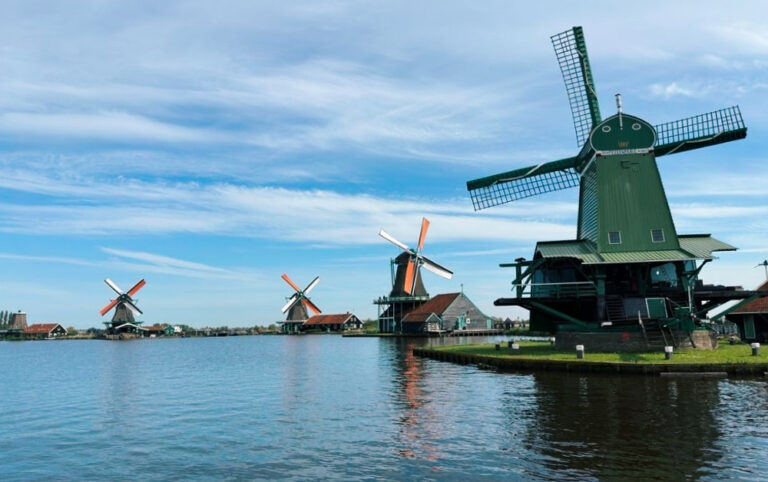
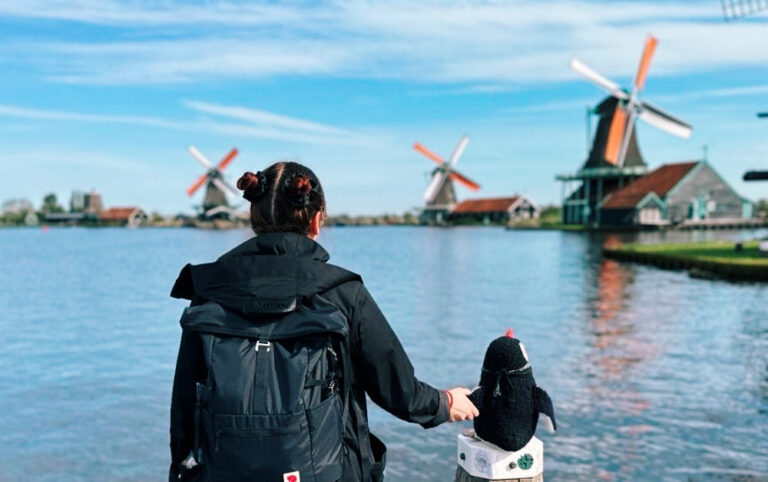
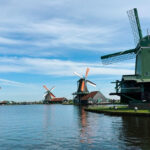
Then you reach the water, and the reason you came begins to reveal itself. Across the Zaan River, the first windmills rise above the green wooden houses, their sails turning against the sky. This is the Netherlands you have seen on postcards, biscuit tins, and travel brochures countless times, except now it is sitting right in front of you. We stopped for a moment to take it in, snapped the inevitable first photos, and then crossed over to begin our waddle through Zaanse Schans.


First Impressions: Yes, Zaanse Schans Really Looks Like That
There is no pretending that Zaanse Schans is anything other than a major tourist attraction. Even early in the day, plenty of people were already around, cameras were out, and the souvenir shops were getting busy. But before we even reached the famous line of windmills, we found ourselves wandering through what felt like a small old Dutch village, with narrow paths, little bridges over the water, gardens, and rows of wooden houses.
And yes, many of those houses really are that unmistakable shade of green. The color is part of the traditional architecture of the Zaan region, where wooden buildings were commonly painted in different shades of green. Historically, paint protected the timber from the damp Dutch weather, and the green pigments became so closely associated with the area that the style is now instantly recognizable as Zaans green. White details around windows, doors, and decorative wooden trim make the houses stand out even more.


What is easy to forget while taking photos is that this is not simply a movie set or purpose-built tourist village. Some of these buildings are private homes, while others contain museums, workshops, and shops. Many were relocated here from elsewhere in the Zaan region to save them from demolition. That creates a strange mix: you wander through a preserved piece of Dutch history, a living neighborhood, and one of the country’s busiest visitor attractions at the same time. And the windmills? Those are still waiting a little farther ahead.
Waddling Along the Zaan: The Windmills Take Center Stage
Leave the little green houses behind, and Zaanse Schans begins to open up. The path follows the Zaan River, the crowds spread out a little, and suddenly the windmills are no longer in the distance. They are right beside you. This is the part we had really come for.
There are more than half a dozen large historic windmills at Zaanse Schans, along with a couple of smaller mills, lined up along and around the river. And while the view is exactly the sort of Dutch postcard we had imagined, the story behind them is much more interesting than the photograph. They weren’t built to look pretty beside the water. They were machines, and this was once an industrial landscape.


At its peak around 1700, roughly 600 windmills were operating at the same time across the wider Zaan region. Over the centuries, more than 1,200 mills stood here. They sawed timber, pressed oil, ground spices and pigments, and powered industries that helped turn the Zaan into one of the world’s major early industrial areas. Timber cut by the mills even helped supply the shipbuilding industry during the Dutch Golden Age.
Knowing that changes the way you look at them. As we waddled farther along the river, each mill stopped feeling like another photo opportunity and started looking more like machinery that somehow survived into the 21st century.
And they do not all do the same job. There is De Huisman, traditionally associated with spices and mustard; De Kat, a paint mill where pigments are still ground; De Zoeker and De Bonte Hen, both oil mills; and Het Jonge Schaap, a working sawmill. Het Jonge Schaap is a reconstruction completed in 2007, built to match the original 17th-century mill. When there is enough wind, it still saws timber today.


Perhaps the most fascinating is De Kat. Dating back to the 17th century, it is the world’s only remaining working wind-powered paint mill of its kind. Instead of flour, its enormous machinery grinds raw materials into pigments. It is a nice reminder that when Dutch painters needed their colors centuries ago, industry like this sat behind the art.
You can enjoy this entire stretch without entering a single windmill. Simply waddling beside the Zaan and watching the sails turn is one of the best parts of visiting Zaanse Schans. We kept stopping because the view changed every few minutes: one mill framed by reeds, another reflected in the water, then several appearing together farther along the river. But if you want to understand what these giants actually did, go inside at least one.
Several of the mills welcome visitors, although not every windmill is open every day. Opening days also vary by season. Some, such as De Kat and Het Jonge Schaap, have regular visitor hours, while others open much less frequently. The Zaanse Schans site is freely accessible, but entering the windmills is generally paid, either individually where available or through the Zaanse Schans ticket, which currently includes admission to two mills open on the day of your visit.
That means it is worth checking the daily opening schedule before deciding which mill you want to enter rather than arriving with one specific mill in mind. On any given visit, some sails may be turning while the doors below remain closed.


Still, you do not need to visit them all. From the outside, the mills give Zaanse Schans its famous skyline. From the inside, one can even explain why that skyline exists in the first place. And that was probably the biggest shift for us while waddling along the Zaan. We arrived to see Dutch windmills. We left understanding that we had actually been walking through the remains of an industrial powerhouse.
Inside a Windmill: More Machine Than Postcard
If you can, step inside at least one windmill. The postcard quickly turns into a working machine, with wooden gears, narrow stairs, creaking timber, and plenty of noise. Some mills also let you step onto an outside platform, giving you a great view across the Zaan and neighboring windmills. You do not need to visit them all, but seeing one from the inside gives the windmills a completely different meaning.
Cheese, Because This Is the Netherlands
From windmills, we moved on to another Dutch essential: cheese. At Catharina Hoeve Cheese Farm, part of the experience is seeing how traditional Dutch cheese is made, with demonstrations and displays explaining the production process without turning your visit into a full afternoon of cheese theory.
Then comes the part most people are really waiting for: the cheese shop. Shelves are stacked with wheels in different sizes and flavors, with plenty of varieties to browse, sample, and, of course, buy. It can get busy around the tasting counters, but trying a few before choosing is part of the experience. We certainly were not going to visit the Netherlands and walk away from a room full of cheese without tasting some.


Beyond the Big Attractions: The Details We Noticed While Waddling
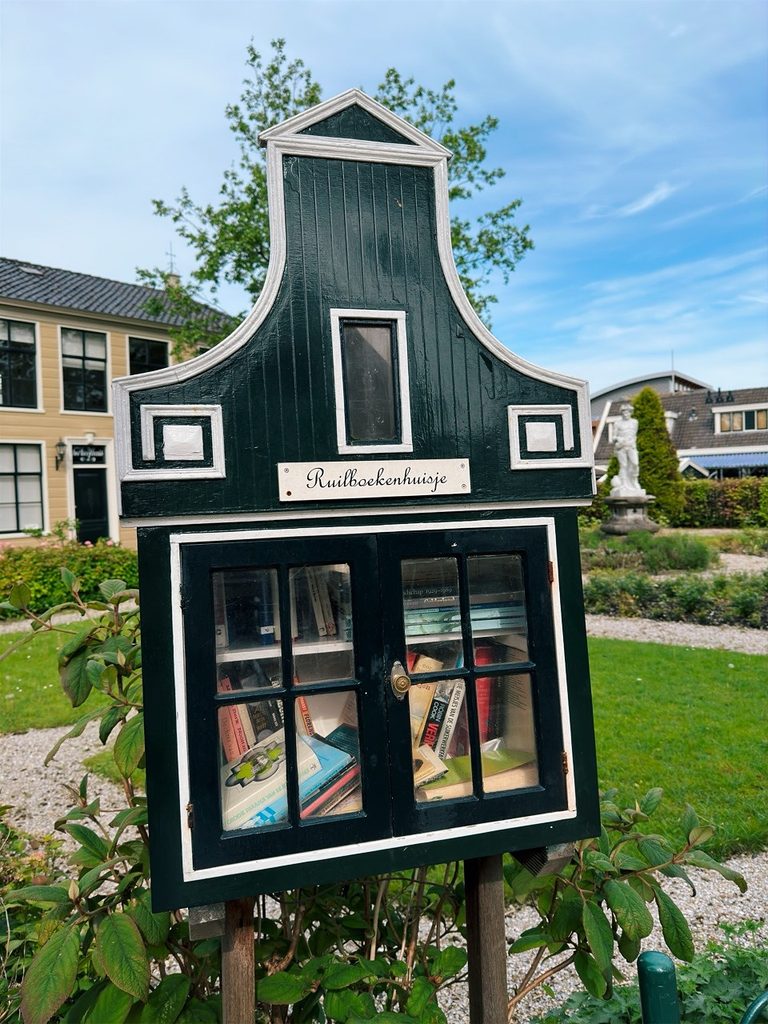
As usual, we enjoyed wandering away from the main tourist paths whenever we could. Zaanse Schans is small, but taking a different turn or crossing one of the little bridges quickly gives you another angle on the place. We found some of our favorite corners this way: green wooden houses reflected in the water, small gardens, quiet paths, boats, and views of the windmills from farther away. The famous riverfront gets most of the attention, but it is worth waddling beyond it. Sometimes, the best view is simply the one everyone else walked past.



Cross the Bridge for Chocolate
We also recommend crossing the bridge and exploring the streets on the Zaandijk side of the Zaan, rather than spending all your time around the windmills. We waddled around here for a while and found some of the prettiest corners of the day, with old houses, quiet streets, and plenty of character away from the main crowds. And then we found the cutest little chocolate shop. Of course, we could not resist going inside and leaving with some chocolate. The whole area felt almost magical, so even if you only cross the bridge for one reason, make it the chocolate.


A Quick Stop for Something to Eat
By this point, we had already done plenty of waddling, so we decided to stop at Wolfsend for something to eat. We were not hungry enough for a full meal, but we still wanted to try something, so we ordered two croquettes and the soup of the day. It was exactly the kind of simple break we needed before continuing our walk. If you are exploring Zaanse Schans and need somewhere to sit down, recharge, and grab a bite, Wolfsend is a nice little stop to keep in mind.


By Afternoon, We Were Back in Amsterdam
In the end, we spent a little over half a day at Zaanse Schans, which felt just right. We had enough time to waddle along the windmills, explore the quieter streets, eat something, buy some chocolate, and make the obligatory cheese stop without rushing. Then we waddled back to Zaandijk – Zaanse Schans station, hopped on the train, and headed back to Amsterdam.
That is perhaps one of the best things about this trip. Zaanse Schans asks very little of you. You do not need a car, an organized tour, or an entire day. By the afternoon, we were back among Amsterdam’s canals with a full day-trip experience already behind us.
The Tourist Question: Does Zaanse Schans Feel Too Touristy
Yes, Zaanse Schans is touristy, especially along the main path where everyone waddles from one windmill to the next. And really, whenever you see dozens of organized tours heading to the same place, you already know you are not going to have it to yourself. Expect tour groups, cameras, souvenir stops, and plenty of people trying to capture the same windmill view. Going early in the morning certainly helped, but we came knowing crowds were simply part of the experience.
What surprised us was how quickly that changed once we wandered away from the main route. Take a different path, cross a bridge, or explore the streets beyond the windmills, and suddenly there can be almost no one around. That was exactly what happened to us. Some of our favorite corners were also the quietest. So yes, come prepared for crowds, but don’t assume the whole of Zaanse Schans feels that way. Waddle a little beyond the obvious path, and you may find a very different side of it.
What Surprised Us About Zaanse Schans
What surprised us most was how much more there is to Zaanse Schans than the famous row of windmills. We expected the postcard views, cheese, clogs, and plenty of tourists. What we did not expect was how much we would enjoy the quieter streets, green houses, little bridges, and simply wandering without following the main route. We were also surprised by how close it is to Amsterdam. Around 20 minutes by train, and suddenly you are standing beside working windmills. Zaanse Schans may be famous for one particular view, but for us, some of its best moments happened when we stopped looking for it.
Is Zaanse Schans Worth Leaving Amsterdam For
If you come expecting an undiscovered Dutch village without another tourist in sight, Zaanse Schans is not it. The windmills are famous, the tour buses come, and you will probably share those postcard views with plenty of other people. But if you want to see working windmills, traditional Zaan houses, Dutch industrial history, cheese, clogs, and a completely different landscape just a short train ride from Amsterdam, it absolutely makes sense.
For us, the crowds never outweighed the experience, especially once we wandered beyond the main paths. It was easy to reach, required only a little over half a day, and gave us something completely different from our days in Amsterdam.
So, is Zaanse Schans worth leaving Amsterdam for? A waddling yes from us.
Planning Your Own Visit to Zaanse Schans?
Want to know a little more before you waddle off? In our Visiting Zaanse Schans: Everything You Need to Know guide, we share interesting facts about Zaanse Schans, its history, how to get there, how much time you really need, the best time to visit, costs, and practical tips from our trip. If Zaanse Schans is making its way onto your Netherlands itinerary, read our full guide here.
What to See at Zaanse Schans at a Glance
- The Historic Windmills
- De Kat Paint Mill
- Het Jonge Schaap Sawmill
- De Huisman Spice Mill
- Catharina Hoeve Cheese Farm
- Kooijman Wooden Shoe Workshop
- Zaans Museum
- Verkade Experience
- Traditional Green Zaan Houses
- Historic Bridges and Waterways
- The Zaan Riverfront
- Zaandijk and the Streets Across the Zaan
- Local Shops and Workshops
Buy Us a Ko-fi

Sometimes the Postcard Places Are Famous for a Reason
We had seen the windmills of Zaanse Schans countless times before we ever arrived. They are on postcards, travel guides, social media, and pretty much everywhere the Netherlands is represented. But seeing a photograph and standing beside the Zaan while those sails turn above you are two very different things.
Yes, Zaanse Schans is touristy. Yes, you will share it with plenty of other visitors. But sometimes places become famous because they are genuinely worth seeing. We came for the windmills, stayed for the little streets, cheese, chocolate, and unexpected corners, and returned to Amsterdam glad we had made the trip. Some postcards are worth waddling into for yourself.
Travel Bold. Eat Well. Waddle Wild.

This post contains affiliate links. If you click and buy, I might earn a tiny commission, enough to help a penguin keep up its globe-trotting lifestyle. No extra cost to you, just more fish for me. Thank you for supporting the adventure!