Kaunas, Lithuania: Top 17 Attractions and Things to Do
Kaunas has far more to see than you might expect from Lithuania’s second city. From medieval landmarks and colorful Old Town streets to Modernist architecture, quirky sculptures, viewpoints and peaceful riverside spots, there is plenty to discover. We managed to see many of these highlights during our visit, while a few are staying on our list for next time. Here is everything we think you should not miss in Kaunas.
Kaunas Things To See at a Glance
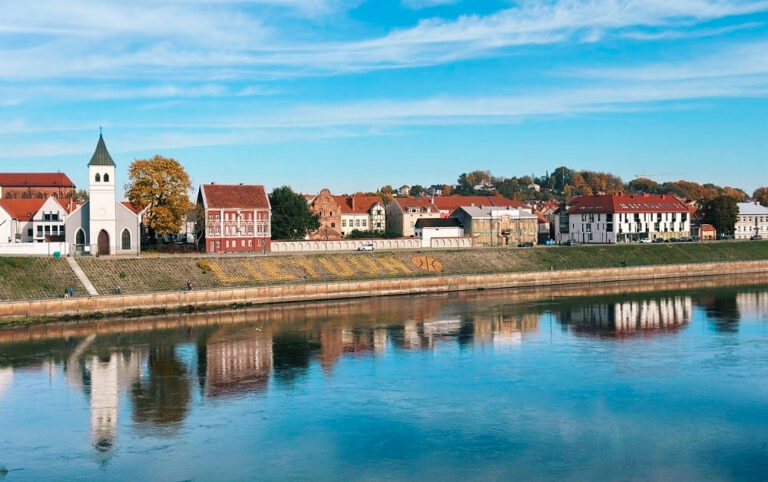
Kaunas is compact enough to explore many of its main attractions on foot, although the hills add a little extra effort. Our route included the Old Town, historic churches, Kaunas Castle, Santaka Park, the Nemunas River, Aleksotas Hill and its funicular, with plenty of little discoveries and quiet streets in between. We also mixed the historic sights with more modern stops, from the #KAUNAS sign and Žalgiris Arena to the lively Laisvės Alėja.
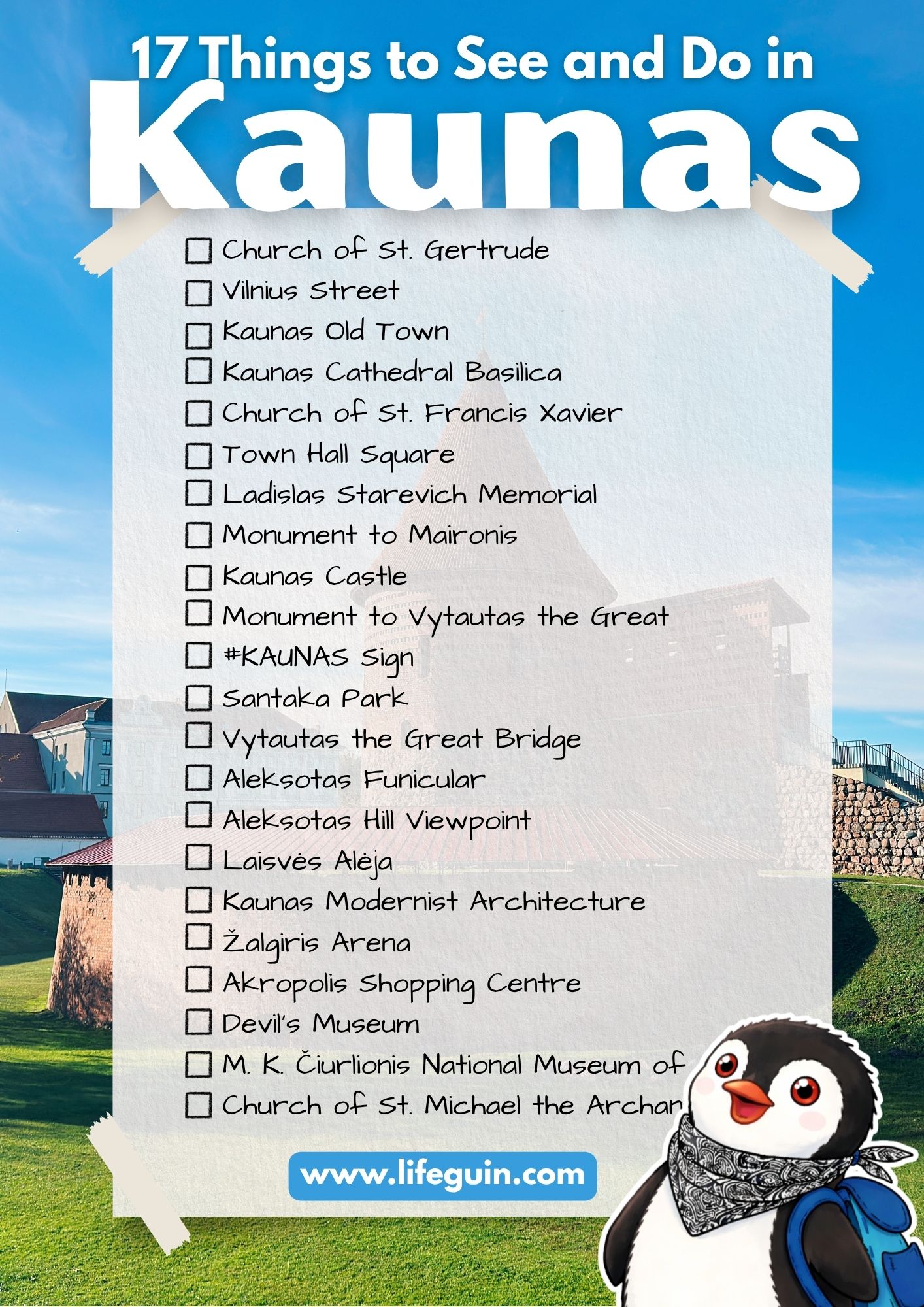
17 Places and Experiences in Kaunas You Shouldn’t Miss
Kaunas rewards the kind of sightseeing where you leave room to wander. The historic center is compact, but the city quickly opens into riverside parks, hills, Modernist neighborhoods, and unexpected little details. During our visit, we mixed the major landmarks with a few smaller stops, and we noted plenty of places for next time. Here are the Kaunas attractions and experiences we think are worth putting on your list.
#1: Kaunas Castle
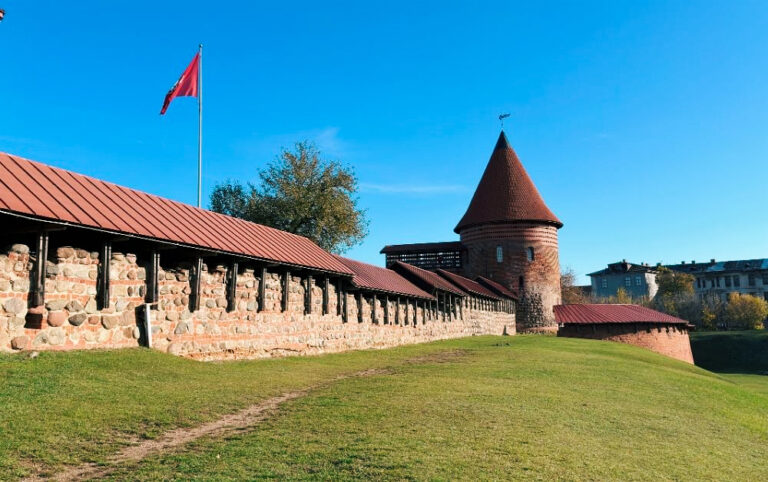
Kaunas Castle is the natural place to start understanding the city. The remains of this 14th-century Gothic fortress sit at the confluence of the Nemunas and Neris rivers, where its position once gave it an important defensive role. The castle was first mentioned in written sources in 1361, was destroyed and rebuilt several times, and today its restored tower houses exhibitions about the castle and its history.
We loved wandering around the surviving walls and tower before exploring the surrounding park.
Don’t miss: Waddling around the outside of the fortress to appreciate its location between the two rivers.
Penguin Pro Tip: Combine Kaunas Castle with Santaka Park rather than treating them as separate stops. They sit right beside each other.


#2: Santaka Park
Just beyond the castle, Santaka Park spreads out at the meeting point of the Nemunas and Neris rivers. The name means “confluence,” and this is one of the places where Kaunas’s geography really becomes part of the sightseeing. The park includes walking paths, open green spaces, the castle, and several other historic and cultural features.
We were especially impressed by how spacious and well-kept the park felt. On a warm summer day, it’s an easy place to bring a picnic blanket and slow down for a while.
Don’t miss: Waddling all the way towards the confluence of the two rivers.


#3: Vilnius Street and Kaunas Old Town
Vilnius Street (Vilniaus gatvė) is one of the easiest places to start exploring Kaunas Old Town. It is the city’s oldest street and follows the route of the former medieval road to Vilnius. Today it is pedestrian-only, with historic buildings, cafés and shops lining the cobblestones.
This is exactly the kind of street where we like to slow down. We stopped for specialty coffee, spotted the playful Zen Triušis sculptures, and kept finding little details between the historic façades.
Penguin Pro Tip: Don’t simply use Vilnius Street to get somewhere else. The street itself is part of the experience.


#4: Kaunas Cathedral Basilica
The Kaunas Cathedral Basilica of St. Peter and St. Paul is one of the city’s most important religious landmarks and one of the historic buildings we wanted to visit inside. The cathedral dates back to the early 15th century and has evolved through several architectural periods, with Gothic, Renaissance, and Baroque elements still visible today. Its interior is particularly notable for its nine altars and elaborate late-Gothic vaulting in the sacristy.
Even a quick peek inside gives you a sense of how many layers of Kaunas’s history its churches hold.
Don’t miss: Looking up at the cathedral’s intricate interior details.


#5: Town Hall Square and the Church of St. Francis Xavier
Town Hall Square is the historical heart of Kaunas Old Town, and the elegant white Town Hall at its center has earned the nickname “The White Swan.” The square is also home to the Church of St. Francis Xavier, the city’s historic Jesuit church, creating one of Kaunas’s most photogenic architectural combinations. Kaunas tourism materials say the Town Hall has stood here since the 15th–16th centuries, before being rebuilt later.
Take your time here instead of just photographing the buildings. The square brings together churches, historic architecture, cafés, and several smaller monuments within a very walkable area.
#6: Church of St. Gertrude
The Church of St. Gertrude is one of Kaunas’s oldest Gothic churches. Its red-brick exterior is much more modest than some of the city’s grander churches, which is exactly what makes it an interesting stop on a walk through the center. The church dates from the 15th century and forms part of Kaunas’s remarkably dense collection of historic religious buildings. We stopped here first because it was so close to our hotel, and it made a perfect introduction to Kaunas.
Don’t miss: The contrast between the small Gothic church and the much grander buildings elsewhere in the city.


#7: Monument to Vytautas the Great
In front of Kaunas Castle, you will find a striking monument to Vytautas the Great, one of the most important rulers in Lithuanian history. Vytautas ruled the Grand Duchy of Lithuania from 1392 until 1430 and is closely associated with the country’s medieval expansion and the Battle of Grunwald in 1410.
We stopped here before continuing around the castle, and the location makes the monument particularly easy to add to an Old Town walking route.
#8: The #KAUNAS Sign
The giant #KAUNAS sign has become one of the city’s easiest photo stops. The oversized letters are hard to miss, and judging by how many people we saw waiting for a picture, we were definitely not the only ones who thought so.
The sign feels much more contemporary than the medieval buildings around it, which is part of its charm. After spending hours photographing churches and castle walls, posing beside enormous letters felt like a fun change of pace.
Penguin Pro Tip: Expect to wait a little if you want a completely people-free picture.


#9: Vytautas the Great Bridge
The Vytautas the Great Bridge crosses the Nemunas and connects the Old Town with Aleksotas. The current bridge dates from the post-war period, while its predecessors were repeatedly rebuilt after war and flooding.
The bridge also has one of Kaunas’s favorite calendar-related stories. Because Kaunas and Aleksotas historically followed different calendars, locals joked that crossing the bridge could take 13 days. The story became one of those wonderfully strange pieces of local folklore that make the bridge more memorable than its engineering alone.
#10: Aleksotas Funicular
The Aleksotas Funicular is one of Kaunas’s most entertaining ways to change elevation. Opened in 1935, it climbs Aleksotas Hill from the Nemunas riverside and is still in everyday use. Kaunas tourism describes it as one of the city’s historic funiculars that survived the interwar period and still operates as both transport and an attraction.
Naturally, we took it up rather than tackling the hill entirely on foot. At the time of our visit, we paid €1 per person for the one-way ride.
Don’t miss: Continuing to the viewpoint after the funicular ride.


#11: Aleksotas Hill Viewpoint
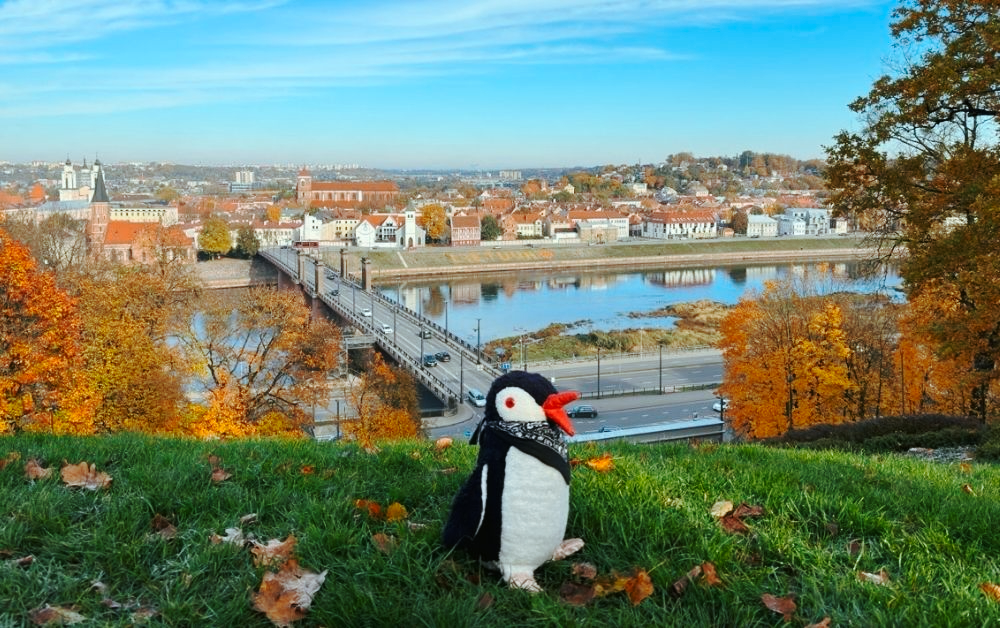
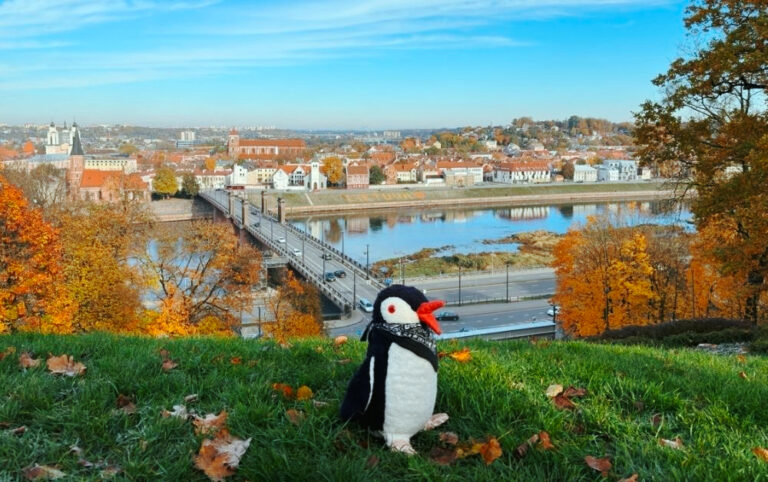
At the top of Aleksotas Hill, the city suddenly spreads out below you. The viewpoint looks towards Kaunas Old Town, with the Nemunas, church towers, castle area, and surrounding rooftops forming the panorama.
We spent quite a while here taking pictures and simply enjoying the view. We then walked back down instead of taking the funicular, which gave us even more time to enjoy the autumn colors and the city reflected in the river below.
Penguin Pro Tip: Take the funicular up and walk down if you have the time. You get the funicular experience without missing the pleasant hillside walk.

#12: Starevich and Maironis Monuments
Kaunas has plenty of monuments that you could easily walk past without realizing the story behind them. Near Town Hall Square, we spotted two particularly different ones: the Ladislas Starevich Memorial, featuring bronze insects referencing the pioneer of puppet animation, and the Monument to Maironis, dedicated to the Lithuanian poet and priest Jonas Mačiulis-Maironis.
Together, they remind you that Kaunas’s cultural history goes far beyond castles and churches. One celebrates the world of early animation and the other Lithuanian literature and national culture.
#13: Laisvės Alėja
Laisvės Alėja, or Freedom Avenue, is Kaunas’s famous pedestrian boulevard and one of the best places to experience the city’s modern side. It runs through Naujamiestis, connecting the historic center with the newer parts of Kaunas, and is lined with cafés, restaurants, shops, and trees. This is where you can put the sightseeing checklist aside for a while. Grab a coffee, find a bench, and simply watch the city move around you.
#14: Kaunas Modernist Architecture
Kaunas has a second architectural personality beyond its medieval Old Town. Between 1919 and 1939, when Kaunas served as Lithuania’s provisional capital, the city modernized rapidly and developed an extraordinary collection of interwar Modernist buildings. In 2023, Modernist Kaunas: Architecture of Optimism, 1919–1939 was added to the UNESCO World Heritage List.
Around 1,500 of the city’s surviving interwar buildings are concentrated within the UNESCO-listed areas of Naujamiestis and Žaliakalnis.
For us, this is one reason Kaunas deserves more than a quick Old Town visit.
Penguin Pro Tip: Look up as you waddle. Some of the best Modernist details are above eye level.


#15: Devil’s Museum
For something completely different, head to the Devil’s Museum, officially the Žmuidzinavičius Museum, where a collection of representations of devils from Lithuania and around the world creates one of Kaunas’s most unusual museum experiences. It is exactly the kind of attraction we love on a city break because it breaks up the churches, architecture, and historical monuments with something a little unexpected.
Don’t miss: The international collection of devil figures.
#16: M. K. Čiurlionis National Museum of Art
The M. K. Čiurlionis National Museum of Art introduces one of Lithuania’s most important artistic figures, Mikalojus Konstantinas Čiurlionis, whose work uniquely combines painting and music. The museum is part of the city’s important interwar cultural landscape and sits within Kaunas’s Modernist area. Even if you are not planning a full museum visit, the building and surrounding Modernist architecture make this part of Kaunas worth exploring.
#17: Church of St. Michael the Archangel
At the eastern end of Laisvės Alėja stands the Church of St. Michael the Archangel, another of Kaunas’s most recognizable landmarks. Built between 1891 and 1895, it was originally constructed as an Orthodox cathedral for the Russian military garrison in Kaunas Fortress before becoming a Catholic church after Lithuanian independence. During the Soviet period, the building was used as a gallery before eventually returning to religious use.


Other Things to See in Kaunas If You Have More Time
One day gives you a good introduction to Kaunas, but the city has plenty more tucked beyond the main Old Town route. With an extra day or two, you can explore its Modernist architecture, museums, viewpoints, fortress sites, and green spaces at a much slower pace. These are some of the places we would add to our list for a future visit.
- Pažaislis Monastery and Church. A beautiful Baroque complex beside the Kaunas Reservoir, known for its ornate interiors and peaceful setting.
- Christ’s Resurrection Basilica. A striking Modernist church with a rooftop viewpoint overlooking Kaunas. Its history includes Soviet occupation and years as a radio factory.
- Žaliakalnis Funicular. Opened in 1931, this historic funicular takes you up Žaliakalnis Hill and is still operating today.
- Ninth Fort Museum. A former part of the Kaunas Fortress, now a museum and memorial documenting the site’s complex history and wartime atrocities.
- Seventh Fort. Another surviving section of the Kaunas Fortress, offering a closer look at the city’s military past.
- House of Perkūnas. One of Kaunas’s oldest secular buildings, known for its distinctive Gothic brick façade.
- Historical Presidential Palace. Explore the building and museum connected with Kaunas’s years as Lithuania’s provisional capital.
- Vytautas the Great War Museum. A major museum covering Lithuanian military and national history.
- M. K. Čiurlionis National Museum of Art. Explore the work of Lithuania’s celebrated artist and composer alongside Kaunas’s Modernist architecture.
- Sugihara House. The former home of Japanese diplomat Chiune Sugihara, telling the story of his work in Kaunas during World War II.
- Lithuanian Aviation Museum. Discover Lithuania’s aviation history through aircraft and historical exhibits.
- Tadas Ivanauskas Museum of Zoology. A natural-history museum with extensive animal collections right in the city center.
- Lithuanian Sports Museum. A good stop for learning more about Lithuania’s sporting heritage and Kaunas’s basketball culture.
- Art Deco Museum. Step inside a recreated interwar apartment to experience Kaunas’s Art Deco style and design.
- Valdas Adamkus Presidential Library-Museum. Learn more about former president Valdas Adamkus and Lithuania’s modern political history.
- Science Island. A modern interactive science center and planetarium on Nemunas Island, particularly appealing to families.
For our next Kaunas visit, Pažaislis Monastery, Christ’s Resurrection Basilica, the Ninth Fort and the Žaliakalnis Funicular would be high on our list, simply because they would add a different side of the city to the Old Town and riverside sights we already explored.
Our Favorite Spot: Kaunas Castle
Kaunas Castle was probably our favorite spot in the city. We loved the combination of the medieval red-brick ruins, the rivers, the open space around the fortress, and the views across Kaunas. It felt like one of those places where history and the landscape come together naturally, and we could have easily spent much longer wandering around the castle and Santaka Park nearby.


How Long Do You Need in Kaunas
For most first-time visitors, two days in Kaunas is plenty of time. One full day is enough to cover many of the main sights in the Old Town, visit Kaunas Castle, walk along the rivers, ride a funicular, and get a feel for the city. With two days, you can slow down and add places outside the main route, such as the Modernist neighborhoods, museums, or Christ’s Resurrection Basilica.
Three days or more gives you even more flexibility and lets you visit attractions such as Pažaislis Monastery, the Ninth Fort, or Science Island without squeezing everything into one itinerary. We had just one full day in Kaunas, and it was enough to see a surprising amount, but there are definitely places we would save for our next visit.
Best Time to Visit Kaunas
Kaunas is a year-round destination, but late spring through early autumn offers the most comfortable conditions for walking.
- Spring (March–May): Mild weather, longer days, and greening parks make spring a pleasant time to explore.
- Summer (June–August): Warm temperatures and long days are ideal for walking, riverside strolls, parks, and outdoor cafés.
- Autumn (September–November): Colorful trees and crisp air make autumn especially beautiful for sightseeing.
- Winter (December–February): Expect cold temperatures, short days, and possible snow, with a festive atmosphere around Christmas.
Our experience: We visited in autumn and absolutely loved it, especially the beautiful colors and crisp, sunny days we were lucky enough to get.
Festivals and Events in Kaunas
- Spring: Kaunas Jazz is one of the city’s best-known annual events and has been running since 1991, with concerts, street performances, and events across the city.
- Late spring: Hansa Days brings a medieval atmosphere to the Old Town with music, performances, and historical-themed events, celebrating Kaunas’s Hanseatic heritage.
- Summer: The Pažaislis Music Festival runs throughout the summer, with classical music performances taking place in Kaunas and surrounding areas, including the Pažaislis Monastery setting.
- Autumn: Fluxus Festival is one of Kaunas’s quirkiest events, combining creative performances with a famous climb up Parodos Hill, often with participants dressing in inventive costumes.
- Autumn: Kaunas Photo Festival brings photography exhibitions and projects to different indoor and outdoor locations around the city.
Our Map of Things to See and Do in Kaunas
Kaunas may surprise you more than you expect. At first glance, it can seem like a quieter alternative to Vilnius, but once you start exploring, you quickly find medieval history, beautiful churches, colorful streets, impressive Modernist architecture, riverside parks, quirky sculptures, and unexpected viewpoints all packed into one city. The more we waddled around, the more little details we discovered.
Buy Us a Ko-fi

We hope this list inspires you to create your own Kaunas itinerary, whether you have one day or several. Use the sights that catch your eye, leave room for a little wandering, and decide for yourself whether Kaunas deserves a place on your Lithuania itinerary.
Travel Bold. Eat Well. Waddle Wild.

This post contains affiliate links. If you click and buy, I might earn a tiny commission, enough to help a penguin keep up its globe-trotting lifestyle. No extra cost to you, just more fish for me. Thank you for supporting the adventure!