Kaunas vs Vilnius: Two Lithuanian Cities, Two Very Different Ways to See the Country
We spent a day in Lithuania’s capital and a day in its former provisional capital to see which city offers more, where we would stay longer, and why our sunny day in Kaunas may have influenced the verdict.
- Kaunas or Vilnius?
- A Day in Vilnius
- A Day in Kaunas
- Vilnius vs Kaunas: What Is Actually Different
- Which City Is More Interesting
- Which City Is Better for One Day
- Which City Should You Stay In
- Kaunas or Vilnius for Architecture
- Kaunas or Vilnius for Street Art
- Kaunas vs Vilnius for Food and Cafés
- Which City Has the Better Atmosphere
- So, Kaunas or Vilnius?
- Our Choice: Where Would We Stay Longer
Kaunas or Vilnius?
There is a particular moment when a city starts to feel like more than a collection of sights. It happens somewhere between the first coffee and the last walk of the day. You stop checking the map. You notice the people sitting outside cafés, the architecture you would otherwise have walked past, the color of the light on an old façade. You begin to understand how a city wants to be experienced. That is what makes Kaunas and Vilnius interesting to compare. They are close enough to visit on the same trip, but they do not feel interchangeable.
Vilnius is Lithuania’s capital and the larger, more layered introduction to the country. Its historic center brings together Gothic, Renaissance, Classical and Baroque architecture, while neighborhoods such as Užupis add a distinctly contemporary and creative edge.
Kaunas feels different almost immediately. Its medieval Old Town is only part of the story. The city is particularly defined by its interwar Modernist architecture, street art, cafés, and the legacy of the years when Kaunas served as Lithuania’s provisional capital from 1919 to 1940.
We gave each city one day. And, admittedly, Kaunas had an unfair advantage.
The weather was much better.


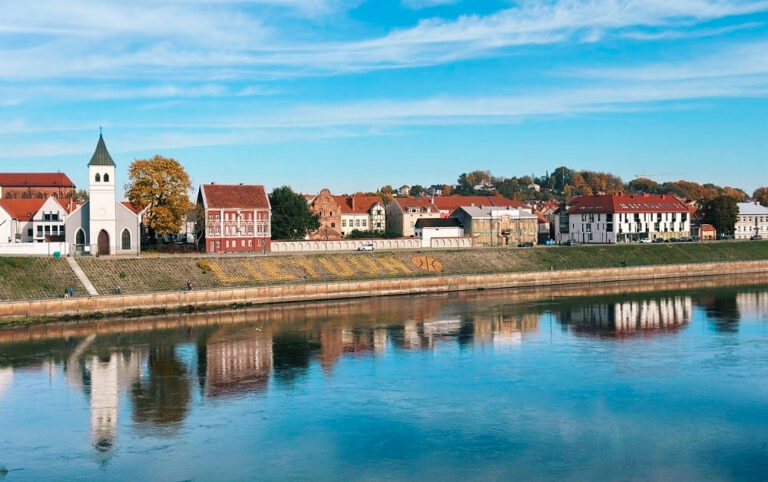
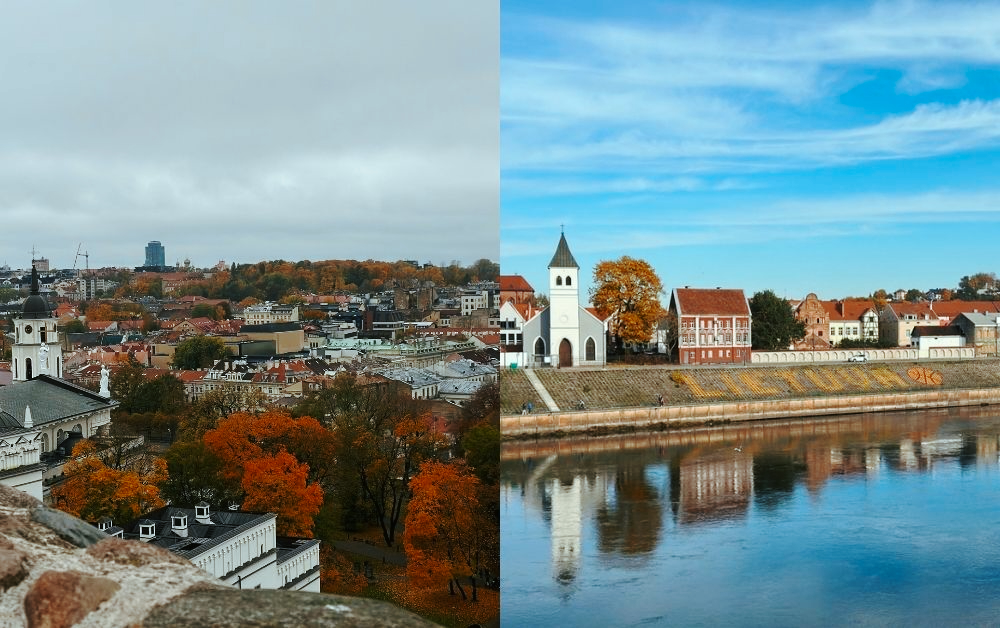
So yes, we arrived in Kaunas under a much more generous sky, while Vilnius gave us a greyer version of itself. We know that weather can color a travel experience. But even allowing for that bias, the two cities reveal something genuinely different. One feels like a capital you could keep returning to. The other feels like a city you are glad you took the time to notice.
A Day in Vilnius
Vilnius does not need to introduce itself loudly. The historic center unfolds through cobbled streets, church towers, courtyards, and unexpected viewpoints. The Old Town is UNESCO-listed and is one of the largest surviving historic centers in Northern Europe, with architectural layers stretching from Gothic and Renaissance buildings to the city’s particularly strong Baroque character. Our day begins where most first visits should begin: in the Old Town.
From Cathedral Square, the city quickly becomes a walking city. Gediminas Tower rises above the rooftops, St Anne’s Church brings its elaborate Gothic façade into view, and the streets grow narrower as we wander deeper into the historic center. Vilnius is generous with its landmarks. There is the cathedral, the castle, the university, the Gate of Dawn, church after church, viewpoints, and museums. Even the spaces between the official attractions are interesting. And then there is Užupis. Cross the Vilnelė and suddenly the tone changes.

Užupis famously declared itself an independent republic in 1997. It has its own Constitution, flag, anthem, and symbolic institutions, although the republic is deliberately playful rather than a sovereign state. Its Constitution is displayed along Paupio Street, while sculptures, studios, cafés and riverside spaces give the neighborhood its artistic personality.
This is one of Vilnius’s great strengths. The city keeps changing its personality without asking you to travel very far. Medieval streets become Baroque churches. A castle hill becomes a panoramic viewpoint. A quiet riverbank becomes an artists’ neighborhood. You can spend a day in Vilnius simply walking, and still feel that you have only opened the first few pages.
A Day in Kaunas
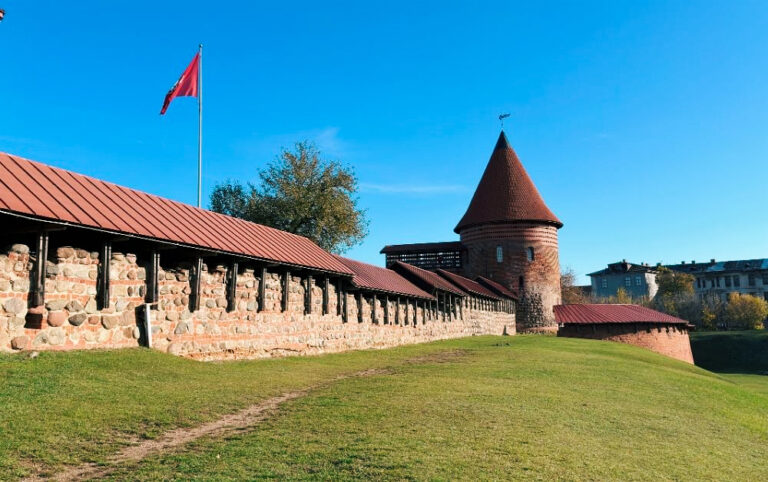
Kaunas starts differently. It is less immediately monumental. Instead, it asks you to pay attention. The medieval heart centers on the Old Town, where Kaunas Castle, Town Hall, and historic streets offer the familiar ingredients of a European city break. But walk beyond this core, and another Kaunas emerges.
This is the city of Modernism. Between the two World Wars, when Kaunas became Lithuania’s provisional capital, the city underwent a remarkable transformation. Modernist architecture spread through what are now Naujamiestis and Žaliakalnis, creating one of the defining layers of contemporary Kaunas. The modernist heritage area is now UNESCO-listed, with around 1,500 modernist buildings within the designated area.
And this is where Kaunas becomes particularly fun to explore. You begin to notice rounded corners, geometric façades, staircases, balconies, and details that are easy to miss if you are moving from one famous attraction to another.

Then comes the street art. Kaunas has turned its walls into part of the sightseeing experience, with murals appearing throughout the city. The enormous Wise Old Man mural is one of the best-known examples and covers approximately 440 square meters.
The city also has the Devil Museum, Kaunas Castle, Laisvės Boulevard, and a food and café scene that adds another contemporary layer. Lithuania’s tourism authority describes Kaunas as a combination of medieval heritage, Modernist architecture, street art, and a growing food scene. And perhaps that is the most interesting thing about Kaunas. It does not give everything away in the first ten minutes. You have to look.
Vilnius vs Kaunas: What Is Actually Different
The easiest way to understand the two cities isn’t to count attractions. It is to look at what kind of traveler each city rewards.
Vilnius feels historical.
Its story is visible everywhere. The castle, churches, university, Old Town, and streets tell you this has long been a political, religious, and cultural center. But contemporary neighborhoods and museums prevent it from becoming a city trapped in its past.
Kaunas feels architectural.
Its history is there, but some of its most fascinating stories are written into buildings rather than monuments.
The interwar period is particularly important. Kaunas became the provisional capital after Vilnius was incorporated into Poland, and the city developed an ambitious modern identity that remains visible today.
Vilnius feels bigger.
Not necessarily in physical scale, but in how many different experiences you can fit into a visit. You can spend your morning exploring historic streets, your afternoon in a museum, cross into Užupis, find contemporary art and still have an entirely different neighborhood waiting for dinner.
Kaunas feels more focused.
That can actually be an advantage.
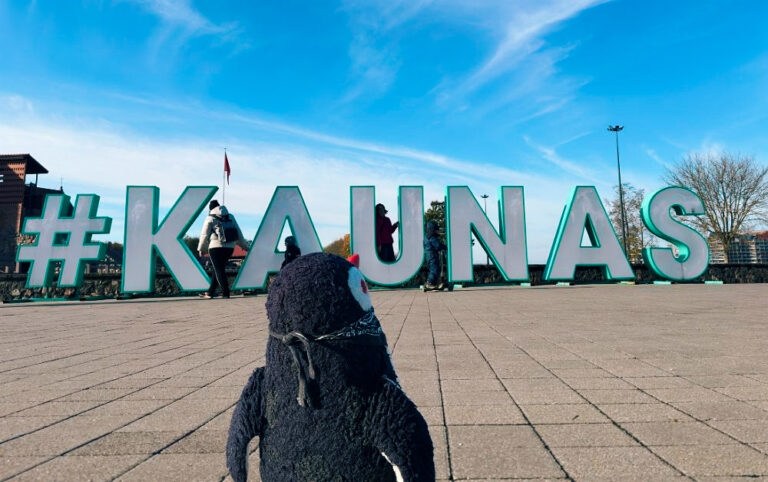
Its Old Town, Modernist architecture, and street art create a very recognizable identity. You are not simply ticking off Lithuania’s second city. You are learning what makes Kaunas Kaunastic.



Which City Is More Interesting
This is where the comparison becomes difficult. Because “more interesting” depends on what you find interesting in a city.
If you are fascinated by history, churches, grand architecture, museums, and atmospheric old streets, Vilnius gives you an enormous amount to explore. If you prefer Modernist architecture, street art, unusual museums, creative neighborhoods and discovering details away from the obvious tourist route, Kaunas has plenty to keep you occupied.
Another difference became apparent to us during our visit.
Vilnius impresses you. Kaunas engages you. That is not to say that one city is better. Vilnius has the kind of historic center where you can turn a corner and find another extraordinary building. Kaunas has streets where you might walk past an ordinary-looking building, stop, look again, and realize the façade is exactly why you came.
Which City Is Better for One Day
For a first introduction to Lithuania, Vilnius probably offers the most comprehensive one-day city break. The major sights are concentrated around the historic center, and you can combine the Old Town with Gediminas Tower, Cathedral Square, and Užupis without needing an elaborate plan. Vilnius’s official tourism information also highlights its compact, walkable historic center and the concentration of major attractions. But Kaunas works beautifully as a one-day visit too.
In fact, one day gives you enough time to combine the Old Town with some of the city’s Modernist architecture and street art without trying to cover every corner. For us, Kaunas had the advantage of surprise. We arrived knowing it would be interesting. We left thinking we had underestimated it.
Hotel search from Trip.comShows Trip.com’s own box, which can set Trip.com cookies.Search hotels on Trip.comTrip.com’s box can’t load on this device (an ad blocker often stops it). This opens Trip.com’s own hotel search.Open Trip.com
Which City Should You Stay In
This is slightly different from asking which city is better to visit. If you are planning a longer trip to Lithuania, I would choose Vilnius as your base. Not because Kaunas lacks accommodation, restaurants, or things to do, but because Vilnius offers more options. You can easily combine your time in the capital with day trips and return to a city with enough neighborhoods, restaurants, and evening options to make several nights feel worthwhile. Vilnius also feels more like a destination in its own right.
You can spend one day sightseeing, another exploring museums and neighborhoods, and another simply walking without feeling that you have run out of things to discover. Kaunas, meanwhile, works exceptionally well as a city-break destination or an overnight stop.
And there is an argument for staying one night precisely because it lets you experience the city after the day-trippers have gone. That quieter Kaunas is worth seeing.
Kaunas or Vilnius for Architecture
This might be the closest comparison. Vilnius gives you centuries of architecture. Kaunas gives you a remarkably concentrated story of Modernism. In Vilnius, the pleasure is in the layering. Gothic sits beside Baroque, historic courtyards open onto busy streets, and centuries of architectural history overlap within a relatively compact center.
In Kaunas, the pleasure is in recognizing a period. The city’s Modernist heritage is connected directly to its role as Lithuania’s provisional capital between the World Wars. Around Naujamiestis and Žaliakalnis, architecture becomes a way of understanding the optimism and ambitions of interwar Lithuania. If you love architecture, I would not choose between them. See both. They tell different chapters of the same country’s story.
Kaunas or Vilnius for Street Art
Kaunas surprised us here. Street art is part of the city’s visual identity, with large murals and smaller works appearing throughout its streets. The city actively promotes its street-art scene, and new works keep appearing. Vilnius has street art too, including dedicated projects and creative districts such as Užupis and Open Gallery.
But Kaunas makes street art feel particularly connected to the city’s identity. Pair it with Modernist architecture, and suddenly your walk becomes an open-air design tour.
Penguin Pro Tip: Don’t follow your map too closely in Kaunas. Some of the city’s most interesting details are the ones you find between the attractions.


Kaunas vs Vilnius for Food and Cafés
Both cities have developed beyond the traditional idea of Lithuanian dining. Vilnius has the broader choice, simply because it is the capital. Its food scene ranges from historic Old Town restaurants to contemporary dining spaces and neighborhood food halls. Kaunas has a more compact café-and-restaurant culture that fits naturally into a day of walking.
We particularly liked how easily food became part of the exploration rather than a separate activity.
You waddle.
You notice a café.
You stop.
Then you continue.
That rhythm suits Kaunas.
Which City Has the Better Atmosphere
Now we get to the completely subjective part. And this is where we have to admit something. We were biased. Kaunas gave us much better weather. Blue skies over a city make its colors sharper, its cafés more inviting, and its streets easier to love. Vilnius, meanwhile, showed us its greyer side. So perhaps we shouldn’t trust it completely.
But even after allowing for the weather, the atmosphere is different. Vilnius feels confident, historic and culturally layered. Kaunas feels creative, slightly unexpected and quietly self-assured. Vilnius asks you to admire it. Kaunas encourages you to investigate it.
So, Kaunas or Vilnius?
After spending a day in each, we would not frame this as a competition. They are better understood as two different versions of Lithuania.
Choose Vilnius if you want:
- A classic European capital
- A larger historic center
- Gothic and Baroque architecture
- Major landmarks and museums
- Užupis and its artistic atmosphere
- More choice for restaurants and nightlife
- A city that works well as a longer base
Choose Kaunas if you want:
- Interwar Modernist architecture
- Street art
- A slightly less obvious city experience
- A compact city for wandering
- Creative cafés and neighborhoods
- A fascinating architectural story
- Somewhere that rewards curiosity
And if you have enough time?
Do both.
That is actually the answer we prefer. Because the journey between them is short enough that there is little reason to force yourself to choose. Vilnius shows you the Lithuania of castles, churches, courtyards, and centuries of history. Kaunas shows you the Lithuania of Modernism, reinvention, murals, and a city building its own identity.
Buy Us a Ko-fi

Our Choice: Where Would We Stay Longer
If we had to choose where to stay for several nights, we would lean towards Vilnius. There is simply more to spread across multiple days. But if you asked us which city surprised us more?
Kaunas. Perhaps that is partly the sunshine talking. Perhaps it is because we arrived with fewer expectations. Or perhaps Kaunas has that particular quality some cities possess: the pleasure of discovering there is more here than you expected. And maybe that is why we would not put these two Lithuanian cities against each other at all.
Vilnius is the city you should see. Kaunas is the city you should take your time to notice. And somewhere between the two, you get a much fuller picture of Lithuania.
Travel Bold. Eat Well. Waddle Wild.

This post contains affiliate links. If you click and buy, I might earn a tiny commission, enough to help a penguin keep up its globe-trotting lifestyle. No extra cost to you, just more fish for me. Thank you for supporting the adventure!