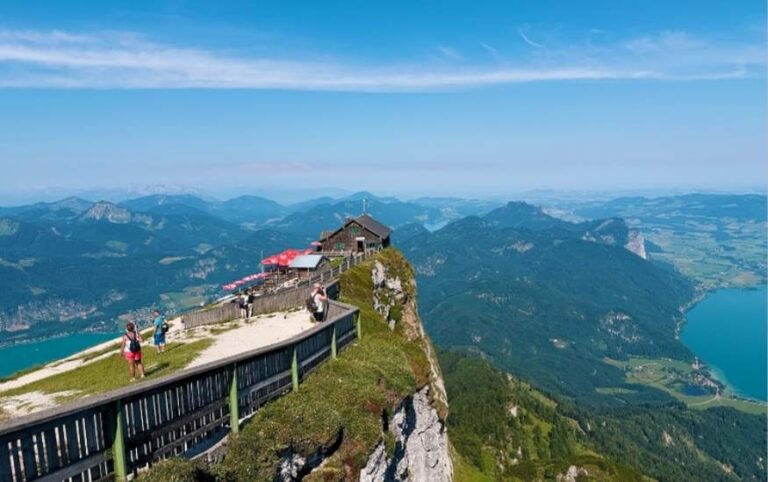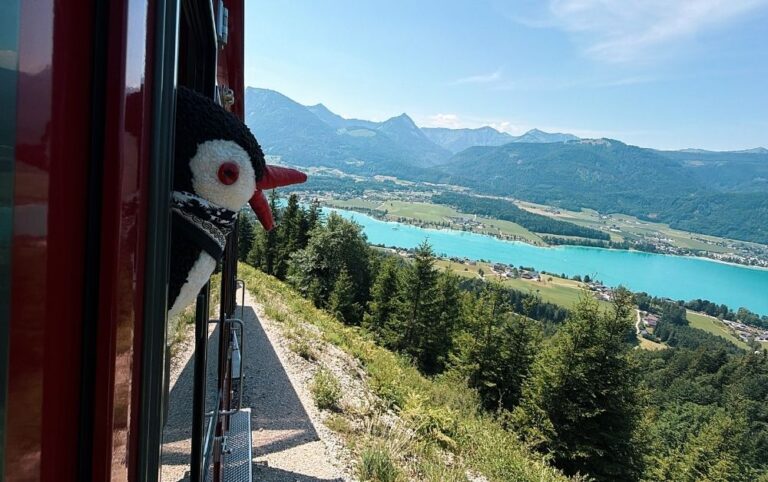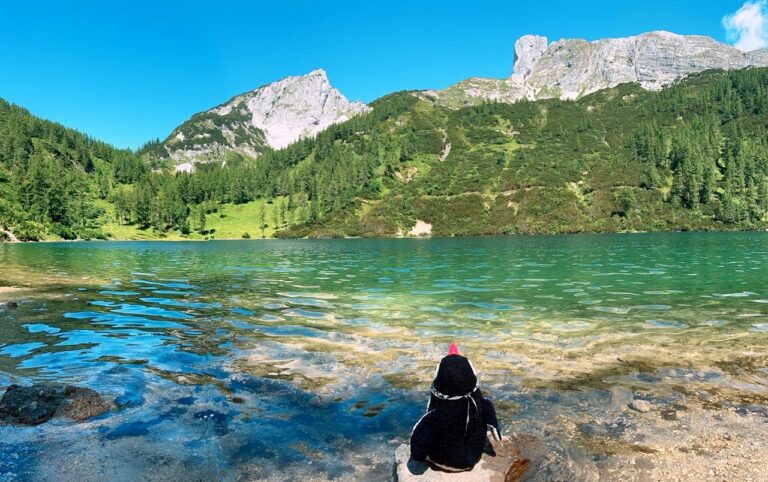
A Day at Hoher Dachstein: Sky Walk, Glacier & Incredible Alpine Views
Hoher Dachstein was one of the places we were most excited to visit during our road trip in Austria. Sitting at 2,995 meters, it’s the highest point in Styria and home to some of the country’s most famous mountain attractions. We had seen countless photos of the glacier, the Sky Walk, and the suspension bridge before our trip, so we couldn’t wait to experience it for ourselves.
After taking the cable car to the top, we spent time exploring the glacier, enjoying the incredible alpine views, and ticking off each of the attractions. In this guide, we’ll share everything you need to know before visiting Hoher Dachstein, along with our experience and practical tips to help you plan your own trip.
- Hoher Dachstein at a Glance
- Where Is Hoher Dachstein
- How to Get to Hoher Dachstein
- The Legend of Hoher Dachstein
- Opening Hours & Ticket Prices
- Our Experience Exploring Hoher Dachstein
- Dachstein Panoramic Cable Car Facts
- Restaurants & Facilities
- How Long Do You Need
- Best Time to Visit Hoher Dachstein
- Nearby Attractions
Hoher Dachstein at a Glance
- Elevation: 2,995 m (9,826 ft)
- Location: Schladming-Dachstein region, Styria, Austria
- Time Needed: 3–5 hours
- Cost: From €49 for the cable car (varies by season and ticket type)
- Difficulty: Easy (most attractions are accessible from the cable car station)
- Best For: Families, scenic views, glacier experiences, photographers, and first-time visitors to the Austrian Alps
Where Is Hoher Dachstein
Hoher Dachstein is in the Schladming-Dachstein region of Styria, Austria, right on the border with Upper Austria. At 2,995 meters (9,826 feet), it is the highest mountain in Styria and one of the most iconic peaks in the Austrian Alps.
The summit is part of the Dachstein massif, a UNESCO World Heritage landscape known for its dramatic limestone cliffs, glaciers, and panoramic mountain views. Most reach Hoher Dachstein via the Dachstein Gletscherbahn cable car, which departs from the Hunerkogel valley station, about a 20-minute drive from Ramsau am Dachstein and around 1 hour 15 minutes from Salzburg.
How to Get to Hoher Dachstein
The easiest way to reach the mountain is via the Dachstein Gletscherbahn cable car, which takes you from the valley station up to the glacier in just a few minutes.
By Car
We visited Hoher Dachstein by car during our road trip in Austria, and it was by far the easiest option. Set your GPS to Dachstein Gletscherbahn Talstation (Hunerkogel Valley Station), where you’ll find a large paid parking area right next to the cable car.
Driving times:
-
- Ramsau am Dachstein: 15–20 minutes
- Schladming: 25–30 minutes
- Hallstatt: 1 hour
- Salzburg: 1 hour 30 minutes
- Vienna: Around 3 hours 30 minutes
The final mountain road is well maintained but includes several steep sections and hairpin bends, so allow a little extra time for the drive.
By Public Transport
It’s also possible to reach Hoher Dachstein without a car, although the journey takes a bit longer. Take a train to Schladming, then continue by regional bus towards Ramsau am Dachstein. During the summer season, buses connect with the Dachstein Gletscherbahn valley station, where you can board the cable car to the summit.
Public transport is a good option if you’re staying in Schladming or Ramsau, but if you’re planning to explore more of the region, having a car offers much more flexibility.
Our starting point for the day was Glöshof Bauernhof – Pension, where we stayed during our visit to Ramsau am Dachstein. We honestly couldn’t have picked a better location. The guesthouse is just a few minutes’ drive from the Dachstein Gletscherbahn valley station, making it incredibly convenient for an early start. Instead of spending hours on the road, we were enjoying the mountain views almost as soon as we left our room.


The Legend of Hoher Dachstein
As with all of our trips, we found that the Hoher Dachstein has its own local legend. According to the tale of the Dachstein King, the area where today’s glacier lies was once covered with lush alpine meadows. The local dairymaids enjoyed such abundance that they became wasteful, even using old cheese to pave a path to the well. Their greed and lack of gratitude angered a mysterious old man, who warned them to change their ways. When they ignored him, a terrible storm swept across the mountain, burying the pastures beneath snow and ice. The glacier that you see today is said to be the lasting reminder of that lesson about respecting nature and not taking its gifts for granted.
Opening Hours & Ticket Prices
Opening Hours
The Dachstein Gletscherbahn cable car operates daily during the summer season, typically from early May until early November. During this period, the cable car runs from 8:00 AM to 5:20 PM, while the main attractions at the top, including the Sky Walk, Suspension Bridge, Stairway to Nothingness, and Ice Palace, are generally open from 9:00 AM to 4:15 PM. Opening hours may change depending on weather conditions or seasonal maintenance, so it’s always a good idea to check the latest schedule before your visit.
Ticket Prices
Tickets can be purchased online or directly at the Dachstein Gletscherbahn valley station. We recommend booking in advance, especially during the busy summer season, as cable car seat reservations are mandatory and the most popular departure times can sell out quickly.
Adult tickets start at around €49 for a return journey, with discounted prices available for children, families, and holders of the Schladming-Dachstein Summer Card. Most tickets include access to the Sky Walk, Suspension Bridge, Stairway to Nothingness, and Glacier.


One of the best perks of staying at Glöshof Bauernhof – Pension was receiving the Schladming-Dachstein Summer Card, which included our return cable car tickets to Hoher Dachstein at no extra cost. Considering that tickets are among the biggest expenses of visiting the mountain, this was a fantastic bonus that made the experience even better. If you’re planning to stay in the region, we highly recommend choosing accommodation that includes the Summer Card; it can save you a significant amount of money if you plan to visit several attractions.
An important thing to know is that even if your cable car ticket is included with the Summer Card, you still need to reserve a specific departure time in advance. The reservation cost us 5.80€. The cable car operates with timed entries, and popular slots, especially in the morning, can fill up quickly during the summer. We recommend making your reservation as soon as you know which day you want to visit to secure your preferred time.
Our Experience Exploring Hoher Dachstein
As we mentioned earlier, our day started at Glöshof Bauernhof – Pension, where we enjoyed breakfast before heading straight to Hoher Dachstein. Since the guesthouse is only a short drive from the valley station, we were on the mountain road in no time.
Before you can drive up to the Dachstein Gletscherbahn valley station, you’ll reach a checkpoint where you need to pay the Dachstein toll road fee. If you’re not using the cable car, the toll costs €26 per car (up to nine passengers). However, the toll is included for cable car passengers and is also covered by the Schladming-Dachstein Summer Card, so all we had to do was show our card to the staff member at the entrance, and we were good to go.
From there, the drive itself became part of the adventure. The winding mountain road climbs steadily through the Alps, with plenty of hairpin bends and increasingly impressive views as you gain elevation. By the time we reached the cable car station, it already felt like we had experienced a small part of Hoher Dachstein before even stepping into the gondola.
Hotel search from Trip.comShows Trip.com’s own box, which can set Trip.com cookies.
A few minutes later, we reached the Dachstein Gletscherbahn valley station at an elevation of approximately 1,700 meters (5,577 ft). There is a huge parking area available, but we actually parked in the smaller parking lot. Parking is free for cable car passengers, so there are no additional fees to worry about.
Before even stepping out of the car, we had to pause for a moment and take in the scenery. The views were already incredible, with rugged mountain peaks surrounding us in every direction. Honestly, look at it! It was hard to believe that this was only the starting point of our adventure and that we were about to climb another 1,000 meters by cable car.


After taking in the scenery for a few minutes (and snapping way too many photos), we waddled over to the cable car station. Since we had reserved a specific departure time in advance, we didn’t have to wait long. The entrance process was seamless; we showed our reservation, the staff member scanned it, and we were through the gates in seconds.
One handy thing to know is that there are free public toilets at the valley station. If you need to use the bathroom before heading up the mountain, this is the perfect place to do it, as you’ll be spending the next few hours exploring the glacier and its attractions.
Dachstein Panoramic Cable Car
Getting to the top is an experience in itself. The Dachstein Panoramic Cable Car takes you from the valley station to the glacier while offering incredible views of the surrounding Alps through its floor-to-ceiling glass windows. As you climb higher, you’ll get a close-up look at the impressive Dachstein South Face before arriving at the summit station.
Dachstein Panoramic Cable Car Facts
- Travel time: Approximately 10 minutes
- Elevation gain: Around 1,000 meters
- Panoramic windows: Fully glazed gondola with 360° views
- Open-air balcony: Step outside during the ride for an even better view
- Highest point above the ground: Up to 210 meters above the Dachstein South Face
- Capacity: Around 50 passengers per gondola
- Speed: Up to 43 km/h
The ride to the top was an experience in itself. I’ll admit, it was a little exciting and maybe even a bit scary if you’re afraid of heights, like one of my hoomans. As the gondola climbs nearly 1,000 meters above the valley, there are moments when you’re suspended high above the dramatic Dachstein South Face. Thankfully, the weather was perfect during our visit. There was almost no wind, so the ride was incredibly smooth, giving us plenty of time to enjoy the breathtaking views through the panoramic windows. Every minute of the journey brought us closer to the glacier, and the scenery just kept getting better and better.


The cable car gondola wasn’t overcrowded, so everyone had plenty of space to move around and enjoy the views during the ride. Stepping out at the top was another moment that felt a little intimidating- at least for us. Standing almost 3,000 meters above sea level, surrounded by steep cliffs and endless mountain views, definitely makes you realize how high up you are. If you’re not a fan of heights, it can feel a bit overwhelming at first.
That feeling didn’t last long. Once we took a few deep breaths and got used to the surroundings, we could enjoy the experience. And there’s so much to explore!
Things to Do at Hoher Dachstein
Dachstein Sky Walk
The Dachstein Sky Walk was the very first attraction we headed to after arriving at the summit. Before entering, there’s one thing to know: if you don’t have the Combi Ticket, you’ll need to purchase an Attractions Ticket, which costs €13.50 per adult. This ticket includes access not only to the Sky Walk but also to the Suspension Bridge, the Stairway to Nothingness, and the Dachstein Ice Palace. If you’re visiting with the Schladming-Dachstein Summer Card, the cable car ride is included, but you’ll still need to buy this attractions ticket separately.
Dachstein Suspension Bridge
We won’t lie, we were nervous. Standing nearly 3,000 meters above sea level is one thing, but walking across a 100-meter-long suspension bridge with a 400-meter drop beneath your feet is another. If you’re afraid of heights like we are, it definitely gets your heart racing.
The first few steps were the hardest. We held on to the railings a little tighter than usual and took it slowly, but after a few moments, we relaxed enough to appreciate just how incredible the views were. Looking out across the surrounding Alpine peaks while suspended high above the Dachstein massif is an unforgettable experience. The bridge feels sturdy and secure, so even if you’re a little nervous, we definitely think it’s worth crossing.


Stairway to Nothingness
At the end of the suspension bridge, you’ll find one of Dachstein’s most famous attractions: the Stairway to Nothingness. This narrow staircase has 14 steps leading down to a small glass viewing platform that extends out over a 400-meter vertical drop. If the suspension bridge got your heart racing, this takes it to the next level.
As for us… Well, let’s say not everyone made it down the stairs. Some of us took one look at the drop below and decided that admiring the attraction from the top was more than enough! We happily waited while the braver members of our group made their way down to the platform. No regrets, we still had an amazing view, just with both feet firmly on solid ground.
If you’re comfortable with heights, it’s a unique experience and one of the most photographed spots on Hoher Dachstein. But if you’re not, don’t worry, you definitely won’t be the only one choosing to stay at the top.


Dachstein Ice Palace
After spending time outside in the sun, we headed into the Dachstein Ice Palace, and it couldn’t have come at a better time. We visited on one of the hottest days of the summer, so stepping into the icy world beneath the glacier felt incredibly refreshing. The temperature inside stays at around -2°C (28°F) year-round, making it the perfect place to cool down and take a break before continuing to explore the mountain.
The Ice Palace is carved around six meters beneath the surface of the Dachstein Glacier and was created by hand using ice picks, shovels, and chainsaws. You wander through a series of beautifully illuminated ice chambers connected by tunnels, all carved directly into the ancient glacier.
Inside, you’ll find dozens of detailed ice sculptures, including animals, mythical figures, historical displays, and seasonal installations. There are also interactive exhibits, frozen crystal formations, and even an ice throne that’s perfect for a photo. Soft lighting and music create a surprisingly peaceful atmosphere, making it feel completely different from the dramatic mountain scenery outside.
We spent longer here than we expected. Not only was it fascinating to see the intricate sculptures carved entirely from ice, but it was also a welcome escape from the summer heat. Just be aware of the ice cause we slipped and fell.


Glacier Waddle
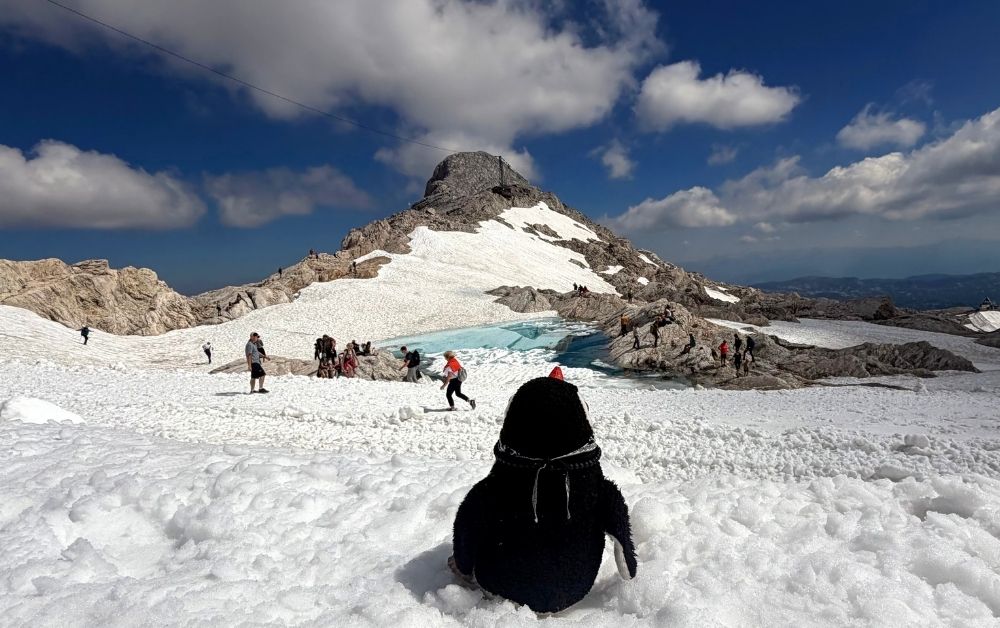
After leaving the Ice Palace, we waddled down onto the glacier. The snowy path was much steeper and slipperier than we expected, so getting down took a bit of effort, but we made it safely. Instead of rushing, we took our time, wandered around the glacier for a while, and then found a few rocks where we sat down, relaxed, and enjoyed the contrast between the hot summer sunshine and the snow all around us. It was one of those moments where you stop, take it all in, and appreciate where you are.
The Dachstein Glacier is one of the easternmost glaciers in the Alps and has existed for thousands of years, forming during the last Ice Age over 10,000 years ago. Today, it covers roughly 4–5 square kilometers, although like many Alpine glaciers, it has been gradually shrinking due to climate change.


Panoramic Viewpoints
Besides the main attractions, Hoher Dachstein offers several free panoramic viewpoints well worth visiting. They’re all connected by easy walking paths, so you can wander from one to another and take in the scenery from different angles.
Each viewpoint offers a slightly different perspective of the surrounding Alps, the glacier, and the valleys below. We found ourselves stopping again and again to admire the views, take photos, and soak in the atmosphere. The best part? You don’t need to pay anything extra to access them, making them a great addition to your visit even if you’re not planning to do every paid attraction.


After exploring all the main attractions, it was time to head back down. Just like on the way up, our return cable car ride was booked for a specific departure time, so we made our way back to the station a little early. The boarding process was just as quick and smooth as before, and before we knew it, we were back at the valley station.
Before continuing our road trip, we stopped at the restaurant by the cable car station for a well-deserved break. If you visit, we can highly recommend trying the giant yeast dumpling (Buchtel). It was soft, fluffy, and exactly the kind of comforting treat we needed after spending the morning exploring the glacier.


Restaurants & Facilities
Hoher Dachstein is well equipped, making it easy to spend several hours at the summit without needing to head back down. Whether you’re looking for a meal, a coffee break, or a souvenir, you’ll find everything within a short walking distance of the cable car station.
- Mountain Restaurant. If you get hungry, there’s a mountain restaurant right next to the summit station serving a selection of Austrian classics, light meals, desserts, and drinks. We stopped here for a quick break, enjoying the views and relaxing before continuing our adventure. On sunny days, the outdoor terrace is a great place to sit and take in the Alpine scenery.
- Toilets. Free public toilets are available at both the valley and summit stations. They’re clean, well-maintained, and easy to find, so there’s no need to worry about the facilities during your visit.
- Souvenir Shop. Before heading back down, don’t forget to browse the souvenir shop near the cable car station. You’ll find a variety of Dachstein-themed gifts, postcards, local products, clothing, and hiking accessories. It’s a nice place to pick up a small souvenir to remember your visit to one of Austria’s most spectacular mountain peaks.
How Long Do You Need
We spent around half a day exploring Hoher Dachstein, and it was enough time to visit all the main attractions, including the Sky Walk, Suspension Bridge, Stairway to Nothingness, Ice Palace, and the glacier. We never felt rushed and still had time to sit down, enjoy the views, and simply soak in the mountain atmosphere.
That said, if you have the time, we’d recommend setting aside a full day for your visit. Beyond the main attractions, several hiking trails start from the summit that let you experience even more of the Dachstein Glacier and the surrounding mountains. Spending the whole day gives you the freedom to explore at a slower pace, take a longer lunch with a view, and enjoy one of the most spectacular alpine landscapes in Austria.
Best Time to Visit Hoher Dachstein
The best time to visit Hoher Dachstein depends on what you’re hoping to experience. Thanks to the glacier, it’s a destination you can enjoy year-round, whether you’re looking for snowy adventures, hiking trails, or simply incredible mountain views.
- Spring (May–June). Spring is a great choice if you prefer a quieter visit. The glacier is still covered in plenty of snow, while the valleys below slowly turn green again. It’s a lovely time to enjoy the winter scenery without the peak summer crowds.
- Summer (July–August). Summer is when Hoher Dachstein is at its busiest, and we can absolutely see why. The hiking trails are open, the mountain views seem to stretch forever, and despite the warm temperatures in the valley, you can still waddle across snow on the glacier. We visited on one of the hottest summer days and couldn’t stop smiling as we swapped the heat for crisp mountain air and icy landscapes just a few minutes later.
- Autumn (September–October). Autumn is perfect if you enjoy peaceful mountain escapes. The crowds begin to disappear, the air becomes cooler, and the surrounding valleys are painted in beautiful shades of gold and orange. It’s a fantastic season for photography and enjoying the views at a slower pace.
- Winter (November–April). Winter turns Hoher Dachstein into a true alpine playground. Skiers, snowboarders, and cross-country skiers flock here to make the most of the reliable snow, while the glacier becomes even more magical under a fresh white blanket. Just keep in mind that mountain weather can change quickly, so cable car operations may occasionally be affected by strong winds.
Nearby Attractions
- Ramsau am Dachstein. A charming alpine village known for its hiking trails, mountain huts, cross-country skiing, and stunning Dachstein views. It’s also a great base for exploring the region.
- Silberkarklamm. A beautiful gorge featuring waterfalls, wooden walkways, bridges, and hundreds of stairs. A perfect hike if you love dramatic scenery and rushing mountain streams.
- Dachstein Giant Ice Cave. One of Austria’s largest ice caves, filled with spectacular frozen formations and impressive underground chambers. Located near Obertraun.
- Five Fingers Lookout. One of Austria’s most famous viewpoints, with five platforms extending over a cliff high above Hallstatt and Lake Hallstatt.
- Hallstatt. Austria’s iconic lakeside village, famous for its colorful houses, historic center, salt mine, and postcard-worthy scenery.
- Gosausee. A crystal-clear alpine lake offering one of the best reflections of the Dachstein massif. Ideal for an easy walk, photography, or simply relaxing by the water.
Buy Us a Ko-fi

Hoher Dachstein was one of the absolute highlights of our Austria road trip and a place we’d recommend to anyone visiting the region. A big waddling yes from us! From riding the panoramic cable car and walking across the suspension bridge to cooling off in the Ice Palace and waddling across the glacier, every part of the experience felt unique.
If you’re staying in or around Ramsau am Dachstein, this is one attraction you shouldn’t skip. Set aside enough time to explore, take plenty of photos, and enjoy being surrounded by the Alps. We left with unforgettable memories, and we’re already looking forward to returning one day to discover even more of the hiking trails around the glacier
Travel Bold. Eat Well. Waddle Wild.
Save This Pin for Later!
This post contains affiliate links. If you click and buy, I might earn a tiny commission, enough to help a penguin keep up its globe-trotting lifestyle. No extra cost to you, just more fish for me. Thank you for supporting the adventure!