What to See and Do in Kaunas in One Day
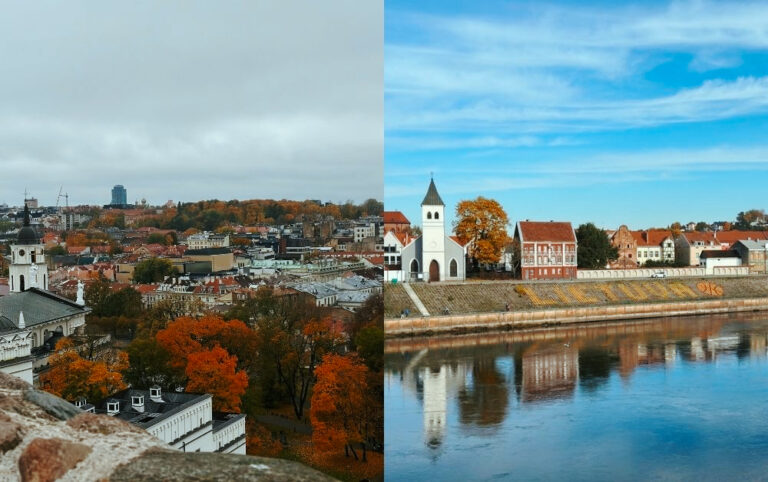
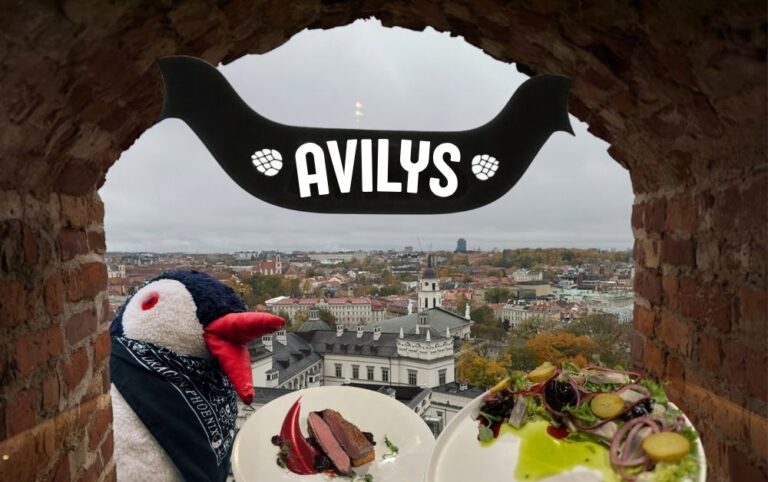
We had just one full day to see Kaunas, so we wanted to make the most of every hour. With a mix of historic streets, colorful buildings, Modernist architecture, viewpoints, and riverside sights to explore, we planned a route that would take us through the city’s main highlights without spending the day rushing from one place to another. This is how we spent our one day in Kaunas.
Our Day in Kaunas at a Glance
- Time in Kaunas: 1 full day
- Arrival: Flew directly into Kaunas
- Stay: Based in Kaunas during our Lithuania trip
- Hotel: BEST WESTERN Santakos Hotel
- Season: Autumn
- Getting around: Waddling around on foot
- Best for: History, architecture, street art, viewpoints, and exploring the Old Town
- Our highlight: Kaunas Castle & Aleksotas Funicular
A Day in Kaunas: What We Saw and Did
We started our day with a quick breakfast at the hotel before checking out and leaving our bags with the luggage storage. Then we set off to explore Kaunas, with our first stop conveniently just a short walk from the hotel: the Church of St Gertrude. This small Gothic church dates back to the second half of the 15th century and is considered one of the oldest Gothic churches in Lithuania. It is best known for its candle sanctuary, where visitors can light candles designed to burn continuously for seven days. The church also survived a very different chapter during the Soviet period, when the building was used as a medical equipment store until 1987.


Our next stop was Vilnius Street (Vilniaus gatvė), one of the historic streets running through Kaunas Old Town. It was a lovely autumn morning, with the street still partly tucked into the shadows as we began our waddle along the cobblestones. The street follows the route of an old road toward Vilnius, and today it’s one of the city’s most atmospheric pedestrian streets, lined with historic buildings, cafés, and small shops.


As we waddled down Vilnius Street, we really enjoyed the relaxed morning atmosphere. The historic cobblestone street is the oldest in Kaunas and follows the route of the medieval road that once connected the city with Vilnius. Today, it is pedestrian-only and lined with cafés, restaurants, and historic buildings, making it an easy place to slow down and take in the Old Town.
We also loved the specialty coffee options along the way. Vilnius Street is dotted with independent cafés, including Kavos kerai, a local coffee stop for more than a decade, as well as several others where you can pause for a proper cup before continuing your waddle. As we walked, we kept spotting sculptures among the buildings, including the two Zen Triušis (Zen Rabbit) sculptures by Kęstutis Balčiūnas. With its mix of medieval history, coffee stops, and playful street art, Vilnius Street felt like much more than simply a route through the Old Town.


Our next stop was the Kaunas Cathedral Basilica of St. Peter and St. Paul, right in the heart of the Old Town. We took a quick peek inside, and once again, we were reminded how beautiful churches across the Baltic states can be. The cathedral dates back to the early 15th century, when Grand Duke Vytautas the Great established it, and it is one of Kaunas’s oldest brick buildings. Its interior brings together centuries of architectural styles, with Gothic and Renaissance elements joined by an elaborate Baroque interior.

One detail that makes the cathedral particularly interesting is its nine altars and its elaborate late-Gothic crystal vaulting in the sacristy, considered one of the most extensive examples of its kind in Europe. The cathedral is also the final resting place of several important Lithuanian religious and cultural figures, including the priest and poet Maironis and Lithuania’s first cardinal, Vincentas Sladkevičius.


As we continued our waddle through Kaunas Old Town, we came to yet another beautiful church, the Church of St. Francis Xavier, also known as the Kaunas Jesuit Church. Standing on Town Hall Square, this late Baroque church was built between 1666 and 1720 and is one of the most recognizable buildings surrounding the square.
What makes the church particularly interesting is how much history it holds. The Jesuits established themselves in Kaunas in the 17th century and also became involved in education here. Later, the church survived fires, occupations, and several changes of use. During the Soviet period, it was even converted into a sports hall before the Jesuits returned after Lithuania regained independence. The church also has a literary connection: the famous Romantic poet Adomas Mickevičius lived and taught in the adjoining Jesuit complex, while the poet Maironis also preached here.


We then headed towards Kaunas Castle, but our waddle took us past two interesting monuments worth stopping for. First, we spotted the bronze memorial dedicated to Ladislas Starevich, a pioneer of stop-motion puppet animation. The installation features bronze insects, including an ant and a grasshopper wearing a top hat, referencing Starevich’s famous early animated films and his fascination with insects. Born in Moscow to Polish parents, Starevich spent part of his early career in Lithuania and is remembered as a pioneer of puppet animation.
A little further along, we came across the Monument to Maironis, dedicated to Jonas Mačiulis-Maironis, one of Lithuania’s best-known poets and a Catholic priest. Maironis lived and worked in Kaunas and became an important figure in Lithuanian literature and national culture. We liked that these two monuments offered such a different glimpse into the city: one celebrating the inventive world of early animation, the other remembering a figure who helped shape Lithuanian literary identity.


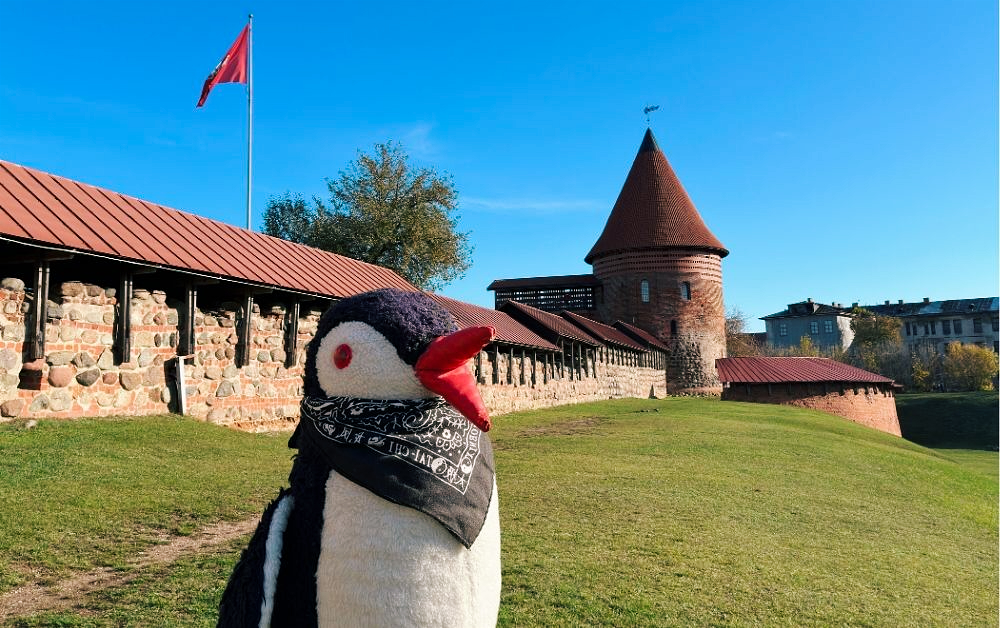
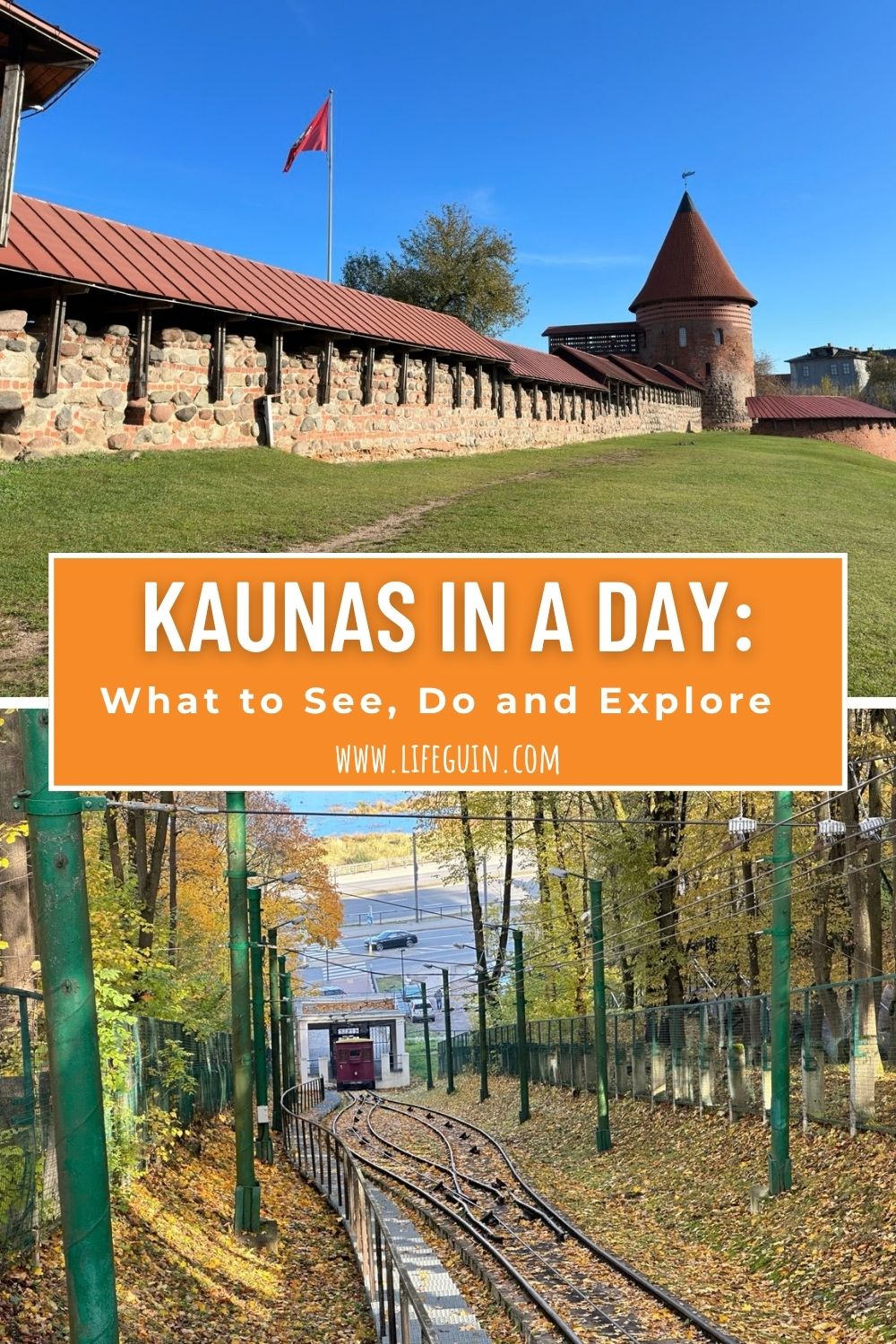
When we finally reached Kaunas Castle, we had one of those moments where the name sets your expectations a little too high. This is not a grand, fully preserved castle with elaborate rooms and towering interiors, but rather the remains of a 14th-century Gothic fortress, built at the strategic meeting point of the Nemunas and Neris rivers. Today, only part of the original defensive complex survives, including the distinctive round tower and sections of the red-brick walls. It is easy to imagine how imposing the fortress must have been in medieval times, particularly given its role in defending Kaunas against the Teutonic Knights. The castle grounds are open and pleasant to explore, while the surviving tower houses a small museum where you can learn more about the city’s medieval history.


In front of Kaunas Castle, we also stopped by the striking Monument to Vytautas the Great, one of Lithuania’s most important medieval rulers. The sculpture depicts Vytautas on horseback and commemorates his role in the history of the Grand Duchy of Lithuania, including the Battle of Grunwald in 1410, one of the largest battles in medieval Europe. We waddled around the monument before continuing towards the castle tower, where stairs lead up for a closer look at the surviving fortress and, most importantly, views across Kaunas and the meeting point of the Nemunas and Neris rivers. It is a great spot to pause and see the city from above before continuing your waddle through the Old Town.


After exploring the castle and taking in the views, we waddled a little further to one of Kaunas’s most recognizable photo spots: the giant #KAUNAS sign. The oversized white letters are hard to miss and, naturally, we had to stop for a few photos of our own. The sign has become one of the city’s familiar modern landmarks. It was designed as part of Kaunas’s visual identity, and the city even made its Kaunas typeface available for public use.
It was probably the busiest spot we encountered during our day, with plenty of visitors taking turns in front of the enormous letters. We waited for our moment, snapped our pictures and continued our waddle through the city.


Kaunas Castle: A Little More History
After the KAUNAS sign, we still weren’t quite ready to leave the castle area. We wanted a little more time to wander around the ruins and take in just how strategic this spot must have been centuries ago. Standing where the Nemunas and Neris rivers meet, it is easy to understand why a fortress was built here and why control of this point mattered so much to medieval Lithuania.


Interesting facts about Kaunas Castle:
- Built. The first stone castle was built in the mid-14th century, although the exact construction date is uncertain.
- First mentioned. Kaunas Castle appears in written sources in 1361, linking the castle’s history closely to Kaunas’ earliest written history.
- Strategic location. The castle was built at the confluence of the Nemunas and Neris rivers to help defend Lithuania against attacks by the Teutonic Order.
- The 1362 siege. In 1362, the Teutonic Order besieged the castle for several weeks before capturing and destroying it.
- A second castle. After its destruction, the castle was rebuilt, and a second masonry castle was constructed around the beginning of the 15th century during the reign of Vytautas the Great.
- Four towers. The later castle had four towers and much stronger fortifications, reflecting the site’s continuing military importance.
- Two defensive walls. Kaunas Castle was unusual for Lithuania because it was fortified with two rows of defensive walls.
- Its military importance faded. After Kaunas developed as a trading city and received Magdeburg rights in 1408, the castle gradually lost its central role in city life.
- The river changed the castle. Over the centuries, the Neris River washed away much of the castle territory, contributing to the ruins we see today.
- A museum today. The restored castle tower now houses a branch of the Kaunas City Museum, with exhibitions covering the fortress and its long history.


Once we had our fill of the castle, we waddled into the huge green space right beside it, Santaka Park, also known as Confluence Park. We were genuinely impressed by how spacious, clean, and beautifully maintained it was. With its wide grassy areas and walking paths stretching towards the meeting point of the Nemunas and Neris rivers, we could easily imagine spending a summer afternoon here with a blanket and a picnic. The park is also considered the heart and even the mythical birthplace of Kaunas because of the two rivers meeting here.
What makes Santaka even more interesting is how much history this green space holds. Besides Kaunas Castle, you can find a pagan fire altar, Pope Hill, and a monument to Pope John Paul II, who celebrated Mass here in 1993. Today, the park is also a popular place for walking, jogging, sports, picnics, and simply escaping the bustle of the Old Town.


From Santaka Park, we continued along the river and crossed the Vytautas the Great Bridge, which connects Kaunas Old Town with the Aleksotas district across the Nemunas. The bridge we see today dates from the post-war reconstruction of 1948, after the original bridge was destroyed during World War II. It is around 256 meters long, but its most entertaining piece of history is the old joke that it was once “the longest bridge in the world” because, before 1807, Kaunas and Aleksotas belonged to different territories that used different calendars. With a 13-day difference between the calendars, locals joked that it took 13 days to cross the bridge. The bridge also leads directly to the Aleksotas Funicular, which was exactly where we were heading next.


After crossing the bridge, we reached the Aleksotas Funicular, and of course, we had to take it. Opened in 1935, it is one of the oldest funicular railways in Lithuania and is still operating today, climbing the steep Aleksotas hill from the Nemunas riverside. The short ride is an experience in itself, but the real reward comes at the top, where the Aleksotas viewpoint opens up across the Nemunas towards Kaunas Old Town, the church towers and the castle area.


What makes the funicular particularly interesting is that it has retained much of its historic character, including its original-style cars and infrastructure. Together with the Žaliakalnis Funicular, it gives Kaunas two historic hillside railways that are still part of the city’s transport network rather than simply museum pieces. For us, it was also a welcome break from waddling uphill!


Aleksotas Funicular Practical Information
- Opening hours: Daily, 7:00 AM–7:00 PM, with a lunch break from 12:00–1:00 PM.
- Frequency: The funicular runs approximately every 10 minutes.
- Journey time: The ride takes just over one minute, making it a very quick way to tackle the steep hill.
- Capacity: Each wooden carriage can carry up to 25 passengers.
- Opened: The Aleksotas Funicular opened on 5 December 1935.
- Location: The lower station is close to Vytautas the Great Bridge, while the upper station is at Amerikos Lietuvių g. 6.
- View: At the top, there is a viewpoint overlooking Kaunas Old Town and the city center.
- Ticket price: We paid €1 per person for a one-way ride
We took a one-way ride up the Aleksotas Funicular for €1 per person, mainly to see the views from the top. The funicular climbs Aleksotas Hill, one of Kaunas’s historic hills, and the viewpoint at the upper station opens across the Nemunas towards the city center. From up here, we could look back towards Kaunas Old Town, Kaunas Castle, the Church of St. Francis Xavier, and the city skyline, with the river winding through the landscape below. After taking in the panorama, we continued our waddle from the top rather than taking the funicular back down.


We took a couple of pictures from the top, then decided to make our way down on foot, following the same route rather than taking the funicular back. It was such a beautiful autumn day that we did not want to waste a minute of it. The colorful trees, crisp air, and views over Kaunas Old Town made the walk down especially enjoyable, and at several points we could see the city’s historic rooftops and church towers reflected in the Nemunas River below. It was one of those walks with no reason to hurry.


Once we reached the bottom, we crossed the bridge again to the other side of the Nemunas and continued our waddle towards Akropolis shopping center. The riverside route was a lovely surprise. It was calm, green and almost completely free of crowds, with only a handful of people crossing our path. After a morning filled with churches, cobblestones, castles and viewpoints, this stretch along the water gave us a chance to slow down and enjoy the day. The peaceful river, autumn colors, and reflections on the water made it one of the most relaxing parts of our Kaunas waddle.


Before heading to the shopping center for lunch, we made a little detour to Žalgiris Arena, home of Kaunas basketball and one of the city’s most recognizable modern landmarks. Opened in 2011, the arena stands on Žalgiris Island beside the Nemunas River and is closely associated with BC Žalgiris, one of Lithuania’s most celebrated basketball clubs. With space for around 15,000 spectators, it is the largest indoor arena in the Baltic States. Even without a game, we thought it was worth waddling over to see the building and get a feel for how important basketball is to Kaunas.


From Žalgiris Arena, we continued our waddle towards Akropolis shopping center, where we had a couple of practical things to take care of. We wanted to pick up a few souvenirs and little reminders of our time in Lithuania, so we took some time to wander through the shops before thinking about the next part of our day. By then, our stomachs were also making it very clear that lunch was overdue.
We stopped at one of the grills inside the shopping center and grabbed some burgers. It was a simple shopping-center lunch rather than a culinary experience, but sometimes that is exactly what you need when you are spending the whole day exploring. The food did the job; we refueled, and after a little break from walking, we were ready to head back out and continue discovering Kaunas.


From the shopping center, we headed back towards the Old Town, and one little detail we enjoyed along the way was our newfound love of the Lithuanian word miško. We learned that miško means “of the forest,” so once we started recognizing it, we spotted it everywhere. There was even a Miško Street, and the word appeared on shop signs, cafés, and all sorts of places around the city. For us, it became one of those small travel discoveries that made Lithuania feel a little more familiar with every new occurrence.


Our last stop in Kaunas was the Church of St. Michael the Archangel, standing at the eastern end of Laisvės Alėja. By this point, we had already checked out of our hotel and spent the whole day waddling around the city, so this felt like a fitting final stop before collecting our bags and moving on. We stepped inside this impressive Neo-Byzantine church, built between 1891 and 1895 as an Orthodox cathedral for the Russian military garrison stationed in Kaunas Fortress.
What makes the church particularly interesting is its rather unusual history. After Lithuania became independent, it was converted into a Catholic church in 1919. During the Soviet period, it took on a completely different purpose and became a stained-glass and sculpture gallery in 1965. After Lithuania regained independence, the building returned to its role as a Catholic church, and the crosses removed during the Soviet era were once again placed on its domes.


That really was our last stop in Kaunas. We had already spent a full day exploring the city, so after taking a few final pictures of the Church of St. Michael the Archangel, we called a Bolt and headed straight for the airport. The sudden change of pace was quite funny: one minute we were still wandering around, taking photos and admiring the sights, and the next our taxi arrived; we hopped in with our bags and headed to catch our flight home. After a full day of waddling around Kaunas, it felt like the perfect, slightly chaotic ending to our visit.


Our Kaunas Day at a Glance
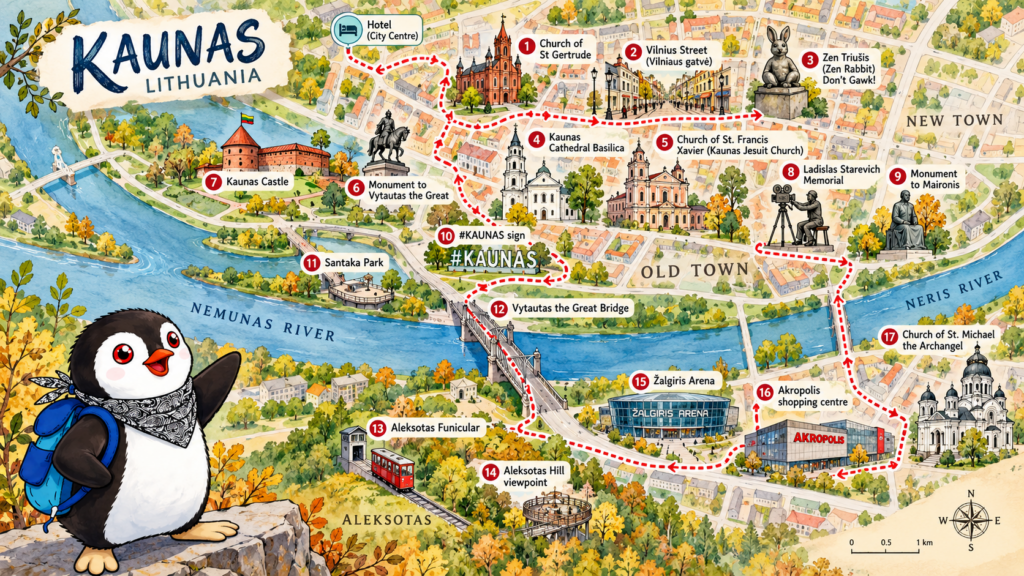
Our One Day in Kaunas Route
- Church of St. Gertrude (our first stop, conveniently close to our hotel)
- Vilnius Street (Vilniaus gatvė, a historic cobblestone pedestrian street through the Old Town)
- Zen Triušis (Zen Rabbit, including the playful “Don’t gawk!” sculpture)
- Kaunas Cathedral Basilica (a quick look inside one of the city’s most important churches)
- Church of St. Francis Xavier (the historic Kaunas Jesuit Church on Town Hall Square)
- Ladislas Starevich Memorial (a quirky bronze tribute to the pioneer of puppet animation)
- Monument to Maironis (remembering one of Lithuania’s most famous poets and priests)
- Kaunas Castle (exploring the medieval fortress and its riverside setting)
- Monument to Vytautas the Great (the striking statue of the Lithuanian Grand Duke)
- #KAUNAS Sign (a popular photo stop with the giant city letters)
- Santaka Park (wandering through the large green space where the Nemunas and Neris meet)
- Vytautas the Great Bridge (crossing the Nemunas towards Aleksotas)
- Aleksotas Funicular (taking the historic funicular uphill for €1 per person)
- Aleksotas Hill Viewpoint (enjoying the panoramic views over Kaunas Old Town and the Nemunas)
- Žalgiris Arena (a quick detour to Kaunas’s famous basketball arena)
- Akropolis Shopping Center (picking up souvenirs and stopping for a simple lunch)
- Church of St. Michael the Archangel (our final sightseeing stop before heading to the airport)
Is One Day in Kaunas Enough
One day in Kaunas can take you surprisingly far. Of course, there is always more to discover in any city, and with extra time you could slow down, visit more museums or explore further beyond the center, but with a well-planned route, one full day gives you plenty of time to see many of Kaunas’s highlights. We managed to combine historic churches, the Old Town, Kaunas Castle, riverside walks, viewpoints, the funicular, and even a little shopping and lunch without feeling like we were racing from one stop to the next. For us, it was enough to get a real feel for the city, while still leaving a few reasons to come back.
Our Map of One Day in Kaunas
Overall, we really enjoyed our day in Kaunas. The city was easy to explore on foot, and we loved how quickly the scenery changed from historic churches and cobblestone streets to the castle, riverside paths, parks, and modern parts of the city. Some of our favorite moments were actually the short encounters along the way, from quirky sculptures and unexpected street details to quiet stretches beside the river. We were also incredibly lucky with the weather, enjoying a beautiful, bright autumn day that made the parks, colorful trees, and views over Kaunas even more enjoyable. With so much to see within a relatively compact area, Kaunas turned out to be a very easy city to waddle through and enjoy at our own pace.
Buy Us a Ko-fi

We hope our one-day waddle through Kaunas helps you plan your own time in the city. You can see a surprising amount in a single day if you plan your route, but most importantly, leave room to wander, stop for a coffee, and enjoy the unexpected details that make Kaunas feel like more than just a list of sights.
Travel Bold. Eat Well. Waddle Wild.
Save This Pin for Later!
This post contains affiliate links. If you click and buy, I might earn a tiny commission, enough to help a penguin keep up its globe-trotting lifestyle. No extra cost to you, just more fish for me. Thank you for supporting the adventure!