One Day in Vilnius, Lithuania: Where to Go and What to See
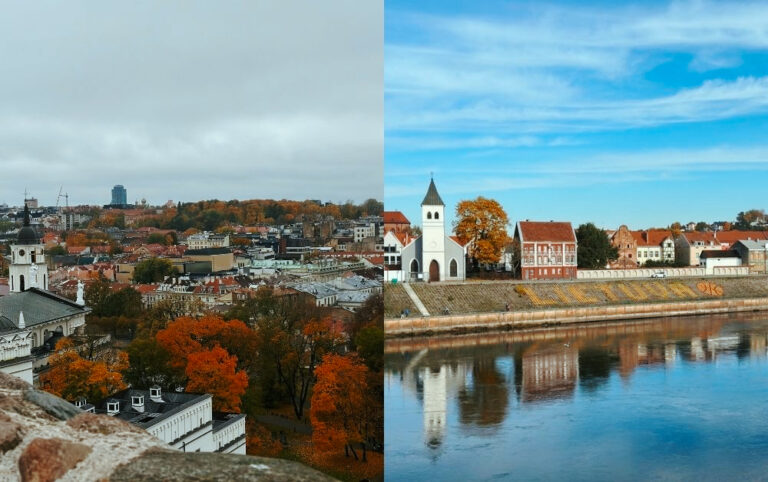
We had just one day in Vilnius, so we wanted to make the most of our time without feeling rushed from one attraction to the next. Instead of trying to tick every sight off a list, we focused on the historic center, the city’s most memorable landmarks, and a few places that gave us a feel for Vilnius beyond the main tourist trail. Here is how we spent our day in Vilnius, from the Old Town and Cathedral Square to Gediminas Tower.
Our Day in Vilnius at a Glance
- Time in Vilnius: 1 day
- Trip: Day trip from Kaunas by train
- Season: Autumn
- Getting around: Waddling around on foot
- Best for: History, architecture, viewpoints, and exploring the Old Town
- Our highlight: Gediminas Tower and the views across Vilnius
Our One Day in Vilnius
We arrive in Vilnius by train from Kaunas, which makes the start of our one-day visit simple. The railway station puts us close enough to the Old Town to begin exploring on foot almost immediately. One thing catches our attention before we even leave the station: photography inside Lithuanian railway stations is restricted. Organized or commercial photography may require permission from the railway company. The restrictions are connected to security, so if you want to take photographs inside a station, it is worth checking the current rules or asking for permission first.
Once outside, the rules feel very different. We put the camera away for the station and start waddling towards the Old Town, with our first glimpse of Vilnius unfolding street by street.


The Vilnius Portal
As soon as we step outside Vilnius Railway Station, the day is already underway. Right in front of us stands the Vilnius Portal, a futuristic circular installation that looks a little like a giant doorway. It uses cameras and a large screen to create a live connection with Lublin, Poland, showing people on the other side in real time. The Portal originally stood directly beside the railway station before moving to Vilnius Old Town in 2025.
We cannot resist stopping for a look. Suddenly, our first activity in Vilnius is waving at strangers in another country. People in Lublin wave back, smile and play to the camera, turning what could have been an ordinary walk out of the station into a surprisingly fun little encounter. For a city we have only just arrived in, Vilnius certainly knows how to make a first impression.


From the railway station, we head towards the Old Town, and somehow Vilnius already feels familiar. The streets are quiet enough to take in the details as we walk, the city gradually shifting from the bustle around the station to its historic center. At one crossroads, we wait for the light to turn green when an old bus rumbles past us. For a moment, it feels as though someone has pressed rewind and dropped us into another decade. Then the light changes, we cross the road, and Vilnius carries on around us.


Already waddling towards the Old Town, we begin noticing another side of Vilnius. Along the streets, walls become unexpected canvases, covered in murals, bold colors, and layers of street art. The paintings bring a modern, creative edge to the city, sitting comfortably alongside the older buildings. It is a small reminder that Vilnius is not simply a city preserved in time. Its historic streets leave plenty of room for contemporary art to make its mark.


Halės Market
On our way towards the Old Town, we make an unplanned stop at Halės Market. Markets are one of our favorite ways to glimpse everyday city life, and Halės feels like a great place to pause. Locals come here for fresh produce, meat, fish, cheese and other groceries, while newer food stalls and cafés give the market a more contemporary feel. It is also Vilnius’s oldest continuously operating market, with the current market hall dating back to 1906.
There is an interesting detail above the stalls, too. The market’s metal structure was considered remarkably modern when it was built, with its designer drawing inspiration from the great iron structures appearing across Europe at the time, including the Eiffel Tower.
If you want to visit, Halės Market is currently open Tuesday to Saturday from 7:00 to 18:00 and Sunday from 7:00 to 15:00. It is closed on Mondays. For us, it is a quick wander rather than a dedicated shopping trip, but it gives the morning a welcome taste of everyday Vilnius before we head toward the historic center.


Church of St. Casimir
Our next stop is the Church of St. Casimir, and its pink-and-white Baroque façade immediately catches our attention. Standing on the edge of the Old Town, the church feels grand without overwhelming the narrow streets around it. Its distinctive dome, crowned with a cross, rises above the surrounding rooftops, making it one of those Vilnius landmarks you naturally notice as you wander. Built by the Jesuits in the early 17th century, St. Casimir is considered the oldest Baroque church in Vilnius. Its history is anything but quiet, having served different religious and institutional purposes over the centuries before returning to Catholic worship. We pause here for a look before continuing deeper into the Old Town, where the streets become increasingly architectural, and the city’s Baroque character starts to take over.


Vilnius Town Hall and Town Hall Square
Our next stop is Vilnius Town Hall and the wide square in front of it, a welcome change from the narrower streets we have been following through the Old Town. We take our time here, looking across the open space and up at the neoclassical Town Hall, which has stood at Vilnius’s heart for centuries. The building we see dates from the late 18th century, although a town hall has occupied this site since the Middle Ages.
It is a cold day, the kind that makes you instinctively pull your coat a little tighter, but we are not in any hurry. We waddle slowly across the square, stopping to look at the details and watching the city move around us. There is something satisfying about exploring Vilnius this way, without trying to squeeze every sight into a timetable. Even in the cold, the Old Town invites us to slow down.


We turn off the main street and wander into one of Vilnius’ quieter alleyways, where a string of colorful lanterns catches our attention overhead. We have no idea whether this little display has an official name or is simply one of those charming details you stumble across while exploring, but it makes the narrow passage feel unexpectedly playful. Against the old walls and muted colors of the surrounding buildings, the lanterns add a splash of color, giving us another reason to slow down before continuing our waddle through the Old Town.


Then we get lost in Vilnius’s streets. Not properly lost, of course, but the pleasant kind where the map stays in your pocket, and every turn seems to offer another courtyard, church façade, or cobbled lane worth following. The Old Town is remarkably clean, and the streets feel surprisingly calm for a European capital. We stop looking at the route and start looking at the city instead.
That turns out to be one of the best parts of our day. Vilnius Old Town is one of the largest surviving medieval old towns in Central and Eastern Europe and has been a UNESCO World Heritage Site since 1994. Its layers are easy to spot as we wander, from Gothic and Renaissance buildings to the Baroque churches that give the city much of its character. We have no particular destination for a while, and somehow that feels like exactly the right way to experience Vilnius.


Daukanto Square
Our next stop is Daukanto Square, one of those elegant open spaces that seem to appear naturally as we wander through the Old Town. The square is named after Simon Daukantas, a 19th-century Lithuanian historian and one of the first writers to document Lithuania’s history in Lithuanian. His statue stands at the center, while the surrounding historic buildings give the square a quieter, more formal character.
After the winding streets we have just been exploring, the open space feels like a natural pause. We slow down again, take in the architecture and look towards the Presidential Palace, which occupies the northern side of the square. It is another small change of rhythm in our one-day walk through Vilnius, and we are beginning to appreciate how easily the city shifts between grand landmarks and intimate corners.


Vilnius Cathedral and Bell Tower
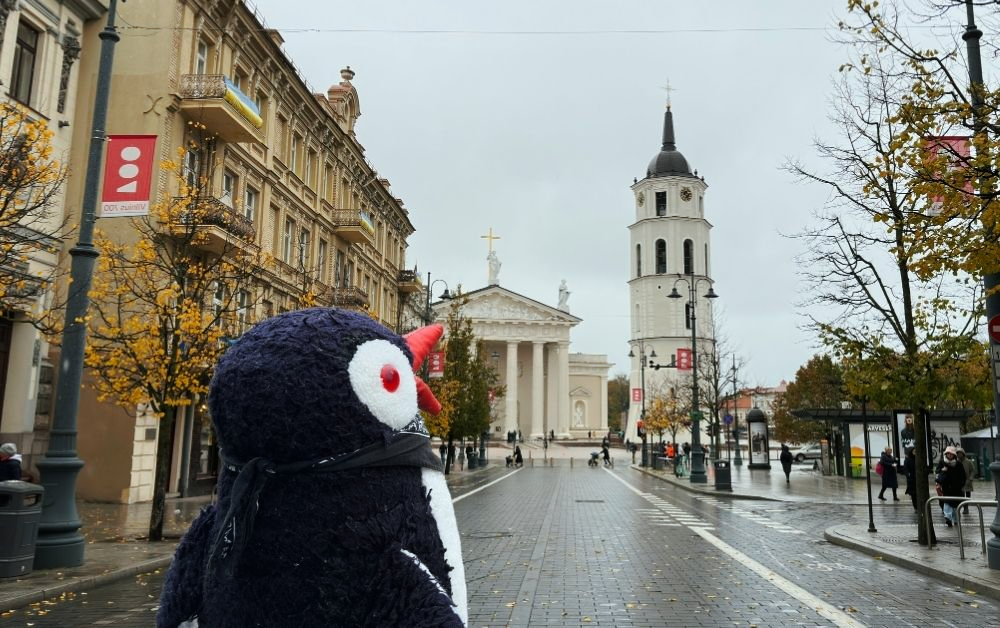
From Daukanto Square, we continue towards Vilnius Cathedral and its distinctive Bell Tower, where the narrow streets suddenly open into the vast Cathedral Square. The scale changes immediately. In front of us, the white neoclassical cathedral stands almost like a classical temple. At the same time, the separate Bell Tower rises beside it, one of the most recognizable landmarks in the city.
We wander across the square, taking in the cathedral from different angles and watching people move between the Old Town and Gediminas Hill beyond. The Bell Tower has an unusually long history, with its lower section incorporating part of the city’s medieval defensive walls. What looks like a perfectly elegant tower today has actually changed considerably over the centuries, taking on its current neoclassical appearance in the 19th century.


Along Pilies Street
From Cathedral Square, we continue along Pilies Street, the main artery running through the heart of Vilnius Old Town. The pace changes again as cafés, small shops, and historic façades line the route, and the street gradually draws us toward Gediminas Hill.
We take our time rather than simply walking from one landmark to the next. Plenty of details compete for our attention, from ornate doorways and courtyards to the warm glow of cafés tucked into old buildings. Pilies Street is busy enough to feel lively, but it still has that relaxed Vilnius rhythm that has followed us throughout the morning.


A Cold-Weather Detour
By now, the cold has started to win. Instead of pushing straight on to Gediminas Tower, we duck into the G9 shopping center for a little warmth and a snack. We waddle around for a while, browsing the shops before eventually finding ourselves in the food court, where there is plenty to choose from. After a morning of walking, something small and sweet sounds just right.
We settle on mochi, including one with a flavor called Miško. It feels like a particularly good find for us, until we discover an even better coincidence: miško means “of the forest” in Lithuanian. Our little penguin, Miško, has somehow ended up with his own Lithuanian flavor without us even planning it. We leave warmer, slightly more energized, and amused that our wandering has produced a snack with a name that feels made for him.


Heading Towards Gediminas Tower
With our hands warmed and our energy restored, we head toward Gediminas Tower, the main attraction we have been spotting all day. It is one of those landmarks that seems to follow you around Vilnius. We have seen it rising above the rooftops, appearing between buildings and waiting at the end of our streets, so eventually there is no avoiding it. We have to waddle up.
The climb takes us towards one of Vilnius’ most recognizable landmarks and, as it turns out, one of the highlights of our day. We wrote a separate post about our experience at Gediminas Tower, including the climb, what to expect, and the views from the top so that you can read the full story there.

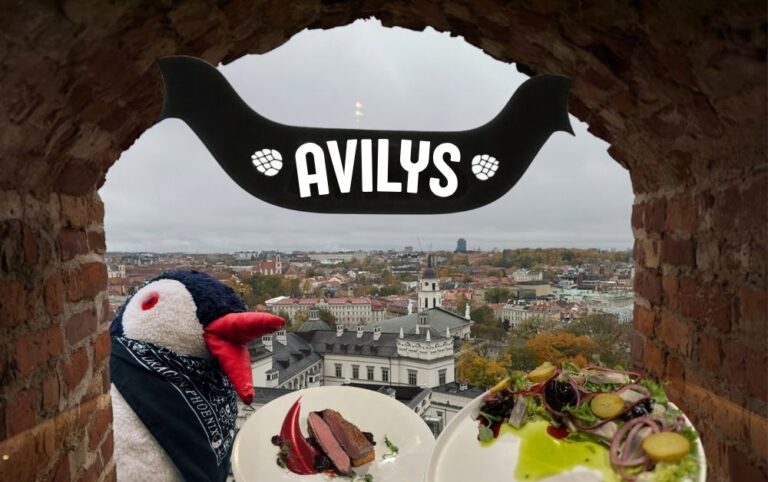
What we enjoy most is not even the tower itself, but what it gives us once we reach the top. Vilnius unfolds beneath us in every direction, with its red rooftops, church towers, winding streets, and patches of green stretching far beyond the Old Town. After a day of exploring the city at street level, seeing it from above gives everything a different perspective. This is easily one of our favorite moments in Vilnius and a stop we would make time for on any one-day visit.
If our day in Vilnius reminds us of one thing, it is that some of the best travel moments happen between the landmarks. We came with a plan, but once we started waddling through the city, the plan became more of a loose suggestion. We stopped for colorful street art, wandered through quiet alleyways, paused at unexpected statues, and ducked into places simply because something caught our attention. Even the cold could not quite hurry us along.
That is what we love about exploring a city on foot. You see the grand sights, of course, but you also notice the small things that would be easy to miss from a bus or behind a carefully planned itinerary. In Vilnius, those details kept appearing around every corner. A historic doorway, a quirky sculpture, a glimpse of Gediminas Tower between rooftops, or a tiny courtyard suddenly became part of our story. Our waddle through Vilnius was never really about getting from one attraction to the next. It was about seeing what we would find along the way.


St. Anne’s Church
We continue our waddle towards St. Anne’s Church, and this turns out to be one of the places that really stops us in our tracks. The red-brick Gothic façade is unlike almost anything else we have seen in Vilnius, with its intricate arches, towers, and patterns making the church look almost too delicate to have been built from brick. We circle it slowly, taking in the details from different angles before stepping inside.
A wonderful sense of calm settles in here, especially after wandering through the busier parts of the Old Town. The church has stood here for more than 500 years and is one of Vilnius’ best-known Gothic landmarks. Local legend even claims that Napoleon was so impressed by St. Anne’s that he wanted to take it back to Paris in the palm of his hand. Whether the story is true or not, standing in front of the elaborate red-brick façade, it is easy to see why the church has made such an impression. We love every second of our stop here, from the details outside to the quiet interior, and it quickly becomes one of our favorite corners of Vilnius.


The Mosaic Wall
With a little time left before our train, we keep wandering toward one of Vilnius’ more unexpected sights: the mosaic wall. After so many historic churches and Baroque façades, arriving at a colorful contemporary artwork feels like another change of rhythm.
The wall is made up of countless small pieces that come together to create a larger image, turning an otherwise ordinary stretch of the city into something worth stopping for. It is exactly the kind of discovery we enjoy while traveling. We did not come to Vilnius specifically for a mosaic, but there it is, waiting along our route, giving us one more reason to slow down, take a few photos, and enjoy our final waddle through the city.


By the end of our day, our feet are ready for a rest, and the cold has finally caught up with us. We ducked inside for warmth more than once, but it never slowed our waddle for long. What we enjoy most about Vilnius isn’t just the big sights, but the small discoveries tucked between them: colorful street art, quiet alleyways, unexpected statues, cozy corners, and historic façades that reveal themselves as we walk.
With only one day, we certainly cannot see everything Vilnius has to offer. But we never feel as though we are racing through a checklist either. From the moment we step out of the railway station to our final wander through the Old Town, the city gives us plenty of reasons to stop, look around, and follow the next interesting corner. And perhaps that is the best way to spend a day in Vilnius: keep waddling, keep looking, and leave a little room for the unexpected.


As evening approaches, it is time to leave Vilnius behind and head back to Kaunas. We return to the railway station and catch our train, watching the city slowly disappear beyond the window. We are tired, a little cold, but pleasantly satisfied after a full day of waddling through Vilnius. One day may only offer a glimpse of the city, but it certainly gives us plenty to remember.
Is One Day in Vilnius Enough
For us, one day in Vilnius was enough to get a real feel for the city. We managed to explore the Old Town, see some of its most recognizable landmarks, climb up to Gediminas Tower, and still leave plenty of time for the little discoveries that made the day memorable. That said, one day only scratches the surface. If we return, we would definitely stay at least another day, giving ourselves more time to explore the museums, neighborhoods, and corners we had to leave behind.
One Day in Vilnius
How Much Can You See in One Day in Vilnius
A surprising amount, especially if you are happy to explore Vilnius on foot. In our one day, we covered a good stretch of the Old Town, from Halės Market and St. Casimir’s Church to Town Hall Square, Daukanto Square, Cathedral Square, St. Anne’s Church, and Gediminas Tower. We also had time for street art, unexpected corners, a warm-up stop at G9, and a few unplanned discoveries along the way.
We deliberately didn’t try to squeeze every museum, church, or attraction into the day. Instead, we left room to wander, stop for photographs, and enjoy the streets. That made the day feel much less like following a checklist and more like actually experiencing Vilnius. If you are planning a similar visit, I would allow a full day from morning until early evening, with a flexible route rather than scheduling every stop by the minute.
With more time, we would add another day to explore the museums, spend longer in Užupis, visit more of the city’s viewpoints, and discover neighborhoods beyond the historic center. One day gives you a great introduction to Vilnius, but two days let you slow the pace and see the city beyond its main landmarks.
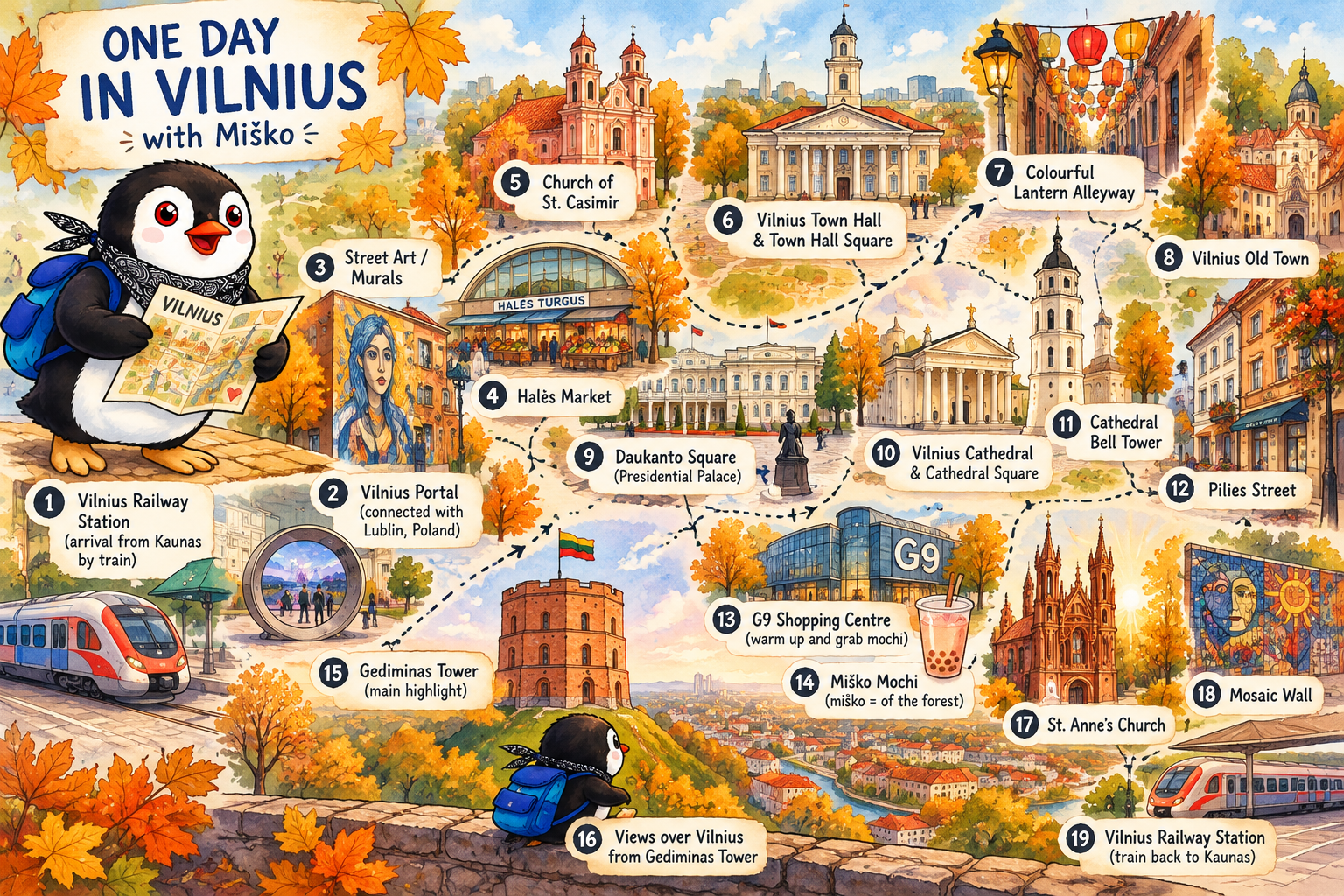
Our One Day in Vilnius Route
- Vilnius Railway Station (arrival from Kaunas by train)
- Vilnius Portal (the interactive Portal connecting Vilnius with Lublin, Poland)
- Street Art / Murals (wandering towards the Old Town)
- Halės Market (a glimpse of local life and the historic market hall)
- Church of St. Casimir (Baroque church in the Old Town)
- Vilnius Town Hall & Town Hall Square (exploring the square on a cold day)
- Colorful Lantern Alleyway (an unexpected discovery while wandering)
- Vilnius Old Town (getting pleasantly lost in the historic streets
- Daukanto Square (with the Presidential Palace)
- Vilnius Cathedral & Cathedral Square
- Vilnius Cathedral Bell Tower
- Pilies Street (continuing along the main street)
- G9 Shopping Center (warming up and grabbing mochi)
- Miško Mochi (the fun discovery that miško means “of the forest” in Lithuanian)
- Gediminas Tower (the main attraction and your highlight)
- Views over Vilnius from Gediminas Tower
- St. Anne’s Church (one of your favorite stops)
- Mosaic Wall (a final contemporary-art stop before leaving)
- Vilnius Railway Station (train back to Kaunas)
One Day in Vilnius: Our Tips
- Start early enough to avoid rushing. A full day gives you plenty of time to explore, but starting earlier means you can take your time between the main sights.
- Wear comfortable shoes. You will cover a lot of ground on foot, including cobbled streets and the walk up to Gediminas Tower.
- Leave space for wandering. Some of our favorite moments came from turning into an unexpected alleyway, spotting street art, or simply getting pleasantly lost.
- Check Gediminas Tower opening times before going. It was one of the highlights of our day, so we planned our route around having enough time to visit.
- Don’t overplan the Old Town. Vilnius is particularly enjoyable when you leave some room to wander. The historic center is compact enough that you can easily add an unexpected stop along the way.
- Take breaks when you need them. We visited on a cold day and were glad to have places such as G9 where we could warm up and grab a snack.
- Keep an eye out for the small details. From colorful murals and lanterns to unexpected statues and architectural details, some of the best discoveries are between the major attractions.
Our Map
Getting Around Vilnius
For a one-day visit, walking is the easiest way to experience central Vilnius. Most of the main sights are clustered around the Old Town, so you can move naturally from one landmark to the next without constantly checking transport connections. We covered our entire route on foot, from the railway station through the Old Town, across Cathedral Square and up to Gediminas Tower, with plenty of little detours along the way. The compact center also makes it easy to change your plans when something catches your attention.
Public transport is especially useful if you want to venture beyond the historic center or visit attractions farther away. Vilnius has an extensive network of buses and trolleybuses, while the city’s central areas are particularly pleasant to explore on foot. For our one-day itinerary, though, we never needed public transport once we arrived. Our feet, and a determined little penguin waddle, were enough to get us around.
Buy Us a Ko-fi

We arrive in Vilnius with only one day, and honestly, we manage to see a lot without feeling like we are running from one attraction to the next. We wander through the Old Town, stop whenever something catches our attention, warm up with mochi, get a little lost in the streets, and eventually make our way up to Gediminas Tower.
Standing at the top and looking over the rooftops, we realize how much of the city we have covered on foot. One day is enough to get a really good feel for Vilnius, but we also know we have only scratched the surface. If we come back, we will definitely stay longer. For now, though, we are happy with our little waddle through the city and the many unexpected corners we found along the way.
Travel Bold. Eat Well. Waddle Wild.
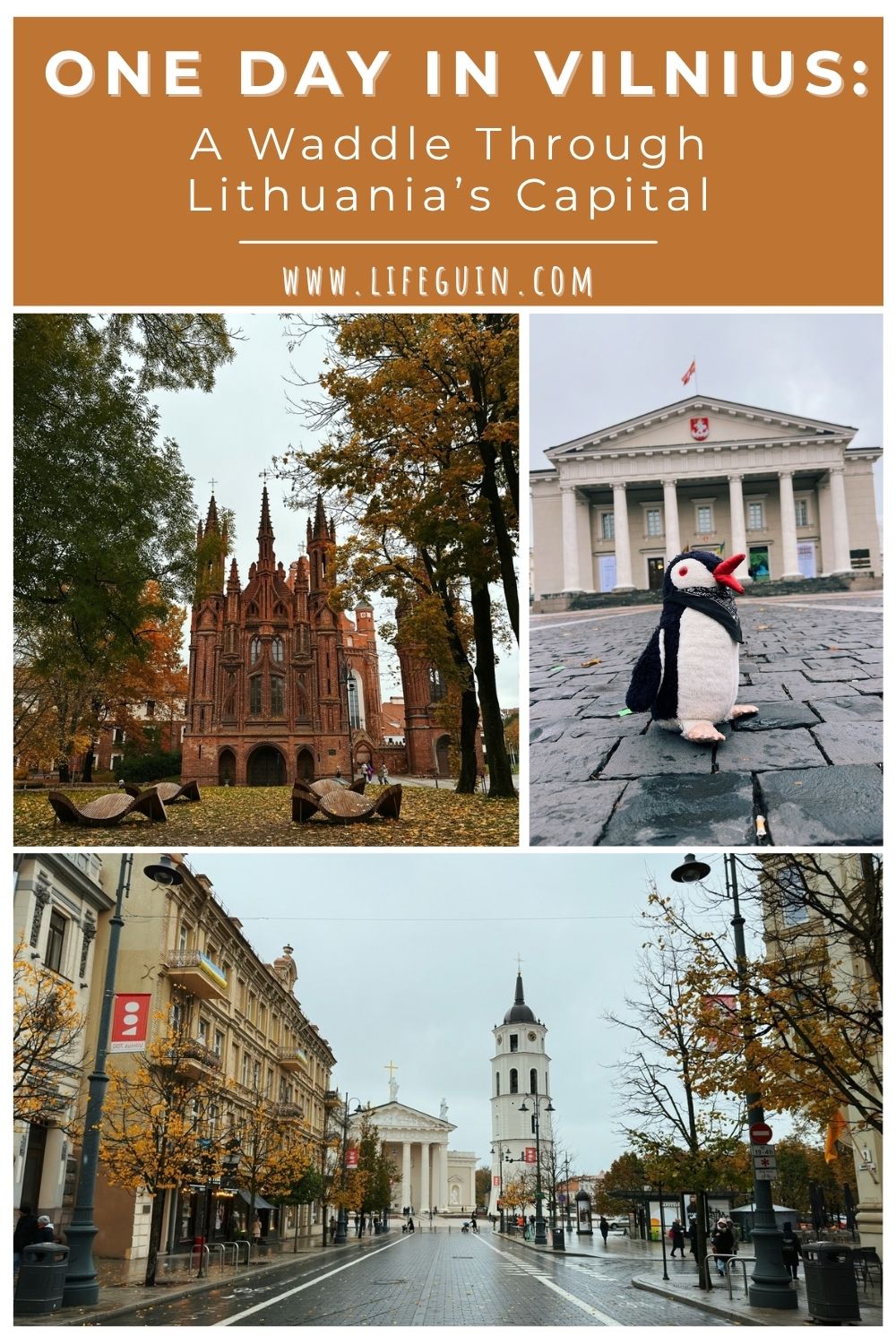
Save This Pin for Later!
This post contains affiliate links. If you click and buy, I might earn a tiny commission, enough to help a penguin keep up its globe-trotting lifestyle. No extra cost to you, just more fish for me. Thank you for supporting the adventure!