Munich in Two Hours: A Quick Itinerary
You can easily spend several days exploring Munich, but sometimes a city gives you only a few hours. Maybe you are between flights, have a long layover, or have just finished a business meeting and need to be back on the move. That is exactly what happened to us. We had just two hours in Munich, but instead of spending them at the airport or in a hotel, we decided to make the most of our little window and see how much of the city we could squeeze in.
Quick Facts About Munich
- Established: Munich was founded in 1158.
- Location: Bavaria, southern Germany.
- Population: Around 1.6 million people.
- Area: Approximately 311 km².
- Getting around: Munich has an extensive network of U-Bahn, S-Bahn, trams, and buses.
- Airport connection: Munich Airport is about 28–30 kilometers from the city center. S-Bahn lines S1 and S8 connect the airport with central Munich, including Marienplatz, in roughly 40–45 minutes.
- Nickname: Its traditional nickname, “Isar Athens” (Isar-Athen), reflects the city’s historic reputation as a center of art, culture, and learning along the Isar River.
Getting Around Munich
Munich is easy to navigate, especially if you are staying near the historic center. The U-Bahn, S-Bahn, trams, and buses form an extensive public transport network, while many of the main sights in the Old Town are close enough to explore on foot. For a short visit like ours, combining public transport with a good pair of walking shoes is the easiest way to make the most of your time.
- U-Bahn. Munich’s underground trains are especially useful for getting quickly between neighborhoods and the city center. We took the U-Bahn from our hotel to Marienplatz, where we started our two-hour exploration.
- S-Bahn. The suburban railway is useful for longer journeys around Munich and for getting between the city center and Munich Airport.
- Trams. Munich’s trams are a pleasant way to travel above ground while also getting a glimpse of the city along the way.
- Buses. Buses fill in the gaps between the rail and tram network and can be useful for reaching areas away from the main center.
- Waddling. Once you reach Marienplatz, many of Munich’s most famous sights are within easy walking distance. For a two-hour visit, staying in the historic center saves valuable time.
- Cycling. Munich is a cycle-friendly city, with dedicated cycle paths and bike-sharing options if you want to explore beyond the Old Town.
- Tickets. Munich’s public transport is integrated into the MVV network, so the same transport system covers the U-Bahn, S-Bahn, trams and buses. Always check the ticket zone and current fares before traveling.
Penguin Pro Tip: If you only have a few hours in Munich, don’t overcomplicate it. Get yourself to Marienplatz and explore from there on foot. The historic center packs a lot into a relatively small area, which is exactly what we needed with only two hours on the clock.
Things We Saw in Munich at a Glance
From Our Hotel to Munich’s Old Town
With only two hours in Munich, we knew we had no time to waste. We took the U-Bahn from our hotel to Marienplatz, heading straight for the historic heart of the city.
Marienplatz is the perfect starting point for a short visit because so many of Munich’s highlights are gathered around it. Once we emerged from the underground, we could leave the transport behind and waddle from one landmark to the next, exploring the Old Town on foot and making every minute count.


Marienplatz: Starting in the Heart of Munich
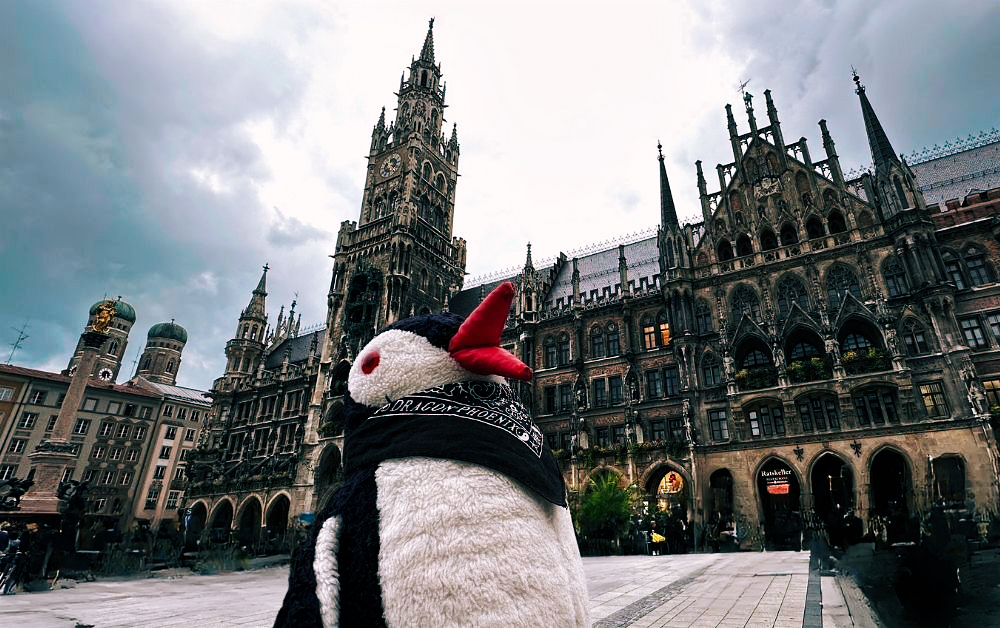
We emerge from the U-Bahn at Marienplatz, and Munich feels grander than the two-hour window we have given it. It is a cloudy summer day, and the muted light casts a slightly dark-academia mood over the square. The Gothic towers of the Neues Rathaus (New Town Hall) rise above us, their dark stone looking almost dramatic against the grey sky, while colourful flowers soften the scene below.
At the center of the square stands the Mariensäule, a Marian column topped with a golden statue of the Virgin Mary. Around it, Marienplatz buzzes with visitors, trams, and city life, framed by some of Munich’s most recognizable architecture.


The Neues Rathaus is the square’s star. Its elaborate Neo-Gothic façade is covered with towers, statues and intricate details, while its famous Glockenspiel brings some of those figures to life several times a day. We do not have time to linger for the performance, but even without it, the building gives Marienplatz the theatrical quality that makes this such a memorable first stop.
And somehow, the flowers make the whole scene work. Against the cloudy summer sky and dark architecture, their color feels almost deliberately placed, turning our first few minutes in Munich into something that feels unexpectedly cinematic.


Interesting Facts About Marienplatz
- Munich’s central square has been central for centuries. The area was already an important crossroads when Munich’s history was officially recorded in 1158, and it later became the city’s main marketplace.
- It used to be called Schrannenplatz. The square only received the name Marienplatz in 1854, after the central market was moved elsewhere.
- The Mariensäule has stood here since 1638. The column was erected after Munich survived the Thirty Years’ War, as a monument of thanksgiving. Its base depicts four dangers of the period: heresy, war, famine, and plague.
- The Glockenspiel tells two stories from Munich’s history. The upper scene depicts the 1568 wedding of Duke Wilhelm V and Renata of Lorraine, including a jousting tournament, while the lower scene shows the traditional Schäfflertanz, or Coopers’ Dance, associated with Munich’s recovery after a plague epidemic.
- There is even a food story here. According to a long-standing Munich legend, Weißwurst was invented at an inn on Marienplatz in 1857 when a butcher supposedly ran out of the usual sheep casings and improvised with pork casings. The story is considered a legend rather than a proven historical fact, so it’s a fun detail rather than something to present as certain.
Stepping Inside the Prunkhof
From Marienplatz, we head straight through the Gothic-looking entrance of the Neues Rathaus and suddenly find ourselves in the Prunkhof, the grand inner courtyard of Munich’s New Town Hall. The change is almost theatrical: just moments ago we were surrounded by the bustle of Marienplatz, and now we are enclosed by elaborate Neo-Gothic architecture.
The Prunkhof is one of six courtyards within the enormous New Town Hall complex, but it is the one open to the public. The courtyard is roughly rectangular and surrounded by the Rathaus’s different wings.
One detail worth looking for is the mosaic floor, which forms a huge labyrinth. Above it, the courtyard is packed with architectural details, including the impressive spiral staircase known as the “Staircase of the Ages.” Its sculptures represent different stages of human life, from childhood to old age.


A wonderfully quirky detail also appears at the former cash-office portal. A stone dog appears to wag its tail at people bringing money into the city coffers, while a pug opposite seems to growl at those taking money out. It is the sort of tiny detail we love discovering when we waddle through historic buildings.
And then there is the history behind the building itself. Architect Georg von Hauberrisser designed the New Town Hall, which was built in three stages between 1867 and 1905, as Munich’s rapidly growing administration outgrew the Old Town Hall.
Frauenkirche: Munich’s Iconic Twin Towers
From the Prunkhof, we continue towards the Frauenkirche, officially the Cathedral of Our Lady (Dom zu Unserer Lieben Frau). Its two enormous towers are among the most recognizable features of Munich’s skyline, and with only two hours in the city, you can’t miss them.
Construction of the present Gothic cathedral began in 1468 and was completed remarkably quickly, in just around 20 years. Its distinctive towers rise to almost 99 meters, while its famous onion-shaped domes were added later, in the 16th century.
One of the church’s most curious details is the Devil’s Footprint (Teufelstritt) near the entrance. According to legend, the Devil visited the church while it was being built and, standing in one particular spot, failed to notice any windows. When he realized he had been tricked, he stamped his foot into the floor. The dark footprint-shaped mark can still be seen today.
The Frauenkirche is also closely tied to Munich’s identity. Its twin towers are protected as part of the city’s skyline, and for generations they have served as a visual symbol of Munich. From Marienplatz, their sheer size makes them particularly impressive, rising above the surrounding historic buildings.


Max-Joseph-Platz and the National Theatre
From the Frauenkirche, we continue our waddle towards Max-Joseph-Platz, one of Munich’s grandest squares. The imposing National Theatre takes center stage, its neoclassical façade inspired by ancient Greek architecture and lined with towering Corinthian columns.
The theatre is home to the Bavarian State Opera and Bavarian State Ballet, making it one of Germany’s most important opera houses. The building we see today is actually the third version of the theatre. The original opened in 1818, but after a fire destroyed it and later damage during the Second World War, it was rebuilt.
Facing the theatre, you will also spot a statue of King Maximilian I Joseph, after whom the square is named. Even with our two-hour deadline ticking away, this is one of those Munich corners worth stopping for: grand architecture, royal history and a surprisingly theatrical atmosphere all gathered in one place.


Odeonsplatz and the Theatine Church
Our next stop is Odeonsplatz, where the bright yellow façade of the Theatine Church (Theatinerkirche St. Kajetan) immediately catches our eye. After the darker Gothic architecture we have seen earlier, its warm Baroque exterior feels like a completely different chapter of Munich.
The church was commissioned in the 17th century to celebrate the birth of the long-awaited heir to the Bavarian throne. Construction began in 1663, and the church became one of Bavaria’s earliest large Baroque churches.
Inside, the contrast continues. The exterior may be striking yellow, but the interior is remarkably light, with white stucco decoration, soaring arches, and an impressive dome. The church also became the burial place of members of the Bavarian ruling family, adding another layer of royal history to this already grand corner of Munich.
From here, we could also see the Feldherrnhalle, the monumental loggia at the southern end of Odeonsplatz. With our two-hour clock still ticking, we pause for a quick look before continuing our waddle.


The Feldherrnhalle at Odeonsplatz
While we are already at Odeonsplatz, we also stop to admire the Feldherrnhalle, the monumental loggia standing opposite the Theatine Church. Built between 1841 and 1844, King Ludwig I of Bavaria commissioned it as a monument celebrating the Bavarian army, inspired by the Loggia dei Lanzi in Florence.
Two enormous Bavarian lions guard the structure, while the central monument honors important military figures from Bavaria’s past. But the Feldherrnhalle also carries a much darker piece of modern history. In 1923, it became the scene of the Beer Hall Putsch, when Adolf Hitler and his supporters attempted to seize power in Bavaria. The failed coup ended with a confrontation here, during which several people were killed.
Today, the Feldherrnhalle is simply part of the grand architectural ensemble of Odeonsplatz, but knowing what happened here adds another layer to what initially looks like an elegant square. For us, it is another quick stop before the two-hour clock keeps us moving.


Hofgarten and the Dianatempel
From Odeonsplatz, we continue our waddle into the Hofgarten, Munich’s elegant Renaissance-style court garden. After the grand architecture and busy streets around the square, the pace changes immediately. Tree-lined paths, neatly arranged flowerbeds and open lawns give us a little breathing space in the middle of the city.
At the center of the garden stands the Dianatempel, or Diana Temple, an open pavilion built in 1615–1616 as part of the original Hofgarten. Rather than being a traditional temple, it is an elegant domed pavilion with eight arched openings, designed as a focal point for the garden.
One of its most striking details is the bronze figure of Diana, the Roman goddess of the hunt, standing atop the dome. The original figure was created in the early 17th century, while the one visible today is a later replacement.
Duke Maximilian I created the Hofgarten in the early 17th century, and it is one of Munich’s oldest surviving gardens. Even with our limited time, it makes a lovely final waddle through the city, offering a quieter contrast to the grand squares and churches we have just explored.


The Bavarian State Chancellery
From the Hofgarten, we continue our waddle towards the Bayerische Staatskanzlei (Bavarian State Chancellery), the official seat of the Bavarian state government. The building immediately stands out, combining a historic central section with two modern glass wings that extend dramatically on either side.
The central part is the former Bavarian Army Museum, built in the late 19th century. After the Second World War, the building was heavily damaged, and the modern glass wings were added during its reconstruction. The State Chancellery officially moved in in 1993.
One of the most striking details is the huge glass dome above the historic center. From the Hofgarten, the building creates an interesting contrast between Munich’s royal past and its modern political life.
Penguin Fact: The State Chancellery stands directly beside the Hofgarten, so it is an easy addition to this route. You don’t need a separate detour, which matters when your entire Munich adventure is only two hours long.


Kaiserhof: A Final Glimpse of the Munich Residenz
One of our last stops is the Kaiserhof, the grand Imperial Courtyard inside the Munich Residenz, Bavaria’s former royal palace. After spending much of our two hours moving through Munich’s squares and streets, stepping into this elegant courtyard feels like entering another chapter of the city’s history.
The Residenz grew from a small 14th-century castle into an enormous palace complex as the Wittelsbach rulers expanded their residence over the centuries. The Kaiserhof was created as part of the Renaissance-era expansion and was designed to reflect the power and status of the Bavarian rulers.
Arcaded galleries surround the courtyard, decorated with historical frescoes, while the octagonal tower at its center gives the space its distinctive character. It was also designed for ceremony, providing an impressive setting for royal processions and court occasions.
We only have time for a glimpse rather than a full visit to the Residenz museum and treasury, but even this courtyard is enough to show how grand Munich’s royal past really was. And with our two-hour adventure almost over, it feels like a fitting final stop before we waddle back towards the U-Bahn.


Old Town Hall and Talburgtor
From the grand courtyards of the Residenz, we continue through Munich’s historic center and soon find ourselves back at Marienplatz, this time looking towards the Old Town Hall (Altes Rathaus) and the remains of the Talburgtor.
The Old Town Hall has stood here in various forms since the Middle Ages, and the current building largely dates to the late 15th century. Its tall Gothic tower rises above the square, while the arched passage beside it marks the location of one of Munich’s historic city gates. The Talburgtor was once part of the medieval fortifications, controlling access into the city from the Isar.
What makes this corner particularly interesting is how much history is packed into such a small space. The Old Town Hall once served as the seat of Munich’s city government, and the tower also served a defensive purpose. Today, of course, the atmosphere is very different. Tourists gather around the square, cafés fill the surrounding streets, and the old gate has become part of the city’s everyday rhythm.
After squeezing so much into our two-hour waddle, it feels almost fitting to end up back where we started, surrounded by the layers of Munich’s medieval and modern city center.


Church of the Holy Spirit: Our Final Stop
Our final stop is the Church of the Holy Spirit (Heilig-Geist-Kirche), just a short waddle from Marienplatz. After the grand squares, royal courtyards,, and Gothic towers we have seen along the way, this church gives us one last glimpse of Munich’s historic character before our two-hour adventure ends.
The church dates back to the 13th century, when it was connected to a hospital founded near the old city walls. Much of what we see today comes from later rebuilding, particularly after a major fire in 1327. Its distinctive late Baroque and Rococo interior dates to the 18th century, with elaborate ceiling frescoes and ornate decoration transforming the medieval structure into something far more theatrical.
The church also sits right beside Viktualienmarkt, Munich’s famous food market, making this a particularly convenient final stop. We have managed to squeeze an impressive number of Munich landmarks into just two hours, and ending here feels surprisingly calm after the bustle of Marienplatz.
Two hours is nowhere near enough to know Munich, but it is enough to get a taste of the city. And sometimes, that is all a little adventure needs.


What We Enjoyed Most About Munich
What we enjoyed most about our two hours in Munich was not ticking landmarks off a list. It was simply getting a little lost. Between the grand squares and famous buildings, we kept turning down smaller streets, peeking into courtyards and noticing details we would have easily missed if we had rushed from one attraction to the next. A carved figure here, a colorful flower box there, an unexpected doorway or a tiny architectural detail suddenly became part of our Munich story.


With so little time, we could have tried to see as much as possible, but the moments we remember most are the ones where we stopped looking at the map. Munich rewards that wandering. Even when you think you are simply heading toward the next landmark, something is usually tucked around the corner, waiting to catch your eye. And perhaps that is the best way to experience a city in just two hours: waddle with a plan, but leave enough room to get pleasantly lost.
What We Would Do With More Time
If we had more than two hours in Munich, we would slow the pace down and give ourselves time to explore beyond the main highlights.
- Half a day: Add a few museums, explore more of the Munich Residenz, and spend more time wandering through the Old Town without constantly checking the clock.
- One day: Explore Munich properly, with time for the Old Town, museums, food markets and the English Garden, one of the city’s most famous green spaces.
- Two or three days: Go beyond the city center and take your time with Munich’s museums, palaces, neighborhoods and food scene. You’ll also have more room to wander and discover the smaller details.
How Many Days Do You Need in Munich
Two hours in Munich are definitely not enough to experience the city properly, but they are enough to get a glimpse, taste the atmosphere, and see some of its most recognizable landmarks. We managed to waddle through the historic center, discover beautiful squares, royal courtyards, churches, and hidden corners, and get pleasantly lost along the way. It was a very quick introduction, but it left us wanting more.
For a more relaxed experience, we would recommend at least two full days in Munich. This gives you enough time to explore the Old Town without rushing, visit a few museums or the Residenz, spend time in the English Garden and, most importantly, leave some room for spontaneous discoveries. With three days or more, you can slow the pace even further and explore Munich’s neighborhoods, food scene, and attractions beyond the historic center.
Two-Hour Munich Itinerary at a Glance
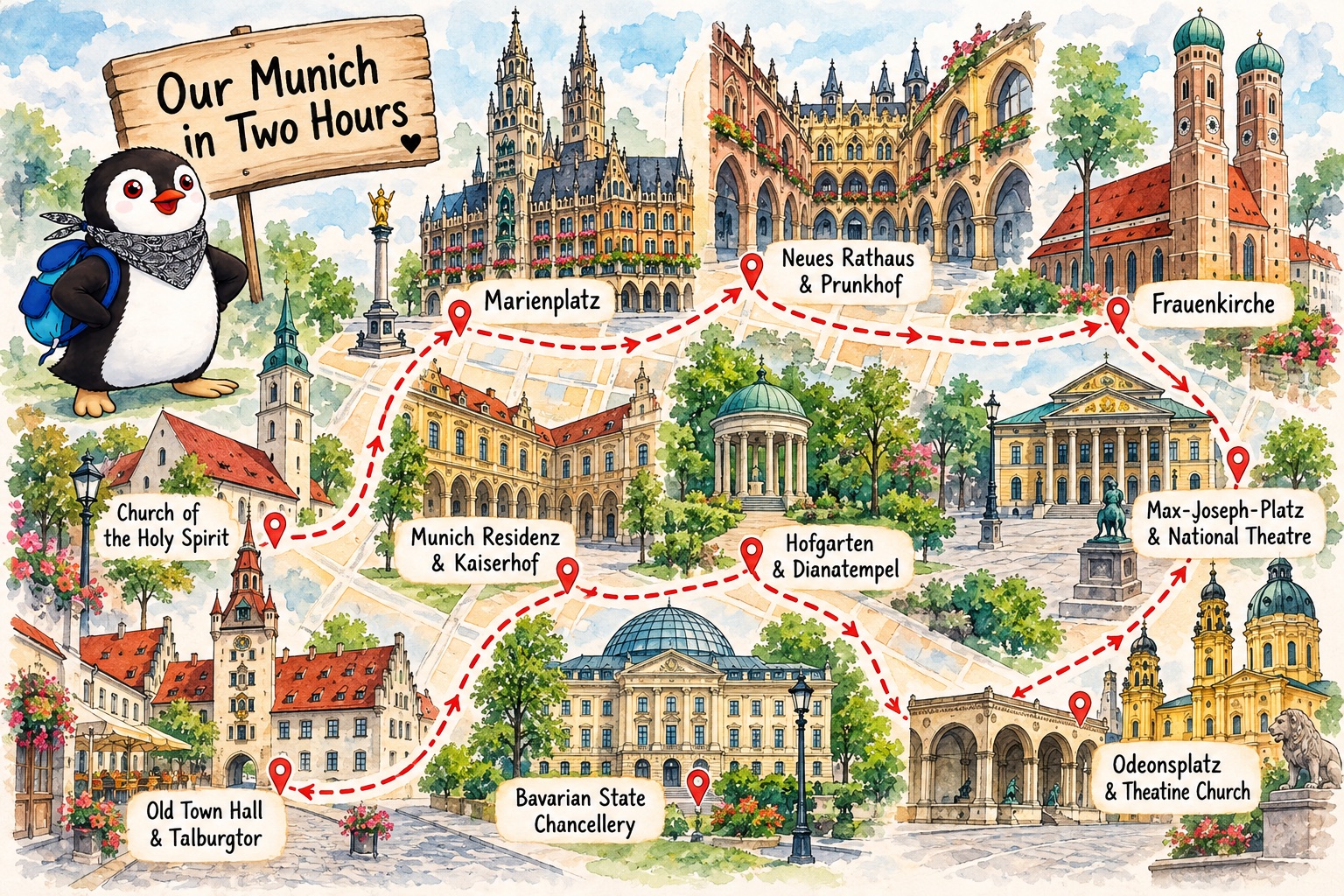
Here is the route we actually managed to cover during our quick Munich waddle:
- 00:00 – Marienplatz. Start at the heart of Munich, taking in the Neues Rathaus, Mariensäule, and the Old Town Hall.
- 00:15 – Neues Rathaus & Prunkhof. Step through the Gothic entrance into the beautiful Prunkhof courtyard of the New Town Hall.
- 00:25 – Frauenkirche. Waddle over to Munich’s iconic cathedral and its distinctive twin towers.
- 00:40 – Max-Joseph-Platz & National Theatre. Continue to the grand square and admire the neoclassical National Theatre.
- 00:50 – Odeonsplatz & Theatine Church. See the bright yellow Theatine Church and the Feldherrnhalle.
- 01:00 – Hofgarten & Dianatempel. Take a quick waddle through the peaceful Hofgarten and its central pavilion.
- 01:10 – Bavarian State Chancellery. Admire the striking glass dome and historic building beside the Hofgarten.
- 01:20 – Munich Residenz & Kaiserhof. Step into the Kaiserhof for a glimpse of Bavaria’s former royal residence.
- 01:35 – Old Town Hall & Talburgtor. Return towards Marienplatz and see the Old Town Hall tower and historic gate.
- 01:45 – Church of the Holy Spirit. Make one final stop at Heilig-Geist-Kirche before heading back towards the center.
- 02:00 – Back to the U-Bahn. Our two-hour Munich adventure ends, leaving us with a taste of the city and plenty of reasons to return.
Map of Our Munich Waddle
Best Time to Visit Munich
Munich is a year-round destination, and each season brings a different side of the city.
- Spring. March to May brings milder weather, blooming parks, and the return of outdoor cafés and beer gardens. April and May are especially pleasant for exploring the city on foot.
- Summer. June to August is the warmest period and a great time for outdoor activities, the English Garden, beer gardens and the Isar. We visited Munich in August, so technically we arrived right in the middle of summer. We were expecting sunshine and warm summer streets, but Munich had other plans for us. Our day was very cloudy and rainy, giving the city a completely different atmosphere. The dark clouds actually added a slightly moody, almost cinematic feeling to our quick waddle through the Old Town. Summer also tends to have more rainfall than other seasons, despite being the warmest time of year.
- Autumn. September and October are excellent for sightseeing, with comfortable temperatures and colorful parks. September also brings Oktoberfest, which can make the city considerably busier.
- Winter. December is a particularly atmospheric time to visit if you love Christmas markets. January and February are colder, with temperatures sometimes dropping below freezing, but museums, cafés and Munich’s indoor attractions make the city enjoyable even when the weather is less inviting.
Our experience: August gave us a grey, rainy day, but we still enjoyed seeing Munich under those cloudy skies. The weather did not stop us from exploring, and it gave our two-hour adventure a completely different mood. So while you cannot guarantee sunshine, Munich is a city you can explore in almost any season and in almost any weather.
There is no single best time to visit Munich. Spring and autumn can be lovely for sightseeing, summer brings long days and outdoor life, while winter transforms the city with Christmas markets and a cozy atmosphere. We visited in August and ended up with a very cloudy and rainy day, but even that became part of the experience. Munich simply put on a different mood for us, and we still managed to have a wonderful couple of hours getting pleasantly lost in the city.
Buy Us a Ko-fi

Two hours in Munich are nowhere near enough to truly get to know the city, but they are enough to catch a glimpse of what makes it so enjoyable. We managed to see grand squares, Gothic churches, royal courtyards, historic gates, and beautiful architecture, all while squeezing in a little time to simply wander.
Honestly, we enjoyed getting lost most. Some of our favorite moments came from turning down streets without a plan, spotting tiny architectural details and discovering places we might have missed if we had been rushing from one famous landmark to another. Munich has plenty of headline attractions, but those smaller details make exploring feel like an adventure.
We visited on a cloudy, rainy August day, and even the weather became part of the story. We may have only had two hours, but Munich gave us enough of a taste to make us want to come back for more. Two hours gave us a glimpse. Next time, we want the whole waddle.
Travel Bold. Eat Well. Waddle Wild.

This post contains affiliate links. If you click and buy, I might earn a tiny commission, enough to help a penguin keep up its globe-trotting lifestyle. No extra cost to you, just more fish for me. Thank you for supporting the adventure!