Japan Tax-Free Shopping Guide: Rules, Refunds & How to Save Money
Before our trip to Japan, we hadn’t given much thought to tax-free shopping. We knew Japan offered tax exemptions for tourists, but we weren’t entirely sure how the system worked, which purchases qualified, or what we needed to do to take advantage of it. Once we arrived, we quickly realized that understanding the rules could make quite a difference, especially with all the shopping opportunities Japan has to offer. So, we did our homework, checked the requirements, and figured out how to make the most of it. In this guide, we’re sharing everything we learned about tax-free shopping in Japan, from eligibility and participating stores to the rules tourists should know before making a purchase.
- Quick Facts About Tax-Free Shopping in Japan
- Japan’s Tax-Free Shopping System: What Changed in November 2026
- What Is Tax-Free Shopping in Japan
- Who Is Eligible for Tax-Free Shopping in Japan
- What Can You Buy Tax-Free in Japan
- What is the Minimum Purchase Amount
- How to Shop Tax-Free in Japan: Step-by-Step Guide
- How Does the Tax Refund Work at Japanese Airports
- Where to Find Tax-Free Shops in Japan
- Tax-Free Shopping in Japan: Things to Remember
Quick Facts About Tax-Free Shopping in Japan
Before heading out for a shopping spree in Japan, a few things are worth knowing about the country’s tax-free shopping system. Japan adds a consumption tax to most purchases, but eligible international visitors can claim it back when they take their purchases home. Here are the basics to keep in mind.
- Tax system: Japanese Consumption Tax (JCT), applied to most goods and services.
- Standard tax rate: 10%, with a reduced 8% rate applying to certain food and beverage purchases.
- Minimum purchase: ¥5,000 or more before tax at the same participating tax-free store on the same day.
- Who qualifies: Eligible non-resident visitors, including tourists entering Japan under the Temporary Visitor status.
- What you need: Your passport and proof of your qualifying entry status, such as the relevant landing permission.
- Current system: Japan introduced a new refund-based tax-free shopping system on 1 November 2026.
- How it works: You pay the tax-inclusive price at the shop and receive a refund equivalent to the consumption tax after customs confirms that you are taking your purchases out of Japan.
- Departure deadline: You must complete customs confirmation within 90 days of your purchase.
- Good to know: The new system means you no longer receive the tax exemption immediately at the checkout. Keep your purchases accessible, as customs may need to inspect them before you leave Japan.
Japan’s Tax-Free Shopping System: What Changed in November 2026
Japan introduced a major change to its tax-free shopping system on 1 November 2026, switching from an immediate tax exemption to a refund-based system. Previously, eligible international visitors could present their passport at participating stores and buy goods at tax-excluded prices, meaning the 10% consumption tax was deducted at checkout. Under the new system, the process works differently. Shoppers now pay the full, tax-inclusive price first and receive a refund equivalent to the consumption tax after customs confirms at the airport or seaport that the purchased goods are leaving Japan. This confirmation must take place within 90 days of the purchase date. Essentially, the biggest difference is that you no longer save on the spot at the checkout. You pay first and claim your tax refund before departing Japan.
Old vs. New Tax-Free Shopping System
| Until 31 October 2026 | From 1 November 2026 | |
|---|---|---|
| Payment at checkout | Tax-excluded price | Full price, including tax |
| Tax exemption | Applied at the time of purchase | Refund after customs confirmation |
| Departure procedure | No mandatory pre-refund customs confirmation | Customs confirmation required |
| Refund process | Immediate tax exemption or in-store refund | Refund after departure confirmation |
| Goods categories | General goods and consumables treated separately | No distinction between the two |
| Consumables packaging | Special sealed bags required | Special packaging no longer required |
| Consumables limit | Separate ¥500,000 limit | Separate limit abolished |
| Departure deadline | No equivalent 90-day confirmation deadline | Customs confirmation within 90 days of purchase |
Why Did Japan Change the System?
The main reason behind the reform was to prevent misuse of the tax-free shopping scheme. Japanese authorities identified cases where international visitors bought goods tax-free but did not take them out of the country, instead reselling them within Japan.
The previous system allowed eligible visitors to purchase goods without paying consumption tax upfront. Under the new arrangements, customs must confirm that the purchased goods are leaving Japan before issuing the tax refund.
According to Japan’s Ministry of Finance, the reform also aims to simplify requirements for participating retailers and improve the shopping process by removing some previous restrictions, including the separate treatment of general goods and consumables.
What Is Tax-Free Shopping in Japan
Tax-free shopping in Japan lets eligible international visitors buy certain goods without ultimately paying the Japanese Consumption Tax (JCT). Think of it as a little shopping perk for tourists! Japan applies a standard consumption tax of 10% to most goods and services, while certain food and beverage products are subject to a reduced rate of 8%. At regular stores, this tax is included in the price you pay. However, eligible visitors can benefit from tax-free shopping when they purchase qualifying goods at officially authorized tax-free stores.
The idea behind the system is relatively simple: visitors buy goods they intend to take out of Japan rather than consume in the country. Since these purchases are considered exports, eligible non-resident visitors can receive an exemption from the consumption tax, provided they follow the required procedures.
Since 1 November 2026, Japan has operated a refund-based system. This means you pay the full price, including consumption tax, at the checkout and receive the equivalent tax amount back after customs confirms that you are taking the purchased goods out of Japan. So, although the shopping experience starts like any other purchase, you have one extra step to complete before heading home.
Tours and tickets from KlookShows Klook’s own box, which can set Klook cookies.Tours and tickets on KlookKlook’s box can’t load on this device (an ad blocker often stops it). This opens Klook’s own page.Open Klook
Who Is Eligible for Tax-Free Shopping in Japan
Tax-free shopping in Japan is available to eligible non-residents, not everyone visiting or living in the country. Your immigration status and the length of your stay determine whether you qualify.
- Tourists with Temporary Visitor status: Most international tourists entering Japan for sightseeing, holidays, or short visits under the Temporary Visitor status are eligible for tax-free shopping.
- The six-month rule: For most foreign visitors, eligibility requires that you have been in Japan for less than six months since your entry date. This is not a general six-month residency requirement, but a time limit based on your latest arrival in Japan.
- Foreign residents in Japan: Foreign nationals who live in Japan are generally not eligible. This includes people with working visas, international students, permanent residents, and other mid- or long-term resident statuses. Simply leaving Japan temporarily does not automatically make you eligible again.
- Your passport is essential. You must provide your passport so the store can verify your identity, nationality, and immigration status. You can also use the approved Visit Japan Web procedure to provide the required passport information. Each shopper must complete the procedure in their own name.
- Diplomats and government officials: Foreign nationals holding Diplomat or Official status can also qualify. They are exempt from the usual six-month entry limit.
- Cruise ship visitors: Passengers entering Japan under a special Landing Permission for Cruise Ship Tourists can qualify. They must present their passport together with their cruise ship landing permit. A passport copy is also accepted in this particular case.
Good to know: Japanese citizens living abroad may also qualify when temporarily returning to Japan, provided they have lived outside the country continuously for at least two years and present the required supporting documentation.

What Can You Buy Tax-Free in Japan
One of the best things about shopping in Japan is the sheer variety of things you can bring home. From Japanese skincare and electronics to cute stationery, traditional souvenirs, and snacks you might never find back home, there is plenty to fill your shopping bags. The good news is that many of these purchases can qualify for tax-free shopping, as long as you meet the requirements and shop at an authorized tax-free store.
What can you buy tax-free?
Most everyday consumer goods can qualify, including:
- Electronics and gadgets. Cameras, headphones, gaming accessories, smartphones, chargers, and other electronic devices.
- Clothing and accessories. Japanese fashion, shoes, handbags, watches, jewelry, and accessories.
- Cosmetics and skincare. Japanese beauty products, sunscreen, face masks, makeup, lotions and skincare sets.
- Japanese snacks and sweets. Matcha chocolates, KitKat flavors, Japanese sweets, packaged snacks, tea and other food products.
- Souvenirs and traditional crafts. Japanese pottery, fans, ceramics, traditional textiles, decorative items, and locally made souvenirs.
- Household goods and lifestyle products. Kitchenware, stationery, home accessories, character merchandise, and everyday lifestyle items.
Are there any excluded items?
Not everything you purchase in Japan qualifies for a tax refund. The main exclusions include:
- Gold and platinum bullion.
- Gold and platinum coins.
- Items that are already exempt from Japanese Consumption Tax.
- Goods you do not take out of Japan or cannot present for customs confirmation when required.
Purchased goods must also be limited to quantities you can personally carry out of Japan.


What Is the Minimum Purchase Amount
To qualify for tax-free shopping, your purchases must total at least ¥5,000 before tax at the same participating store on the same day. This means you can combine several eligible items from one store to reach the threshold. For example, purchasing a ¥3,000 skincare set and ¥2,500 worth of Japanese snacks at the same shop on the same day would bring your total to ¥5,500 before tax, making the purchase eligible.
What changed under the new system in November 2026?
Previously, Japan separated tax-free goods into two categories: general goods, such as clothing and electronics, and consumables, such as food, drinks, and cosmetics. Consumables had a maximum purchase limit of ¥500,000 before tax and required special sealed packaging.
Since 1 November 2026, this distinction has been abolished. There is no longer a separate ¥500,000 purchase limit for consumables, and special sealed packaging is no longer required. However, remember one important rule: if you intend to claim the refund, you must not use or consume food, beverages, cosmetics, or other consumables purchased tax-free in Japan. You must take them out of the country and make them available for customs confirmation.
For other goods, such as clothing and electronics, using them in Japan before departure does not automatically disqualify them, as long as you ultimately take them out of the country.
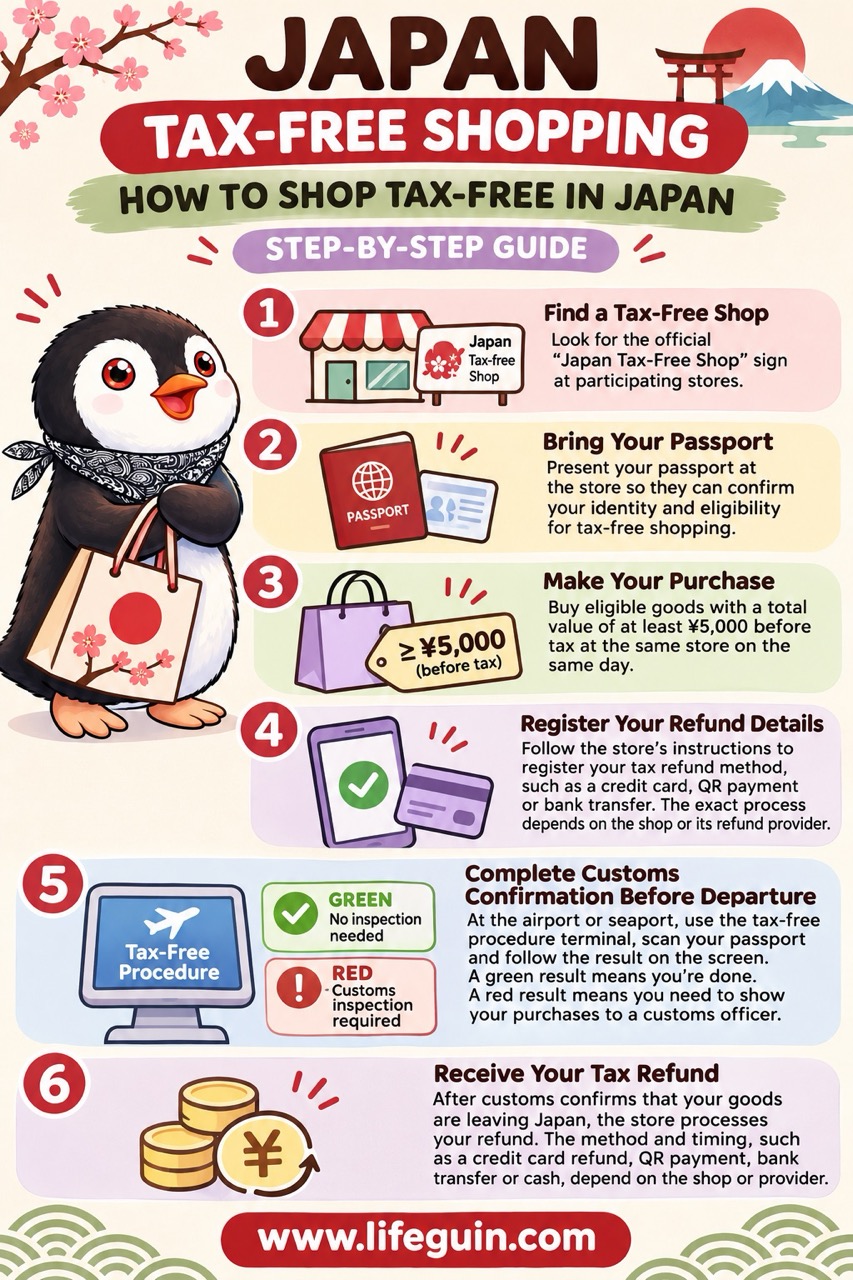
How to Shop Tax-Free in Japan: Step-by-Step Guide
How Does the Tax Refund Work at Japanese Airports
Step 1: Arrive at the Airport with Your Passport and Purchases.
Once you arrive at the airport, make sure you have your passport and all your tax-free purchases with you. Customs may need to inspect the goods to confirm that they are leaving Japan.
Important: Do not put your tax-free purchases in checked luggage before completing customs confirmation. Once you check your luggage in, you cannot retrieve it for customs inspection.
Step 2: Find the Tax-Free Procedure Terminal
Head to the international departure lobby and look for the Tax Refund Kiosk or Tax-Free Procedure Terminal. These terminals are located in the public departure area, before the security checkpoint.
You can find their exact locations on your airport’s official website or by following the airport signage.
You will need to scan your passport at the terminal to access your tax-free purchase records and complete the customs confirmation procedure.
Step 3: Check Your Customs Confirmation Result
After scanning your passport, the terminal will display one of two results:
- Green result: No physical customs inspection is required. Your customs confirmation procedure is complete, and you can proceed to airline check-in.
- Red result: Customs inspection is required. Take your passport and tax-free purchases to the designated customs inspection area, where an officer will verify the goods before completing the procedure.
Good to know: A red result does not automatically mean your refund has been rejected. It simply means customs needs to inspect your purchases. Follow the instructions displayed at the terminal and provided by customs officials.
Step 4: Use Visit Japan Web Instead of the Terminal
Travelers departing from selected Japanese airports have another option. Instead of scanning your passport at a physical kiosk, you can complete the customs confirmation procedure online through Visit Japan Web.
This option is currently available at seven airports:
- New Chitose Airport
- Narita International Airport
- Haneda Airport
- Chubu Centrair International Airport
- Kansai International Airport
- Fukuoka Airport
- Naha Airport
To use this option, you need to access the dedicated customs Wi-Fi network in the international departure lobby before passing through security. You also need to set up Visit Japan Web and have it ready before starting the procedure.
Follow the website instructions to complete your customs confirmation. You will receive the same green or red result as with the physical terminal. Should the online procedure fail, you can use the airport kiosk instead.
Step 5: Complete Airline Check-In and Proceed to Security
Once customs confirmation is complete, you can proceed with your usual departure procedures.
If your purchases require physical inspection, make sure customs completes the verification before you check in your luggage. After clearance, you can pack the inspected purchases into your checked baggage if needed. Remember that customs confirmation must be completed before the security checkpoint. You cannot return to the public departure area to complete the procedure after passing through security.
Step 6: Receive Your Tax Refund
This is the final step. Once customs confirms that your purchases are leaving Japan, the tax-free store processes your refund using the payment method you registered when shopping.
Depending on the store and its refund provider, this may be:
- A refund to your credit card.
- A refund through a supported QR payment service.
- A bank transfer.
- Cash through a participating airport refund counter or kiosk, where available.
Keep in mind that customs confirmation and receiving your money are two separate steps. A green result means your customs procedure is complete, but it doesn’t mean the money has reached your account yet. Refund processing times depend on the store and its payment provider.
Also, not every store offers cash refunds at the airport, so check the refund instructions provided at the time of purchase.
Pro Penguin Tips
We recommend keeping all your tax-free purchases together in one easily accessible bag, rather than distributing them across several suitcases. It makes the customs procedure much easier, especially when you are rushing to catch your flight!
Where to Find Tax-Free Shops in Japan
Finding tax-free shops in Japan is relatively easy, especially in major shopping districts and popular tourist areas. You will find participating retailers across the country, from large department stores to smaller specialty shops.
Here are some of the most common places to look:
- Department stores: Large retailers offering fashion, cosmetics, accessories, electronics, and souvenirs.
- Electronics stores: Popular chains selling cameras, smartphones, headphones, gaming accessories, and other gadgets.
- Drugstores and beauty shops: Great for Japanese skincare, cosmetics, sunscreen, toiletries, and packaged snacks.
- Fashion retailers: Clothing, shoes, bags and accessories from Japanese and international brands.
- Souvenir shops: Traditional crafts, Japanese gifts, character merchandise and local specialties.
- Shopping malls and large retail chains: Many shopping complexes have several participating tax-free stores under one roof.
Not every retailer offers tax-free shopping, even when located inside a large shopping mall. Always look for the official Japan Tax-Free Shop sign at the entrance or checkout, and check whether the store participates before you buy.
Tax-Free Shopping in Japan: Things to Remember
Before heading out on your Japanese shopping spree, keep these points in mind:
- Always carry your passport: You will need it to verify your identity and eligibility.
- Check for tax-free signage: Make sure the store is an authorized tax-free retailer.
- Remember the minimum purchase: Spend at least ¥5,000 before tax at the same participating store on the same day.
- Keep your receipts: They can help you check your purchases and resolve any refund queries.
- Keep your purchases accessible: Customs may ask to inspect your tax-free goods before departure.
- Do not consume tax-free consumables: Food, drinks, cosmetics, and other consumables must remain unused and leave Japan. You may use general goods, provided they leave the country.
- Mind the 90-day deadline: Complete customs confirmation within 90 days of your purchase.
- Complete customs confirmation before check-in: Keep your tax-free purchases out of your checked luggage until the procedure is complete.
- Allow extra time at the airport: Queues, customs inspections, and refund procedures may take longer than expected.
Buy Us a Ko-fi

We didn’t think much about tax-free shopping before our trip to Japan, but we quickly realized that understanding the rules can make a real difference, especially if you plan to do a bit of shopping. From Japanese skincare and electronics to souvenirs and snacks, those savings can add up. The process now involves a few extra steps, particularly at the airport, but a little preparation goes a long way. Do your research before hitting the shops, keep your passport handy, and leave enough time before your flight to clear customs. Happy shopping and happy waddling!
Travel Bold. Eat Well. Waddle Wild.

This post contains affiliate links. If you click and buy, I might earn a tiny commission, enough to help a penguin keep up its globe-trotting lifestyle. No extra cost to you, just more fish for me. Thank you for supporting the adventure!