Three Stops in Shibuya That Show Three Different Sides of Tokyo
Shibuya is one of those places where Tokyo’s energy hits you immediately. From meeting the famous Hachiko to crossing the world’s busiest pedestrian crossing and discovering the little lantern-lit lanes of Nonbei Yokocho, we explored three spots that show very different sides of this fascinating neighborhood.

How to Get to Shibuya, Tokyo
Shibuya is one of Tokyo’s best-connected neighborhoods, making it easy to reach from almost anywhere in the city. Shibuya Station is the main transport hub, serving several JR railway lines, private railway services, and Tokyo Metro subway lines. If you’re visiting the Hachiko Statue and the famous Shibuya Crossing, take the Hachiko Exit, which leads to the main sightseeing area.
The easiest ways to get to Shibuya:
- From Shinjuku: Take the JR Yamanote Line to Shibuya Station. The journey takes approximately 7 minutes.
- From Tokyo Station: Take the JR Yamanote Line directly to Shibuya. Allow around 23 minutes.
- From Harajuku: Take the JR Yamanote Line for one stop, or walk for about 20 minutes.
- From Asakusa: Take the Tokyo Metro Ginza Line directly to Shibuya.
Closest station: Shibuya Station
Recommended exit: Hachiko Exit, for the Hachiko Statue and Shibuya Crossing.
Train and subway lines serving Shibuya:
- JR Yamanote Line
- JR Saikyo Line
- JR Shonan-Shinjuku Line
- Tokyo Metro Ginza Line
- Tokyo Metro Hanzomon Line
- Tokyo Metro Fukutoshin Line
- Tokyu Toyoko Line
- Tokyu Den-en-toshi Line
- Keio Inokashira Line
Shibuya Station is quite large and can feel confusing, especially if it’s your first time in Tokyo. Follow the signs carefully and allow a few extra minutes to find the correct exit.
Hachiko Statue: Meeting Tokyo’s Most Famous Dog
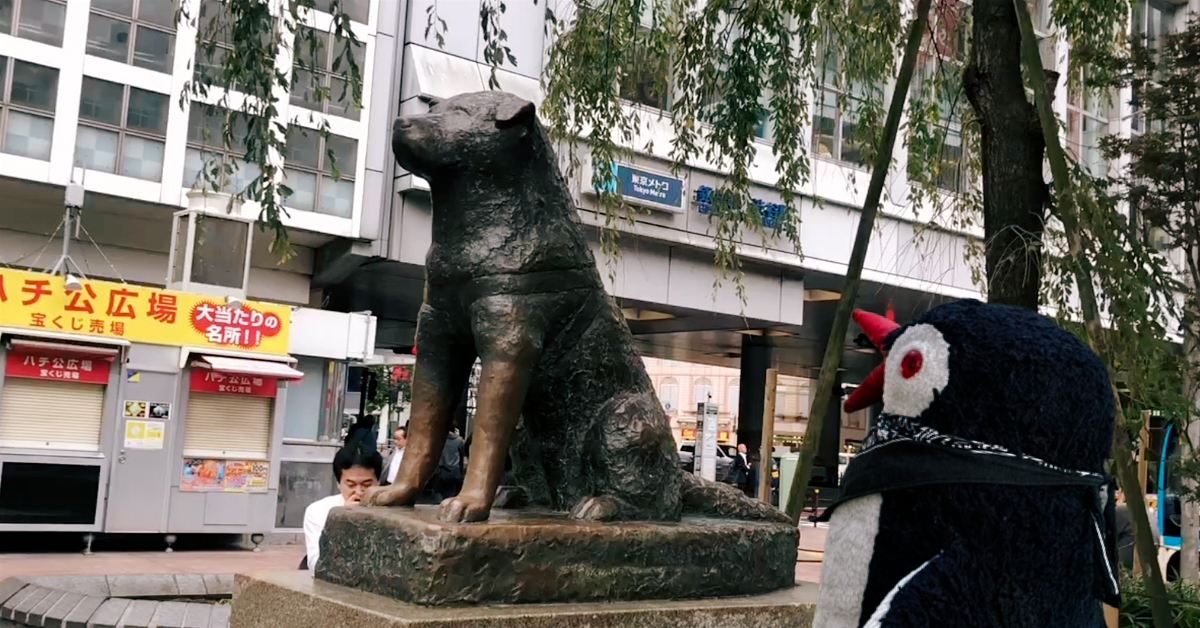
Right outside Shibuya Station, you’ll find one of Tokyo’s most recognizable meeting points: a bronze statue of a dog named Hachiko. While Shibuya is famous for its neon lights, shopping streets and endless crowds, this little statue tells a much quieter story about loyalty, devotion and the bond between a dog and its owner. It has become a popular stop for visitors and locals alike, and almost everyone passing through the area seems to know where Hachiko is.
Who Was Hachiko?
Hachiko was an Akita dog born in 1923 in Odate, Akita Prefecture, Japan. He belonged to Professor Hidesaburo Ueno, who worked at the University of Tokyo. Every day, Hachiko accompanied his owner to Shibuya Station and returned in the afternoon to welcome him home.
That routine changed in May 1925, when Professor Ueno died suddenly while at work. He never returned to the station. However, Hachiko continued to visit the station around the time his owner usually arrived, waiting for him day after day.


For nearly ten years, Hachiko kept returning to Shibuya Station, waiting for his owner, who never came back. His story gradually attracted attention from residents and eventually newspapers, turning him into a national symbol of loyalty and devotion in Japan.
Hachiko passed away on 8 March 1935, but his story lives on. His preserved remains are kept at the National Museum of Nature and Science in Tokyo, while part of his remains is buried alongside Professor Ueno at Aoyama Cemetery.
Why Is Hachiko’s Statue So Famous
The original bronze Hachiko statue was unveiled in 1934, while Hachiko was still alive and able to attend the ceremony. The statue was later removed during World War II, when Japan needed metal for the war effort. Takeshi Ando, the original sculptor’s son, unveiled a replacement in 1948. Today, the statue serves as one of Shibuya’s most popular meeting points. You’ll often hear people saying, “Let’s meet at Hachiko,” making it a familiar landmark for both Tokyo residents and international visitors.
Where to Find the Hachiko Statue
Finding Hachiko is easy. The statue stands in Hachiko Square, just outside Shibuya Station’s Hachiko Exit. You’ll find it near the famous Shibuya Scramble Crossing, making it a convenient first stop when exploring the neighborhood. It’s completely free to visit, and you don’t need to book anything. Just be prepared to wait a little if you want a photograph, as the statue is a popular meeting point and often attracts a small crowd.
Our Experience Visiting Hachiko
Of course, we couldn’t visit Shibuya without stopping to meet Hachiko. We’ve heard his story before, but seeing the statue in person adds something different to the experience. It’s a relatively small monument surrounded by the constant movement of one of Tokyo’s busiest areas, which makes the contrast even more interesting. We stopped for a few photographs before continuing towards the famous crossing. It’s one of those little Tokyo landmarks that deserves a place on your itinerary, even if you only spend a few minutes there.
Pro Penguin Tips
Visit Hachiko early in the morning if you want a photograph without too many people in the background. During the day, the square gets busy with tourists and locals using the statue as their favorite meeting point.
Shibuya Crossing: Experiencing Tokyo’s Famous Scramble
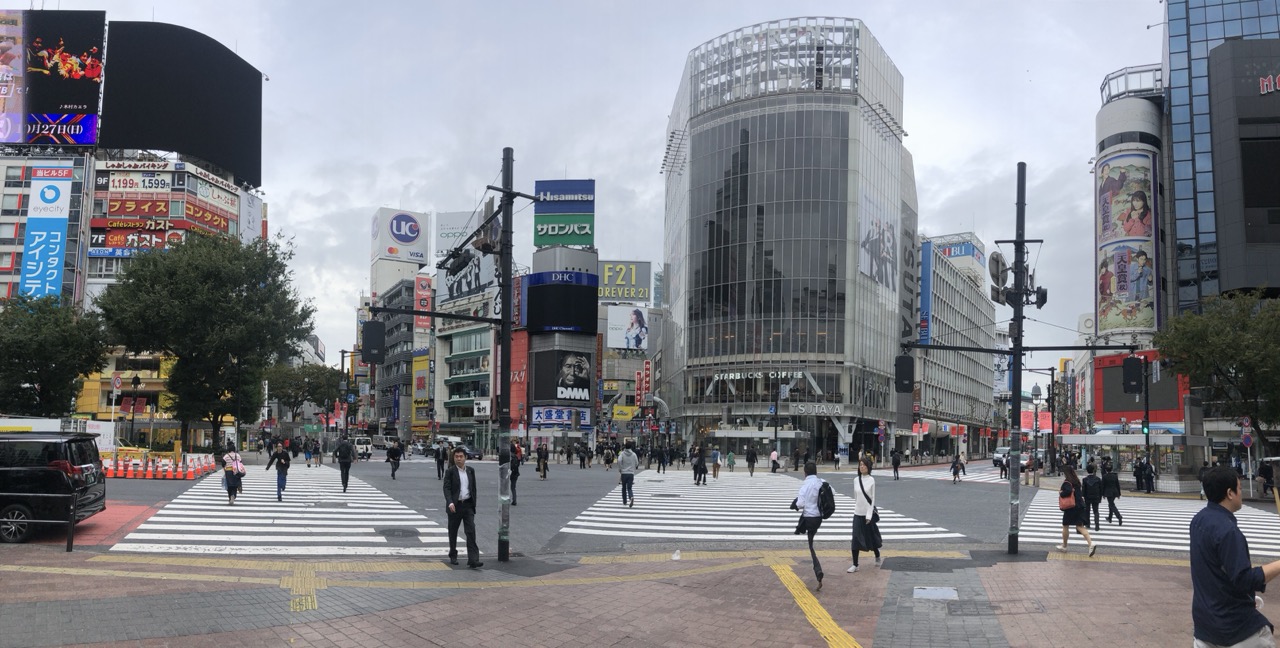
If one image immediately comes to mind when you think of Tokyo, it is probably Shibuya Crossing. You’ve seen it in films, travel photos, and countless social media videos, but seeing it in person feels completely different. Right outside Shibuya Station, this famous intersection brings together pedestrians from several directions, creating what looks like organized chaos every time the traffic lights change. It is one of those places where you can stand and watch the city move for much longer than you originally planned.
What Makes Shibuya Crossing So Famous
Shibuya Crossing, also known as Shibuya Scramble Crossing, is often described as one of the world’s busiest pedestrian intersections. Its fame comes from the sheer number of people crossing at once, the distinctive diagonal routes, and the spectacular urban setting.
Five pedestrian crossings converge at the intersection. When the traffic lights change, vehicles stop in every direction, and pedestrians can cross at the same time. People move from the pavements on all sides, including diagonally through the center, before the lights change again and traffic resumes.
Towering buildings, enormous digital advertising screens, colorful shop signs, and Shibuya’s constant movement frame the experience. It has also appeared in numerous international films and television productions, making it one of modern Japan’s most recognizable images.
How Does the Shibuya Scramble Crossing Work
Unlike a traditional intersection, where pedestrians cross one street at a time, Shibuya uses an all-direction pedestrian signal. All vehicles stop at the same time, letting people cross in multiple directions without navigating moving traffic. The signal cycle repeats roughly every two minutes, although the exact timing can vary. Once the lights turn red for pedestrians, everyone clears the road and vehicles take over again.
The interesting part is how smoothly it all works. Despite the crowds, people generally manage to move around each other without much difficulty. It looks chaotic from above, but from street level, it has a surprisingly natural rhythm.
How Many People Cross Shibuya Crossing
The numbers are impressive. According to the Japan National Tourism Organization, an estimated 1,000 to 2,500 pedestrians cross during the busiest two-minute periods. Other tourism sources cite peak estimates of around 3,000 people during a single green light. Exact figures vary by time and counting method, but either way, that’s a remarkable number of people sharing one intersection.
What Is It Like to Cross Shibuya Crossing for the First Time
There is something quite surreal about standing at the edge of the crossing, watching the pedestrian signal turn green and suddenly finding yourself surrounded by hundreds of people moving in every possible direction. You can choose your route, follow the crowd, or cut diagonally through the middle. For a few seconds, it feels as though the entire city is moving around you. Then, almost as quickly as it started, the crossing empties, traffic returns, and everyone waits for the next cycle.
It’s a simple experience, but one that somehow captures Tokyo perfectly. We had seen Shibuya Crossing countless times before our trip, yet being there in person made it feel entirely different. Naturally, we had to cross it ourselves rather than watch from the pavement!
Tours and tickets from KlookShows Klook’s own box, which can set Klook cookies.Tours and tickets in Tokyo on KlookKlook’s box can’t load on this device (an ad blocker often stops it). This opens Klook’s own page.Open Klook
Where Are the Best Places to Photograph Shibuya Crossing
One of the best things about Shibuya Crossing is that you can experience it from several different perspectives. Waddling through the intersection is fun, but seeing the sheer scale of the crowds from above gives you a completely different appreciation of the place.
- SHIBUYA SKY. Located 229 meters above the city, this rooftop observation deck offers spectacular 360-degree views of Tokyo, including Shibuya Crossing. It’s a paid attraction, and sunset is a particularly popular time to visit.
- Starbucks Shibuya Tsutaya. A classic spot for watching the crossing from above. The windows overlooking the intersection offer a great view of pedestrian movement, though getting a window seat can be challenging when it’s busy.
- MAGNET by SHIBUYA109. Its rooftop viewpoint, MAG8, offers a closer overhead perspective of the crossing. It’s another option if you want to photograph the pedestrian flow from above.
When Is the Best Time to Visit Shibuya Crossing
Shibuya Crossing looks different throughout the day, and the best time to visit depends on the atmosphere you’re after.
- Morning: A good opportunity to see the commuter rush and experience the crossing before the neighborhood gets too busy with tourists.
- Afternoon: The surrounding streets are full of shoppers, visitors, and locals. It’s a good time to combine the crossing with sightseeing around Shibuya.
- Evening: Arguably the most photogenic time. The giant advertising screens light up, the surrounding buildings glow with neon, and the crossing becomes even more atmospheric.
- Late at night: The crowds gradually thin out, although Shibuya remains lively well into the evening.
If you want the classic Tokyo photograph, aim for sunset and early evening, when you can capture both the crowds and the illuminated buildings.
Pro Penguin Tips
Don’t just cross Shibuya Crossing and move on. Find an elevated viewpoint and spend a few minutes watching the crowds from above. The contrast between the seemingly chaotic movement and how smoothly everyone navigates the intersection is fascinating. For a closer overhead photograph, consider MAG8; for panoramic Tokyo views, head to SHIBUYA SKY.
Nonbei Yokocho: Exploring Tokyo’s Drunkard’s Alley
Just a short waddle from the famous Shibuya Crossing, we found ourselves on a completely different side of Tokyo. Nonbei Yokocho, also known as Drunkard’s Alley, is a collection of narrow lanes lined with tiny traditional Japanese bars and eateries. The contrast is quite something. One moment you’re surrounded by enormous digital screens, shopping centers, and thousands of pedestrians; the next, you’re standing in a little alley lit by red lanterns, with wooden shopfronts and barely enough room for a handful of people. It’s a glimpse of an older Tokyo that feels worlds away from the modern Shibuya just around the corner.
What Does Nonbei Yokocho Mean
The name Nonbei Yokocho (のんべい横丁) roughly translates to Drunkard’s Alley or Drinkers’ Alley. The Japanese word nonbei refers to someone who enjoys drinking, while yokocho means a narrow side street or alley. And the name is rather fitting. The area is known for its small izakayas, traditional Japanese pubs where people gather after work for drinks, conversation, and a little something to eat. Unlike the larger, more commercial nightlife venues elsewhere in Shibuya, these establishments offer a much more intimate setting.


A Little History of Drunkard’s Alley
Nonbei Yokocho dates back to the early 1950s, during the post-war period when Tokyo was rebuilding itself. Its origins are connected to the small food stalls and informal markets that appeared around Shibuya after World War II. These stalls eventually developed into the permanent little shops and drinking establishments that make up the alley today.
Over the decades, much of Shibuya has transformed dramatically. Modern shopping complexes, office towers and enormous entertainment buildings have replaced many of the older streets. Nonbei Yokocho, however, has managed to retain much of its original character.
Today, the alley is home to around 40 small bars and eateries, some with only a handful of seats. It’s a little piece of post-war Tokyo that has survived right in the middle of one of the city’s busiest neighborhoods.
What Makes Nonbei Yokocho Different from Modern Shibuya
The contrast is probably the first thing you’ll notice. Shibuya is all about movement, bright screens, department stores, and crowds rushing between destinations. Nonbei Yokocho feels almost frozen in another era.
Instead of glass buildings and enormous advertising displays, you’ll find narrow passageways, modest wooden façades, small signs and traditional lanterns. The shops are packed closely together, and the whole area has a much more personal atmosphere.
It’s not a large neighborhood, and you won’t need much time to explore its lanes. Yet that’s precisely what makes it interesting. Just a few minutes away from the famous crossing, you can experience a quieter, more nostalgic side of Tokyo that many visitors might otherwise miss.
The Atmosphere: Lanterns, Tiny Bars and Traditional Izakayas
As the evening approaches, Nonbei Yokocho becomes particularly atmospheric. Red paper lanterns illuminate the narrow passageways, small signs light up above the entrances, and the little bars begin welcoming their evening customers.
Many establishments specialize in traditional Japanese food and drinks. You might come across a yakitori bar serving grilled chicken skewers, a little counter offering oden (a Japanese hot pot dish), or a cozy bar specializing in sake, whisky, or cocktails.
What makes the experience special is the scale. These aren’t large restaurants with rows of tables. Most places have a counter with just four to eight seats, bringing customers close to the person preparing their food and drinks.
If you decide to step inside one of the establishments, don’t expect a spacious restaurant. Some bars are barely larger than a small living room, with a counter, a few stools, and shelves filled with bottles.
Is Nonbei Yokocho Worth Visiting If You Don’t Drink
We think so! Even if you’re not planning an evening of bar hopping, Nonbei Yokocho is an interesting little detour when exploring Shibuya. The narrow lanes, traditional architecture, and glowing lanterns offer a different perspective of Tokyo, especially if you’re interested in photography and discovering places beyond the usual sightseeing stops.
Our Experience Visiting Nonbei Yokocho
We added Nonbei Yokocho to our Shibuya itinerary as our final stop after visiting Hachiko and crossing the famous scramble intersection. What stood out most was the contrast. After spending time surrounded by enormous screens, busy streets, and constant movement, stepping into these little lanes felt like finding a completely different Tokyo.
We wandered through the narrow alleyways, admired the traditional shopfronts, and took in the atmosphere. Even without stopping for a drink, we enjoyed seeing this older side of Shibuya and how it continues to exist alongside the neighborhood’s modern developments. It’s a small place, but one that adds a little more character to a day spent exploring Shibuya.
Pro Penguin Tips
Be respectful when taking photographs. Nonbei Yokocho is home to small independent bars, not just a picturesque sightseeing spot. Avoid photographing customers or interiors without permission, and don’t block the narrow passageways while taking pictures. The best photographs are often of the lanterns and shopfronts from the alley itself.
How to Visit All Three Shibuya Attractions
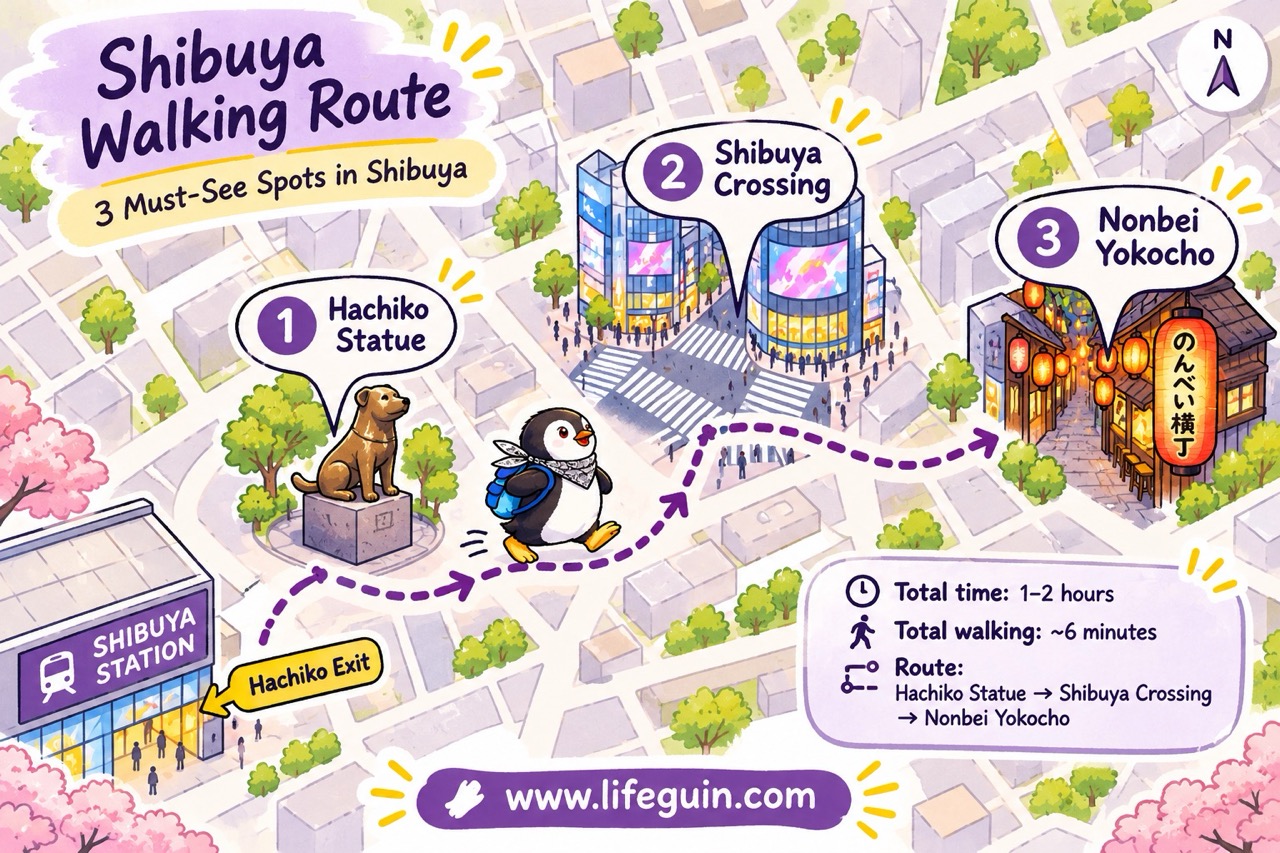
One of the best things about exploring Shibuya is that you don’t need to spend much time traveling between its main attractions. Hachiko Statue, Shibuya Crossing, and Nonbei Yokocho are all within a short waddle of each other, making them easy to combine into one sightseeing route.
We recommend starting at Shibuya Station, visiting Hachiko first, experiencing the famous scramble crossing, and finishing with a stroll through the atmospheric lanes of Nonbei Yokocho. It’s a lovely way to see three very different sides of Tokyo without rushing from one part of the city to another.
Where to Start: Shibuya Station’s Hachiko Exit
Start your waddle at Shibuya Station’s Hachiko Exit. Once outside, you’ll find Hachiko Square and the famous dog statue just a few steps away.
From there, the Shibuya Scramble Crossing is directly in front of you. After experiencing the crossing from street level, continue to Nonbei Yokocho, tucked away just a few minutes from the main intersection.
Walking Route Between the Three Attractions
Here’s the order we’d recommend:
- Hachiko Statue: Start at Hachiko Square and spend about 10–15 minutes learning the famous dog’s story and taking photos.
- Shibuya Crossing: Head straight towards the intersection and cross it yourself. Allow another 15–30 minutes to take in the crowds and snap photos from different angles.
- Nonbei Yokocho: Finish your waddle in Drunkard’s Alley. Explore the narrow lanes, admire the lanterns and, if you fancy it, stop at one of the tiny izakayas for a drink or something to eat.
Other Things to See Near Shibuya
- Shibuya Center-Gai. A lively pedestrian shopping street filled with fashion stores, restaurants, arcades and colourful neon signs.
- Miyashita Park. A modern rooftop park with green spaces, cafés, restaurants and a skatepark.
- Shibuya PARCO. A shopping destination featuring Nintendo TOKYO, Pokémon Center SHIBUYA and plenty of Japanese pop-culture stores.
- SHIBUYA SKY. A spectacular rooftop observation deck offering panoramic 360-degree views of Tokyo.
- Shibuya Hikarie Sky Lobby. A free indoor viewpoint on the 11th floor with large windows overlooking the city.
- Spain-Zaka (Spain Slope). A charming little sloping street lined with cafés, restaurants, and independent shops.
Buy Us a Ko-fi

Shibuya is much more than its famous pedestrian crossing. From the heartwarming story behind the Hachiko Statue to the organized chaos of the scramble crossing and the nostalgic atmosphere of Nonbei Yokocho, these three stops offer a lovely introduction to Tokyo’s many personalities. We loved how quickly the scenery changes as you waddle from one place to another, from modern skyscrapers and flashing screens to little lantern-lit alleys that feel like another era. If you’re planning your first Tokyo itinerary, add all three to your list. They’re close to each other, easy to explore on foot, and together capture what makes Shibuya such a fascinating neighborhood.
Travel Bold. Eat Well. Waddle Wild.

This post contains affiliate links. If you click and buy, I might earn a tiny commission, enough to help a penguin keep up its globe-trotting lifestyle. No extra cost to you, just more fish for me. Thank you for supporting the adventure!