MUNCH Museum Oslo: What to See, The Scream and Our Visit
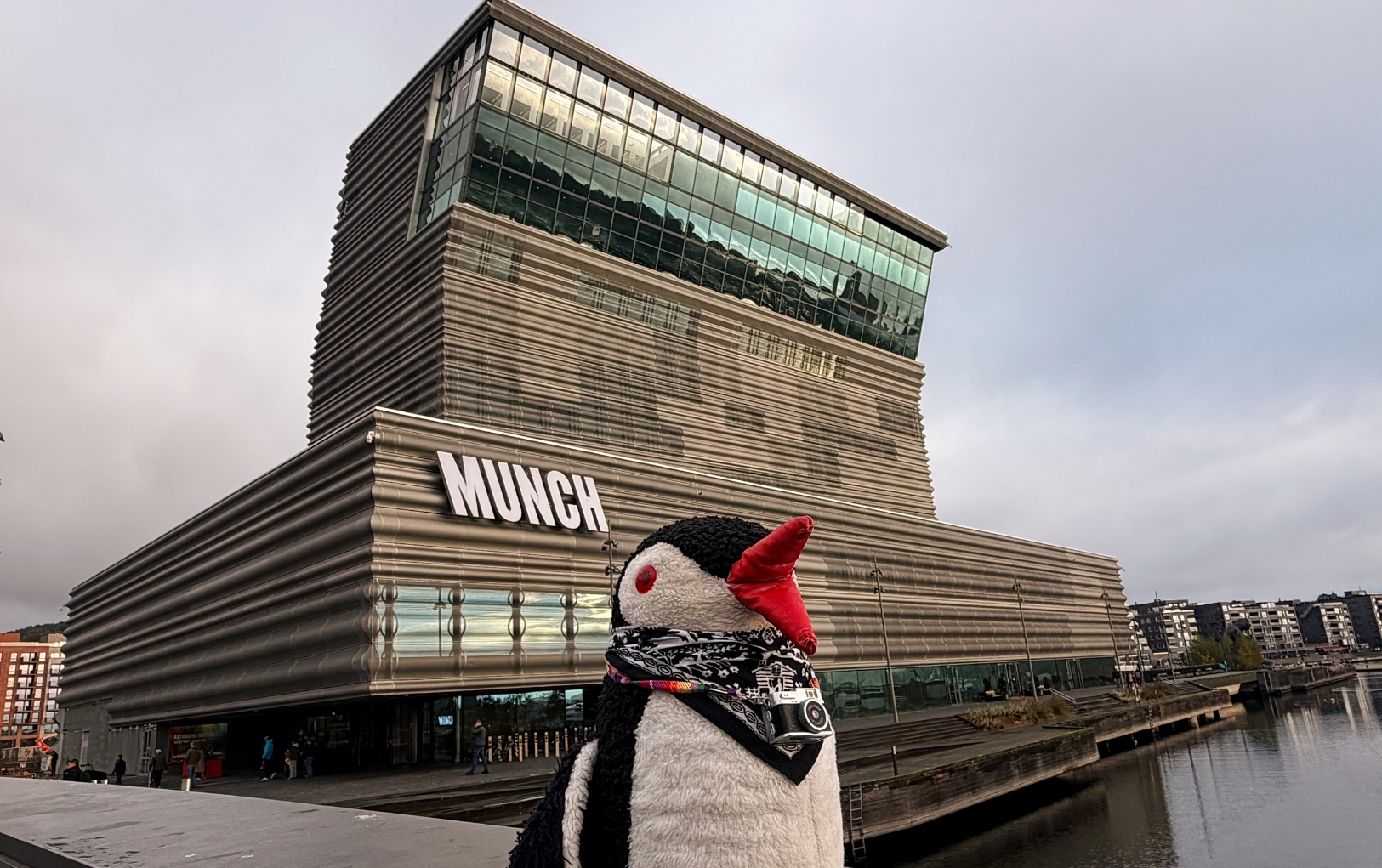
As you start exploring Oslo, the MUNCH Museum is another must-see building. Rising high above the Bjørvika waterfront, its distinctive silhouette catches your eye long before you get close. Visiting it was on our Oslo list, and thankfully, MUNCH stays open quite late, which meant we could save our visit for the evening. Something was fitting about ending the day surrounded by Edvard Munch’s paintings, especially in a city that inspired so much of his work. So, after a day of waddling around Oslo, we headed to MUNCH for an evening with one of Norway’s most famous artists.
- Why Does Oslo Have a Museum Dedicated to Edvard Munch
- Quick Facts
- How to Get to MUNCH Museum
- Opening Hours and Tickets
- How We Explored MUNCH: Start at the Top and Waddle Down (Almost)
- How Much Time Do You Need at MUNCH
- Facilities and Amenities at MUNCH
- The Best Time of Day to Visit MUNCH
- What to See Near MUNCH Museum
- Is MUNCH Worth Visiting if You Don’t Have the Oslo Pass
Why Does Oslo Have a Museum Dedicated to Edvard Munch
Edvard Munch is so closely woven into Oslo’s cultural history that a museum dedicated to his work feels almost inevitable. Munch was born in Norway, spent much of his life working in and around Oslo, and left the city an extraordinary artistic legacy. In 1963, marking the centenary of his birth, the original Munch Museum opened at Tøyen to preserve and display the collection he had donated to Oslo. Today, that collection has a much more dramatic home in Bjørvika, where the new MUNCH opened in 2021. And this is where the story becomes much bigger than The Scream.
Quick Facts
📍 Location: Edvard Munchs plass 1, 0194 Oslo
🕒 Opening Hours: Monday–Tuesday and Sunday 10:00–18:00. Wednesday–Saturday 10:00–21:00. Opening hours can change, so double-check before visiting.
🎟️ Tickets: Adult admission is currently NOK 180
🎫 Oslo Pass: Included with the Oslo Pass.
⏱️ Time Needed: Allow around 1.5–2 hours
🌐 Official Website: MUNCH Museum
How to Get to MUNCH Museum
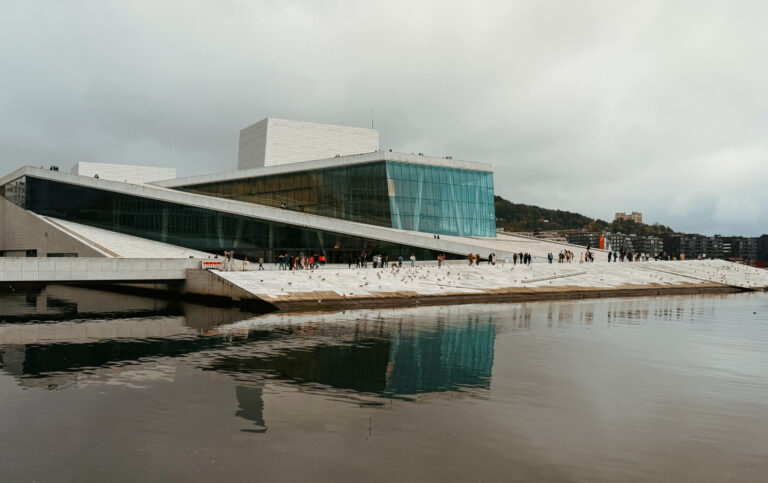
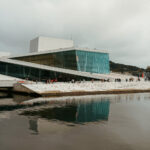
MUNCH is in Bjørvika, right on Oslo’s waterfront, so it’s easy to reach and simple to combine with the Oslo Opera House and the rest of the neighborhood. The museum is only a short waddle from Oslo Central Station, making it particularly convenient if you are exploring the city on foot. If you are already visiting the Oslo Opera House, you can continue along the waterfront towards MUNCH. The two buildings are close enough that visiting them together is an easy part of the same walk.
If you are coming from farther across Oslo, public transport is straightforward. Tram lines 13 and 19 serve the Bjørvika / Stortorvet area, while buses also stop nearby. From Oslo Central Station (Oslo S), however, you are better off walking: MUNCH is only a short stroll away in Bjørvika. For the most up-to-date route, check Ruter before traveling, as Oslo’s public-transport routes and stops can change.


Our tip: If you plan to visit both, start at the Opera House, waddle across its rooftop, then continue to MUNCH. It makes a particularly nice little Bjørvika route, with the fjord, modern architecture, and Munch’s art all packed into one walk.
Opening Hours and Tickets
MUNCH is open late on selected days, which is particularly useful if you want to fit the museum into a busy Oslo itinerary or, like us, visit in the evening. The museum is open Monday and Tuesday from 10:00 to 18:00. From Wednesday to Sunday, it stays open until 21:00. Opening hours can change, especially around holidays and special events, so it is always worth checking the official MUNCH website before you visit.
Tickets
- Adults: NOK 180
- Young visitors aged 18–25: Reduced admission
- Under 18: Free
- Oslo Pass: Admission is included with the Oslo Pass.
- Plushies: Free entry
You can buy tickets online through the official MUNCH website. Check the official website before visiting, particularly because opening hours, ticket prices, and exhibition access can change.
How We Explored MUNCH: Start at the Top and Waddle Down (Almost)
We decided not to start at the bottom and work our way up. Instead, we wanted to get as high as possible first and then slowly make our way down through the museum. MUNCH rises across 13 floors, and while not every floor is an exhibition space, the building is designed so that you can move between galleries and experiences as you descend. We started around the upper exhibition floors and then worked our way down, stopping whenever something caught our attention.
We started our visit much like we would at any other museum. We came in, headed to the ticket counter, and showed our Oslo Pass, which got us our admission tickets to scan before entering the exhibition spaces. Before heading upstairs, we left our backpacks and other belongings in the lockers so we could enjoy the museum without carrying everything around. Also, no backpacks are allowed.
And a little shout-out to the lockers, because these deserve one. They are completely free to use, and the system is wonderfully simple. You choose a locker, enter a code, put your things inside, and close it. No coins, no complicated instructions, no hunting around for a key. Just lock it and go.
Then it was time to start exploring. We took the escalator up and, for reasons mostly down to our own laziness, decided the ninth floor was high enough to start with. Instead of going all the way to the top, we got off there and worked our way down through the exhibitions. Later, when we wanted to move between the higher floors, we gave our legs a break and used the elevator. It turned out to be a rather random starting point, but it actually worked well for us because we got to explore the museum in a less predictable order.


Floor 9: Munch and the Chocolate Factory
Our MUNCH adventure started on the ninth floor, where we came across one of the exhibitions we least expected: Munch and the Chocolate Factory. It offered a different introduction to the artist. Instead of starting with The Scream or one of his other famous paintings, we learned about Munch’s connection to Freia, Norway’s best-known chocolate company.
Freia commissioned Munch to create a series of paintings for the company’s new factory and headquarters in Oslo. The resulting works were not traditional advertising posters. Munch created large-scale scenes inspired by the workers and the factory environment, turning an industrial workplace into an artistic subject. The paintings capture people at work, machinery, and the rhythm of everyday life, giving you a glimpse of a very different side of Munch’s creativity.


Floor 7: Getting Closer to Munch
Our next stop was the seventh floor, and this was one of the parts of MUNCH we enjoyed the most. The exhibitions here felt much more personal and, importantly for us, much more interactive. Rather than simply standing in front of paintings and reading about Munch, we could actually try some of the techniques he used ourselves.
The floor explores Munch’s relationship with printmaking, including his famous woodcuts, and there are interactive stations where you can experiment with the process. We could create our own little designs and try cutting and printing, which made it much easier to understand how much work and experimentation went into Munch’s prints. It was the kind of museum experience we love: you can look at the art, but you can also do something yourself.
After the more unexpected chocolate factory exhibition on the ninth floor, this was a completely different side of Munch. And honestly, getting to be a little creative ourselves made this one of our favorite stops along the way.


Floor 6: Munch on a Monumental Scale
From the seventh floor, we continued down to floor six, where the sheer scale of Munch’s work really caught us by surprise. The exhibition Monumental is housed in a double-height gallery, giving his enormous paintings the space they need to breathe. Some works were created for the University of Oslo’s Ceremonial Hall, and several are so large that they are difficult to appreciate fully in photographs.
Standing in front of them, you suddenly understand why seeing Munch in person is so different from seeing his paintings reproduced in a book or online. Some of these works cover up to around 50 square meters, so they completely dominate the space. We knew Munch was famous for his paintings, of course, but we were not quite prepared for how monumental some of them actually are. It was one of those moments in the museum when you stop and look up.


Floor 4: The Munch You Came to See
Before heading straight for The Scream, take your time on the fourth floor. Infinite is the museum’s largest collection exhibition, designed less like a greatest-hits gallery and more like a journey through the ideas that kept returning throughout Munch’s career. The works are arranged into thematic sections exploring love, death, sexuality, loneliness, self-portraits, landscapes, the human body, and Munch’s fascination with movement and variation. You will find paintings alongside drawings, prints, photographs, film, and even sculpture, giving you a much broader sense of how experimental he was as an artist.
You’ll also find plenty of works you may recognize without immediately knowing their names. Munch returns again and again to the same subjects, sometimes repainting or reworking them years later and changing the colors, mood, or composition. That makes the exhibition particularly interesting to wander through because you start noticing how one idea develops into another. The Scream is undoubtedly the star of the floor, but it makes much more sense once you’ve seen the rest of Munch’s world around it.


Finally, The Scream
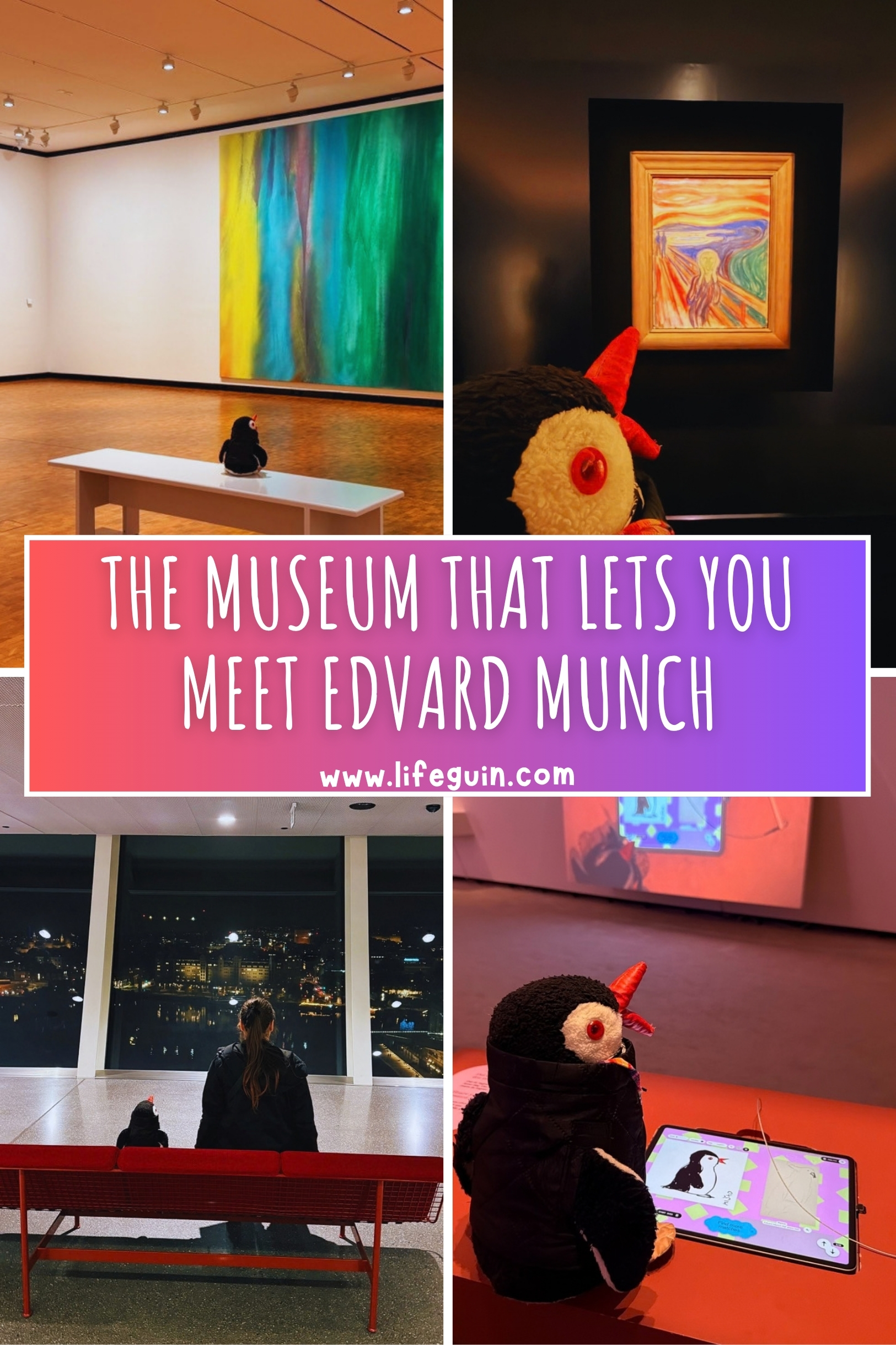
And then, of course, there it is: The Scream. Seeing it in person is one of those museum moments where you cannot help but join everyone else gathered around it. MUNCH actually owns three versions of The Scream: a painted version, a pastel version, and a lithographic version. They don’t display them all at once. Instead, the museum rotates some versions so you can see different works from the series while protecting the fragile originals.
During our visit, we were lucky enough to catch one of the rotating versions on display. The museum changes the works about every 30 minutes, so if you arrive when one version is being swapped, stick around for a little while. You might get to see another side of Munch’s most famous image. And yes, we definitely stayed long enough to get our Scream moment.


Floor 3: Katharina Grosse Turns the Museum Into a Canvas
Heading down to floor three, we suddenly left Munch’s world behind and stepped into the much more explosive universe of German artist Katharina Grosse. Her exhibition, Black Bed, was one of the temporary exhibitions during our visit, and it felt like a completely different world. Grosse is known for breaking the traditional boundaries of painting, spraying color across not just canvases but walls, floors, objects, and entire spaces.
What really caught our attention were the huge, monumental installations, including Locke, a large steel work created especially for this exhibition, alongside intensely coloured paintings and the central Black Bed installation. Grosse has also been directly inspired by Munch, particularly his monumental The Sun, creating an intentional conversation between the two artists. Interestingly, while preparing the exhibition, she worked in Munch’s historic studio at Ekely in Oslo, bringing the connection full circle.
For us, it was a great reminder that MUNCH is not only about preserving Munch’s art. The museum also puts his work into dialogue with contemporary artists, and floor three felt more like stepping inside a painting than simply looking at one.


Floor 12: A Quick Detour for the Views
After exploring the lower floors, we hopped into the elevator and headed back up to floor 12. We weren’t finished with MUNCH yet, but this felt like a good moment to take a detour and see what was waiting higher up. The restaurant is here, but even if you are not stopping for a meal, you can step out of the elevator or come up the stairs and find a viewing platform with places to sit.
We took a moment to enjoy the panorama before continuing with the museum. From here, you get a great view across Bjørvika, the Oslofjord, and the city, and after spending so much time looking at Munch’s world indoors, it was nice to step outside and look at Oslo itself. We definitely recommend coming up even if you are not planning to eat at the restaurant. The views are too good to skip.


Floor 11: Munch in His Artistic World
After our little detour on the 12th floor, we continued to floor 11, where the museum shifts the focus from Munch as a lone artistic genius to the world around him. The exhibition Edvard Munch Horizons places his work alongside artists and artistic movements from his time, helping you understand the influences and conversations that shaped his career.
What we liked here was the added context. Instead of seeing Munch’s work in isolation, you start to notice connections, similarities, and differences between his approach and that of other artists. It gives you a better idea of where Munch fit into the wider European art scene and, at the same time, how distinctive his visual language became.


Floor 10: Draw, Experiment and Find Your Munch Twin
We finished our MUNCH adventure on the 10th floor, and it turned out to be a favorite. The exhibition Connect the Lines takes Munch’s drawings and turns them into a much more interactive experience. Instead of simply looking at his work behind glass, you can actually create your own drawing and then see which of Munch’s works it most closely resembles. We could experiment, draw, and play around with the digital displays, and then discover unexpected connections between our own little creations and Munch’s originals.
After so many floors of standing in front of important artworks, we loved ending with something we could actually participate in. It made the museum feel playful and personal, and once again showed that MUNCH is not afraid to let visitors do more than look. Our final stop ended with us making our own little pieces of art and seeing what Munch might have thought.


We also loved the atmosphere of this floor. The gallery is spacious and relaxed, with plenty of places to sit down and take your time. There were iPads available for drawing, so you could settle in and create something without feeling rushed; one section even let you share your drawing straight away. It felt almost like a cozy creative studio tucked inside a museum, and after several floors of looking at Munch’s work, it was the perfect place to slow down and play with the art ourselves.
Although our exploration of MUNCH was admittedly a little chaotic, it somehow worked out perfectly for us. We jumped between floors, took an elevator when our legs needed a break, and even detoured back to the top for the views. In the end, that slightly random route let us experience the museum in our own way.
Of course, there is no wrong way to explore MUNCH. You can start at the top and waddle your way down, or begin on the lower floors and slowly make your way upwards. If we came back, though, we would probably do it from the bottom up and finish with the views from the upper floors. After all those paintings, installations, and interactive experiences, ending your visit high above Oslo sounds like a pretty perfect finale.
How Much Time Do You Need at MUNCH
How long you spend at MUNCH really depends on how closely you like to look at art. You could see the highlights in an hour, but with 13 floors of exhibitions, interactive experiences, and different sides of Munch’s work, there is plenty to keep you there much longer. We spent almost two hours exploring, and honestly, we could easily have stayed longer. MUNCH itself suggests anything from one hour for a highlights visit to two to four hours for a more comprehensive experience, so I would recommend allowing at least two hours if you want to properly enjoy the museum without rushing from one floor to another
Facilities and Amenities at MUNCH
- Free Lockers: Lockers are available in the lobby and are free to use. They are designed for hand luggage up to 55 × 40 × 23 cm, so you can’t store larger suitcases.
- Toilets: Toilets are available in the lobby, with accessible toilets and baby-changing facilities also on floors 3, 6, 9, 12 and 13.
- Elevators: Elevators run throughout the museum, with step-free access between exhibition floors. You can also borrow wheelchairs from the lobby.
- Escalators: Escalators connect the different levels, making it easy to move up and down the building without relying on the elevators.
- Accessibility: MUNCH is fully wheelchair accessible and designed according to universal accessibility standards. The museum has seating throughout, step-free access, and accessible facilities.
- Free Audioguide: A free audioguide is available in several languages, including English, Norwegian, German, French, Spanish, Japanese, Chinese, and Sign Language.
- Café, Restaurant & Bar: Grab something at MUNCH Kafé on the ground floor, have a meal at the restaurant on the 12th floor, or head to the MUNCH Bar on the 13th floor for panoramic views.
- Gift Shop: The museum shop is in the lobby, so you can browse books, art-related gifts, and Munch souvenirs after finishing the exhibitions.
- Free Wi-Fi: The museum offers free MUNCH-guest Wi-Fi throughout the building.
- Photography: You can take photographs inside the museum, but flash photography is not permitted in the exhibition halls.
- Families: Strollers cannot be taken into the exhibition galleries, but stroller parking is available, and the museum also has baby carriers available to borrow.
For us, the free lockers, plenty of seating, and easy elevators and escalators made a big difference, especially because there is so much ground to cover across the building.


The Best Time of Day to Visit MUNCH
We visited MUNCH in the evening, which worked thanks to its later opening hours. The museum felt calm and unhurried, and finishing our visit with the views over Oslo after dark was a lovely bonus. During the day, you will have brighter views through the huge windows, but an evening visit gives the museum a slightly more atmospheric feel.
Pro Penguin Tips
MUNCH regularly changes its temporary exhibitions and parts of its floor program, so the exact exhibitions you find on each floor may differ by the time you visit. We visited in October 2026, so treat our route as a snapshot of what was on display then rather than a permanent floor-by-floor guide. It is always worth checking the official MUNCH website before you go to see the latest exhibitions and layout.
What to See Near MUNCH Museum
- Oslo Opera House: Waddle across its famous marble rooftop and enjoy views over the Oslofjord.
- Deichman Bjørvika: Oslo’s striking main public library, with impressive modern architecture and city views.
- Barcode Project: A row of distinctive high-rise buildings forming one of Oslo’s most recognizable modern skylines.
- Oslobukta: A lively waterfront area with restaurants, cafés and public spaces.
- Sørenga: A waterfront neighborhood with restaurants, walking paths and the popular Sørenga seawater pool.
- SALT: A distinctive waterfront cultural venue with saunas, food and events.
- Sukkerbiten: A small waterfront area with views across the fjord and towards the Oslo coastline.
- Oslo Central Station: Just a short walk away, making it easy to continue exploring the city from Bjørvika.
Hotel search from Trip.comShows Trip.com’s own box, which can set Trip.com cookies.
Is MUNCH Worth Visiting if You Don’t Have the Oslo Pass
Whether MUNCH is worth the admission price really depends on how much you enjoy art and how interested you are in seeing Edvard Munch’s work, particularly The Scream. For us, it was definitely worth the visit. We enjoyed exploring the different exhibitions, the interactive elements, and seeing Munch’s work in person, but the building and the views were an important part of the experience too. Even between exhibitions, we could stop by the windows and look out across Oslo and the fjord. So while art lovers could easily spend several hours here, even visitors less familiar with Munch can find something to enjoy. And honestly, those views from the upper floors made the admission feel even more worthwhile.
Buy Us a Ko-fi

Whether MUNCH is worth the admission price really depends on how much you enjoy art and how interested you are in seeing Edvard Munch’s work, particularly The Scream. For us, it was definitely worth the visit. We enjoyed exploring the different exhibitions, the interactive elements, and seeing Munch’s work in person, but the building and the views were an important part of the experience too. Even between exhibitions, we could stop by the windows and look out across Oslo and the fjord. So while art lovers could easily spend several hours here, even visitors less familiar with Munch can find something to enjoy. And honestly, those views from the upper floors made the admission feel even more worthwhile.
Travel Bold. Eat Well. Waddle Wild.
Save This Pin for Later!
This post contains affiliate links. If you click and buy, I might earn a tiny commission, enough to help a penguin keep up its globe-trotting lifestyle. No extra cost to you, just more fish for me. Thank you for supporting the adventure!