What to See in Ľutina, Slovakia: Mini-Skanzen and Local Sights
We often head to places where tourists rarely go, and Ľutina turned out to be one of those little gems. It is a shame more people do not stop here, because this quiet corner of Eastern Slovakia packs more into one small area than we expected. From the Mini-Skanzen and its wooden churches to the surrounding sights, local history, and practical tips, this is everything you need to know before visiting Ľutina.
- Practical Information for Visiting Ľutina
- Why We Came to Ľutina
- Ľutina: A Village Shaped by Pilgrims and Wooden Churches
- Ľutina at a Glance
- How to Get to Ľutina
- Our First Impressions of Ľutina
- The Mini-Skanzen and Its Wooden Churches
- The Stories Behind the Miniature Churches
- Interesting Facts You Might Not Know
- Exploring the Rest of the Area
- Pilgrimages and Events in Ľutina
- How Long to Spend in Ľutina
- Best Time to Visit Ľutina
Practical Information for Visiting Ľutina
- Location: Ľutina, Prešov Region, Slovakia
- Getting there: Easiest by car
- Parking: Available in the area
- Entrance: Free
- Time needed: Around 30–60 minutes
- For children: Yes, especially the miniature churches
- Accessibility: Mostly easy to explore, with some uneven areas
Why We Came to Ľutina
Ľutina was not on our map. In fact, until that day, we did not even know this place existed. We had planned to spend our free day exploring the region, but heavy rain put those plans on hold. Then, almost as quickly as it arrived, the rain stopped. We grabbed our jackets, jumped in the car, and decided to let the road choose the adventure.
We had no carefully researched itinerary, no must-see list, and no real idea where we would end up. We wanted to see what was nearby. Somewhere along the way, Ľutina appeared on our radar, and curiosity did the rest. What started as an unplanned drive turned into a stop at a place we would probably never have visited if we had stuck to the usual tourist trail. And that is exactly what makes days like this so much fun: sometimes the places you know nothing about become the ones you remember.
Ľutina: A Village Shaped by Pilgrims and Wooden Churches
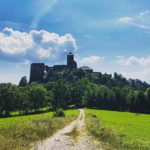
Ľutina sits in the Sabinov District of eastern Slovakia, on the southern slopes of the Čergov Mountains and in the valley of the Ľutinka stream. It is only about 9.5 kilometers from Sabinov, yet it feels far removed from the usual tourist route.
The village itself has a long history. Ľutina was first mentioned in written records in the 14th century, with the municipality dating its earliest mention to 1312. But an event much later, in 1851, changed the village forever. According to the Greek Catholic tradition, local woman Zuzana Feketová experienced apparitions of St Nicholas on Ľutinská hora. The events turned Ľutina into an important pilgrimage destination, and by 1855 the first official pilgrimage was held here.
Today, the pilgrimage complex is much more than a church. The Basilica of the Dormition of the Mother of God, chapels, walking routes, viewpoints, and the Miniskanzen are spread across the area. The first part of the Miniskanzen opened in 2011, displaying miniature wooden churches from eastern Slovakia at a 1:10 scale. A second stage followed in 2013 with another ten models from the Bardejov area.
That’s when Ľutina caught our attention. We came looking for a small local stop and found an entire piece of regional history gathered in one place. The wooden churches may be miniature, but the stories behind them reach across the villages and mountains of eastern Slovakia.
Ľutina at a Glance
- First mentioned: 1312, with the village itself documented by 1330.
- Distance from Sabinov: around 9.5 km.
- Elevation: Approximately 426 meters above sea level.
- Population: Around 475 inhabitants according to the municipality’s published data.
- Area: About 6.91 km², with much of the land covered by meadows and forest.
- Historic trade route: A medieval trade route to Kraków once passed through Ľutina.
- Pilgrimage history: Ľutina became a major Greek Catholic pilgrimage site after reported apparitions in 1851.
- First official pilgrimage: Held in 1855.
- Little-known fact: A noble castle called Hrádok stood above the village from the 14th to the mid-16th century.
How to Get to Ľutina
Ľutina is easiest to reach by car, making it a simple addition to a road trip through eastern Slovakia. The village sits close to Sabinov, with good road connections to the region’s larger cities.
-
- From Košice: Around 80 km, approximately 1 hour 15 minutes by car.
- From Prešov: Around 35 km, approximately 35–40 minutes by car.
- From Bratislava: Around 430 km, approximately 4 hours 45 minutes by car.
- From Sabinov: Around 10 km, approximately 10–15 minutes by car.
Ľutina has no railway station, so the easiest option is still to drive. Regional buses serve the village, including route 708468, which connects Ľutina with Sabinov and the surrounding villages. There are several stops in Ľutina, including Ľutina, centrum, Ľutina, nižný koniec, and Ľutina, vyšný koniec.
If you are already exploring the Šariš region, Ľutina is a good short detour from Sabinov or part of a wider road trip through eastern Slovakia.
Parking in Ľutina
You don’t need to worry about parking in Ľutina. The pilgrimage area has plenty of parking, with additional space around nearby buildings and roads. We visited outside the main pilgrimage crowds, so finding a spot was easy. We parked for free within the pilgrimage area, with plenty of space to choose from. During major pilgrimages, however, conditions can be different, so arriving early is a good idea.
Our First Impressions of Ľutina
We drove to Ľutina, arriving from the Sabinov side, following the road into the foothills of the Čergov Mountains. The village was already slipping into autumn, with the first leaves turning color and the landscape taking on that unmistakable early-season change. What struck us first was how well everything was kept. The streets were clean, the houses tidy, and the village had a quiet, lived-in feel rather than the polished atmosphere of a place built for visitors.
We didn’t feel like we had arrived at a major tourist attraction. Instead, Ľutina carried on with village life around us. That made our arrival feel even more unexpected. We had set off without much of a plan, and here we were in a place we hadn’t even known existed, beginning to realize there was more to see than we had expected.
The Mini-Skanzen and Its Wooden Churches
We had heard about the wooden churches in Ľutina, which is why we decided to come. We didn’t expect how much more there would be to explore once we arrived. We thought we were driving out to see a collection of miniature churches, but the Mini-Skanzen turned out to be part of a much larger pilgrimage area with its own history and stories.
The Mini-Skanzen brings together miniature versions of wooden churches from eastern Slovakia, built at a 1:10 scale. As you waddle around them, you can see the different shapes, towers, and architectural details that make these churches so distinctive. It is almost like taking a small architectural road trip through the region without leaving Ľutina.
The first ten models were unveiled in 2011, followed by another ten in 2013, including churches from the Bardejov area. Each represents a real church elsewhere in eastern Slovakia, many of them connected to the region’s Greek Catholic heritage.
For us, the miniatures were only the beginning. We came because we had heard about the wooden churches, but once we started walking around, we realized Ľutina wasn’t simply a quick stop to tick off a sightseeing list. There was a whole pilgrimage complex, more buildings to discover, and plenty of little details that made us want to stay longer.
Sometimes the unexpected part of a destination becomes the reason you remember it. Ľutina was exactly that kind of stop.


The Stories Behind the Miniature Churches
We were impressed from the moment we realized just how ambitious this place is. More than 40 wooden churches have survived in eastern Slovakia, most dating from the 18th and 19th centuries, and the Mini-Skanzen in Ľutina brings their stories together in one place. The collection is being built up as a miniature version of these remarkable buildings, with the replicas made as exact 1:10-scale copies of the originals.
What makes the churches special goes beyond their appearance. They were built entirely from wood, using construction techniques that make them distinctive examples of Carpathian architecture. Eight of the wooden churches in the Slovak part of the Carpathian Arc are even included on the UNESCO World Heritage List.


We found ourselves getting surprisingly absorbed in the details. The replicas reproduce the original churches in miniature, and each one has an information board explaining its history. Instead of trying to imagine what these churches look like from photographs, we could walk around them, compare their different forms and see how much they vary from one village to another.
The project has grown in stages. The first 10 miniatures, from around Snina, were created in 2011–2012. Another 10, representing the Bardejov area, followed in 2013. During the third stage in 2015–2016, 10 more from around Svidník and Snina, plus 10 from Ukraine, were added. A further nine miniatures from the Svidník area were also completed during 2015–2016, bringing the collection to 49 miniature churches.


And there is something important to remember when looking at them. These churches are not simply architectural curiosities. They were built as places of worship and remain active religious spaces in many of the villages where the originals stand. The Mini-Skanzen lets us see this scattered heritage together, even though the real churches are spread across remote parts of eastern Slovakia and beyond.
Interesting Facts You Might Not Know
- Some churches have no nails: Traditional wooden churches were often assembled with wooden joints and pegs rather than metal fasteners.
- The churches were designed around the landscape: Their locations were not random. Many stand on hills or other prominent spots, making them visible landmarks for the surrounding communities.
- There are different architectural types: The wooden churches of eastern Slovakia are not all built to the same plan. Their layouts and tower shapes vary by local tradition.
- The oldest surviving examples are centuries old: Some of the region’s wooden churches date back to the 16th century, making them among Slovakia’s oldest surviving wooden religious buildings.
- They were built without modern machinery: Local craftsmen constructed the churches using traditional hand tools and techniques passed down through generations.
- The interiors can be as remarkable as the exteriors: Many original churches contain historic iconostases, icons, and wall paintings, some of which are centuries old.
Exploring the Rest of the Area
We came to Ľutina for the wooden church miniatures, so we didn’t expect the rest of the area to keep us there much longer. But once we started walking around, we found a whole pilgrimage complex to explore. Everything was nicely looked after; the paths and surroundings were tidy, and there was plenty to see beyond the Mini-Skanzen. It turned our quick stop into a proper little afternoon adventure.
The Church of the Holy Family
You actually see the Church of the Holy Family before you reach the heart of Ľutina. As we drove towards the village, the church stood on the hill above us, making it hard to miss. It became one of those landmarks that quietly guide you towards your destination, and once we arrived, we could see that it was part of a much larger pilgrimage area. With the church visible from the road and the surrounding complex spread across the hillside, Ľutina makes its religious importance known before you even park.


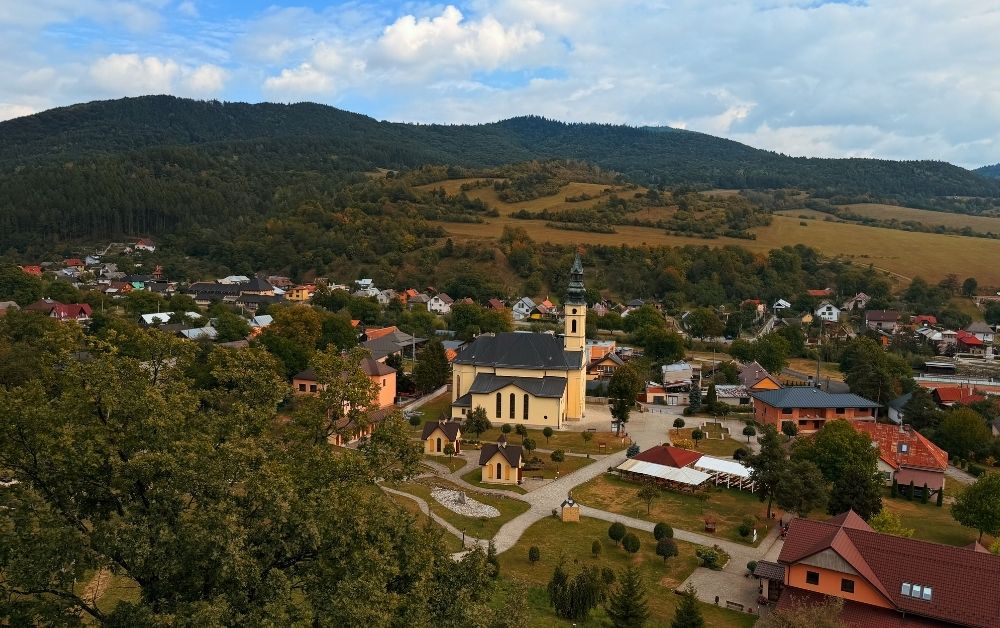
Once we reached the church, we decided to keep waddling and climb up the tower. It became our favorite part of the visit. Views are always one of our favorite things to look for when we travel, no matter which country we are exploring, and this one was worth the climb. From the top, Ľutina and the surrounding landscape spread out below us, giving us exactly the kind of perspective we love to find on our adventures. After coming here for the miniature wooden churches, we certainly did not expect a church tower view to become the highlight of our stop.


The Chapels Around Ľutina
The pilgrimage area extends beyond the main church. As we continued waddling around the grounds, we found several small chapels scattered across the hillside, each adding another stop to the walk. They make the area feel more like a pilgrimage route than a single attraction, with paths leading you from one place to another. We enjoyed taking our time here rather than rushing from one sight to the next, especially because the chapels also give you more chances to look out across the surrounding landscape.


Bazilika Ľutina
The Basilica of the Dormition of the Mother of God is the heart of the pilgrimage site in Ľutina. Built in 1908 to replace an earlier church, the present basilica remains one of Slovakia’s most important Greek Catholic pilgrimage sites. In 1988, Pope John Paul II granted the church the title of Basilica Minor. The basilica also houses a historic Baroque iconostasis from 1766, adding another layer of history.
We liked how naturally the basilica fits into the hillside. You can walk around the grounds, visit the chapels, explore the Mini-Skanzen, and then come back to the basilica itself. It gives the whole area a sense of purpose rather than feeling like a collection of separate sights.


The Basilica is only part of what you find in the Ľutina pilgrimage area. The complex is set up for visitors, with toilets, a souvenir shop, and pilgrim facilities, so you can comfortably spend more time here rather than just stopping for a quick look at the church. The grounds also include chapels, outdoor spaces, walking paths, seating areas, and the Mini-Skanzen. We liked that everything is within easy reach, so you can wander around at your own pace, take in the views, and make the visit as short or as leisurely as you like.
Pilgrimages and Events in Ľutina
Ľutina has a year-round religious calendar, so the main celebrations follow a fairly regular pattern. If you want to experience the pilgrimage site when it is most active, these are the key times to keep in mind:
- Main Ľutina Pilgrimage: August, the biggest pilgrimage of the year, centered around the Basilica and Ľutinská hora.
- Fatima Saturdays: Every month, on the first Saturday, with a special focus on Marian devotion.
- Feast of St Peter and Paul: June, celebrated with special liturgies at the basilica.
- Anniversary of the Basilica Minor: June, commemorating the granting of the Basilica Minor title.
- Feast of the Nativity of St John the Baptist: June, another celebration given special importance at the basilica.
- Small Pilgrimage of St Anne: July, held around the Feast of St Anne at the Chapel of St Anne on Ľutinská hora.
- Pilgrimage on Ľutinská hora: Throughout the year, with the hill hosting various liturgical and prayer celebrations in addition to the main pilgrimage.
A Place with More History Than We Expected
By the time we waddled through the Mini-Skanzen, climbed toward the church tower, and explored the chapels, Ľutina had already given us far more than we had planned for. What started as a search for miniature wooden churches had turned into a glimpse into the history of one of eastern Slovakia’s important pilgrimage sites. The story goes back centuries, but the turning point came in 1851, when local woman Zuzana Feketová reported visions of St Nicholas on Ľutinská hora. The first official pilgrimage followed in 1855, and the site has remained a pilgrimage destination ever since.
Standing there, it was easy to understand how a small village could become such an important place for the Greek Catholic community. The basilica, chapels, pilgrimage routes, and Mini-Skanzen are all part of that story. We arrived in Ľutina without even knowing it was here. We left wondering how many other places in our own region we’d driven past without ever stopping.

How Long to Spend in Ľutina
If you are coming mainly for the Mini-Skanzen, you can see the miniature churches in around 30 minutes. We would suggest allowing 1–2 hours if you want to explore the wider pilgrimage area properly, including the basilica, chapels, church tower, and viewpoints. We ended up staying longer than planned because there was more to wander around than we expected. If you are visiting during a pilgrimage or want to take your time, you can easily make Ľutina part of a longer day exploring the surrounding region.
Best Time to Visit Ľutina
We visited Ľutina in mid-September, just as the first signs of autumn were appearing. A few leaves had begun to turn, but the landscape was still mostly green, giving us a preview of what was to come. We would happily recommend this time of year, especially if you enjoy cooler weather and quieter places. But if you want to see the surrounding hills at their most colorful, we would go a little later, when autumn is in full swing, and the trees turn shades of yellow, orange and red. The views from the church tower should be even more impressive then.
In general, late spring through early autumn is a good time to visit Ľutina. The warmer months make it easier to explore the pilgrimage area, walk between the chapels and climb the church tower, while summer is also when the site hosts some of its larger religious celebrations. August is particularly busy because of the main Ľutina pilgrimage, so expect more people and less parking during major events. For a quieter visit, we would choose a weekday in late spring or September and take our time exploring the whole area.
Buy Us a Ko-fi

We came to Ľutina for the wooden church miniatures and honestly did not expect much more. Instead, we found a pilgrimage area with a basilica, chapels, a church tower with great views, and enough history to turn a quick stop into a proper afternoon adventure.
Would we stop again? Absolutely. Ľutina is the kind of place we love discovering while traveling. It is easy to add to a road trip through eastern Slovakia, yet it still feels like somewhere most tourists have not discovered. If you are exploring the region, we would definitely put it on your list. You might come for the Mini-Skanzen, but you may end up staying for everything else.
Travel Bold. Eat Well. Waddle Wild.

This post contains affiliate links. If you click and buy, I might earn a tiny commission, enough to help a penguin keep up its globe-trotting lifestyle. No extra cost to you, just more fish for me. Thank you for supporting the adventure!