

Living Abroad: Are You an Expat or a Digital Nomad
Ever wondered what the difference is between an expat and a digital nomad? Yes, there actually is one, even though the two lifestyles can look surprisingly similar from the outside. Both involve living abroad, adapting to new places, and building a life away from home, but how you work, travel, and settle down can make them very different experiences.
- Expat, Digital Nomad… Or Just Someone Living Abroad?
- So, What Exactly Is an Expat?
- And What Makes Someone a Digital Nomad?
- Expat vs Digital Nomad: Where Is the Line
- Is It Really About How Long You Stay?
- Maybe It Is More About Intention
- The Little Things That Mean You Actually Live Somewhere
- When Does a Digital Nomad Become an Expat
- But Do Expats Really Become Locals
- The Expat Bubble vs the Digital Nomad Bubble
- There Is Another Word We Need to Talk About: Immigrant
- What Expats and Digital Nomads Actually Have in Common
- So… Expat or Digital Nomad?
Expat, Digital Nomad… Or Just Someone Living Abroad?
We love putting labels on everything, and living abroad is no exception. You are an expat. An immigrant. A digital nomad. A remote worker. A long-term traveler. Sometimes the label seems obvious, but other times the lines get surprisingly blurry. Stay somewhere for a few weeks while working from your laptop, and you are probably a digital nomad. Stay for a few years, rent an apartment, learn the language, and build a routine, and suddenly the answer isn’t quite so simple.
So, what actually makes someone an expat rather than a digital nomad? Is it how long you stay, where you work, whether you have a permanent address, or simply whether you are already planning where to waddle next? And at what point does traveling through another country turn into actually living there?
The more you look at these labels, the less straightforward they become. Because life abroad rarely fits neatly into one box, and sometimes the biggest difference between an expat and a digital nomad might be how they see the life they are building.

So, What Exactly Is an Expat?
An expat, short for expatriate, is someone who lives outside their home country, usually for work, family, lifestyle, or simply because life has taken them somewhere else. Unlike a traveler, an expat has a more permanent base, though that doesn’t necessarily mean they plan to stay forever.
And while “expat life” can sound like one long adventure abroad, the reality is usually much more ordinary. You find your supermarket. You register with a doctor. You discover a favorite restaurant and the coffee shop where they eventually start recognizing you. You deal with paperwork you barely understand, figure out how the local healthcare system works, and develop strong opinions about public transport.
That is perhaps one of the biggest shifts. At some point, you are no longer discovering a destination every day. You are simply living your normal life, just in another country.
And What Makes Someone a Digital Nomad?
A digital nomad is someone who works remotely while traveling or living in different places, without being tied to one permanent location. As long as there is a laptop and a decent internet connection, work can technically happen from almost anywhere, whether that is Lisbon, Bali, Bangkok or a small apartment somewhere you had never even heard of six months earlier.
From the outside, digital nomad life can look pretty glamorous. Laptop by the swimming pool, coffee overlooking the ocean and another country waiting around the corner. And yes, sometimes it really does.
But there is another side to it. Delayed flights, unreliable Wi-Fi, temporary apartments that look nothing like the photos, working strange hours because your colleagues or clients are in another time zone, figuring out visas and constantly packing and unpacking. Even simple things like finding a comfortable place to work can become part of the routine.
And unlike expat life, one question often sits quietly in the background: Where are we going next?

Expat vs Digital Nomad: Where Is the Line
On paper, the difference between an expat and a digital nomad seems pretty straightforward. One tends to build a life in one country, while the other builds a lifestyle around the freedom to move. In reality, there is plenty of overlap, but these are some of the biggest differences you will usually notice.
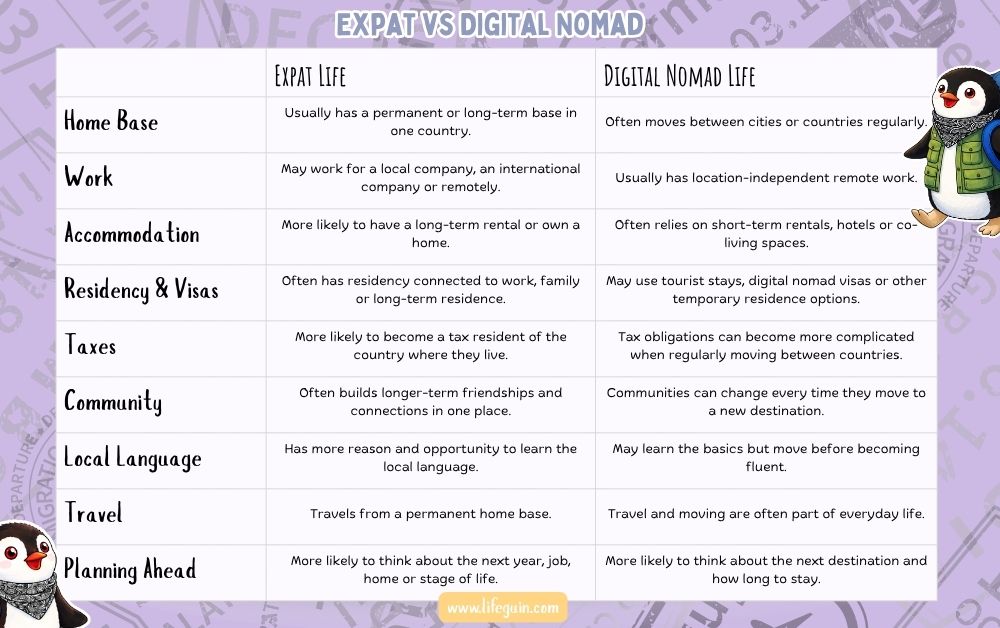
Of course, none of these are strict rules. An expat can work entirely remotely and travel constantly, while a digital nomad might fall in love with one destination and stay for years. That’s where the line between the two starts to blur.
Is It Really About How Long You Stay?
This is where things start to get messy. You might assume that a digital nomad stays somewhere for a few weeks or months, while an expat settles down for years. But real life does not always work that way.
Someone might live in Lisbon for three years, work remotely and still proudly call themselves a digital nomad. Someone else might move to Germany on a 12-month work contract, rent an apartment, register as a resident and immediately describe themselves as an expat.
So, time alone cannot really be the answer. Staying somewhere longer can certainly make your life feel more permanent, but the number of months or years you spend in a country does not automatically decide which label fits. What matters more is what you are doing there, how you are living, and, perhaps most importantly, whether you arrived expecting to move on eventually.
Maybe It Is More About Intention
Perhaps the bigger difference between an expat and a digital nomad is not how long you stay, but what you intend to do when you arrive.
A digital nomad might land in a new country already knowing that another destination will eventually follow. Even while settling into an apartment and finding a favorite coffee shop, there is often another city, country, or adventure somewhere on the horizon. The question is not necessarily if you will leave, but when.
Expat life often starts from a different place. You might not know whether you will stay for two years, ten years or forever, but you begin building a life that is harder to pack into a suitcase. You sign longer contracts, buy furniture, build friendships, create routines and start making plans that stretch further than your next flight.
Maybe that is where the real line sits. A digital nomad builds a life that can move. An expat starts building a life around a place.

The Little Things That Mean You Actually Live Somewhere
There is no official moment when a foreign country suddenly becomes the place where you live. More often, it happens through the small, ridiculously ordinary things you barely notice.
You have a loyalty card for the supermarket. You know which pharmacy stays open late and which bus you definitely do not want to take during rush hour. The person at your favorite café recognizes you, you have a go-to takeaway order, and you no longer need Google Maps every time you leave the house. You even know which famous tourist attraction absolutely isn’t worth standing in line for.
You also start doing things that would never make it onto an Instagram reel about living abroad: going to the dentist, waiting for a package, taking out the rubbish, complaining about roadworks, and trying to understand a letter from a government office. Somewhere between all these very normal moments, the destination stops feeling quite so much like a destination.
And perhaps these little routines tell us more about actually living somewhere than a visa, residency card or number of years ever could.
When Does a Digital Nomad Become an Expat
There probably isn’t a specific day when a digital nomad wakes up and suddenly becomes an expat. The change can happen so gradually that you might not even notice it.
Maybe you planned to stay for three months, but three months became six. Then six became a year. You swap the short-term rental for a proper lease. You buy things you would never want to carry onto a plane. Your belongings no longer fit into one suitcase, and suddenly packing everything up again sounds more exhausting than exciting.
You also stop spending quite so much time researching where to go next. Instead, you are making dinner plans for next month, buying tickets for something happening in six months, or wondering whether it is finally worth getting that piece of furniture you have been putting off.
There might never be an official moment when the label changes. Somewhere along the way, however, you stopped traveling through the place and started living there.
But Do Expats Really Become Locals
Living in another country for a long time does not automatically make you part of it. You can spend ten years somewhere, speak very little of the local language, mostly socialize with other expats, and still feel like an outsider. Meanwhile, someone who arrived six months ago might already be learning the language, making local friends and throwing themselves completely into everyday life.
This is where the expat bubble comes in. Expat communities can be incredibly useful, especially when you first arrive. They help with everything from finding an apartment to understanding bureaucracy, meeting people and simply having someone who understands what it is like to start again in another country. But they can also become very comfortable places to stay.
And once you are comfortable, it is surprisingly easy to build an entire life abroad without really becoming part of the place around you.
Because living somewhere and belonging somewhere aren’t necessarily the same thing. You can have the residency card, the apartment and ten years of history in a country and still feel foreign. Or you can arrive much later and somehow find your place remarkably quickly.
Hotel search from Booking.comShows Booking.com’s own box, which can set Booking.com cookies.
The Expat Bubble vs the Digital Nomad Bubble
Expats and digital nomads might like to think their lifestyles are completely different, but put them under a microscope and their bubbles can look suspiciously similar.
The classic expat bubble has international schools, expat Facebook groups, imported food shops and that one Irish pub where somehow half the city’s foreign population ends up on a Friday night. You can arrive knowing nobody and, within a few weeks, have a social circle made up almost entirely of people who also arrived knowing nobody.
Digital nomads have created a more modern version. Swap the Irish pub for a specialty coffee shop, the Facebook group for a WhatsApp chat and the international office for a coworking space. Everyone has a laptop, everyone knows a “great little place” with fast Wi-Fi, and half the conversations eventually seem to involve visas, cheap flights or which country everyone is heading to next.
There is nothing necessarily wrong with either bubble. Finding people who understand your lifestyle can make living abroad much easier. But there is a slightly uncomfortable question hiding underneath it all: if you move halfway across the world only to spend most of your time with people who look, live and think like you, how much of the country are you actually experiencing?
Different labels. Different lifestyles. Different reasons for being there. But sometimes, the expat bubble and the digital nomad bubble are really just the same bubble with different Wi-Fi passwords.
There Is Another Word We Need to Talk About: Immigrant
Another label sits rather awkwardly in this conversation: immigrant. Technically, an expat and an immigrant can be doing the same thing. Both have left their home country and are living somewhere else. Yet we don’t always use the words the same way.
A professional moving from London to Dubai might be described as an expat. Someone moving from another country to London for work might be called an immigrant. Why? Is it because of how long they plan to stay? The type of job they have? Their nationality? Their income? Or simply the way we have become accustomed to talking about certain groups of people?
The word expat can sometimes make moving abroad sound temporary, comfortable and voluntary. It brings to mind international jobs, relocation packages and the possibility of eventually going home. Immigrant, meanwhile, is more often associated with someone permanently building a new life in another country. But real people’s lives rarely divide themselves so conveniently.
An expat might arrive for a two-year contract and still be there 20 years later. An immigrant might move abroad intending to stay forever and return home five years later. Both might work, pay taxes, raise families, learn the language and become part of their communities.
Perhaps the difference sometimes tells us less about the person who moved and more about how society chooses to describe them. And that makes “expat” one of those seemingly simple labels that becomes much more complicated the longer you think about it.
Instagram vs Reality: Digital Nomad Life
Laptop open. Coconut within reach. Beach in the background. Sunset conveniently arriving just as you finish your last email. Digital nomad life looks pretty good on Instagram.
What you probably do not see is the morning spent trying to find Wi-Fi strong enough for a video call. Or the temporary apartment that looked much bigger in the photos. There are visas to figure out, taxes that do not disappear just because you changed countries, accommodation to find every few months, and time zones that can turn a perfectly normal meeting into a 10 pm appointment.
Then there is the constant movement itself. Packing again. Finding another apartment. Learning another public transport system. Finding another supermarket. Making new friends, only for you or them to leave a few weeks later. The freedom to go anywhere can be exciting, but constantly starting again can also get tiring and surprisingly lonely.
And that dreamy beach office? Try having a Zoom meeting while your laptop overheats, the Wi-Fi disappears, and someone at the table beside you orders their third mojito.
The Instagram version is not necessarily fake. It is just a very carefully cropped version of reality.


Instagram vs Reality: Expat Life
Digital nomads are not the only ones whose lives look better on Instagram. Expat life gets romanticized too.
At first, almost everything feels exciting. You have a new city to explore, unfamiliar food to try, different traditions to discover, and weekends that can feel like mini holidays. Even going to the supermarket can somehow count as a cultural experience.
Then normal life catches up.
One Tuesday, you are standing in a government office holding a form you barely understand. Your internet stops working. You need to find a dentist. You have bills to pay, laundry waiting at home and absolutely no desire to explore another “hidden gem” this weekend.
And that is not necessarily a bad thing. It simply means the honeymoon period is over. The place that once felt like a destination has become the backdrop to your everyday life.
Eventually, living abroad becomes surprisingly normal. You still notice the differences and occasionally remember that you are thousands of kilometers from where you started. Still, most days you are simply going to work, buying groceries, meeting friends, and deciding what to have for dinner.
Maybe that’s one of the clearest signs that somewhere abroad has started to feel like home.
What Expats and Digital Nomads Actually Have in Common
For all the differences between expat life and digital nomad life, the two have more in common than the labels might suggest.
Both involve leaving something familiar behind. Your routines change, your support network might suddenly be hundreds or thousands of kilometers away, and even the simplest things can require a little more effort at first. You have to figure out how things work, adapt to different customs, and learn that “normal” can mean something completely different depending on where you are.
Both also know what it feels like to be the outsider. You might not understand the joke, know the unwritten rule, or pronounce the name of a local dish correctly on the first five attempts. Sometimes that is frustrating. Other times, it is exactly what makes living abroad so interesting.
And both require building relationships away from home. Some friendships last for a few weeks, others for years, and occasionally people you meet on the other side of the world become part of your life long after one of you has moved on.
Perhaps the biggest thing expats and digital nomads share is the chance to see everyday life from a completely different perspective. You start questioning things you once considered normal, appreciating things you previously took for granted, and picking up little pieces of every place you call home, even temporarily.
Different lifestyles, different levels of permanence, but ultimately both involve learning how to waddle through life somewhere unfamiliar and slowly make it your own.

So… Expat or Digital Nomad?
So, after all of that, which one are you? The answer can still be a rather unsatisfying it depends.
You work remotely and change countries every two months? Probably a digital nomad.
You moved abroad for a job, rent an apartment, have a local bank account, and no plans to leave anytime soon? Probably an expat.
You work remotely, have lived in the same country for four years, know your neighbors and own enough furniture that moving would require an actual truck?
Well… now it gets interesting.
Maybe you arrived as a digital nomad and slowly became an expat without ever deciding to. Maybe you still call yourself a digital nomad because your job allows you to work from anywhere, even though you have not actually gone anywhere in years. Or perhaps neither label feels quite right anymore.
And that is exactly the problem with trying to draw a perfect line between the two. Real life has a habit of ignoring our neat little definitions.
Does the Label Even Matter?
Maybe we spend too much time trying to fit life abroad into neat little boxes. Plans change. A six-month adventure becomes five years, while a permanent move can be over within nine months.
The label might change several times, even though the person living the experience remains exactly the same.
Buy Us a Ko-fi

There probably isn’t one big moment when you stop feeling like a traveler and start feeling like you belong. It happens quietly, somewhere between routines, friendships, frustrations, favorite places, and completely ordinary Tuesdays. One day, you realize that the place that once felt unfamiliar doesn’t anymore.
And perhaps the most interesting question was never “Am I an expat or a digital nomad?”
It was “When did this foreign place stop feeling foreign?”
Travel Bold. Eat Well. Waddle Wild.

This post contains affiliate links. If you click and buy, I might earn a tiny commission, enough to help a penguin keep up its globe-trotting lifestyle. No extra cost to you, just more fish for me. Thank you for supporting the adventure!