Deichman Bjørvika: Why Oslo’s Modern Library Surprised Us as Bookworms
We have a soft spot for libraries, especially the old ones where polished wooden shelves, grand staircases, and centuries of stories seem to cling to the walls. In Oslo, however, Deichman Bjørvika makes us reconsider our usual preference. Modern, spacious, and unexpectedly playful, Oslo’s main public library feels less like a place built to store books and more like a place built around everything books can inspire.
We are bookworms. Whenever we visit a new city, libraries somehow find their way onto our itinerary. We like the grand ones, the old ones, the slightly dusty ones. Give us a historic reading room, a beautiful staircase and shelves that look as though they have been collecting stories for a century, and we are happy penguins.
So when we heard about Deichman Bjørvika, Oslo’s main public library, we were curious but didn’t expect it to become a highlight.
After all, it is modern. Very modern. And we usually have a weakness for libraries with a little more history written into their walls.
Then we stepped inside.
Quick Facts
📍 Location: Anne-Cath. Vestlys plass 1, 0150 Oslo
🕒 Opening Hours: Monday–Friday 08:00–22:00. Saturday–Sunday 10:00–18:00.
🎟️ Tickets: Free entry.
⏱️ Time Needed: Around 1 hour if you want to explore the architecture, browse the shelves, and take in the different spaces. Bookworms may want longer. 🐧📚
🌐 Website: Deichman Public Library
A Library That Feels More Like a Public Living Room
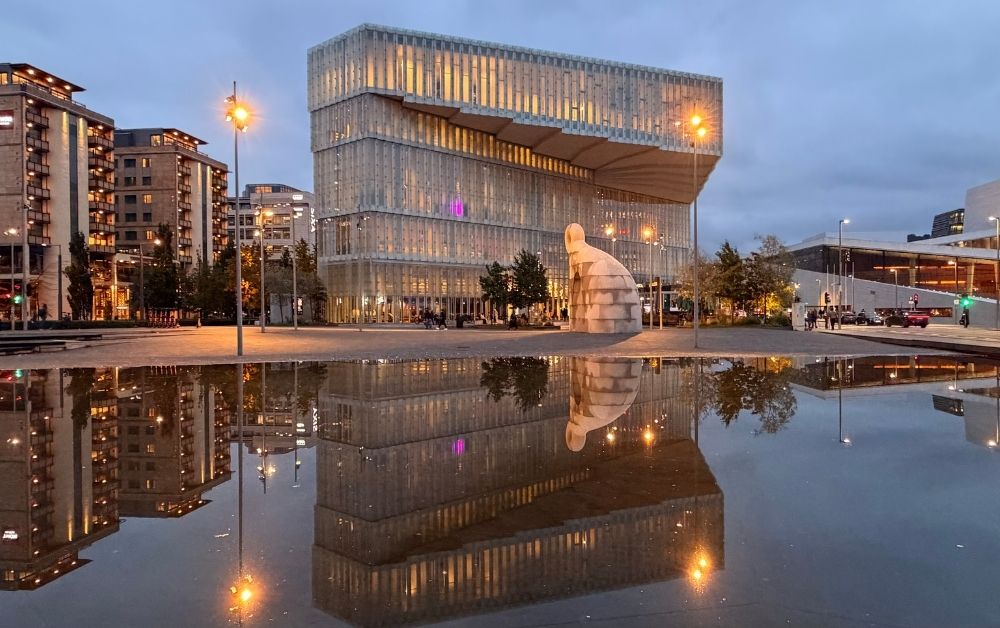
Deichman Bjørvika sits in the heart of Oslo’s waterfront district, close to the Oslo Opera House and MUNCH.
From the outside, its architecture immediately tells us this is not the traditional library we usually seek out. Inside, the feeling continues. Instead of rows of intimidating shelves disappearing into the distance, the building opens up into a bright, contemporary space designed for far more than borrowing books.
There are places to sit, read, work, meet, browse, listen, and spend time.
And that is perhaps what surprises us most.
The library does not feel like somewhere we have to have a reason to visit.
We can be here.
Deichman describes its libraries as places where people can read, work, relax, meet friends or spend time alone. Across Oslo, the library network includes 22 branches and more than a million books, films, CDs and other materials.
For a traveling bookworm, that is a rather tempting invitation.


Deichman Bjørvika Is More Than Books
One of the first things we notice is how much the library does beyond traditional reading.
The library offers spaces for events, workshops, and cultural activities, alongside more familiar library functions. Deichman also provides free Wi-Fi, computers, and workshop facilities, with visitors paying only for materials when printing or copying.
The result is a library that feels alive.
People are reading.
People working.
People meeting.
People browsing shelves.
And people who, like us, seem to be happily wandering around simply because being surrounded by books is a perfectly good way to spend an afternoon.
For us, this is where the library becomes particularly interesting.
It does not try to preserve the idea of a library as a quiet warehouse for books.
It treats the library as a place where ideas meet.


What surprises us is how busy the library is on a Sunday afternoon. Almost every seat is taken; people read, work, study, chat quietly, and spend time here. There is barely an empty corner to claim, and we love seeing it. This is exactly how libraries should look: alive, welcoming, and genuinely used by the community. Deichman Bjørvika does not feel like a place where books are stored. It feels like a place where people come to spend time, discover something new, and be surrounded by stories, and for us bookworms, that is pretty hard to beat.
From Old-School Libraries to the Library of the Future
We have visited libraries around the world, and many of our favorites are beautiful precisely because they feel connected to another era.
Deichman Bjørvika takes the opposite approach.
It asks what a library should be now.
And perhaps even more interestingly, what it should become in the future.
Deichman’s current strategy focuses on encouraging reading and a reading culture, making literature accessible to children, young people and adults, and strengthening multilingual collections. It also emphasizes storytelling across different art forms.
That philosophy makes sense once we are inside.
Books are still at the center.
But they are no longer the only attraction.


A Surprisingly Good Place for Bookworms
We admit it: we were prepared to prefer Oslo’s older libraries.
Instead, Deichman Bjørvika catches us off guard.
Something wonderfully democratic about the place: you don’t need to be a serious reader, a student, or a local book collector to appreciate it. You can come in, sit down, browse a shelf, work for a while, attend something, or enjoy the architecture.
And if you are a serious bookworm?
Well, you might have a problem.
The kind where you suddenly realize you have been wandering between shelves for much longer than planned.
We know that feeling.


The Library Is Part of Bjørvika’s Cultural Neighborhood
Location helps.
Deichman Bjørvika is surrounded by some of Oslo’s most recognizable contemporary cultural landmarks. The MUNCH museum is nearby, while the Oslo Opera House sits just across the waterfront.
That makes the library particularly easy to combine with a day exploring Bjørvika.
You can admire art, wander along the harbor, climb onto the Opera House roof, and then retreat into the library for a quieter dose of culture.
It is a very Oslo combination.
Modern architecture.
Art.
Water.
Books.
And plenty of places to slow down.
Is Deichman Bjørvika Worth Visiting
For us, absolutely.
Not because it is the oldest or most traditionally beautiful library we have visited—quite the opposite.
Deichman Bjørvika surprises us because it shows how a library can evolve without losing its most important ingredient: books.
We arrive expecting to make a quick stop.
Instead, we find ourselves exploring the building, looking at the shelves and appreciating how thoughtfully the space brings together reading, culture, work, and community.
Perhaps that is the real lesson here.
A library does not have to look old to feel meaningful.
Sometimes the most interesting libraries are the ones showing us what libraries can become next.
And for two bookworms who usually prefer their libraries with a little more history, Oslo makes a modern one hard to leave.
Buy Us a Ko-fi

Our Verdict
Deichman Bjørvika is proof that a public library can be a destination in its own right. We came looking for books and found a contemporary cultural space that made us appreciate libraries in a completely different way.
And yes, even though we still have a soft spot for the old ones, this modern Oslo library has earned a place on our bookworm map.
Pro Penguin Tips
Don’t just pop in and leave. We expected to admire the architecture and perhaps browse a few books before moving on, but the building is designed to make you linger. Give yourself enough time to waddle around the different floors, find a cozy reading spot, and see why Oslo’s modern library surprised two bookworms who normally prefer their libraries old.
Deichman Bjørvika reminds us that a great library does not have to be old to have character. It is modern, busy, and wonderfully alive, with books at its heart and people filling every corner. We came as bookworms expecting to admire the architecture, but we left thinking: this is exactly how a library should feel.
Travel Bold. Eat Well. Waddle Wild.
Save This Pin for Later!
This post contains affiliate links. If you click and buy, I might earn a tiny commission, enough to help a penguin keep up its globe-trotting lifestyle. No extra cost to you, just more fish for me. Thank you for supporting the adventure!