One Day in Palma de Mallorca: What to See, Do & Eat
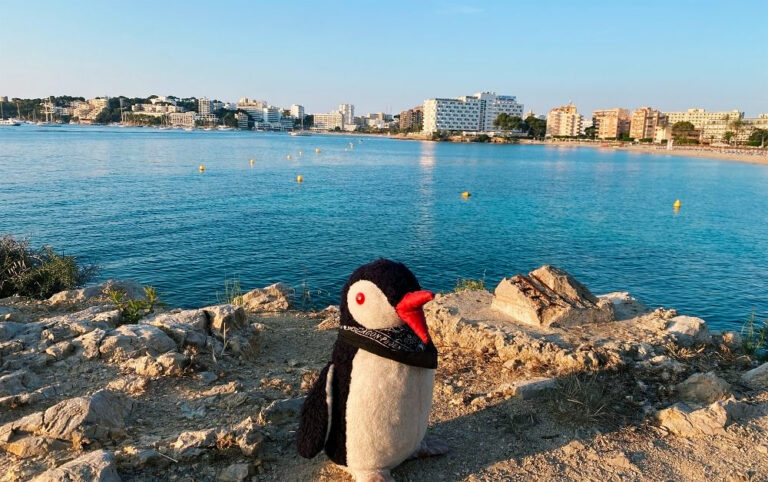
We spent a week on the island of Mallorca, although we weren’t staying directly in its capital. Of course, we couldn’t come all this way without setting aside a day to explore Palma de Mallorca, the island’s vibrant capital. We headed into the city to see its famous cathedral, wander its historic streets, discover its beautiful courtyards, and soak up a little Mediterranean atmosphere. With just one day, we focused on the highlights, and it made for the perfect introduction to Palma.
- Why Visit Palma When You’re Exploring Mallorca
- Palma de Mallorca Quick Facts
- Our Day in Palma de Mallorca
- What We Left for Another Day
- Our Palma de Mallorca Map: Follow Our Waddle Through the City
- Is One Day in Palma de Mallorca Enough
- Getting Around Palma de Mallorca
- Our One Day in Palma de Mallorca
- Our One Day in Palma de Mallorca Route
- One Day in Palma de Mallorca: Our Tips
Why Visit Palma When You’re Exploring Mallorca
Even if you are staying somewhere else on the island, Palma de Mallorca is well worth adding to your Mallorca itinerary. As Mallorca’s capital and largest city, Palma offers a completely different experience from the island’s beaches and mountain villages. Here, you can wander through a historic Old Town, admire the spectacular La Seu Cathedral, explore royal palaces and hidden courtyards, stop for a long Spanish lunch and finish the day by the Mediterranean. We were staying elsewhere on Mallorca during our week-long trip, but we decided to dedicate one full day to the capital, and it gave us a chance to see a completely different side of the island.
Palma de Mallorca Quick Facts
- Island: Mallorca, Balearic Islands
- Role: Capital of Mallorca and the Balearic Islands
- Population: Approximately 435,000 (official 2025 figure)
- Municipal area: Approximately 213.6 km²
- Founded: 123 BC as a Roman settlement
- Location: Bay of Palma, southwestern Mallorca
- Main language: Spanish and Catalan
- Known for: La Seu Cathedral, Almudaina Palace, Old Town, Bellver Castle, Mediterranean waterfront and historic courtyards
- Historic names: The city was known as Madina Mayurqa during the Islamic period.
- Best way to explore: On foot. Palma’s historic center is compact and packed with sights, hidden courtyards, and narrow streets.
- Fun fact: Palma combines Roman, Moorish, and Christian heritage in one historic center, making its architecture a fascinating reflection of the island’s history.
Our Day in Palma de Mallorca
From Palma Nova to Palma de Mallorca
We started our day in Palma Nova, where we were staying, by hopping on a bus to Mallorca’s capital. Getting to Palma was easy, with regular buses connecting the two places. You can buy as many tickets as you need, making it a convenient option even if you’re traveling as a couple or with a group. The journey takes roughly 30 minutes, depending on traffic, and the two places are only around 15 kilometers apart, so Palma is an easy day trip from Palmanova. When we arrived at Palma’s bus station, we also spotted something particularly useful for travelers: large luggage lockers. So, if you’re visiting Palma before check-in, checking out of your accommodation, or simply arriving with bigger bags, you can leave your luggage at the station and explore the city hands-free.


Monument a Jaume I
As we stepped out of the station, the first thing to greet us was the Monument a Jaume I, standing proudly in Plaça d’Espanya. The bronze equestrian statue depicts Jaume I of Aragón, also known as James I the Conqueror, the medieval king who led the conquest of Mallorca from Muslim rule in 1229. His victory marked a major turning point in the island’s history and shaped the Christian kingdom that followed. The monument itself is much newer, dating from 1927, but it deliberately keeps this important chapter of Mallorca’s history alive.
Penguin Pro Tip: Don’t just snap a photo and walk away. Take a moment to look around the monument and remember that you’re standing at the beginning of a story that shaped Palma for centuries.


Mercat de l’Olivar
From Plaça d’Espanya, we continued straight to Mercat del Olivar, one of Palma’s most famous and atmospheric food markets. We have to admit, we absolutely love something about Spanish markets. Give us the choice between wandering through a market filled with fresh fruit and vegetables, colorful stalls, seafood, local cheeses and all sorts of tempting bites, or walking down a regular shopping street, and we’ll waddle towards the market every single time. Mercat de l’Olivar has served Palma since 1951 and today brings together fresh Mallorcan produce, fish and seafood, meat, cheeses, cured meats, flowers, and plenty of places to stop for tapas or something to eat.


The market is right in the heart of Palma’s Old Town, making it an easy stop while exploring the city. It is generally open Monday to Friday from 7:00 to 14:30, with a partial reopening on Friday afternoon until 20:00, and on Saturday from 7:00 to 15:00. It is closed on Sundays. If you want to experience the market at its liveliest, we recommend coming in the morning, when locals are shopping and the stalls are at their freshest.
Basílica de Sant Miquel
From the market, we continued to the Basílica de Sant Miquel, one of Palma’s oldest parish churches. What makes this church particularly interesting is its history: it stands on the site of what is believed to have been one of the main mosques of Madina Mayurqa, Palma’s Islamic city. Tradition says that the first Christian Mass inside the city walls was celebrated here on 31 December 1229, the day Jaume I’s troops entered Palma. The present Gothic church began toward the end of the 14th century and was later rebuilt and expanded in the Baroque style.
We also decided to wander inside for a little while because, by this point, the weather was getting noticeably hotter. It was the perfect excuse to escape the sunshine, cool off for a few minutes, and take in the peaceful interior before continuing our exploration of Palma. The church is free to visit outside Mass, so it makes for an easy little stop while wandering through the Old Town.


Waddling Through Palma’s Old Town
From the basilica, we continued waddling through Palma’s old streets, and this quickly became one of our favorite parts of the day. The Old Town is a maze of narrow lanes, honey-colored stone buildings, quiet squares, and beautiful historic courtyards, with centuries of Roman, Islamic, and Christian history woven into its streets. We loved not really having a plan and simply seeing where each little street would take us. Look up as you wander, and you’ll spot ornate balconies, colorful shutters, and hidden architectural details, while some of the grandest historic houses conceal beautiful patios behind their doors. Palma’s Old Town is also wonderfully walkable, so sometimes the best thing to do is simply put the map away and waddle wherever looks interesting.


Plaça Major
Our next stop was Plaça Major, one of the most important squares in Palma’s Old Town. The square has been a central meeting point for centuries and sits near the former Convent of Sant Felip Neri, with parts of the historic structure still influencing the surrounding architecture. Today, it is a place surrounded by cafés, shops, and arcaded buildings, and during our visit we also found market stalls selling local crafts and handmade products, which made the square feel even more alive. Take a moment to look around at the details, especially the elegant balconies and the covered arcades surrounding the square. From here, several of Palma’s pedestrian streets branch off, making Plaça Major a great place to continue your wander through the Old Town.


Olivera de Cort
As we continued our walk through Palma’s Old Town, we came across one of the city’s most unusual landmarks: Olivera de Cort, the enormous, twisted olive tree standing in the middle of Plaça de Cort. Estimated to be 500–600 years old, this gnarled tree originally grew on a finca near Pollença before being moved to Palma in 1989. The city donated it as a symbol of peace and connection to the land, and it is now protected as a singular heritage tree.
But here’s the fun part: look closely at the trunk. The strange folds and knots in the ancient wood are said to form different shapes, including a face and the famous “Orella de Mallorca”, or “Ear of Mallorca.” A popular story connects the tree with Jaume I, but the history is different: it did not grow during the conquest of Mallorca and was brought to Plaça de Cort only in the late 20th century. Either way, standing beneath a tree that has been growing for centuries is a pretty special stop on a Palma walk.


Catedral-Basílica de Santa María de Mallorca
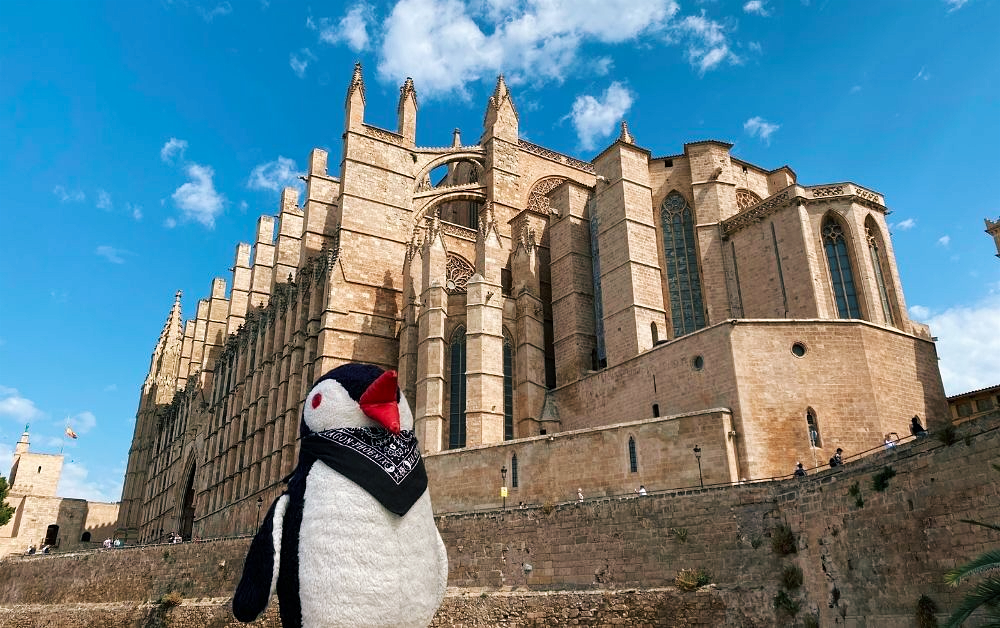
Then we finally waddled toward Palma’s landmark: the magnificent Catedral-Basílica de Santa María de Mallorca, better known simply as La Seu. Standing dramatically above Parc de la Mar, this enormous Gothic cathedral is impossible to miss and arguably defines Palma’s skyline. Its story dates back to 1229, when King Jaume I ordered the former main mosque of Madina Mayurqa to be consecrated as a Christian church and planned a new cathedral on the site. The building we see today took centuries to complete, with construction continuing into the 17th century.
Once inside, there is plenty to see. The cathedral’s enormous rose window, measuring around 11 meters across, is one of its most spectacular features and is considered the world’s largest Gothic rose window. Look closely, too, because Antoni Gaudí worked on the interior in the early 20th century, while much later the Mallorcan artist Miquel Barceló created a striking contemporary chapel. So although La Seu looks unmistakably medieval from the outside, stepping inside reveals layers of art and architecture from very different periods.
Penguin Pro Tip: Don’t rush straight inside. Waddle around the outside first and take in the cathedral from the Parc de la Mar. The view across the water is one of Palma’s most iconic perspectives.


We spent quite a while simply waddling around the cathedral, taking it in from every possible angle. From the historic streets behind it to the waterfront and the Parc de la Mar in front, the view seemed to change with every few steps. Somehow, each new angle made La Seu look even more impressive, especially with the Mediterranean stretching out behind it. It is one of those places where you can take plenty of photos, but none quite capture how spectacular it feels to be there.


S’Hort del Rei: A Little Corner of Magic
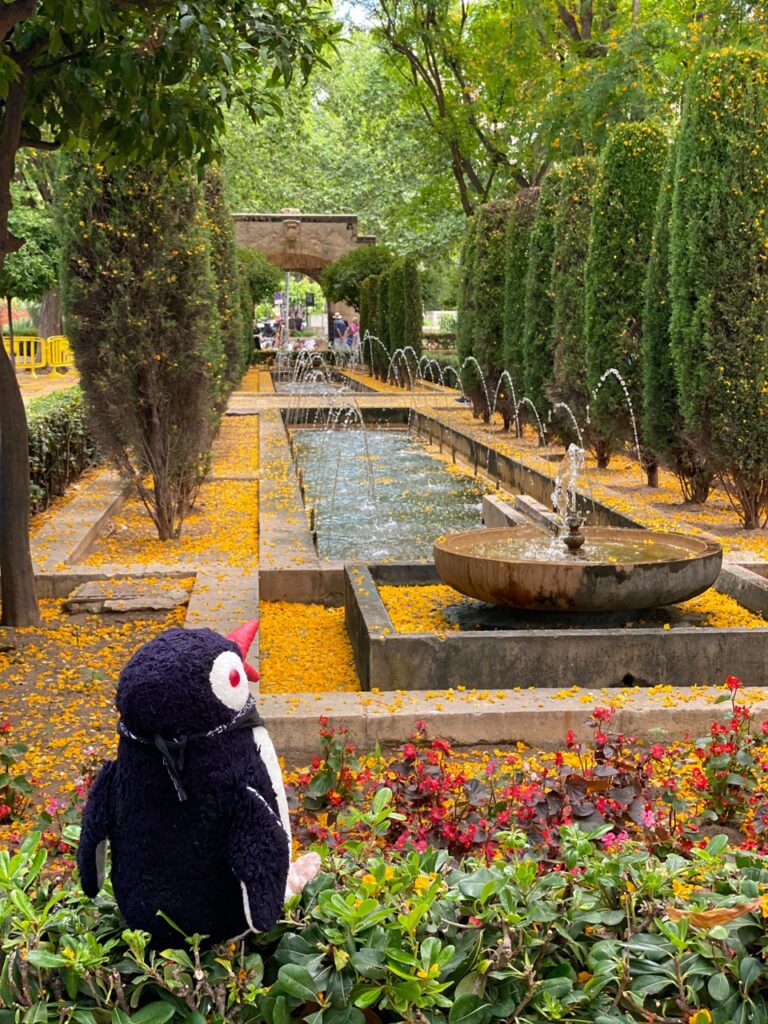
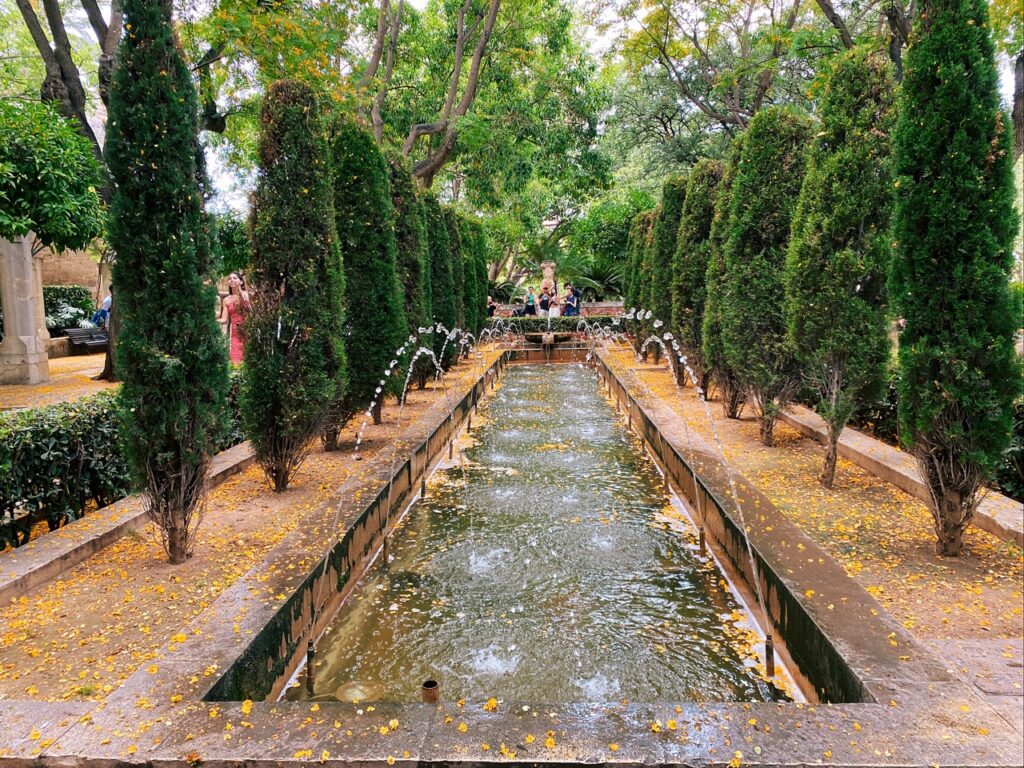
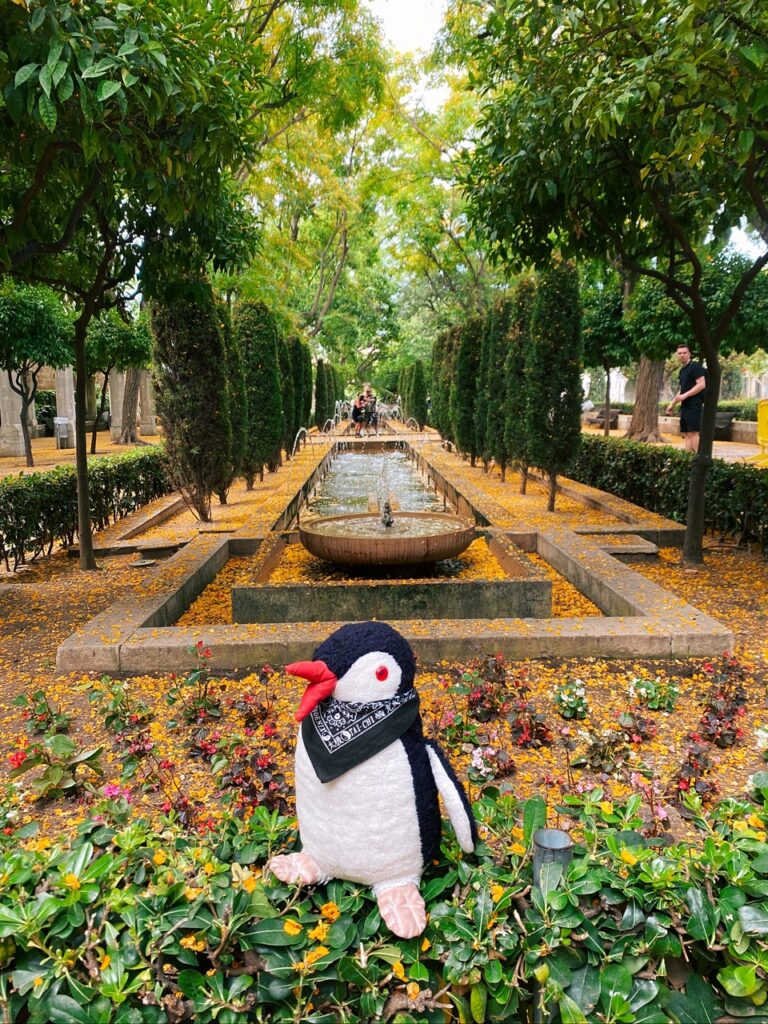
After wandering around the cathedral, we discovered S’Hort del Rei, or the Garden of the King, tucked away at the foot of the Royal Palace of La Almudaina. Honestly, this became our favorite little spot in Palma. The moment we stepped through the gardens, it felt as if we had left the city behind and wandered into another world. With its fountains, water channels, lush greenery, shaded paths, and stone walls, the garden has an almost magical atmosphere.
What makes it even more special is its history. The gardens were created in the early 14th century for the Kings of Mallorca, and they once served not only as a beautiful royal garden but also as a place where fruit, flowers, and vegetables were grown for the palace. The gardens we see today were redesigned in the 1960s, influenced by Hispano-Muslim and Italian Renaissance gardens, including the famous Generalife gardens in Granada.
For us, though, it was simply the kind of place where you want to slow down, wander beneath the greenery, and wonder how a little oasis like this can be hiding right in the middle of Palma.
Puerto de Palma
From the gardens, we waddled to the Puerto de Palma, following the waterfront for yet another view of La Seu. From here, the cathedral rises dramatically above the city, with the marina and rows of boats stretching out in front of it. We had already seen the cathedral from so many angles by this point, but somehow this perspective felt completely different. It was the perfect place for one more look, a few photos and a short wander along the waterfront before continuing with our Palma adventure.


Palma: A Pop of Red by the Waterfront
From the Puerto de Palma, we continued our waddle along the waterfront and soon came across one of the city’s most recognizable modern sculptures, the bright red “PALMA” sign by Mallorcan artist Pep Llambías. Created in 1999 for the Universiade, the sculpture spells out the city’s name in huge letters and was designed to change visually depending on where you stand. From the front, you clearly read Palma, while from the side it becomes a more abstract piece of art.
We loved this part of the walk because the modern sculpture sits so well against the historic city and the Mediterranean. And, of course, the palm trees lining the waterfront make the whole scene feel wonderfully Mallorcan. It is one of those simple little spots that makes for a great photo and reminds you that Palma isn’t only about Gothic buildings and centuries-old history.


Monumento a los Crucero Baleares
Our next stop was Parc de Sa Feixina, a pleasant green space between Palma’s historic center and the Santa Catalina neighborhood. In the middle of the park stands the imposing Monumento a las Víctimas del Crucero Baleares, built in the late 1940s to commemorate those who died when the cruiser Baleares sank during the Spanish Civil War in 1938. The monument has a complicated history because it was erected during the Franco dictatorship and originally carried symbols and inscriptions associated with the regime. Those elements were later removed, and the site has since been reinterpreted as a place to remember the victims and reflect on the horrors of war and dictatorship.
The park itself is worth a little wander too, with terraced gardens, fountains and shady paths, making it a nice break between the Old Town and the waterfront.


Sa Ronda Restaurante
After all that waddling around Palma, lunchtime had finally arrived, and we were more than ready to sit down and refuel. We stopped at Sa Ronda Restaurante, a traditional Spanish and Mediterranean restaurant in the Santa Catalina area, known for its relaxed, old-school atmosphere, tapas and, of course, paella. We couldn’t come to Mallorca without ordering a proper seafood paella, so we chose that for lunch. The restaurant has been part of Palma’s food scene since 1968, and its menu also includes fresh seafood, grilled octopus, tapas and plenty of other Spanish classics. After a morning of exploring the city on foot, sitting down with a plate of paella felt like exactly the kind of Spanish lunch we had been waiting for.


Mercat de Santa Catalina
After lunch, we couldn’t resist another market stop, this time at Mercat de Santa Catalina. By now, you may have noticed a pattern: Palma has several fantastic markets, and apparently we wanted to see as many of them as possible! This one is in the historic Santa Catalina neighborhood, traditionally a fishing district, and is Palma’s oldest municipal market. Inside, you’ll find more than 50 stalls selling everything from fresh fruit and vegetables to fish and seafood, cheese, cured meats, and local specialties, alongside tapas bars and other places to eat.
And yes, we bought something here too. Apparently, walking into a Spanish market without leaving with a little edible souvenir isn’t something we are capable of doing. The market is currently open Monday to Saturday, with market stalls generally operating from 7:00 to 15:00 and food services continuing until 17:00.


After the market, we decided it was finally time to call it a day and head back to Palmanova, where we were staying. Our feet had certainly earned the rest after a full day of waddling through Palma’s streets, markets, historic buildings and waterfront. We managed to see a lot in just one day, from La Seu and the Old Town to hidden gardens, lively markets and plenty of little corners we would have otherwise missed. While one day gave us a great introduction to Mallorca’s capital, it left us with a feeling that Palma deserves more than a quick visit.
What We Left for Another Day
After spending one full day waddling around Palma, we quickly learned one thing: Palma is definitely not a city where one day is enough. We still had so much more to see, from royal palaces and ancient Arab baths to grand boulevards, hidden courtyards, and castles overlooking the city. So, rather than trying to squeeze everything into one exhausting day, we decided to leave these places for our next visit.
- Almudaina Palace. Standing beside La Seu, this impressive royal palace was originally built as an Islamic fortress before being transformed into a royal residence after the Christian conquest. We had already admired it from outside, but decided to save the interior and its fascinating history for another day.
- Parc de la Mar. Stretching between La Seu and the waterfront, this large park offers one of Palma’s most iconic views of the cathedral reflected in the water. It is also a lovely place to slow down and enjoy the Mediterranean atmosphere.
- The Arab Quarter. Palma’s historic Arab Quarter is a maze of narrow streets that reveals the city’s Islamic past through its architecture, quiet lanes and hidden corners. We left ourselves a reason to return and explore it properly.
- Banys Àrabs. The Arab Baths are among the few surviving examples of Islamic architecture in Palma. Dating back to the period of Madina Mayurqa, the small complex includes the beautifully preserved bathhouse and a peaceful garden.
- Passeig del Born. Often considered one of Palma’s grandest promenades, Passeig del Born is lined with elegant buildings, shops, cafés and impressive trees. We definitely wanted to return with more time to stroll along the boulevard.
- La Rambla. Palma’s La Rambla is another beautiful pedestrian promenade, famous for its flower stalls, trees and relaxed atmosphere. It connects several parts of the historic center and is particularly pleasant for a leisurely walk.
- Palma’s Hidden Courtyards. One thing we noticed while wandering through the Old Town was how many beautiful courtyards hide behind Palma’s grand historic façades. Many of these patios belong to centuries-old houses, and exploring them properly deserves more than a quick glimpse.
- Bellver Castle. Sitting on a wooded hill above Palma, Bellver Castle is one of the city’s most distinctive landmarks thanks to its unusual circular design. We saved this one for another visit because the castle itself and the panoramic views across Palma deserve plenty of time.
- More of Palma’s Waterfront. We saw part of Palma’s waterfront during our day, but there was clearly much more to explore. From the marina and Paseo Marítimo to the beaches and different viewpoints of La Seu, this is an area we’d happily return to with more time.
- Es Baluard Museu d’Art Contemporani de Palma. We would also add Es Baluard to the list for a future visit. The contemporary art museum is housed within Palma’s historic bastion walls and combines modern art with impressive views over the city and harbor.
- Palau March Museu. Another worthwhile addition is Palau March, a former palace near the cathedral that houses an interesting collection of modern and contemporary sculpture, along with historic interiors and a terrace overlooking Palma.
- Convent de Santa Clara. Hidden among the Old Town’s narrow streets, this historic convent is another place we’d like to explore properly on a return visit. Its quiet cloisters offer a completely different atmosphere from Palma’s busy main streets.
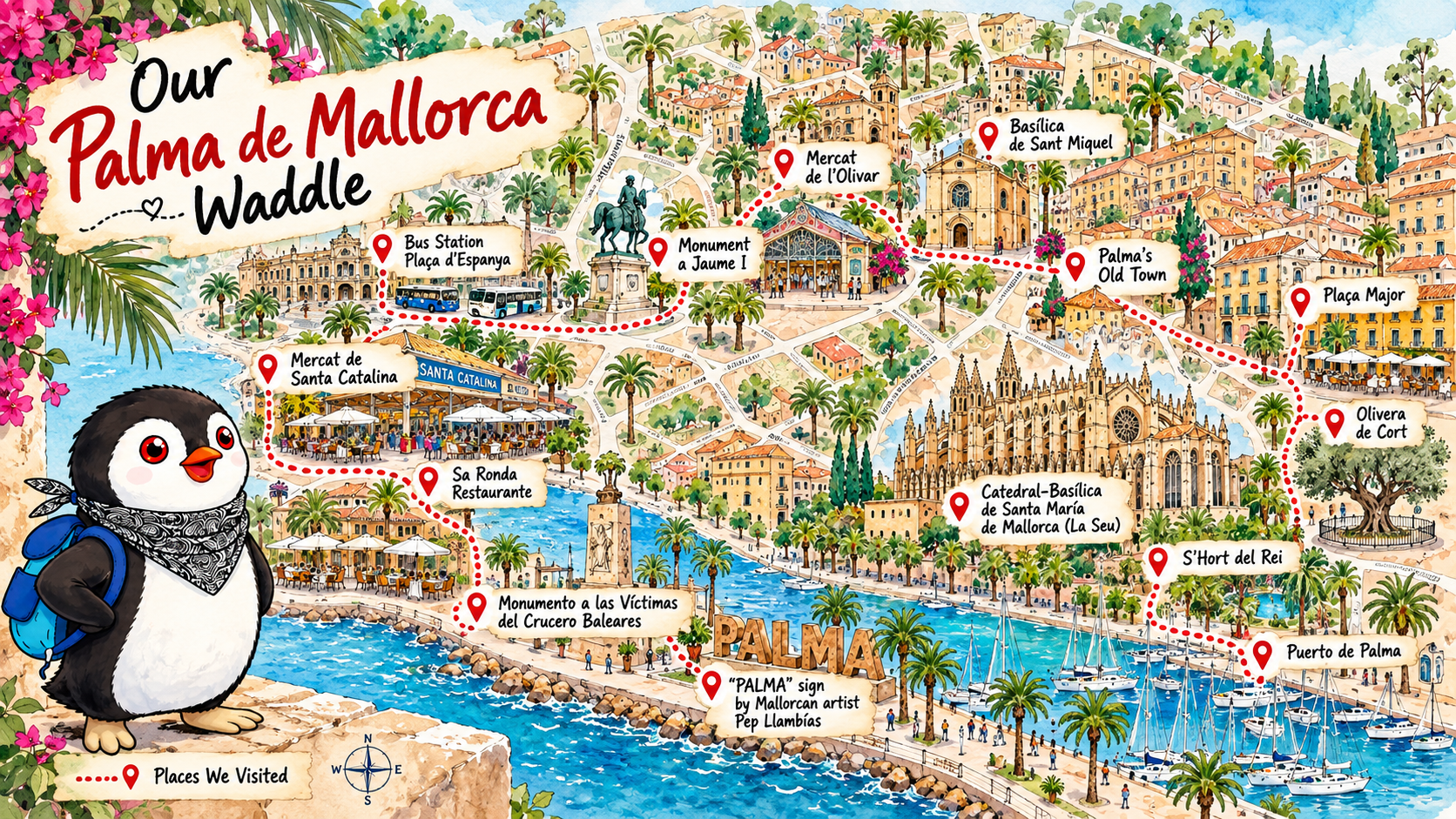
Our Palma de Mallorca Map: Follow Our Waddle Through the City
Is One Day in Palma de Mallorca Enough
No, one day in Palma de Mallorca is not enough if you want to experience the city properly. We managed to see many of the main highlights in one day. Still, we left several places for another visit, including Almudaina Palace, Banys Àrabs, Bellver Castle, and more of the historic center. We would recommend at least two full days in Palma, which gives you enough time to explore the major sights without rushing and still leave time for a long Spanish lunch, wandering through the Old Town and enjoying the waterfront. If you want to explore the city at a slower pace, visit museums and discover more of its hidden corners, three days would be even better.
Getting Around Palma de Mallorca
We mostly waddled around Palma on foot, and for the historic center, this is definitely the easiest way to explore. Most of the main sights are relatively close together, so you can walk from the markets and Old Town to La Seu, S’Hort del Rei and the waterfront without constantly worrying about transport. For longer distances, Palma also has a bus and taxi network, and cycling can be a good option if you want to cover more ground. We arrived from Palmanova by bus, which took around 30 minutes, and then spent most of the day exploring Palma on our own two feet.
Penguin Pro Tip: Wear comfortable shoes because the best part of Palma is often simply getting lost among its historic streets.
Our One Day in Palma de Mallorca
Our One Day in Palma de Mallorca Route
- Monument a Jaume I. We started our Palma adventure at this impressive monument in Plaça d’Espanya, dedicated to the medieval king who conquered Mallorca in 1229.
- Mercat de l’Olivar. We continued to this lively food market, where colorful stalls filled the halls with fresh produce, seafood, local specialties, and plenty of tempting bites.
- Basílica de Sant Miquel. We stopped at this historic basilica, known for its connection to Palma’s Islamic past and its beautiful interior.
- Palma’s Old Town. From here, we waddled through the maze of narrow streets, admiring the historic buildings, balconies, and hidden corners along the way.
- Plaça Major. We reached this lively central square, surrounded by arcades, cafés and shops, and took a moment to soak up the atmosphere.
- Olivera de Cort. We then came across Palma’s famous ancient olive tree, standing proudly in Plaça de Cort with its wonderfully twisted trunk.
- Catedral-Basílica de Santa María de Mallorca. We finally reached La Seu, Palma’s magnificent Gothic cathedral, and spent quite a while admiring it from different angles.
- S’Hort del Rei. Just beside the cathedral, we discovered this peaceful royal garden with fountains, greenery, and shady paths.
- Puerto de Palma. We continued towards the harbor, enjoying the waterfront views and another completely different perspective of La Seu.
- “PALMA” Sign by Mallorcan Artist Pep Llambías. We stopped at the striking red PALMA sculpture, one of those fun modern landmarks that makes for a great travel photo.
- Monumento a los Crucero Baleares. We continued through Parc de Sa Feixina, where we came across this imposing historic monument.
- Lunch at Sa Ronda Restaurante. After all that waddling, we finally sat down for lunch and enjoyed a proper Spanish meal, including a delicious seafood paella.
- Mercat de Santa Catalina. We finished our day with another market visit, wandering through the colorful stalls of the historic Santa Catalina neighborhood before heading back to Palmanova.
Hotel search from Booking.comShows Booking.com’s own box, which can set Booking.com cookies.
One Day in Palma de Mallorca: Our Tips
If you only have one day in Palma de Mallorca, a little planning will help you make the most of it without spending the whole day rushing from one sight to another. We managed to see quite a lot by combining the main landmarks with plenty of wandering, but there are a few things we wish we had known before our visit.
- Start Early. Start your day early, especially during the warmer months, so you can explore the Old Town before the streets get busier and temperatures rise.
- Wear Comfortable Shoes. Palma is wonderfully walkable, but you will cover plenty of ground if you follow a route like ours, so comfortable shoes are essential.
- Visit the Markets in the Morning. Mercat de l’Olivar and Mercat de Santa Catalina are best visited earlier in the day when the stalls are lively, and there is plenty of fresh produce on display.
- Plan Your Cathedral Visit. La Seu is one of Palma’s biggest highlights, so check the opening hours and allow enough time to explore both the exterior and interior rather than simply stopping for a photo.
- Leave Time to Wander. Don’t fill every minute of your itinerary with attractions because some of our favorite moments came from simply waddling through Palma’s Old Town and discovering beautiful streets along the way.
- Take a Break From the Heat. Palma can get surprisingly hot, so use churches, markets, cafés, and shaded gardens as natural places to cool down during your walk.
- Have a Proper Spanish Lunch. Give yourself time for a relaxed lunch rather than grabbing something quickly, because sitting down for paella or tapas is part of the experience.
- Use Public Transport for Longer Distances. If you are staying outside the center, buses are a convenient way to get into Palma, while the historic center itself is much easier to explore on foot.
- Don’t Try to See Everything. One day gives you a great introduction to Palma, but it is not enough to see everything. We deliberately left places such as Bellver Castle, Banys Àrabs and Almudaina Palace for another visit.
- Keep Your Afternoon Flexible. Palma has plenty of little streets, squares and waterfront spots where you may want to stop longer than expected, so leave some room in your itinerary for spontaneous waddling.
- Consider Staying Overnight. If your schedule allows, spending at least one night in Palma gives you more breathing room and means you don’t have to squeeze the city into a single day.
Buy Us a Ko-fi

Palma is so much more than a convenient gateway to Mallorca’s famous beaches. Spend a day wandering through its historic center, and you can move from grand Gothic architecture to quiet old streets, lively markets, beautiful gardens and the Mediterranean waterfront without ever feeling like you are in the same part of the city. We loved how Palma blends its long history with everyday Spanish life, with cafés spilling into plazas, colorful markets, and palm-lined streets leading toward the sea. One day gave us a wonderful introduction, but it also showed us just how much we still have left to explore. Palma may be the gateway to Mallorca, but give it a full day, and you quickly realize it deserves to be a destination of its own.
Travel Bold. Eat Well. Waddle Wild.
Save This Pin for Later!
This post contains affiliate links. If you click and buy, I might earn a tiny commission, enough to help a penguin keep up its globe-trotting lifestyle. No extra cost to you, just more fish for me. Thank you for supporting the adventure!