What Surprised Us About Lithuania: A Journey Beyond the Guidebook
We arrived in Lithuania with a fairly simple idea of what we’d find. One of the three Baltic states, a little south of Latvia and Estonia, Lithuania seemed to promise the familiar ingredients of a northern European city break: historic streets, beautiful churches, forests, castles, and a complicated twentieth-century history. We had only a short trip planned, and although we managed to see both Vilnius and Kaunas, we were really only scratching the surface.
- We Came for a City Break and Found a Country With Layers
- Lithuania Is Beautiful Without Trying Too Hard
- The People Were Part of the Impression
- The Train Station Where We Decided Not to Take a Picture
- Lithuania Has a Very Specific Relationship With Alcohol
- Other Rules Are Hiding in the Landscape
- A Country Shaped by More Than One Past
- Even the Food Tells Part of the Story
- The Country We Did Not Have Time to See
- Lithuania Was the Surprise We Did Not Know We Needed
What surprised us was how quickly Lithuania began to feel like something more than another stop on a Baltic itinerary. We appreciated the ease of traveling here, but also a certain reserve. People we met were friendly and often smiling, yet there was still a sense of distance that never felt unfriendly. It was more as though Lithuania did not feel the need to perform for visitors. It simply carried on being itself, and invited us to pay attention.
We Came for a City Break and Found a Country With Layers
The first thing that struck us was how much history sits underneath the modern Lithuania we were seeing. It is easy to think of the country primarily through its twentieth-century history, but Lithuania’s story stretches much further back. The Grand Duchy of Lithuania was once one of Europe’s largest states, and its influence extended far beyond modern Lithuania’s borders. Vilnius grew into an important political, cultural, and religious center, while castles, churches, archaeological sites, and old towns still offer glimpses of the centuries before the modern republic.
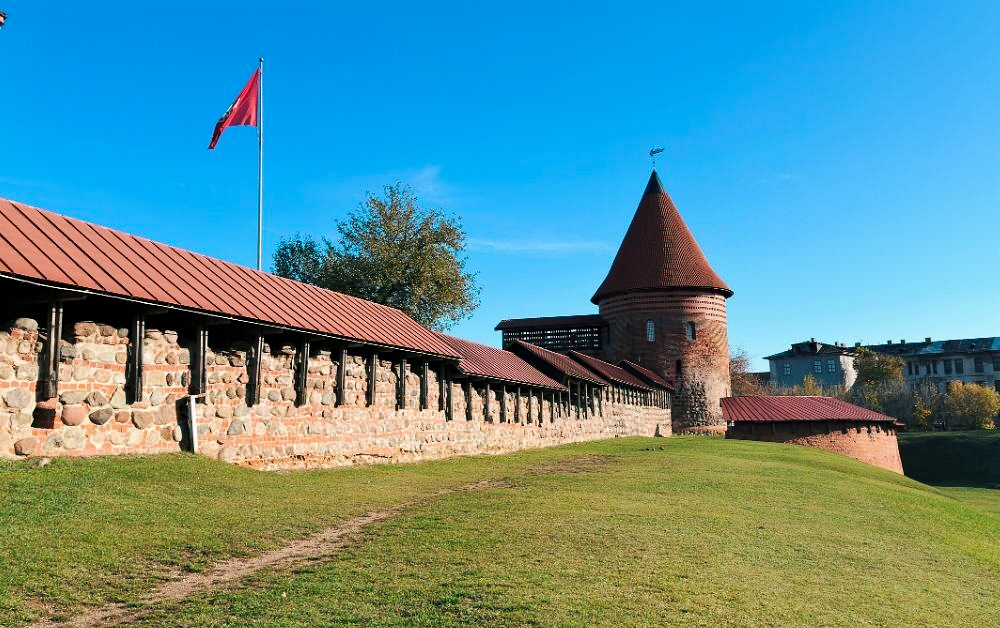
That history does not always announce itself with a grand monument. Sometimes it appears as a fragment of a wall, an old courtyard, or ruins disappearing into the landscape. We particularly liked that sense of incompleteness. Lithuania does not seem to have rebuilt every piece of its past into something polished and tourist-friendly. In some places, the ruins are simply ruins, left to tell their own story.
One place we would have loved to explore more deeply is Kernavė, Lithuania’s ancient capital, where a series of archaeological sites and hill forts rise above the Neris River. The remains do not recreate a medieval city for you. Instead, the landscape leaves you to imagine what once stood there. That kind of historical silence can be much more powerful than another perfectly reconstructed attraction.
Lithuania Is Beautiful Without Trying Too Hard
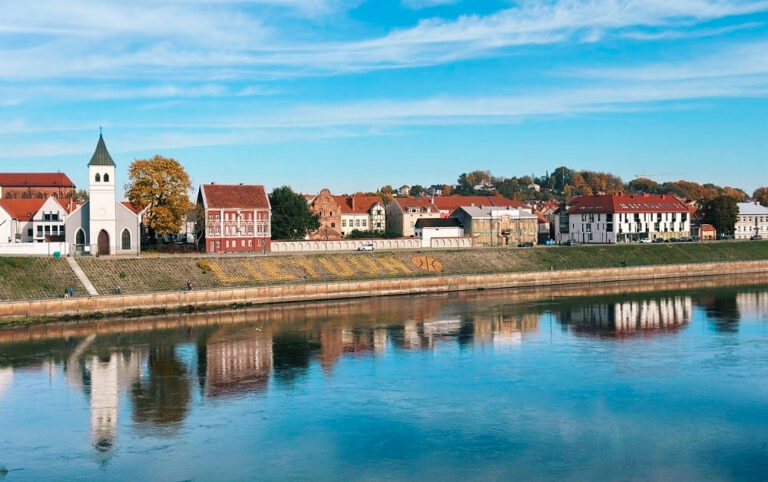
Perhaps this was one of our favorite discoveries. Lithuania does not constantly demand your attention. Its beauty often arrives quietly. A church appears at the end of a street. A line of trees turns gold in October. A castle ruin emerges from the landscape. A narrow lane opens into a courtyard you did not know was there.
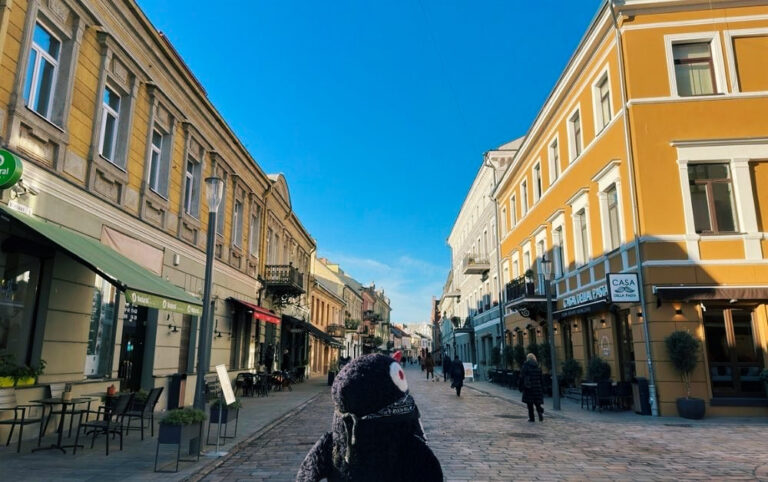
We visited at the end of October, when the country was already properly in autumn mode. The days were cold and often cloudy, but the changing leaves made up for the weather. Lithuania has four distinct seasons, and autumn gives its cities and countryside a particularly atmospheric quality, especially with so much forest covering the country.
It also meant that our travel rhythm became slightly different. We walked until we were cold, found somewhere warm, drank something, went back outside, and repeated the process. More than once, a shopping center became an entirely legitimate sightseeing strategy.

The People Were Part of the Impression
One of the harder things to capture in a travel article is the feeling of a place’s people. It is easy to turn a handful of encounters into a sweeping statement about an entire country, so this is more our impression than a verdict on Lithuanians as a whole. We found people friendly without being overly familiar. There were smiles, helpful interactions, and small gestures, but also a certain reserve. Nobody seemed particularly interested in performing friendliness simply because we were tourists, and we liked that. It felt genuine.
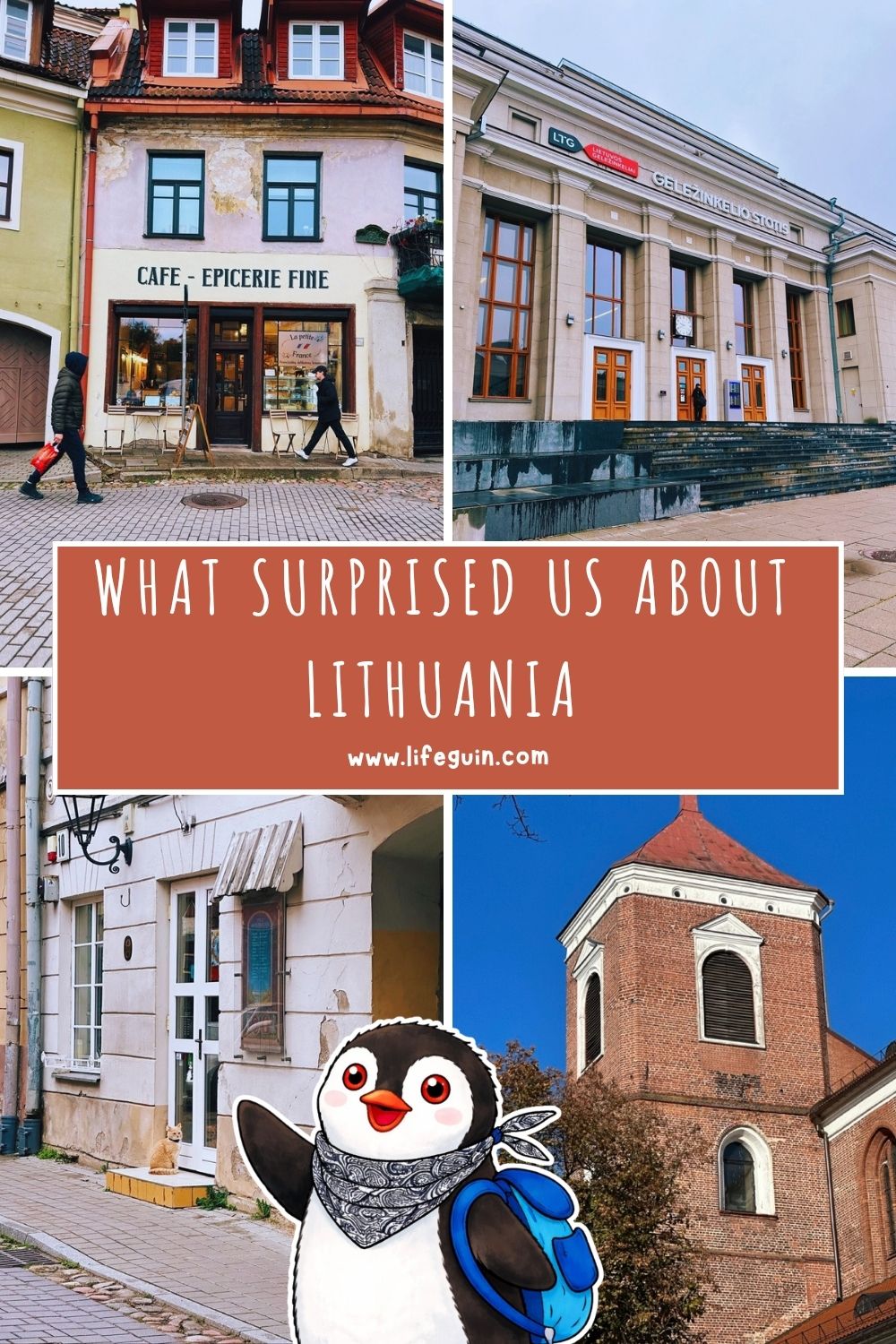
We were sitting at a café when a small scene outside caught our attention. A cat sat in front of a shop door, looking as though she really wanted to get inside. A few locals noticed her too. Someone opened the door, presumably expecting the cat to stroll in. She did not. The door closed. A little later, someone tried again. Still nothing. They opened it once more, waited, and the cat remained exactly where she was, apparently reconsidering her life choices. Nobody made a fuss, but they noticed her, tried to help, and then carried on with their day. It was a tiny interaction, hardly something you would put on a sightseeing itinerary, yet somehow it stayed with us.
Maybe that is what we liked about Lithuania. So much of the experience felt understated. The country didn’t seem to be constantly trying to convince us it was wonderful. There was no desperate need to impress. Instead, the more time we spent walking, watching, and paying attention, the more little things revealed themselves. A helpful stranger, a stubborn cat, a quiet street, a ruined wall, or a view that suddenly opened up in front of us. Lithuania seemed to work best when we stopped looking for the big attraction and paid attention to what was happening around us.
Then, as we settled into that quiet rhythm, Lithuania reminded us that every country has its own rules.


The Train Station Where We Decided Not to Take a Picture
This was one of those moments that probably would never make it into an official tourism brochure, but it stayed with us. We arrived at a Lithuanian train station with cameras in hand, naturally assuming that taking a few photographs of the building and atmosphere would be completely ordinary. Then we noticed another woman doing exactly that. A security guard approached her and told her to stop.
We watched the interaction and immediately decided that we were perfectly happy to admire the station without photographing it.
There is a reason behind this. Photography and filming at Lithuanian railway facilities can be restricted and may require prior permission, as railway infrastructure is treated as having security significance. The rules aren’t a blanket ban on every photograph of every train, but they are strict enough that visitors shouldn’t assume casual photography of railway facilities is permitted.
It was a small moment, but it perfectly illustrated something we kept discovering in Lithuania: the country can feel relaxed and open, yet boundaries can appear when you least expect them.


Lithuania Has a Very Specific Relationship With Alcohol
Our second encounter with Lithuanian rules was considerably less serious and much more personally inconvenient. We wanted to buy a bottle of wine. It was after 8 p.m. That ended our wine-shopping adventure.
Lithuania restricts retail alcohol sales to 10 a.m. to 8 p.m. from Monday to Saturday and 10 a.m. to 3 p.m. on Sundays, and the legal minimum age for purchasing and consuming alcohol is 20. The restrictions form part of a broader public-health policy that has progressively reduced the availability of alcohol in the country.
The funny part was that nothing about the supermarket looked particularly dramatic. The wine was still sitting there, perfectly visible behind us. It was simply no longer available for purchase.
It was one of those small travel lessons that you remember precisely because it catches you completely unprepared. In Lithuania, apparently, wine has a bedtime. And if you are planning a late dinner followed by a bottle back at your accommodation, you may want to rearrange that plan.


The Rules Go Further Than the Supermarket
The reason Lithuania takes alcohol availability so seriously becomes clearer when you look at the country’s recent history. Alcohol consumption became a significant public-health concern after independence, and Lithuania introduced a series of increasingly strict measures to reduce drinking and alcohol-related harm. The major changes took effect in 2018, including shorter retail sales hours, raising the minimum purchasing age from 18 to 20, higher excise taxes, and a near-total ban on alcohol advertising. The WHO notes that Lithuania had one of the highest alcohol-attributable burdens in Europe. At the same time, the OECD reports that the country recorded one of the largest declines in alcohol consumption among OECD countries between 2010 and 2018.
And the restrictions do not stop at the supermarket door. Lithuania has also introduced specific rules around alcohol at public events. Since 2020, drinks stronger than 7.5% alcohol cannot be sold at public events, while additional restrictions apply to outdoor sales, including sales on beaches. In other words, even if you are heading to a festival or outdoor event, the rules around what can be sold and where are considerably tighter than you might expect.
What initially feels like an oddly inconvenient travel rule is therefore part of a much bigger national approach. Lithuania has deliberately chosen to make alcohol less available, less visible and harder to market, rather than treating it simply as another everyday retail product. For us, that policy translated into one missed bottle of wine after 8 p.m.; for Lithuania, it is part of a much longer attempt to change the country’s relationship with alcohol.
Other Rules Are Hiding in the Landscape
The railway and alcohol rules were the two we actually encountered, but Lithuania has plenty of other regulations that become relevant once you move beyond the cities. The country’s forests, for example, are not simply a free-for-all despite the strong culture of access to nature. Camping is generally restricted to designated sites, fires must be made in designated places, and protected areas may have additional rules. At the same time, Lithuania has a strong tradition of enjoying its forests, including foraging for mushrooms, berries, and other wild foods where permitted.
Restrictions also apply around military and certain security-related sites, so the sensible rule for visitors is the same one we accidentally learned at the railway station. If something clearly looks like sensitive infrastructure, admire it without immediately reaching for the camera.
None of these rules made Lithuania feel difficult to visit. If anything, they became part of the trip’s texture. They reminded us that traveling somewhere means stepping briefly into somebody else’s system of rules, habits, and assumptions.
A Country Shaped by More Than One Past
The more we learned about Lithuania, the harder it became to describe it simply as a Baltic destination. Its history contains the Grand Duchy, the Polish-Lithuanian Commonwealth, the Russian Empire, independence, occupation, the Second World War, the Holocaust, Soviet rule and the restoration of independence in 1990. Those chapters have left very different marks on the country, and they do not always sit side by side comfortably.
In Vilnius, the layers are particularly visible. The city was once known as the Jerusalem of the North because of its flourishing Jewish intellectual and cultural life, much of which was destroyed during the Holocaust. Elsewhere, Soviet traces remain in the urban landscape, while older churches, universities, and historic buildings speak to much earlier periods.
This is one reason we found Lithuania more compelling the longer we looked. The pretty streets are only the surface.
Even the Food Tells Part of the Story
We barely scratched Lithuania’s food scene, but what we did encounter helped us understand the country around us. This is food shaped by a northern climate and ingredients that could be grown, stored, or foraged: potatoes, rye, mushrooms, dairy, meat, beetroot, and seasonal produce. Traditional dishes are hearty rather than delicate, the kind of food that makes considerably more sense when the temperature outside has dropped, and you have been walking for hours.
But modern Lithuania is not trapped in its traditional cuisine. A growing contemporary restaurant scene is emerging, and the MICHELIN Guide now covers restaurants across the country. We didn’t stay long enough to explore it properly. That might be one of our strongest reasons for returning. We need to eat more Lithuania.
The Country We Did Not Have Time to See
Perhaps the most telling thing about our trip is the list of places we did not manage to visit. Trakai Castle was still waiting for us, sitting on its island in Lake Galvė like something from a completely different itinerary. The Curonian Spit and the Baltic coast remained unexplored. Kernavė was another place we would have liked to see properly. We barely touched Lithuania’s countryside, forests and smaller towns.
And then there are the ruins. We found ourselves particularly drawn to the places where Lithuania’s history survives in fragments rather than complete monuments. Something is compelling about standing among ruins and reconstructing the story yourself. The missing pieces become part of the experience. Lithuania has five UNESCO World Heritage properties, including Vilnius’ historic center, Kaunas Modernism, Kernavė, the Curonian Spit, and the Struve Geodetic Arc. We saw only a small portion of that story in person.
Buy Us a Ko-fi

Lithuania Was the Surprise We Did Not Know We Needed
We went to Lithuania expecting a pleasant couple of days in a Baltic state. We found a country that was quieter and more layered than we expected, with an enormous history sitting comfortably beside contemporary life. We found beautiful cities without feeling like everything was arranged specifically for visitors. We found people who were welcoming but not performative, landscapes that became spectacular almost without warning, and ruins that made us stop and think about everything that had stood there before us.
We also discovered places where you should think twice before taking a photograph, and that buying wine after eight in the evening is apparently an activity for tomorrow.
But those details are part of the story too. Because travel is rarely just about the famous sights, it is about the little rules you didn’t know, the conversations you remember, the weather you didn’t expect, the meal you stumbled upon, the street you almost walked past, and the ruins that make you wonder what happened there hundreds of years ago.
We only had two days in Lithuania. It was nowhere near enough. And perhaps that is the best thing we can say about the country. We left with a longer list of things we had not seen than things we had, and with the distinct feeling that Lithuania had only just introduced itself.
Travel Bold. Eat Well. Waddle Wild.
Save This Pin for Later!
This post contains affiliate links. If you click and buy, I might earn a tiny commission, enough to help a penguin keep up its globe-trotting lifestyle. No extra cost to you, just more fish for me. Thank you for supporting the adventure!