Niedzica-Zamek: Exploring a Castle Above the Dunajec River
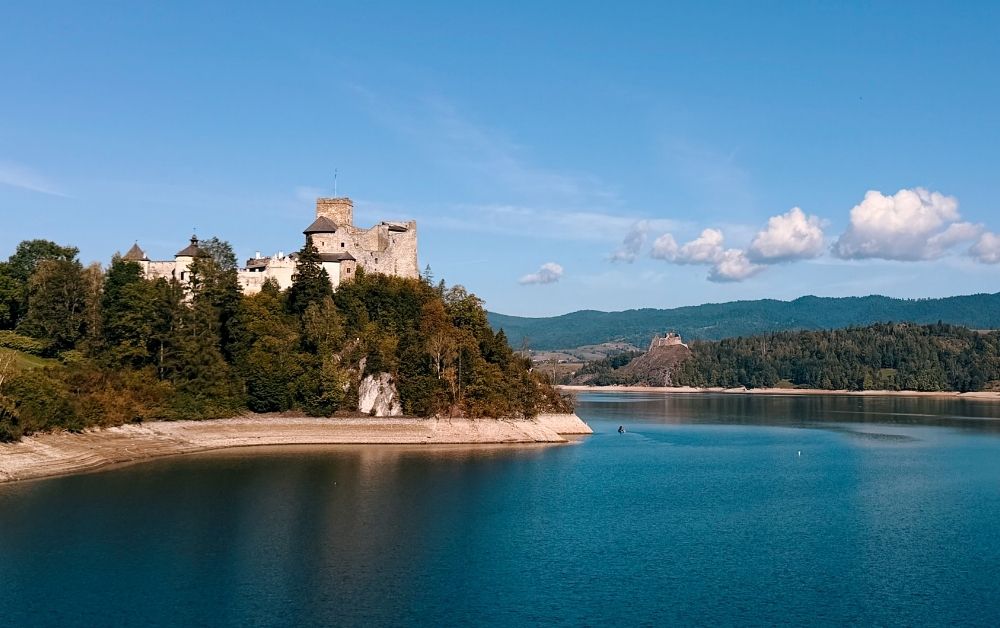
Niedzica-Zamek sits above the Czorsztyn Reservoir, with the Dunajec River winding through the surrounding landscape. Visit the historic castle to explore its centuries-old walls, learn about its past, and take in views across one of southern Poland’s most striking landscapes.
Quick Facts About Niedzica-Zamek
- Location: Zamkowa 2, 34-441 Niedzica-Zamek, Poland
- Opening Hours: Daily, 9 AM–7 PM in summer; shorter hours in winter
- Tickets: from PLN 40 regular / PLN 30 reduced
- Visit Time: Around 1–1.5 hours
- Parking: available near the castle
- Accessibility: Some areas involve stairs and uneven surfaces
- Website: Niedzica Castle Official
How to Get to Niedzica-Zamek
Niedzica-Zamek is easiest to reach by car, especially if you want to explore more of the Dunajec and Czorsztyn Reservoir area. We drove there from Stará Ľubovňa in Slovakia, crossed the Slovak-Polish border, and reached the castle in about 40 minutes. From Kraków, the drive is about 1.5 hours, while Nowy Targ is roughly 30–45 minutes away. The castle is on Zamkowa Street, with parking near the entrance.
For the most flexibility, a car is best, especially if you plan to combine Niedzica Castle with Czorsztyn Castle, the reservoir, or other Pieniny attractions. Public transport is possible, with buses running from Nowy Targ to Niedzica-Zamek, but it requires more planning.
Public Transport
Niedzica-Zamek is also accessible by public bus. From Nowy Targ, buses run to the Niedzica Zamek stop, with the current regional routes including A61 and A71. The official castle website also lists regular buses from Nowy Targ towards Sromowce Niżne, with a stop at Niedzica-Zamek.
The A61 and A71 routes are particularly useful for visitors, as both connect Nowy Targ with Niedzica, although timetables vary by day and season. Check the current timetable before traveling.

Parking at Niedzica Castle
There is parking available near Niedzica Castle, but spaces are limited and can fill up quickly during busy periods. We parked at Parking Elektrownia Wodna Niedzica, which gave us a convenient base for exploring the area. We also wanted to visit the Niedzica Hydroelectric Power Plant, so parking here allowed us to combine both stops without moving the car.
Parking at Elektrownia Wodna Niedzica costs approximately PLN 10 for the day. Prices can change seasonally, so check the current rate when you arrive. The parking area also has toilets, which is handy if you plan to spend a few hours exploring Niedzica Castle and the surrounding area.


Opening Hours and Tickets
Opening Hours
Niedzica Castle is open daily from May to September, from 9 AM to 7 PM. From October to April, opening hours are shorter, with the castle generally open Tuesday to Sunday from 9 AM to 4 PM. Opening times can change, especially around holidays, so check the official website before your visit.
Tickets
You can buy tickets at the ticket booth before entering. Admission to the Castle and Carriage House costs PLN 40 for adults and PLN 30 for reduced admission. The ticket includes the guided tour option, but you can also choose to explore the castle independently.
Hotel search from Trip.comShows Trip.com’s own box, which can set Trip.com cookies.Search hotels on Trip.comTrip.com’s box can’t load on this device (an ad blocker often stops it). This opens Trip.com’s own hotel search.Open Trip.com
Exploring Niedzica and the Czorsztyn Reservoir
We parked our car at the Niedzica Hydroelectric Power Plant and decided not to head straight for the castle. Instead, we took some time to wander along the reservoir and explore the area around the hydroelectric plant, enjoying the views before continuing towards Niedzica-Zamek. From the parking area, the castle is an easy walk, although you do need to tackle a few sets of stairs on the way. There are not too many, but they are worth keeping in mind if you are traveling with young children or anyone with limited mobility. It is a pleasant way to begin the visit, with the water and surrounding mountains setting the scene before the castle comes into view.


The Niedzica Hydroelectric Power Plant
Before heading up to the castle, it is worth taking a closer look at Elektrownia wodna Niedzica. You can waddle across the dam to the other side, taking in views of the Czorsztyn Reservoir and the surrounding mountains along the way. The power plant is still operating today and has a capacity of around 92 MW, generated by two reversible turbines. Interestingly, much of the machinery is hidden underground: the powerhouse sits about 40 meters below ground level and has seven floors.
The nearby Czorsztyn dam is 404 meters long and 56 meters high, making the scale of the whole complex much easier to appreciate once you are standing there.


The waddle across the dam also gives you one of the best views of Niedzica Castle. From here, the fortress appears to rise above the water, almost as if it is floating on the reservoir. Across the water, you can also spot the ruins of Czorsztyn Castle, creating a striking contrast between the two historic sites. With the mountains behind them and the reservoir stretching between the castles, this quickly became one of my favorite views of the area.
From the reservoir, we continue towards the castle, following the road slightly uphill. Along the way, a row of small shops and stalls adds local color to the waddle. You can browse souvenirs, regional products, and, of course, oscypek, the famous smoked sheep’s cheese from the Polish mountain region. It is an easy stretch to wander, with plenty of tempting stops before reaching the castle itself.


Before reaching the castle entrance, stop at the ticket booth to buy your admission. The ticket office is located along the approach to the castle, so you can sort out your tickets before heading inside and beginning the visit.
Pro Penguin Tips
Ask the ticket booth for a Niedzica Castle stamp before you go inside. It makes a fun little souvenir to add to your travel journal or collection.
A Castle Above the Water
After picking up our tickets, we waddle towards the castle gate, with Niedzica-Zamek rising above the Czorsztyn Reservoir ahead of us. Its position makes an immediate impression, with the water below and the Dunajec flowing through the surrounding landscape. Visitors can join a guided tour or explore the castle at their own pace. We decided to waddle on our own, taking our time to discover the fortress and its exhibitions without being tied to a group.
A Little Bit of History
- Medieval origins: Niedzica Castle was erected between 1308 and 1313, during the reign of King Charles I of Hungary. It was built to protect the northern border of the Hungarian Kingdom.
- A strategic trade route: The castle stood above the Dunajec Valley, overlooking an important route connecting Kraków and Budapest. Its position gave it both defensive and strategic importance.
- Rebuilt over the centuries: The families who owned the estate rebuilt and expanded the castle several times, gradually developing the fortress we see today.
- From Hungary to Poland: At the end of the First World War, Niedzica became part of Poland. The Hungarian Salamon family continued to live in the castle until 1943.
- A new chapter: After the state took over the estate, the Salamon family lost their rights to the property. From the 1950s, the Association of Art Historians took over the castle.
- A castle on screen: Niedzica has become a popular tourist attraction for Polish and international visitors and has also served as a setting for numerous films and television productions.
- Today: The historic Dunajec Castle is open to visitors as a museum, offering a glimpse into its architecture, history, and the people who once lived within its walls.


A Fortress Shaped by Centuries of History
Niedzica Castle, also known as Dunajec Castle, has watched over the Dunajec valley for more than 700 years. Built in the early 14th century, the fortress stood in a strategically important location on the historic border between Poland and Hungary. Over the centuries, several noble families held it, and it gradually changed from a defensive stronghold into a residential castle. Its thick stone walls, towers, and elevated position still reflect its original purpose, while today the castle serves as a museum that preserves the region’s history.
Waddling Through Niedzica Castle
Once through the gate, the castle unfolds through courtyards, historic interiors, narrow passages, and stone staircases. We explore at our own pace, taking time to look at the details rather than simply moving from room to room.
- Lower Courtyard. We begin in the lower courtyard, enclosed by the castle’s thick stone walls. This part of the fortress immediately conveys its defensive purpose, with the old masonry and compact layout making it easy to imagine the castle centuries ago.
- Upper Courtyard. From here, we continue higher into the castle. The upper courtyard feels more intimate, with the surrounding buildings revealing how the fortress gradually developed from a defensive stronghold into a residential complex.


- Historic Interiors. Inside, several rooms are furnished with period pieces, paintings, and everyday objects. The displays offer a glimpse into the lives of the noble families who lived here, while the preserved architecture keeps the rooms from feeling like a modern museum reconstruction.
- Chapel. The castle chapel is one of the quieter stops along the route. Its modest interior adds another layer to Niedzica’s story, showing that this was not only a fortress but also a place where people lived, worshipped, and spent their daily lives.
- Defensive Features. Stone staircases, narrow corridors, small windows, and remarkably thick walls remind visitors of the castle’s original military role. As we move through these spaces, the fortress feels much more practical than decorative.
- Museum Exhibitions. Throughout the castle, exhibitions introduce its history, former owners, and life in the region. Historical objects and information panels help connect the rooms and architecture with the people who once occupied them.
- Castle Towers and Views. The higher we climb, the more the landscape opens up. From the castle, you can look across the Czorsztyn Reservoir towards the ruins of Czorsztyn Castle, with the Dunajec and Pieniny landscape stretching beyond.
- The Castle Walls. Waddling along the older sections of the fortress is perhaps the most atmospheric part of the visit. The combination of weathered stone, narrow openings, and views over the water makes it easy to see why this particular spot was chosen for a castle.


The Legends Behind the Castle Walls
Niedzica Castle has no shortage of stories, but perhaps none is as intriguing as the legend of a lost Inca treasure. According to the castle’s account, Sebastian Berzeviczy traveled to Peru in the 18th century and became connected to an Inca family. His descendants eventually sought refuge at Niedzica, where Umina was later killed. The story takes an even more mysterious turn in 1946, when Andrzej Benesz, believed to be a descendant of the family, reportedly discovered a quipu, a system of knotted cords used by the Incas, which was said to contain clues to a hidden treasure. The quipu was later lost, and no treasure has ever been found, leaving the story firmly in the realm of legend.
- The Inca connection: The legend links Niedzica to Sebastian Berzeviczy and his family, who reportedly traveled from Peru to Europe.
- The mysterious quipu: In 1946, a knotted Inca cord was reportedly discovered at the castle. People believed it contained clues about the location of hidden treasure.
- The missing treasure: Despite years of searching, no Inca treasure has been found at Niedzica.
- A castle full of legends: The Inca story is not the only tale connected with the fortress. Local legends also tell of Jánošík, the famous Carpathian outlaw, and the ghost of Brunhilda, who is said to wander the castle after her tragic death.
The mix of real historical figures, mysterious objects, and stories that have never been fully resolved gives Niedzica something beyond its stone walls: a sense that a few secrets might still be hiding here.


Looking Out Over the Dunajec and Czorsztyn Reservoir
This quickly becomes one of our favorite parts of Niedzica Castle. From the higher sections of the fortress, the view opens across the Czorsztyn Reservoir, with the Dunajec flowing through the landscape below. The contrast is striking: centuries-old stone walls and towers in the foreground, while the modern reservoir stretches towards the surrounding Pieniny Mountains. Across the water, the ruins of Czorsztyn Castle add another historic landmark to the scene. We could easily spend much longer here simply watching the water, mountains, and two castles come together in one panorama.


More Than Just a Castle
Niedzica-Zamek is easy to turn into a full day around the water, rather than simply a castle stop. The Czorsztyn Reservoir stretches between the two historic fortresses, with the ruins of Czorsztyn Castle sitting on the opposite shore. The Dunajec adds another layer to the landscape, while the surrounding Pieniny Mountains provide plenty of opportunities for walking, cycling, and sightseeing. You can also explore the reservoir by boat, which lets you see both castles from the water. With so much packed into a relatively small area, we recommend allowing extra time to explore beyond the castle walls.
The Carriage House
The Carriage House is included in the Castle and Carriage House ticket and adds another perspective to Niedzica’s story. Rather than focusing on grand rooms and defensive walls, this part of the visit shows how the castle’s owners actually traveled and moved around the estate. Inside, we find a collection of horse-drawn carriages, sleighs, and transport equipment, with different designs reflecting changing travel methods over the centuries.
The collection includes elegant carriages for formal journeys, alongside more practical vehicles for everyday transport and work. The sleighs are particularly interesting, offering a glimpse into how people traveled through the snowy mountain landscape during winter. Details such as the wooden construction, wheels, seats, and decorative elements also give you a better appreciation of the craftsmanship that went into these vehicles.
It is not a huge exhibition, but we enjoy seeing this more practical side of castle life. After walking through the historic interiors, the Carriage House helps complete the picture of what life at Niedzica looked like beyond the castle walls.


How Long Do You Need
We recommend allowing around 1 to 1.5 hours to visit Niedzica Castle and the Carriage House without rushing. The castle itself takes most of the time, especially if you want to stop for the exhibitions, historic interiors, and viewpoints. Add another 20–30 minutes if you want to explore the Carriage House at a relaxed pace.
If you also want to walk around the Czorsztyn Reservoir, visit the hydroelectric power plant, or enjoy the views, plan for 2–3 hours in total.
Buy Us a Ko-fi

Best Time to Visit Niedzica Castle
For a quieter visit, arrive early. We reached Niedzica at around 10 AM, but even then the parking area directly below the castle was already full. Inside, the castle was also quite busy, with several organized tour groups moving through the rooms at the same time. It did not stop us from enjoying the visit, but the crowds made some of the smaller rooms and viewpoints feel quite packed.
For a more relaxed experience, we would aim to arrive shortly after opening, particularly during the summer season and on weekends. Arriving earlier in the day should also give you a better chance of finding parking closer to the castle and exploring the interiors before larger tour groups arrive.
Is Niedzica-Zamek Worth Visiting
Absolutely. Niedzica-Zamek is worth adding to a southern Poland itinerary, particularly if you enjoy historic castles with a strong connection to the surrounding landscape. We loved the combination of the medieval fortress, the Czorsztyn Reservoir, and the Dunajec, with the views from the castle becoming one of our favorite parts of the visit. The castle itself also reminded us a little of Ľubovňa Castle in Slovakia, especially in its atmosphere, historic character, and hilltop setting, and there is a good reason for the similarity. Both castles date back to roughly the same period, with their origins at the turn of the 13th and 14th centuries, when this part of the Carpathians belonged to the Kingdom of Hungary.
Even with the crowds, Niedzica felt like more than just another castle to tick off the list. It is a place where history, legends, and scenery come together; visiting feels like a proper experience rather than a quick sightseeing stop.
A Final Stop
After finishing our visit to Niedzica, we got back in the car and headed towards Slovakia, but our journey did not end at the border. Along the way, we stopped in Červený Kláštor, where you can cross the historic footbridge connecting Slovakia and Poland. We waddle across to the Polish side for a final look at the border landscape and the small traditional market before returning to Slovakia. Back on the Slovak side, you can visit the historic Červený Kláštor monastery, explore the surrounding Pieniny National Park, walk along the Dunajec or simply enjoy the mountain scenery. For us, it was the perfect little detour to finish the day before continuing home.


We would definitely waddle back to Niedzica-Zamek. The castle itself is fascinating, but for us, the setting makes the visit special. Standing above the Czorsztyn Reservoir with the Dunajec below and Czorsztyn Castle across the water creates a landscape that is hard to forget. We also enjoyed taking our time around the hydroelectric plant and reservoir before heading up to the castle, rather than treating it as a quick stop. It reminded us of Ľubovňa Castle in some ways, but the combination of medieval walls, water, and mountain scenery gives Niedzica its own character. If you are exploring the Pieniny region, this is one castle we would happily add to the itinerary again.
Travel Bold. Eat Well. Waddle Wild.

This post contains affiliate links. If you click and buy, I might earn a tiny commission, enough to help a penguin keep up its globe-trotting lifestyle. No extra cost to you, just more fish for me. Thank you for supporting the adventure!