Hungry in Oslo? Waddle Into the City’s Food Halls
Oslo has turned the food hall into something of an art form. From the original Mathallen to colorful street-food markets and waterfront food halls, these lively spaces bring together Norwegian ingredients, international flavors, and hungry locals under one roof.
- Oslo’s Food Hall Culture
- How Do Food Halls in Oslo Work
- How Many Food Halls Are There in Oslo
- Our Pick: Food Halls Worth Waddling Into
- Other Food Halls Worth Knowing About in Oslo
- Penguin Pro Tip: Posthallen Drinkhub
- Which Oslo Food Hall Should You Visit
- What Surprised Us About Oslo’s Food Halls
- Are Oslo Food Halls Worth Visiting
- Our Oslo Food Halls Map
Oslo’s Food Hall Culture
Oslo has embraced the food hall concept in a way that makes eating in the city feel informal. Instead of choosing one restaurant and committing to a single menu, food halls bring several independent vendors together under one roof, with everything from Norwegian specialties and fresh seafood to burgers, Asian dishes, pastries, and international street food. You order from whichever counter catches your eye, then find a shared table, making food halls especially easy when everyone in the group wants something different.
The concept has also become part of Oslo’s wider food culture. Places such as Mathallen helped introduce the modern food-hall idea to the city, while newer venues have taken it in different directions, from international street food to waterfront dining. For us, that variety is the biggest attraction. We can explore several flavors in one visit, watch locals grab lunch or meet friends, and get a taste of Oslo’s increasingly diverse food scene without having to plan a restaurant reservation.
And it’s practical when traveling. You do not have to agree on what to eat. One person can waddle towards Norwegian salmon, another can hunt down a bao bun, while someone else is already eyeing the dessert counter. Everyone wins, and nobody has to compromise.
How Do Food Halls in Oslo Work
The setup is simple. Food counters surround a shared seating area, where you can choose a table and settle in with whatever you ordered. Everyone in your group can pick food from a different counter, so you don’t need to agree on one restaurant or menu.
You can waddle up to a counter and order there, but in several Oslo food halls, we notice another option: scan the QR code at the table and order from your phone. Once you place the order, you return to your seat and wait. When your food is ready, you get an SMS telling you to collect it from the counter.
This was new to us, but we got used to it. No waiting at the counter, no trying to hear your name over the noise, and no wondering whether your order is ready. You scan, order, sit down, and wait for the message. Then it is time to wander back to the counter, collect your food, and return to the table.
How Many Food Halls Are There in Oslo
There is no single official number of food halls in Oslo because the line between a food hall, food court, and market can get a little blurry. But if you are planning a trip, several places are worth knowing about, with Mathallen, Oslo Street Food, and Vippa as the three main food halls most often compared.
Newer or slightly different versions of the idea include Barcode Street Food, VIA Village, and Paleet Food Hall. Oslo’s food-hall scene has therefore grown beyond one famous address into a collection of places across the city.
What makes them interesting is that they are not all trying to do the same thing. Mathallen focuses on food shops, ingredients, and places to eat in Vulkan. Oslo Street Food emphasizes street food and a central location. Vippa brings the concept to the waterfront at Vippetangen, with food from around the world.
So rather than asking which Oslo food hall is the best, we think the better question is: which one fits your itinerary.
Our Pick: Food Halls Worth Waddling Into
Oslo has several food halls, and while we didn’t manage to visit them all, we made it to the ones that caught our attention. Here, we take you through the food halls we visited, what each one is like, what we ate, and which ones we think are worth adding to your Oslo itinerary. If you are short on time, start with this list.
Vippa Oslo
📍 Location: Akershusstranda 25, 0150 Oslo
🕒 Opening Hours: Thursday–Saturday 12:00–22:00. Sunday 12:00–21:00. Closed Monday–Wednesday. Food service ends one hour before closing.
🌐 Website: Vippa Oslo
🐧 Penguin Rating: ★★★☆☆ 3/5
Vippa sits at the end of Vippetangen, right by the Oslo Fjord. We reach it after wandering along Oslo’s waterfront, and the location becomes part of the experience before we even order anything. Inside, food stalls bring together cuisines from around the world, from Nepal and China to Morocco, Syria, Greece, and the Balkans. It’s a place where food from around the world brings people together.
We arrive hoping to find something Norwegian, but Vippa sends us in another direction. This food hall isn’t really about Norwegian food. Instead, we’re drawn to Balkan food, partly because we miss it and partly because we spot something we know well: ćevapi with somun and kajmak. And that becomes our choice.


What We Ate at Vippa
We ordered ćevapi, the grilled meat we associate with the Balkans, served with somun bread and kajmak, a creamy dairy spread. After spending time away from the region, this is exactly the kind of food we want to find. The ćevapi are grilled, the somun gives us something to tear apart and dip, and the kajmak brings the dish together. It is the kind of meal that makes us forget, for a moment, that we are in Oslo. And that is perhaps what works about Vippa. You come here to eat your way around the world, and sometimes the dish that feels most like home is the one you did not expect to find.


What we loved most was the kajmak, which surprised us. We had just come back from the Balkans, where we had been looking forward to trying it, yet somehow we had not found it anywhere during our travels. And now, in Oslo, we finally get to try it. Apparently, kajmak is a popular part of Balkan cuisine, so discovering it here feels almost comical. We traveled all the way to Oslo to find something we had been looking for in the Balkans.
Bonus Local Tip: Fenaknoken
While we were at Vippa, a local gave us a tip: if we were looking for Norwegian seafood, we should try Fenaknoken. We did not have time to eat there, but we had to wander over and take a look. Fenaknoken is at Akershusstranda 23, right by Vippetangen and only a few minutes from Vippa. It specializes in Norwegian food traditions, with products including smoked salmon, dried and smoked fish, cured meats, and other Norwegian specialties.
📍 Address: Akershusstranda 23, 0150 Oslo
🕒 Opening Hours: Monday–Saturday, 10:30–18:14. Closed Sunday.
🌐 Website: Fenaknoken
So, if seafood is on your Oslo food list, keep this one in mind. We did not get to test the recommendation ourselves. Still, the tip came from someone local, and the location makes it easy to add after visiting Vippa or while exploring Vippetangen.


Mathallen Oslo
📍 Location: Vulkan 5, 0178 Oslo
🕒 Opening Hours: Tuesday–Saturday 10:00–20:00. Sunday 11:00–18:00. Closed Monday. Some restaurants stay open longer.
🌐 Website: Mathallen Oslo
🐧 Penguin Rating: ★★★★☆ 4/5
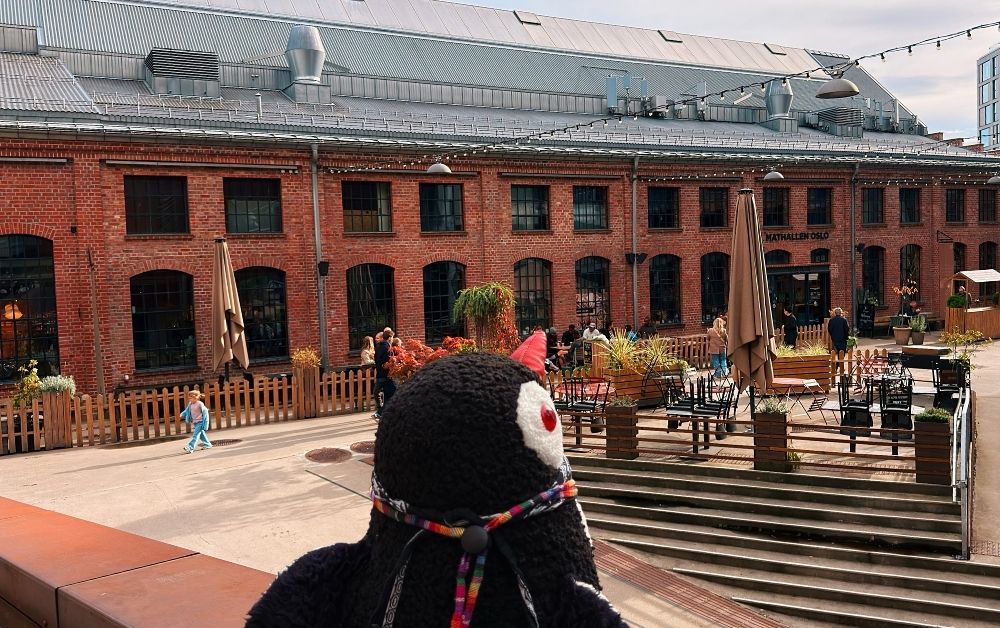
Of course, we had to check out Oslo’s most famous food hall. Mathallen opened in 2012 as Oslo’s first food hall, bringing the food-hall concept to the city. It sits in Vulkan, beside the Akerselva River, in a former early-20th-century industrial building. The building was originally a bridge workshop and was transformed into the food hall while keeping its industrial character.
And we really like what they have done with the place. Inside, the old structure mixes with food counters, shops, and places to eat, and there is plenty to wander through. We ended up buying cheese and a few other things to take with us, which is one reason Mathallen works for more than just lunch. You can come here to eat, but you can also come here to shop for ingredients and Norwegian food products.


Unfortunately, we did not actually eat a meal here. That said, we could easily have chosen from at least seven different stalls, because everything we passed looked like something we would want to try. From seafood and meat to cheese, baked goods, and ready-to-eat dishes, there was no shortage of options. Mathallen currently has specialty shops, cafés and eateries, as well as food-related events and courses.
For us, Mathallen is exactly what we want from a food hall: a place where we can wander without a plan, discover something to eat, and leave with a bag of food we did not intend to buy.
Oslo Street Food
📍 Location: Torggata 16, 0181 Oslo
🕒 Opening Hours: Monday–Thursday 11:00–23:00. Friday–Saturday 11:00–03:00. Sunday 12:00–21:00. The food stalls close earlier, at 22:00 Monday–Saturday and 21:00 on Sunday.
🌐 Website: Oslo Street Food
🐧 Penguin Rating: ★★★★☆ 4/5
Of all the food halls we visited in Oslo, this is the one we liked most. Oslo Street Food sits in the city center, inside the former Torggata Bad, which opened as Oslo’s first public bath in 1925. The old swimming pool has since become a food hall, with the building’s history still part of the setting.
We wandered around, checked out the different stalls, and, once again, somehow didn’t manage to eat anything. Which is almost a shame, because the choice made it hard to pick just one. The current food stalls include Mexican, Hawaiian, Greek, Vietnamese, Japanese, Thai, burgers, wings, and more, with vegetarian, vegan, and gluten-free options too.


What we liked most was the way the place feels when you first enter. There is space to sit, people are coming and going, food is being ordered from different counters, and the whole place works as a meeting point. Oslo Street Food has more than 600 seats, so unlike some food halls where finding a table can become part of the challenge, there is room to settle in.
And there is another side to it. On Fridays and Saturdays, the food hall turns into a nightclub in the evening, with DJs and space for up to 900 people. So this is not only somewhere to come for lunch. It changes as the day goes on.
For us, this was the food hall we would return to first. We came to look around, left without eating, and somehow still left thinking about what we would order next time.
Other Food Halls Worth Knowing About in Oslo
Mathallen, Vippa, and Oslo Street Food may be the names you hear most often, but they are not the only places to eat your way around Oslo. The city has several other food halls and food-court-style spaces, each with its own setting and selection. We didn’t manage to visit them all, but if you have more time in Oslo, these are a few worth putting on your radar.
- Barcode Street Food. Located in Bjørvika, this food hall brings together food from Italy, Asia, Norway, Mexico, India, and more, with vegetarian and vegan options. It also hosts events, music and markets.
- Paleet Food Hall. Right on Karl Johan, this one is smaller and more intimate, with Italian, Japanese and Mexican kitchens alongside a bar. It works for both a quick lunch and an evening meal.
- VIA Village. In Vika, this food court takes inspiration from Lisbon’s Time Out Market concept, bringing together food stalls from restaurants and food enthusiasts. You can find South American, Southeast Asian, Indian, and other cuisines here.
- Østbanehallen. Inside Oslo Central Station, this historic hall is now home to restaurants, cafés, and places to grab something to eat, making it convenient when you are already passing through the station.
- Sten & Strøm Food Hall. A newer food-court option in the city center, located inside the Sten & Strøm department store on Nedre Slottsgate.
So, if you are a food lover with more than a day or two in Oslo, don’t stop at the three famous names. Plenty of other places let you wander in and choose what catches your eye.
Penguin Pro Tip: Posthallen Drinkhub
📍 Address: Prinsens gate 8, 0152 Oslo
🕒 Opening Hours: Tuesday–Thursday 15:00–00:00, Friday–Saturday 15:00–02:00. Sunday–Monday closed
🌐 Website: Posthallen Drinkhub
🐧 Penguin Rating: ★★★★☆ 4/5
Food halls are not the only places in Oslo where you can wander between counters and choose what you fancy. Posthallen Drinkhub is the drinks version of the concept, bringing several bars together under one roof. It is inside Oslo’s former main post office. The building has kept parts of its original granite, marble, and wood interior, so the post office’s history is still part of the experience. Today, Posthallen houses eight bars with different concepts, along with places to get snacks and food.
We were living right next door during our stay, so we kept passing the building before finally wandering inside. A security guard is at the entrance, so you go through security before entering. Once inside, the system feels much like the food halls we had just been exploring.


You choose a bar, scan the QR code, order your drink, and wait for the message that it is ready. Then you wander over, pick it up, and return to your table. We tried drinks from the different bars and really enjoyed the experience. We loved sitting in the middle of the old post hall, surrounded by the original building, while everyone around us chose something different. It felt like a food hall, only the food had been replaced by drinks.


Which Oslo Food Hall Should You Visit
No single food hall fits every appetite, so rather than ranking them, here is what we would choose each one for. We visited all three of the main food halls during our Oslo trip, and each gave us a different experience. If you have limited time, use these categories to decide where to waddle first.
- Best for food lovers: Mathallen. Come here to wander between food counters, shops, and Norwegian produce. We especially liked being able to buy cheese and other food products to take with us.
- Best for international street food: Oslo Street Food. This is where we found the widest mix of cuisines in one place, with food from Mexico, Japan, Vietnam, Greece, Thailand and more.
- Best waterfront atmosphere: Vippa. Located in Vippetangen, Vippa combines food from around the world with seating by the Oslo Fjord. This is where we found the Balkan ćevapi and, most importantly, the kajmak we had been looking for.
- Best for a casual evening: Oslo Street Food. With its communal seating, food counters, bars, and evening events, this is the one we would choose when we want food followed by drinks and people-watching.
- Best for exploring Norwegian produce: Mathallen. If your goal is to take home Norwegian ingredients rather than eat a meal, choose this one. Wander through the shops and look for Norwegian cheese, seafood, cured meats, and other local products.
What Surprised Us About Oslo’s Food Halls
We went into Oslo’s food halls expecting the food to be the main story, but a few things stood out to us along the way. Each place had its own atmosphere, yet they all shared the same approach to keeping people staying, eating, and spending time together.
- They were all so welcoming. Each food hall had its own look and feel, but we found the spaces cozy, well-designed, and made for sitting down rather than simply grabbing food and leaving.
- Water stations were everywhere. This was something we really appreciated. You could get a glass of water without buying a bottle, and we kept noticing water stations throughout the food halls.
- Each food hall had its own vibe. Even though the concept was similar, Mathallen, Vippa, and Oslo Street Food didn’t feel the same. The setting, people, music, layout, and food choices gave each one its own character.
- The QR-code ordering surprised us. You could scan a code at your table, order from your phone, and wait for an SMS telling you when to collect your food. It made the process feel different from the food halls we are used to.
- They were busy. Apart from Vippa, which was quieter when we visited, the food halls were full. We saw locals eating, meeting friends, sitting with laptops and spending time there rather than simply coming in for a quick meal.
- Street food was not as cheap as we expected. This was probably the biggest surprise. We usually associate street food with lower prices than sitting down in a restaurant, but in Oslo the difference wasn’t always that big. Once you add up a main dish and a drink, you can sometimes get surprisingly close to what you would pay for a restaurant meal.
Buy Us a Ko-fi

Are Oslo Food Halls Worth Visiting
For us, yes. Food halls have become part of Oslo’s food culture, giving locals and visitors places to meet, eat, and spend time together instead of just grabbing something to go. We liked seeing how each one had its own atmosphere while keeping the same idea at its heart: choose what you want, find a table, and enjoy the experience together. Prices can be higher than we expected for street food, but the variety, atmosphere, and chance to try different cuisines make Oslo’s food halls worth adding to your itinerary.
Our Oslo Food Halls Map
Oslo’s food halls give us another way to experience the city through food. Each one has its own setting, atmosphere, and selection, but the idea stays the same: wander around, find something that catches your eye, order, and sit down with everyone choosing something different. We did not manage to eat at every place we visited, but we enjoyed seeing how much the concept has become part of Oslo’s food culture.
Our advice? Come hungry, don’t plan every bite, and leave room for a second stop.
Travel Bold. Eat Well. Waddle Wild.
Save This Pin for Later!
This post contains affiliate links. If you click and buy, I might earn a tiny commission, enough to help a penguin keep up its globe-trotting lifestyle. No extra cost to you, just more fish for me. Thank you for supporting the adventure!