Holmenkollen: One Waddle From the Ski Jump Into the Wild
When we realized that we could take the metro from central Oslo all the way up into the forest, we knew we had to try it. It feels slightly strange to think that one moment we can be surrounded by the streets and buildings of Oslo and, without even leaving the city’s public transport network, suddenly find ourselves surrounded by trees.
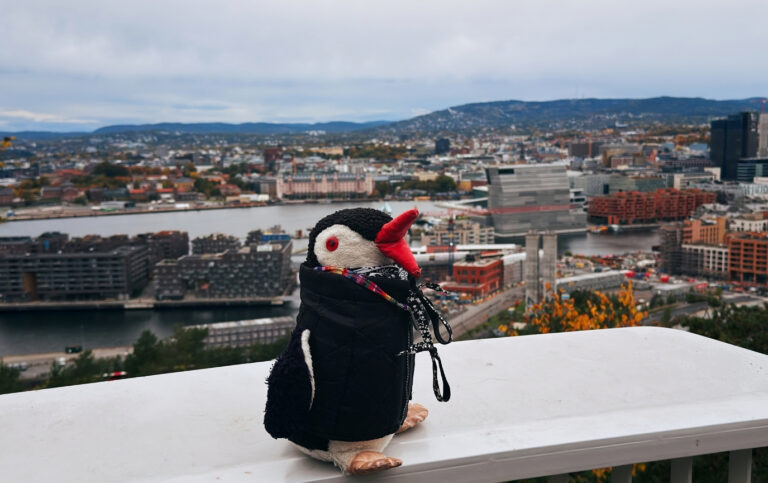
During our Oslo visit, we decided to explore a little beyond the immediate old town and the most famous central sights. We wanted to see what Oslo looks like from above, and more importantly, what lies beyond the city itself.
So we take the metro to Frognerseteren, the final stop high above Oslo. From there, we plan to explore the forest, find Øvresetertjern, a small lake hidden among the trees, and then waddle about two kilometers downhill towards Holmenkollen. Waiting for us at the end of the trail is one of Norway’s most recognizable landmarks: the Holmenkollen Ski Jump. What starts as a simple idea to escape the city turns into one of our favorite Oslo experiences. We get a forest hike, a peaceful lake, spectacular views, and one of Norway’s great symbols of skiing, all without really going far from the city at all.
Our Journey at a Glance
- Route: Frognerseteren → Øvresetertjern → Holmenkollen Ski Jump
- Duration: Approximately 2–3 hours, including the hike and exploring Holmenkollen
- Price: Included in Oslo Pass
- Highlight: Hiking through the forest from Frognerseteren to Holmenkollen, with Øvresetertjern along the way and the iconic ski jump waiting at the end.
We Take the Metro to the Top of Oslo
We start this adventure right in the heart of Oslo, at Nationaltheatret station. Around us, the city is already awake, with trams rattling through the streets and people heading to work, cafés and shops. But instead of staying in the center, we step onto the metro and head toward the hills.
As the train climbs higher, Oslo begins to disappear outside the window. Buildings become fewer, streets give way to trees, and before long the urban landscape is replaced by thick Norwegian forest. It is hard to believe that we are still traveling through the same city.
We stay on until Frognerseteren, the final stop, high above Oslo. We step off the metro and suddenly find ourselves surrounded by trees and hiking trails. We plan to explore the forest, find Øvresetertjern, a small lake hidden among the trees, and then follow the trail downhill towards Holmenkollen. This is exactly the kind of Oslo adventure we are looking for. After exploring the historic center and waterfront, we want to see what lies beyond the city’s postcard image. And here we are, swapping city streets for forest trails, with one of Norway’s most famous ski jumps waiting somewhere below us.


The metro ride itself becomes part of the adventure. We spend roughly 50 minutes traveling from the city center to Frognerseteren, and the journey feels like a gradual escape from Oslo.
At first, the train is underground, surrounded by the familiar rhythm of the city. Then, little by little, it emerges into the open. The buildings begin to thin out, the tracks climb higher, and the landscape opens in front of us. Through the windows, Oslo starts appearing below, with the Oslofjord stretching into the distance. By the time we approach Frognerseteren, it feels less like we are taking public transport and more like we are being carried straight into the forest above the city.
Roseslottet: An Art Stop Above Oslo
Right next to the top station, another unusual Oslo attraction waits among the trees: Roseslottet, an outdoor art installation and memorial dedicated to the values of freedom and democracy. We would have loved to explore it, but our timing was a little too early. We arrive in the morning, before it opens at 11:00, so rather than waiting around, we decide to save Roseslottet for another visit. Instead, we head to the trail and begin our waddle into the forest. The morning is still quiet, the air is crisp, and with the city already far below us, it feels like the perfect moment to start exploring Oslo from a completely different perspective.


Into the Forest and Towards Øvresetertjern
There is something serene and almost surreal about stepping off the metro and suddenly finding ourselves in the middle of the forest. Just minutes ago, we were traveling through Oslo, and now a hiking trail disappears between the trees in front of us. We leave the station behind and start waddling along the path, with nothing but forest surrounding us.
Our first destination is Øvresetertjern, one of the many lakes scattered across the forests around Oslo. In fact, Oslomarka has more than 500 bodies of water, making these forest lakes a natural part of the city’s outdoor landscape.
It’s a short walk to the lake. Øvresetertjern sits between Frognerseteren and Tryvannshøgda, surrounded by trees and small grassy areas. It is also a popular local spot for swimming, picnics, and fishing, with a bathing jetty at the southern end and grassy areas on the western side.
We spent some time simply enjoying the peaceful setting. Benches and grassy spots line the water, and the forest continues right to the shoreline. It feels wonderfully removed from the city, even though Oslo is still just a metro ride away. After taking our time around the lake, we eventually headed back toward the trail and started our downhill walk toward Holmenkollen.


What we love most is how thoughtfully the area is set up for people to enjoy it. A public toilet sits right by the lake, and it is clean, well-maintained, and stocked with everything you might need on a day outdoors. There is also a pontoon by the water, perfect if you fancy jumping in for a swim or heading out for a plunge. And if you arrive by car, there is parking nearby, too. It feels like the lake hasn’t just been left there for people to discover, but thoughtfully prepared so locals and visitors can genuinely use and enjoy it.


From Øvresetertjern to Holmenkollen
After spending some time around Øvresetertjern, we waddle back towards Frognerseteren station. But we are not ready to take the metro back down just yet. From the station, a trail leads through the forest towards Holmenkollen, so we decide to take the scenic route and continue on foot.
The trail takes us for roughly two kilometers through the forest, gradually descending towards the ski jump. And in autumn, it is particularly beautiful. The trees glow with color, the path is covered with fallen leaves, and the whole forest feels wonderfully quiet. It is hard to believe that one of Oslo’s biggest sporting landmarks is waiting just a little further down the trail.


We are now waddling through Nordmarka, the vast forest area north of Oslo and one of the city’s most important outdoor playgrounds. Nordmarka covers around 430 square kilometers and is criss-crossed by trails, forest roads and lakes. People use it year-round for hiking, cycling, swimming and, in winter, cross-country skiing.
What we particularly love is how easily this wilderness connects with the city. Holmenkollen is essentially a gateway to Nordmarka, and the area around Frognerseteren is a natural starting point for exploring the forest.
As we continue downhill, the trees eventually begin to open up, and the landscape changes again. Somewhere ahead is the Holmenkollen Ski Jump, and after the peaceful forest trail, seeing it rise out of the landscape feels like the perfect next chapter of our Oslo adventure.


The Bells in the Forest
As we continue through the forest, we start hearing church bells. At first, we cannot quite work out where the sound is coming from. The trees make it hard to place, so we keep waddling along, following the trail and listening to the bells in the distance.
Eventually, we come across Holmenkollen Chapel, and suddenly everything makes sense. The little chapel sits beautifully among the trees at the entrance to Nordmarka, and its setting makes it feel almost like something we have stumbled upon rather than a church in the middle of Oslo. The original chapel was built in 1903 and was intended partly for people heading into the forest for a day outdoors. A fire destroyed it in 1992, and it was rebuilt in 1996 in a style inspired by Norway’s traditional stave churches.


We would have loved to step inside, but it is Sunday and a ceremony is already taking place. We don’t want to interrupt, so we admire the chapel from outside. Even from here, it looks beautiful against the autumn forest, and hearing those bells before finally discovering where they come from makes the whole encounter feel even more special.
And Then We See the Holmenkollen Ski Jump
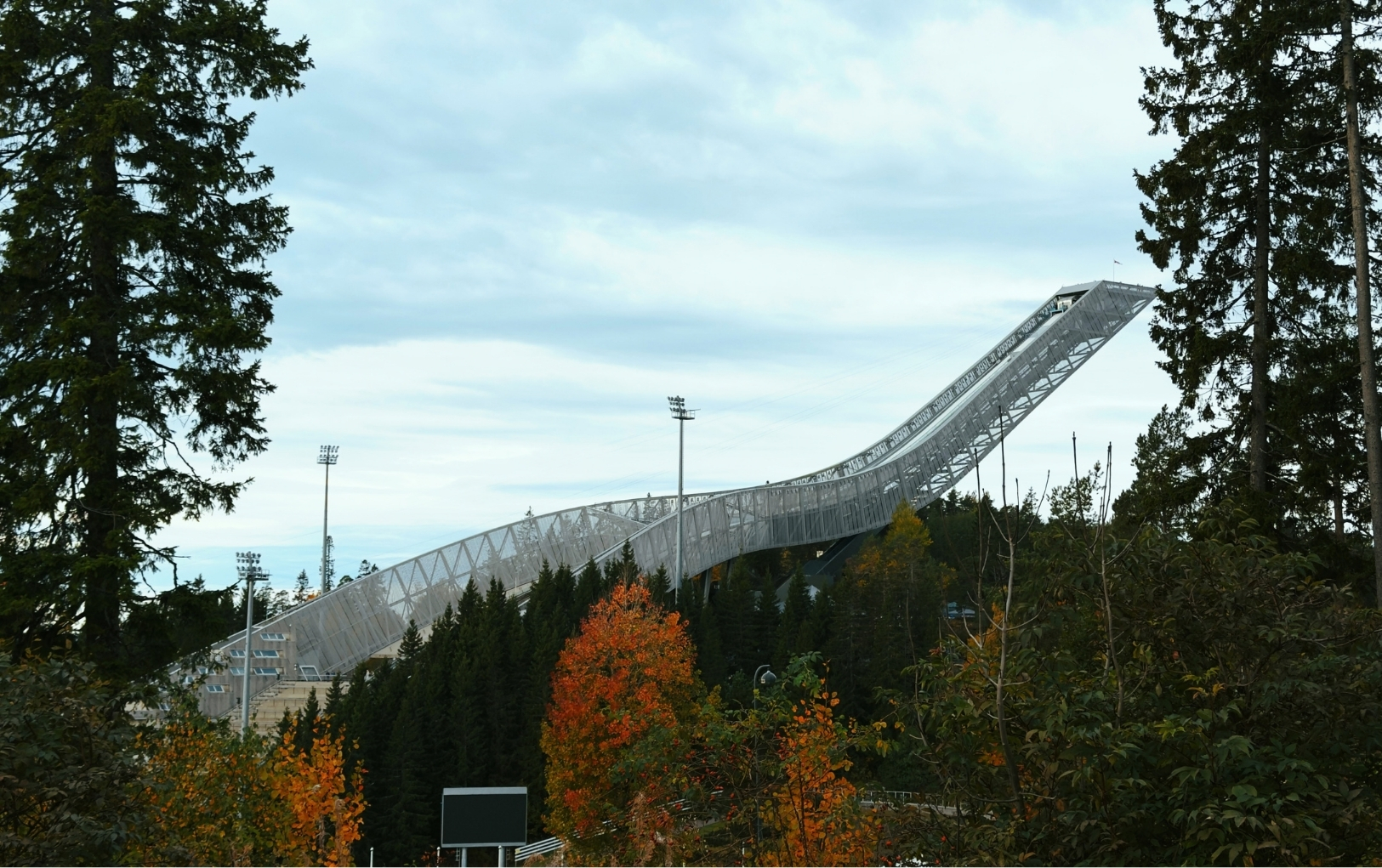
Then, almost without warning, the forest opens up, and the Holmenkollen Ski Jump appears before us. After kilometers of quiet trails, autumn leaves and nothing but trees around us, the enormous structure feels almost surreal. We follow a peaceful forest path, and suddenly it rises dramatically above the landscape.
The contrast could hardly be greater. Quiet forest on one side, one of Norway’s most iconic sporting landmarks on the other. We stop for a moment to take it in because the approach makes the ski jump feel even more impressive. If we had arrived by metro, we would have seen the same structure, but we would have missed this little reveal.
It feels like the forest has been slowly leading us here all along. And after the peaceful hike from Øvresetertjern, arriving beneath the Holmenkollen Ski Jump feels like the perfect reward.


Holmenkollen Ski Jump
Whatever we think we are prepared for, the sheer size of Holmenkollen Ski Jump still catches us by surprise. We have seen photographs, know it is one of Oslo’s most famous landmarks, and watched ski jumping on television, but none of that really prepares us for standing next to it. The structure rises dramatically above the forest, with the enormous jumping hill stretching upward and the landing slope dropping below. From a distance, it already looks impressive. Up close, it is something else entirely.
The current Holmenkollen Ski Jump has a hill size of 134 meters and a construction height of around 60 meters. Designed for ski jumping, it has been modernized several times over its long history.


The History of Holmenkollen Ski Jump
Holmenkollen has been central to Norwegian skiing since the first ski jumping competition here in 1892. The original jump looked very different from the enormous structure we see today. Still, the location has remained one of the country’s most important venues for ski jumping and Nordic skiing.
The hill has been rebuilt and modernized repeatedly over the decades as ski jumping has evolved. The current structure dates from the major reconstruction completed for the 2011 FIS Nordic World Ski Championships, when Holmenkollen took on the form we see today.
That history makes the place even more fascinating. This is not simply an impressive piece of architecture placed on a hill above Oslo. It represents more than a century of Norway’s deep connection with skiing.


We keep looking up, trying to imagine what it must be like to stand at the top, skis pointing towards the slope and knowing that the only way forward is down. There is something almost impossible to comprehend about the courage involved. From where we are standing, the jump looks steep enough to make us question why anyone would voluntarily launch themselves from it.
Waddling Up Into the Holmenkollen Ski Jump
After getting our fair share of the ski jump from ground level, staring up at the enormous structure and trying to comprehend its scale, we decide it is time to get a little closer.
There are a couple of ways to reach the museum and the upper part of the complex. You can follow the official route up alongside the road, but there is also a pedestrian walkway with stairs that takes you directly up along the ski jump itself. Naturally, we choose the more adventurous option.
We start climbing, following the walkway upwards, and the perspective changes with every few steps. What looked impossibly high from below now feels even more impressive as we slowly make our way up the structure.
But before heading inside the museum, we stop to enjoy the views. From higher up, Oslo opens out in front of us, with the city spreading below and the landscape stretching towards the Oslofjord. After coming through the forest and then climbing the ski jump, it feels like we have earned this viewpoint.
We take our time here, looking back towards the route we have just walked and out across Oslo before finally heading inside to discover what is waiting in the museum.


Holmenkollen Ski Museum
After taking in the views from the ski jump, we head inside the Holmenkollen Ski Museum. The entrance is right within the ski jump complex.
Holmenkollen Ski Museum Quick Facts
- Opening hours: October–December 10:00–16:00 daily. From May to September, it is open 10:00–17:00.
- Ticket price: 200 NOK per adult, 100 NOK for children aged 6–17, with other discounted and family tickets available. The ticket includes both the Ski Museum and the Ski Jump Tower.
- Oslo Pass: Free entry with the Oslo Pass.
- Tickets: You can buy them online in advance or directly at the museum.
- Website: Holmenkollen Ski Museum
And once again, we are very happy to have our Oslo Pass with us, as it gives us free entry. We have already experienced Holmenkollen from the outside: stood beneath the enormous structure, climbed alongside it, and looked out across Oslo from above. Now we step inside to discover the story behind Norway’s deep connection with skiing, the athletes who have competed here and the generations who have helped turn Holmenkollen into one of the country’s most important sporting landmarks.
After seeing the ski jump with our own eyes, the museum gives our experience a little more context. Suddenly, the enormous structure outside is not simply an impressive sight. It is part of a much bigger story about Norway, skiing, and a sporting tradition that has shaped the country for generations.
What Can You See Inside
Inside the museum, we learn that Norwegian skiing is much more than the ski jump outside. The exhibition takes us through more than 4,000 years of skiing history, from the earliest skis and traditional equipment to modern competitive skiing. Skiing in Norway goes back thousands of years, with ancient skis showing that people used them long before skiing became a modern sport. Over time, skis evolved from a practical way to travel through snowy landscapes into a major part of Norwegian sporting culture.
We wander past old skis, poles, clothing, and other pieces of equipment, seeing how much the sport has changed over the centuries. The museum also shares stories about famous Norwegian explorers and athletes, including the role skiing played in expeditions into some of the world’s most challenging landscapes.
After a morning of hiking through the forest, the exhibition feels particularly fitting. We have just experienced the same landscape that generations of Norwegians have explored on skis, only today we are waddling through it on foot.


Skiing is much more than a competitive sport in Norway. It is closely connected to everyday life, outdoor culture, and the country’s relationship with its snowy landscape. From childhood, many Norwegians grow up skiing, and “there is no such thing as bad weather, only bad clothing” is very much the attitude. At Holmenkollen, that tradition comes together with Norway’s long history of ski racing, jumping, and exploration.
The Viewing Platform: Oslo From the Top of the Jump
Our favorite part of the museum visit is actually waiting for us above it. Inside the museum, we can take an elevator up to the top of the ski jump, where a viewing platform gives us an entirely different perspective on Holmenkollen.
The elevator takes us up 64 meters above the ground, or 427 meters above sea level. And when the doors open, the view is spectacular. We can look straight down over the ski-jumping arena, then turn towards Oslo and see the Oslofjord, the city, and the vast forests of Marka stretching out around us.


After seeing the ski jump from below and then climbing alongside it, standing this high above the ground feels almost unreal. Suddenly, we understand the hill’s scale in a completely different way. This is definitely not a museum visit where we look at old skis behind glass. We are literally standing at the top of one of Norway’s most famous ski jumps, with Oslo spread out beneath us.


The viewing platform itself is spacious, so even with other visitors around, it never feels uncomfortably crowded. People naturally take their time up there, moving around the platform, taking photographs and soaking in the views, but there is still plenty of room to find your own spot and enjoy the experience. We take our fair share of time too, looking down at the ski jump, across Oslo and out towards the Oslofjord before eventually heading back to the elevator.
For us, this is easily one of the highlights of the day. After seeing the ski jump from below, hiking towards it through the forest and then standing right at the top, we experience it from every possible angle. And now, whenever we watch a ski jumping competition, we know exactly what the athletes are looking down at before they take off.


Back to Oslo by Metro
After taking in the views for a while, we slowly make our way back down to Holmenkollen metro station. The forest and trails are behind us now, and after such a full day above the city, it feels almost strange to head back toward civilization.
We board the metro at Holmenkollen and settle in for the journey back into central Oslo. The same landscape that carried us up into the hills earlier is now passing by in reverse, with the forest gradually giving way to streets and buildings.
It feels like the perfect ending to our adventure. We started the day in the heart of Oslo, traveled into the forest, discovered a hidden lake, hiked toward the ski jump, and stood at the very top. Now we sit back and let the metro carry us home.


The journey back is just as enjoyable as the journey up. As the metro begins its descent, we once again get those beautiful views across Oslo and the Oslofjord, with the landscape opening up below us. We watch the city slowly come back into view, enjoying the last glimpses of the fjord before the metro disappears back underground.
It feels like a fitting bookend to the day. The same metro that carried us out of the city and into the forest now brings us back, giving us one final look at Oslo from above before the tunnel takes us back into the city.


How Long Does the Route Take
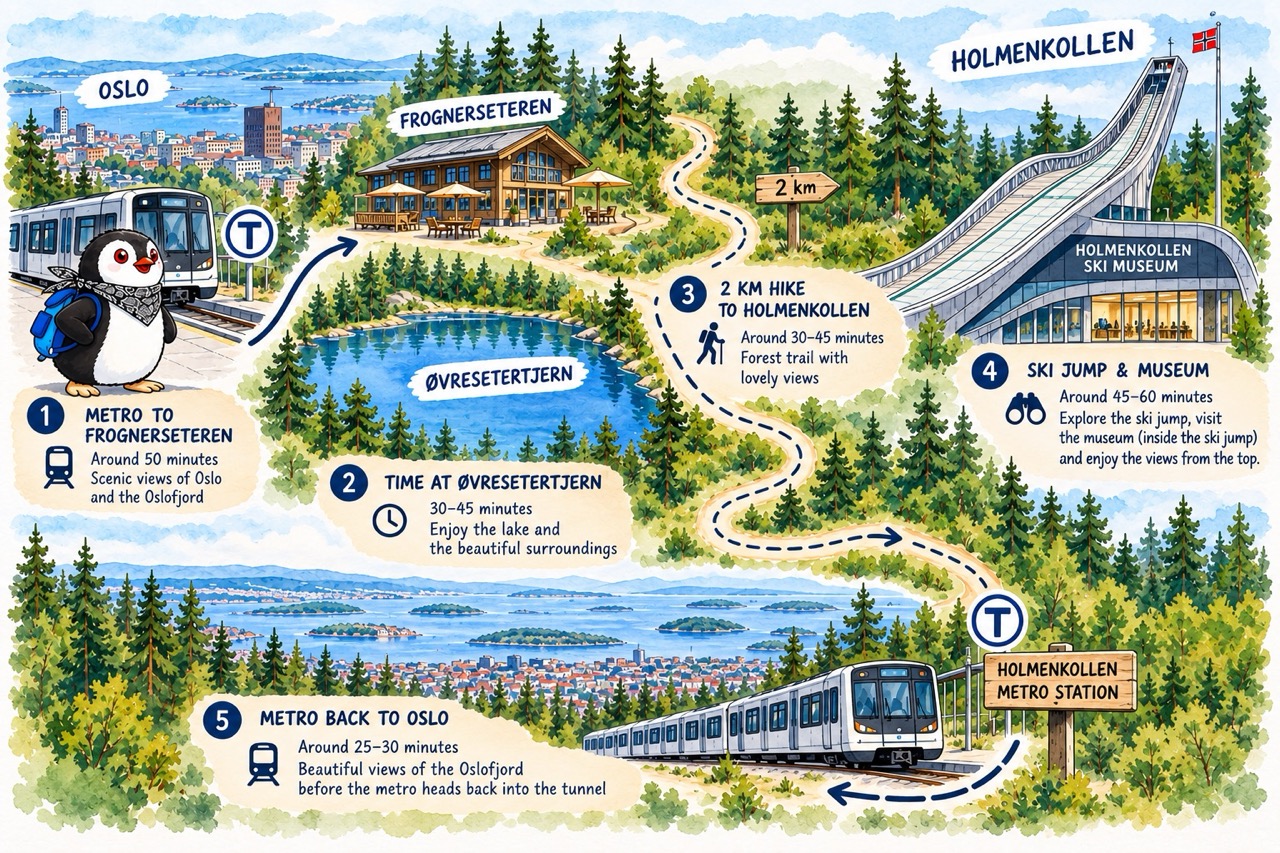
This is not a route we would rush. Between the metro ride, the lake, the forest trail, the ski jump, and the museum, allow about 4–5 hours for the full experience, especially if you want time to enjoy the views along the way.
- Metro to Frognerseteren: Around 50 minutes
- Øvresetertjern: Allow 30–45 minutes to explore the lake and enjoy the surroundings
- Frognerseteren to Holmenkollen: Around 2 kilometers, roughly 30–45 minutes depending on your pace and how often you stop
- Holmenkollen Ski Jump: Around 45–60 minutes, including the viewing platform and taking in the views
- Holmenkollen Ski Museum: Around 45–60 minutes
- Metro back to Oslo: Around 25–30 minutes, depending on where you are heading in the city
For us, the beauty of the route is that the journey itself is part of the experience. Do not plan it too tightly. You will want to stop by the lake, photograph the autumn forest, admire Oslofjord from the ski jump, and spend some time at the top before heading back down.
Is This Hike Difficult
We describe this route as easy to moderate, and it is perfectly manageable for casual walkers comfortable spending a few hours outdoors. The biggest advantage is that the route from Frognerseteren towards Holmenkollen is mostly downhill, so we aren’t battling up steep forest trails.
That said, not all of the trails are perfectly maintained. Good walking shoes or trainers with decent grip make the route much more comfortable, especially after rain. The 2-kilometer forest section itself is not demanding. We take it at an easy pace, stopping whenever we want to enjoy the scenery. The downhill direction also makes it easier on the legs than doing the same route in reverse.
For us, the hardest part comes after the hike, when we reach Holmenkollen. We decide to use the stairs alongside the ski jump as a shortcut to reach the upper area and museum, and waddling up those stairs gives our legs a proper workout. After a peaceful downhill forest hike, suddenly climbing alongside the enormous ski jump feels like a completely different kind of challenge.
Best Time to Do This Route
We would recommend starting this route in the morning. There’s a lot to see along the way, and starting early gives us plenty of time to enjoy Øvresetertjern, take our time on the forest trail, and explore Holmenkollen without feeling rushed. The morning also gives us beautiful light over the forest and Oslofjord, while the trails tend to feel quieter.
As for the season, it really depends on what you want from the experience. We recommend autumn. The forest around Frognerseteren and Holmenkollen comes alive with shades of yellow, orange and red, making the walk to the ski jump especially beautiful. The contrast between the colorful forest, deep green evergreens and blue waters of Øvresetertjern is spectacular.
Summer is a great choice if you want greener forests, longer daylight and a more relaxed outdoor experience. The lake is also particularly inviting during warmer weather.
Spring brings fresh greenery and a quieter atmosphere, although some trails can be wetter and muddier. Winter transforms Holmenkollen into a completely different landscape, with snow covering the forest and the area taking on its classic Norwegian skiing atmosphere. However, conditions can make the trails more challenging, so proper winter footwear is important.
For us, though, an autumn morning is the winning combination. We get the beautiful colors, crisp air, peaceful forest trails, and those spectacular views over Oslo and the Oslofjord, all before spending the afternoon exploring Holmenkollen.

Is Holmenkollen Worth the Detour from Oslo
Holmenkollen is a penguin-approved adventure. We give it two flippers up! 🐧 It is impressive on its own, but adding the forest, lake, and downhill trail turns a simple sightseeing stop into a proper little adventure. We get nature, views, a famous ski jump, and just enough waddling to make it feel earned. If you have the time, take the scenic route. The ski jump is the destination, but the forest is half the fun.
Buy Us a Ko-fi

Forest trails, a quiet lake, autumn colors, spectacular Oslofjord views, and one giant ski jump. This route gives us a little bit of everything that makes Oslo special. We trade the city streets for the forest, follow the trail downhill and eventually arrive beneath the impressive Holmenkollen Ski Jump. For us, it is one of those Oslo adventures where the journey is every bit as memorable as the destination.
Travel Bold. Eat Well. Waddle Wild.
Save This Pin for Later!
This post contains affiliate links. If you click and buy, I might earn a tiny commission, enough to help a penguin keep up its globe-trotting lifestyle. No extra cost to you, just more fish for me. Thank you for supporting the adventure!