FRAM Museum: Inside Norway’s
We kept hearing about Oslo’s famous polar exploration museums, so naturally, we had to check one out. And, of course, with penguins in our everyday waddling adventures, we always hoped to find something penguin-related too. So we headed to the FRAM Museum, ready to climb aboard one of Norway’s legendary polar ships and see what life at the ends of the Earth was really like.
- FRAM Museum Is Where Norway Meets the Ends of the Earth
- Quick Facts
- How to Get to FRAM Museum
- Opening Hours and Tickets
- The Moment You Waddle In, FRAM Is Right There
- The Ship That Was Designed to Be Crushed by Ice
- Why Was Fram Built in the First Place
- Step Aboard Fram
- A Home in the Middle of the Ice
- The Three Great Fram Expeditions
- Gjøa: The Little Ship That Conquered the Northwest Passage
- From Ships to the People Behind the Expeditions
- Getting a Taste of the Polar Cold
- Why FRAM Feels So Different
- How Much Time Do You Need at FRAM Museum
- Best Time of Day to Visit FRAM Museum
- Facilities and Amenities
- What to See Near FRAM Museum
- Is FRAM Museum Worth Visiting
FRAM Museum Is Where Norway Meets the Ends of the Earth
Some museums let you look at history behind glass; the FRAM Museum lets you step aboard one of the greatest exploration ships ever built. Tucked away on Oslo’s Bygdøy peninsula, the museum tells the story of Norwegian polar exploration through the ships, people, and expeditions that pushed into some of the most unforgiving places on Earth. The star of the show is, naturally, Fram, the wooden polar ship built in 1892 for Fridtjof Nansen’s ambitious Arctic expedition. It later sailed with Otto Sverdrup and Roald Amundsen, making three major polar expeditions.
And the best part? You do not just look at Fram. You can go aboard.
Quick Facts
📍 Location: Bygdøynesveien 39, 0286 Oslo
🕒 Opening Hours: Open every day, all year. From 1 October–30 April: 10:00–17:00. From 1 May–30 September: 09:30–18:00
🎟️ Tickets: Adults NOK 180
⏱️ Time Needed: Allow around 1.5–2 hours to explore the ships and exhibitions properly
🌐 Website: FRAM Museum
How to Get to FRAM Museum
FRAM Museum is located at Bygdøynes, on Oslo’s Bygdøy peninsula, right beside the Kon-Tiki Museum and Norwegian Maritime Museum. We made the journey part of the adventure and took the ferry from Rådhusbrygge 3, right next to Oslo City Hall. The boat runs year-round, and Bygdøynes is the second stop, putting you almost directly at the museum entrance. The journey itself is a lovely introduction to Bygdøy, with views back toward Oslo as you cross the water.
The ferry runs roughly every 20 minutes. A single ticket costs NOK 70 at the pier or NOK 75 onboard, while a day pass costs NOK 115. We had the Oslo Pass, so our ferry ride was included. You can also take bus 30 from central Oslo directly to Bygdøy.
Opening Hours and Tickets
Opening Hours
FRAM Museum is open year-round. From 1 October to 30 April, it is open from 10:00 to 17:00. From 1 May to 30 September, opening hours extend to 09:30 to 18:00.
Tickets
- Adults: NOK 180
- Children and students: NOK 70
- Seniors: NOK 140
- Oslo Pass: Free admission
- Plushies: Free admission
FRAM also offers combined tickets if you are planning to explore more than one Bygdøy museum. You can buy a joint ticket for FRAM and the Kon-Tiki Museum, FRAM and the Norwegian Maritime Museum, or a three-museum ticket covering all three, which can be a useful option if you want to make a full museum day out of your visit.
The museum says you don’t need to buy tickets in advance, but you can always check ahead of time.
Always check the official FRAM Museum website before visiting, as opening hours, ticket prices, and admission information may change.
The Moment You Waddle In, FRAM Is Right There
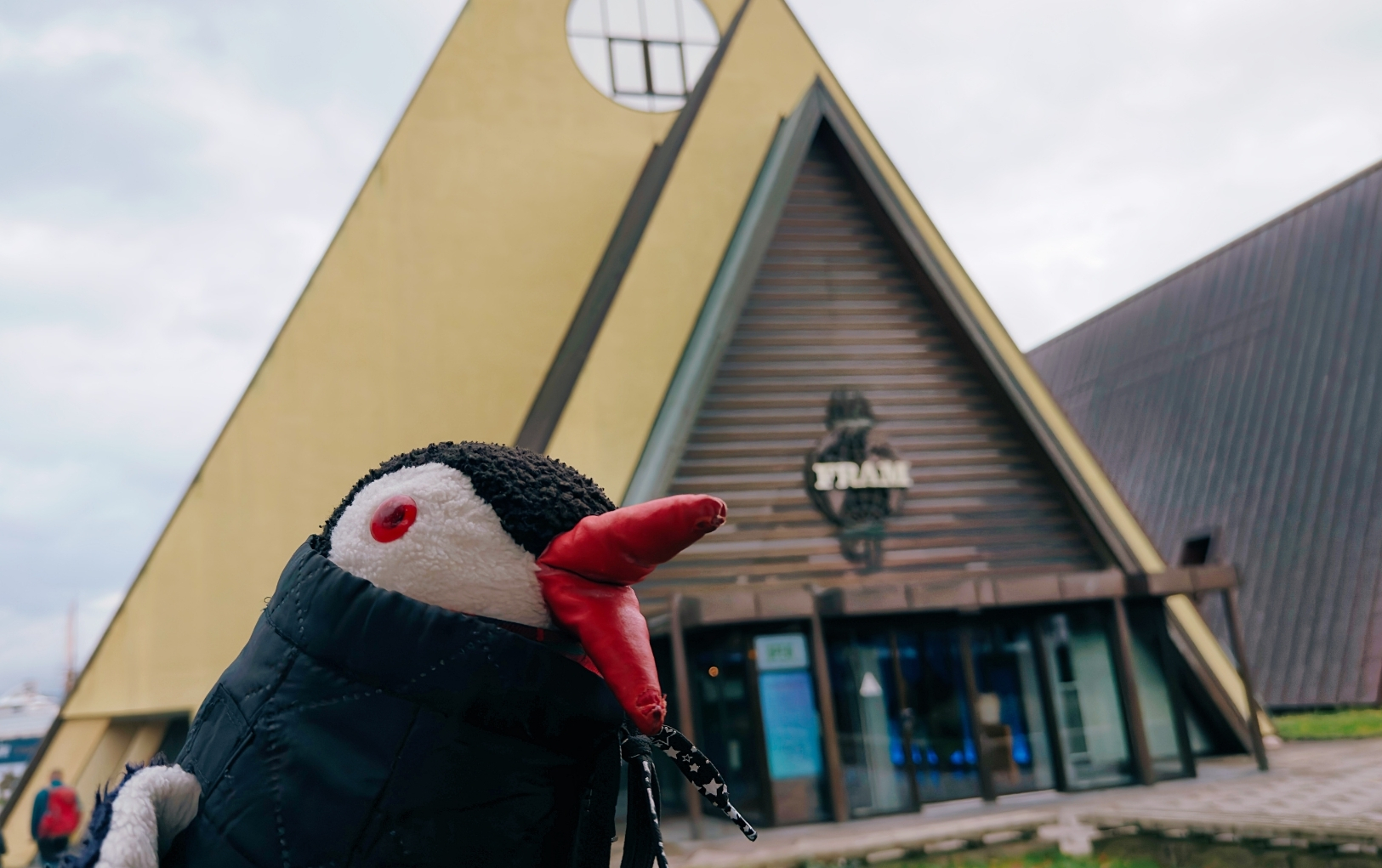
Entering FRAM Museum was easy. We showed our Oslo Pass, had it scanned at the entrance, and were inside in no time, ready to explore. And then you see it. FRAM is immediately in front of you, enormous and impossible to miss. The sheer size of the wooden ship took us by surprise, and before we had even had time to read much about it, we were already eager to get closer and start exploring. There is something quite exciting about walking into a museum and having the main attraction staring straight back at you.


The Ship That Was Designed to Be Crushed by Ice
The most fascinating thing about Fram is that it was designed for a problem that had already defeated other ships: Arctic sea ice.
Commissioned by Fridtjof Nansen and built by Norwegian shipbuilder Colin Archer, Fram had an unusually rounded hull. Instead of trying to force its way through the ice, the idea was that when the ice pressed against the ship, the hull would be pushed upwards, preventing it from being crushed. Its construction was heavily reinforced with oak, iron, Norwegian pine, pitch pine, and exceptionally durable greenheart wood.
Fram was about 39 meters long, 11 meters wide, and had a draught of around 5 meters, with a loaded displacement of about 800 tonnes. That broad, almost unusual-looking shape made it stronger in the ice, although it also meant the ship rolled rather unpleasantly in open water.
In other words, this was not a beautiful ship designed for comfort or speed. Every curve had a job.
Why Was Fram Built in the First Place
Nansen had a bold theory. After learning about ocean currents and the remains of the American ship Jeannette, he believed that an east-to-west current moved across the Arctic Ocean. Rather than fighting the ice, he wanted Fram to freeze into the pack ice and drift with it.
That sounds completely wild from a modern perspective. But the experiment worked. Fram froze into the Arctic ice during Nansen’s 1893–96 expedition and survived the enormous pressure that had destroyed other vessels. The ship eventually became one of the great symbols of Norway’s polar age.


Step Aboard Fram
This was the moment the museum really came alive for us. We climbed aboard Fram, and the first thing that struck us was just how enormous the ship felt from the inside. We wandered through the cabins, saloon, galley, cargo areas, and other parts of the ship, getting a much better sense of what life must have been like for the explorers spending months, or even years, at sea.
But another detail made the experience even more special. Projections across the walls around the ship made it feel as if Fram was actually moving through the ice. Suddenly, we were not just standing inside a historic vessel. With the changing light and images surrounding us, it almost felt as though the ship was sailing again, pushing through the Arctic waters. We found ourselves completely caught up in the experience, and for a few moments, it was very easy to forget that we were standing inside a museum.
A Home in the Middle of the Ice
The more we explored Fram, the harder it was to imagine actually living aboard this ship for months or even years. We went below deck and wandered through the cabins and work areas, getting a surprisingly intimate look at how the crew lived. And honestly, the cabins felt pretty cramped. We could appreciate the history, but we also thought this was definitely not the kind of place we would want to call home for several years!
That is what made it so fascinating, though. Every tiny space had a purpose. Fram had to function as a home, laboratory, workshop, and expedition base all at once, with the crew relying on each other while being completely cut off from normal life. Seeing the preserved interiors, original objects, and personal spaces, including Captain Oscar Wisting’s cabin, made it much easier to imagine what everyday life on board must have been like. We could suddenly picture the crew sleeping, eating, working, and waiting out the endless Arctic ice in these very same cramped quarters.


The Three Great Fram Expeditions
Fram did not make just one famous voyage. The ship served on three major expeditions, each linked to one of Norway’s great polar explorers.
- Fridtjof Nansen and the Arctic Drift. Nansen took Fram into the Arctic in 1893, deliberately allowing the ship to freeze into the ice. The expedition continued until 1896, testing his theory about the Arctic Ocean current and proving that Fram’s extraordinary construction could survive the pressure of the pack ice.
- Otto Sverdrup and the Arctic Islands. The second Fram expedition, from 1898 to 1902, took the ship west of Greenland, where Otto Sverdrup and his crew explored and mapped parts of the Canadian Arctic. The museum’s Fram is preserved in the configuration associated with Sverdrup’s expedition.
- Roald Amundsen and the Road to the South Pole. Fram’s third great expedition took it south with Roald Amundsen, who used the ship on his Antarctic expedition in 1910–1912. This voyage eventually led to Amundsen’s successful race to the South Pole.
Gjøa: The Little Ship That Conquered the Northwest Passage
Once you have explored Fram, do not assume the museum is finished with its famous ships. Next comes Gjøa, the much smaller vessel that Roald Amundsen used to become the first person to navigate the entire Northwest Passage in one ship and one expedition. He and six companions completed the voyage between 1903 and 1906, spending two winters at Gjoa Haven along the way.
Gjøa was built as early as 1872, originally as a Norwegian sloop, before Amundsen bought it and had the vessel strengthened and adapted for Arctic exploration. It is fascinating to see the contrast between the enormous presence of Fram and this comparatively small ship that carried such an important expedition.
Today, you can see Gjøa inside its dedicated museum extension, opened in 2013. After extensive restoration, the ship was opened to the public in 2017. We loved discovering it as a kind of second surprise inside the museum. Just when we thought Fram had stolen the show, Gjøa reminded us that in polar exploration, a smaller ship can still carry an enormous story.


The Northwest Passage Was Not Exactly an Easy Shortcut
The story behind Gjøa is worth lingering over because the Northwest Passage had been explorers’ dream for centuries. The route connects the Atlantic and Pacific through the Arctic waters north of mainland Canada, but ice, shallow waters, fog, and unpredictable conditions made it extraordinarily difficult to navigate.
Amundsen’s expedition spent two years at Gjoa Haven, where the crew waited for favorable conditions. During this time, Amundsen also drew on local Inuit knowledge, learning about Arctic clothing, food, hunting, and dog handling. The expedition eventually continued west and completed the Passage in 1905.
It is a good reminder that polar exploration was not simply about heroic European explorers pushing into unknown territory. Survival depended heavily on knowledge already developed by people who had lived in the Arctic for generations.


From Ships to the People Behind the Expeditions
One thing we liked about FRAM is that the museum does not treat the ships as isolated objects. Around them is the human story: the explorers, captains, doctors, engineers, and crew members who had to live together for months or years in some of the most extreme conditions imaginable.
You begin to realize that polar exploration was not simply about reaching a geographical point on a map. It was also about cooking, repairing equipment, taking scientific measurements, navigating, dealing with illness, and surviving together.
The museum’s broader Arctic Exploration exhibition covers almost 100 expeditions spanning five centuries, putting the Norwegian expeditions into a much larger history of exploration.
Getting a Taste of the Polar Cold
One of our favorite parts of FRAM was discovering the interactive extension, where the museum lets you do more than read about the expeditions. We stepped into the Trapped in Ice experience, and suddenly we could actually feel a little of what the explorers faced. The cold, the sounds, and the atmosphere made it much easier to imagine being surrounded by endless Arctic ice rather than simply reading about it on a panel.
There is also a 4D polar flight simulator recreating Roald Amundsen’s 1925 attempt to reach the North Pole by air. But for us, the cold experience was the real highlight. After exploring the ships and hearing about the conditions the crews endured, it was fun to get a tiny taste of that extreme environment ourselves. And yes, we were very happy to return to the warm museum afterward!
The Norge Airship and Amundsen’s Other Polar Ambitions
The museum also goes beyond ships. In our current 2026 timeframe, the exhibitions include First to the North Pole: Roald Amundsen’s Flight in Norge Across the Arctic, which looks at the 1926 airship expedition. It is part of the museum’s wider story of how polar exploration moved from ships and sleds into the age of aviation.
This also reminds us that Amundsen did not stop after reaching the South Pole. His curiosity kept driving him to find new ways to reach the Arctic.
Nansen Through a Camera Lens
Another current exhibition focuses on The Nansen Photographs, exploring the cameras Nansen selected for his expedition and the photographs produced during his travels. It adds another dimension to the story because these images were not simply souvenirs. Photography became an important way to document places, people, and conditions that few outsiders had ever seen.
Quest: A More Recent Chapter of Polar History
FRAM has also added a permanent exhibition dedicated to Shackleton’s ship Quest. After the wreck was discovered in 2024 and further research dives in 2026, the museum created a replica of the ship’s bridge featuring Quest’s original wheel. Visitors can even recreate the famous photograph of Shackleton on the bridge.
For anyone fascinated by Antarctic exploration, this is a lovely unexpected addition because it takes the story beyond the Norwegian expeditions and connects the museum to the wider heroic age of polar exploration.


And, of course, we could not leave FRAM without one final little stop of our own. As we were waddling out, we spotted the gift shop and had to stop for a few new penguin brothers to join our ever-growing penguin family. Because apparently, even a museum dedicated to Arctic explorers needs a little penguin expedition of its own.


Why FRAM Feels So Different
What really worked for us at FRAM was that you weren’t just reading about polar exploration. The ships are right there, towering over you, and you can actually step aboard them. It reminded us a little of the Vasa Museum in Stockholm, where having the original ship right in front of you makes the history feel much more real.
But FRAM takes it one step further because you can actually waddle through the ship. Once inside, we started thinking about the people who slept in those tiny cabins, worked in cramped spaces, and spent months surrounded by nothing but ice and open water. Suddenly, the maps and dates we had just been reading about felt much more human.
That is what we loved most about FRAM. History isn’t just something you look at. It is something you can physically climb into.
How Much Time Do You Need at FRAM Museum
We spent around an hour at FRAM Museum, and that felt like a comfortable amount of time to explore the ships, wander through the exhibitions, and try the interactive experiences. You could see the main highlights in less time, but we would recommend allowing at least 1.5–2 hours, especially because climbing aboard Fram and exploring all its little corners takes longer than you might expect. If you are a real polar-history enthusiast, though, you could easily stay longer.
Best Time of Day to Visit FRAM Museum
We recommend morning or early afternoon, especially if you are combining FRAM with the other Bygdøy museums. Starting earlier means you have plenty of time to explore the ship without watching the clock. It also gives you flexibility to continue to Kon-Tiki or the Norwegian Maritime Museum afterward.
And there is something rather fitting about arriving by boat in the morning, standing beside a ship built for polar expeditions and then spending the next couple of hours imagining what it was like to head into waters where there was no easy way back.
Facilities and Amenities
- Framheim Café: A café at the museum where you can stop for something to eat or drink.
- Museum Shop: Polar exploration books, souvenirs and expedition-themed gifts.
- Accessibility: The museum is largely wheelchair accessible, with lifts in both buildings.
- Lifts: Available between levels, although below-deck areas on Fram are not wheelchair accessible.
- Wheelchairs: One adult wheelchair and one children’s wheelchair are available to borrow.
- Toilets: Available within the museum.
- Family Friendly: Interactive experiences and simulators make it a good stop with children.
- Photography: A good place for photographs, particularly around the ships and in the large exhibition halls.
What to See Near FRAM Museum
Bygdøy is one of the easiest places in Oslo to turn one museum into a full day:
- Kon-Tiki Museum: The story of Thor Heyerdahl’s famous expeditions.
- Norwegian Maritime Museum: Norway’s relationship with the sea and maritime history.
- Norsk Folkemuseum: Norway’s open-air museum, with historic houses, farms, and the beautiful Gol Stave Church.
- Bygdøy Waterfront: Peaceful paths and fjord views.
- Huk Beach: A pleasant place for a waterfront walk or break.
- Oscarshall: A 19th-century royal summer residence.
- Bygdøy Royal Manor: Historic royal estate and surrounding countryside.
Buy Us a Ko-fi

Is FRAM Museum Worth Visiting
FRAM Museum is one of those Oslo attractions that’s easy to underestimate from the outside. You might think you are simply going to see an old ship. Then you step aboard Fram, and suddenly the Arctic expeditions become real. For us, the magic is in that physical connection. You can see where the explorers slept, where they worked, how the ship was built, and how astonishingly small their world could become when surrounded by endless ice. Add Gjøa, the Northwest Passage story, the interactive experiences, and the newer exhibitions, and FRAM becomes much more than a ship museum. Come for Fram. Stay for the stories of the people who dared to sail her into the ice.
FRAM Museum turned out to be much more than a place to admire an old ship. We climbed aboard Fram, squeezed into its tiny cabins, discovered the surprisingly small Gjøa, felt the Arctic cold for ourselves, and slowly began to understand what it took to venture into places where almost nothing was known. What stayed with us most was how physical the experience felt. We weren’t simply reading about Nansen, Sverdrup, or Amundsen. We were standing where they stood, inside the ships that carried them into the unknown. And for us, that is what makes FRAM such a memorable stop in Oslo. Come for the famous ships, but stay for the stories.
Travel Bold. Eat Well. Waddle Wild.
Save This Pin for Later!
This post contains affiliate links. If you click and buy, I might earn a tiny commission, enough to help a penguin keep up its globe-trotting lifestyle. No extra cost to you, just more fish for me. Thank you for supporting the adventure!