Norsk Folkemuseum: Norway’s History, One Building at a Time
We didn’t quite know what to expect from Norsk Folkemuseum. We were mainly visiting because we had seen a photo of the beautiful Gol Stave Church and wanted to see it for ourselves. But once we started exploring, we quickly realized that the museum goes far beyond one impressive wooden church. Spread across a huge open-air site, it takes you through centuries of Norwegian life, from medieval farmsteads to post-war homes and an entire little old town. It became one of our favorite places we visited in Oslo.
- Where Norway’s History Comes to Life
- Quick Facts About Norsk Folkemuseum
- How to Get to Norsk Folkemuseum
- Opening Hours and Tickets
- Our Route Through Norsk Folkemuseum
- How Much Time Do You Need at Norsk Folkemuseum
- The Best Time to Visit Norsk Folkemuseum
- Facilities and Amenities
- What to See Near Norsk Folkemuseum
- Is Norsk Folkemuseum Worth Visiting
Where Norway’s History Comes to Life
Norsk Folkemuseum feels nothing like a conventional museum. No endless rooms of paintings or rows of display cases lead you from one exhibit to the next. Instead, you step outside and into an entire landscape of Norwegian history, with old farmhouses, churches, workshops, homes and streets spread across the grounds.
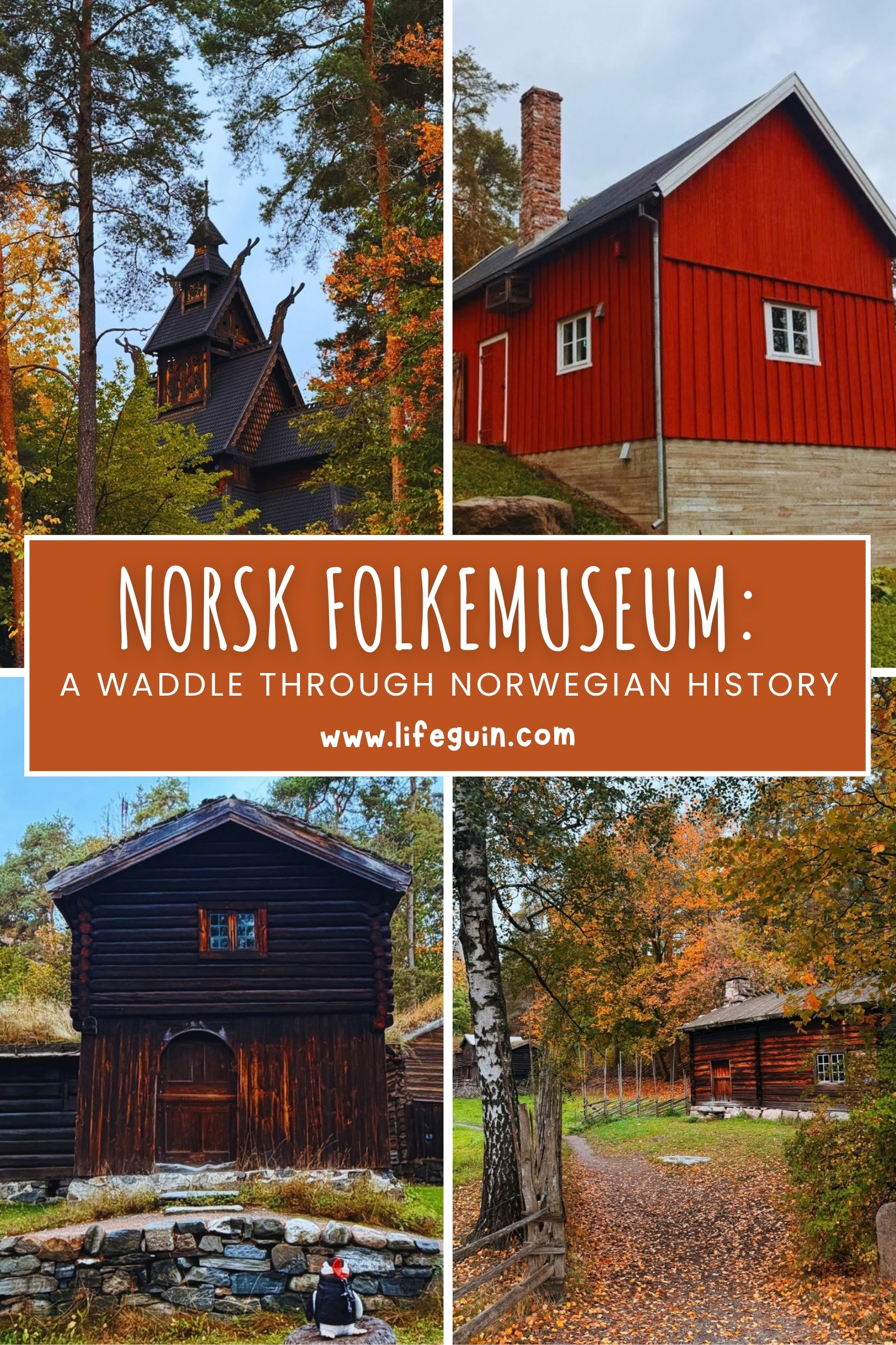
Founded in 1894, Norsk Folkemuseum is one of Europe’s oldest and largest open-air museums. Its collection includes around 160 historic buildings, brought together from different parts of Norway and representing life from the Middle Ages to the present day. Some stand exactly where you would expect them, surrounded by fields and farm buildings, while others appear around corners as you follow the paths through the museum.
What we loved most was feeling like we weren’t simply learning about Norwegian history. We were physically moving through it. One moment we were standing beside a centuries-old wooden building, and the next we were wandering through a historic Oslo street. It made the past feel less like something behind glass and much more like somewhere you could actually waddle into.
Quick Facts About Norsk Folkemuseum
📍 Location: Museumsveien 10, Bygdøy, 0287 Oslo
🕒 Opening Hours: 1 May–4 October: daily 10:00–17:00. 5 October–30 April: Tuesday–Sunday 11:00–16:00, closed Mondays
🎟️ Tickets: Adults NOK 200. Oslo Pass holders enter free
⏱️ Time Needed: Allow at least 2–3 hours to explore the open-air museum properly
🌐 Website: Norsk Folkemuseum
How to Get to Norsk Folkemuseum
Norsk Folkemuseum is on Bygdøy, a peninsula about 5 kilometers from central Oslo, so while it feels like you are heading to a little island, Bygdøy is still connected to the mainland. We made the journey part of the experience and took the Bygdøy Ferry from Rådhusbrygge 3, right by Oslo City Hall. The crossing to Dronningen takes around 15 minutes, followed by an easy 10-minute waddle to the museum, making the whole trip feel like a little fjord adventure before you even arrive. Ferries currently run about every 20 minutes.
A single ferry ticket currently costs NOK 70, or NOK 115 for a day pass, and you can buy tickets at the pier or onboard. The Oslo Pass includes the ferry, which we used. Regular Ruter public-transport tickets are not valid on the Bygdøy museum ferries.
Another option: Bus 30 runs directly from central Oslo to the Folkemuseet stop, right by the museum entrance.


Opening Hours and Tickets
Opening Hours
Norsk Folkemuseum is open daily from 10:00 to 17:00 from 1 May to 4 October, making the warmer months the easiest time to explore the full open-air collection. From 5 October to 30 April, the museum is open Tuesday to Sunday from 11:00 to 16:00, and closed on Mondays. Because this is such a large outdoor museum, we would plan to arrive earlier rather than later, especially if you want enough time to wander between the historic buildings and actually step inside them. The museum also runs seasonal activities and guided tours, so it is worth checking the program before your visit.
One useful detail: from October through November 2026, English guided tours of the Gol Stave Church and Hove Farmhouse run at 11:00, 13:00 and 15:00, and are included with your admission ticket.
Tickets
- Adults: NOK 200
- Students: NOK 140 with a valid student ID
- Seniors/concessions: NOK 160
- Children aged 0–17: Free
- Oslo Pass: Free admission with a valid Oslo Pass
- OBOS members: 25% discount
- Annual Pass: NOK 700 for unlimited visits for 12 months
Tickets are available online or at the Visitor Center when you arrive.
Opening hours and ticket prices can change, especially around holidays and special events, so always check the official Norsk Folkemuseum website before your visit for the latest information.
Our Route Through Norsk Folkemuseum
Once we got off the boat at Dronningen, the museum was still a short waddle away, and the walk itself became part of the experience. We made our way through the lovely, leafy streets of Bygdøy, with the autumn colors making the neighborhood look almost like a painting. By the time we reached Norsk Folkemuseum, we were already in the mood for a journey through old Norway.
Before heading inside, we stopped at the Visitor Center, which also houses the museum shop and bistro, to sort out our admission. With our Oslo Pass, the process was quick and easy, and soon we were through the entrance and standing in front of the enormous open-air grounds. And then came the slightly overwhelming part: where do you even start? There was so much to see in every direction that we wanted to explore everything at once. Old wooden houses, paths disappearing around corners, farm buildings, and the promise of that famous stave church were all competing for our attention. So, without a perfectly planned route, we picked a direction and started waddling.


One of the best things about Norsk Folkemuseum is that you do not have to admire the historic buildings from the outside. You can actually go inside them, and we absolutely loved that part. We tried to peek into as many houses as possible, exploring the rooms, furniture, and little details that made each one feel like a real home rather than a museum display. One of our first stops was a traditional house from Finnmark in northern Norway, and we immediately fell in love with it. We could honestly picture ourselves living there, surrounded by the warm wooden interior and simple, practical design. It was one of those moments when the museum stopped feeling like somewhere we were visiting and started feeling like somewhere we could actually belong.


Waddling Through the Norwegian Countryside
After exploring a few of the first houses, we headed deeper into the Countryside section of the museum. This is where the experience really starts to feel like a journey through rural Norway, with farmsteads and buildings brought here from different parts of the country. As we wandered between them, we could see how Norwegian rural life changed over the centuries, from the oldest timber buildings and medieval traditions to increasingly modern farmhouses and more practical homes.
We loved that you didn’t present the transition as a history lesson. You kept waddling forward, and the architecture changed around you. The buildings became lighter, more spacious, and more familiar, giving us a surprisingly clear picture of how life in the Norwegian countryside gradually evolved. It felt almost like walking through several different eras of Norway without ever leaving the same path.


The Countryside Brings Different Norways Together
The countryside section isn’t a single Norwegian village. It is a collection of farmsteads and individual buildings from across the country, each shaped by its region, landscape, and way of life. As you waddle from one farmyard to another, the differences become surprisingly obvious, from the clustered buildings of western Norway to the more spread-out farmsteads of the valleys and the distinctive timber traditions of eastern Norway.
Some of the highlights you can encounter include:
- Numedal: Historic farm buildings from the valley, including a medieval farmhouse from Søre Rauland dating to around 1240.
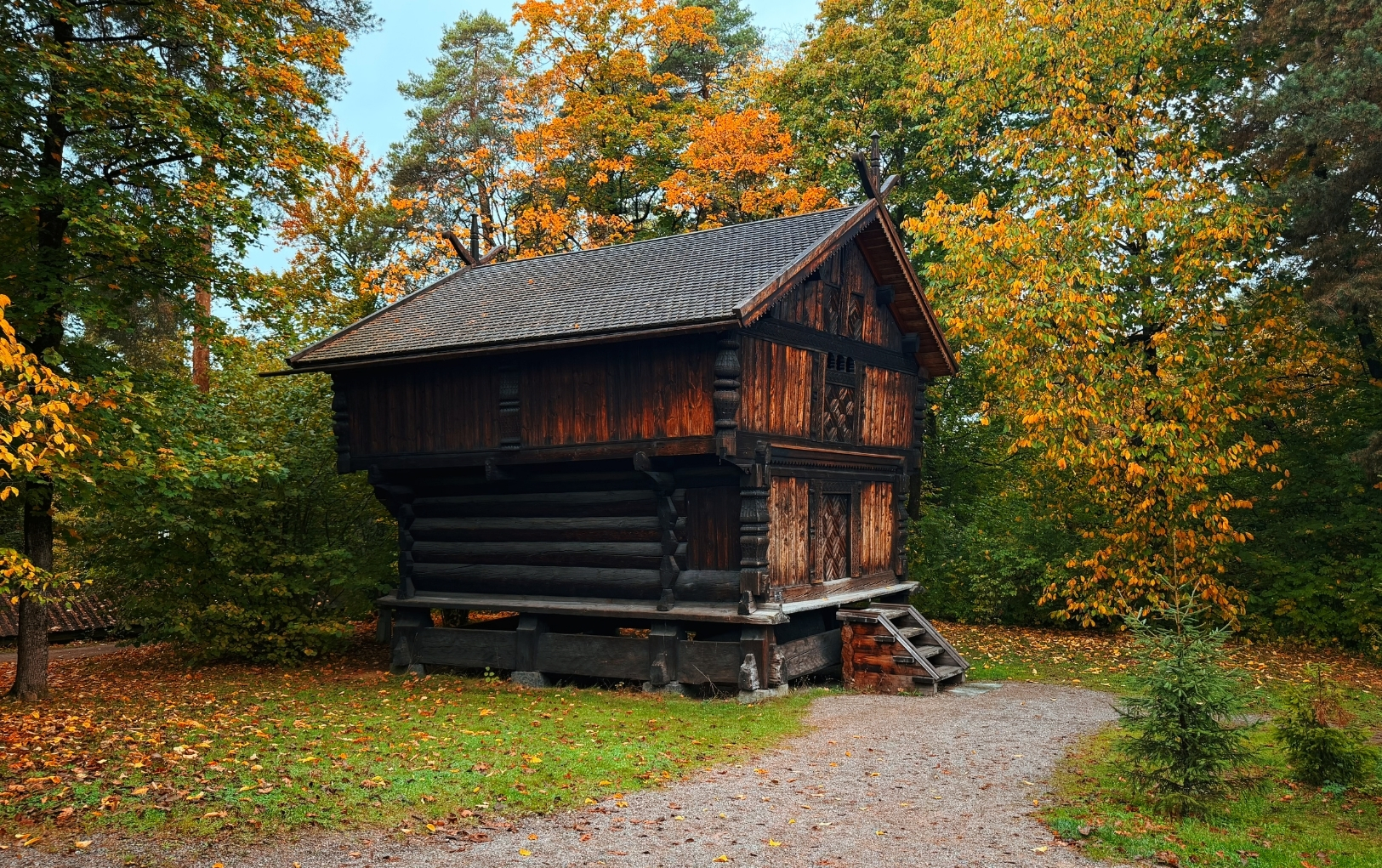
- Telemark: A collection of buildings from inland Telemark, including a remarkable medieval loft from around 1300 with carved details and surviving traces of original paint.
- Voss: Buildings from western Norway, including guesthouses and storehouses dating from the 1600s and 1700s, reflecting the region’s distinctive clustered farmsteads.
- Setesdal: A traditional farmstead representing rural life in the valley, with buildings arranged around a farmyard.
- Hardanger: Buildings representing the farming traditions of one of western Norway’s fjord landscapes.
- Trøndelag: A farmstead showing a different side of Norwegian rural life, including a 1950s kitchen that gives the open-air museum its leap into much more recent history.
- Finnmark: Buildings representing life in Norway’s far north, adding another very different architectural and regional perspective.
- Hallingdal, Valdres, Gudbrandsdalen, Sunnfjord, Nordfjord and Jæren: More regional buildings and farmsteads that make the countryside section feel like a miniature tour of Norway itself.


Gol Stave Church: The Medieval Heart of the Museum
Our next stop was a major highlight for many visitors: the Gol Stave Church. The church dates from around 1200, making it roughly 800 years old, and it is one of only 28 surviving stave churches in Norway. The story of how it ended up here is almost as fascinating as the church itself. When the old church in Gol was due to be replaced in the 1880s, the Society for the Preservation of Norwegian Ancient Monuments saved it from demolition, bought it, and eventually gave it to King Oscar II. They carefully dismantled it and re-erected it on Bygdøy in 1884–1885. Much of the original main structure survived, although the church was extensively reconstructed to create what its restorers believed was its medieval appearance.
And then you notice the details. The portals are covered with intricate carvings of dragons, animals, and plant motifs, while inside you can spot medieval runic inscriptions and carved figures. One inscription has been interpreted as “Kiss me, because I struggle”, which is perhaps not the message you would expect to find carved into an 800-year-old church.
For us, this was one of those moments when Norsk Folkemuseum really delivered on its promise. We were no longer looking at history. We were standing inside it.


A Little Fire Break in the Countryside
After exploring the church, we wandered back towards the countryside section, but first made a small stop at one of the museum’s cozy fire spots. A ready-made fire was burning, with simple things available so visitors could stop, warm up, and spend a little time enjoying the surroundings. It was such a lovely touch, especially in the crisp autumn weather. After so much walking between the historic buildings, sitting down by the fire for a while felt like a very natural part of the experience.


We wandered back into the Countryside section, where the museum once again felt wonderfully removed from modern Oslo. Farmhouses, barns, storehouses and smaller wooden buildings are scattered across the landscape, often grouped into traditional farmyards just as they would have been in the regions they came from. We loved the sense of space. You can wander between the buildings, peek inside their interiors, and imagine what everyday life must have looked like when a farm was its own little world. With the autumn colors around us, it was easy to forget that we were still in the middle of Oslo. The countryside section is really where Norsk Folkemuseum feels less like a museum and more like a waddle through Norway itself.


The Old Town Was Our Favorite Part
If we had to choose one part of Norsk Folkemuseum to explore again, it would be the Old Town. After wandering through farms and rural homes, suddenly finding ourselves on little streets lined with historic buildings felt like stepping into another Oslo. The area recreates urban life through buildings from Christiania, the old name for Oslo, as well as Brevik and Kragerø, and you can see everything from homes and businesses to places connected with everyday city life.


A Peek Inside the Old Liquor Shop
One of the places we explored in much more detail was the old Wine Monopoly shop, and it was such a fun glimpse into everyday life from another era. The interior comes from Holmestrand and dates to 1904, when it housed the Holmestrand Spirits Cooperative. We loved looking at all the details, from the colorful patterned floor tiles to the traditional fittings. It is one of those places where you can almost imagine stepping up to the counter as a customer more than a century ago.


Apartment Life Through the Decades
Then we discovered the Wessels Gate 15 apartment building, and this quickly became another favorite. The three-story brick building was built in 1865, and inside you can walk through reconstructed homes from 1879 to 2002. Each apartment tells a different story, from an old-fashioned 19th-century home to a 1950s working-class flat, a 1960s family home, and a Pakistani Norwegian home from 2002. We loved how clearly you could see everyday life changing from generation to generation simply by looking at the furniture, colors, kitchens, and technology.


A Pharmacy Frozen in Time
Another little discovery was the Pharmacy Museum, which traces the development of pharmacy in Norway from the country’s first privileged pharmacy in 1595 through the 20th century. We were especially fascinated by the preserved sales areas, including Apoteket Hjorten from 1860 and Skillebekk apotek from 1960. It is the kind of place where the details do the storytelling: old counters, bottles, fittings, and equipment make you realize just how different buying medicine once looked.


And Then We Found the Sweet Shop
And then came the moment that felt like a reward at the end of our little historical city walk: the old-fashioned sweet shop. Unlike many museum displays where you can only look, here you can actually buy sweets, which made this stop even more fun. Norsk Folkemuseum uses its Old Town to recreate not just historic architecture but the atmosphere of everyday urban life, including shops and businesses. Suddenly, after all those old houses and exhibitions, we were standing in a historic street choosing candy. Honestly, it was hard to imagine a better way to finish our favorite part of the museum.


After exploring the Old Town, we slowly waddled along the paths to complete our little circle through the museum grounds. By then, we had wandered through so many different versions of Norway that it felt almost strange to find ourselves back near the entrance. Before heading out, we made one final stop at the museum gift shop, where we browsed the usual mix of books, Norwegian crafts, souvenirs, and little reminders of everything we had just seen.
It felt like a fitting end to the visit. We had started the day not really knowing what to expect, and now we were leaving with the feeling that we had somehow traveled through centuries of Norwegian life, all in one afternoon.


How Much Time Do You Need at Norsk Folkemuseum
We spent around two hours waddling around Norsk Folkemuseum, but we could easily have stayed longer. The grounds are much bigger than you might expect, and with so many buildings to explore, it is easy to lose track of time. We would recommend allowing at least 2–3 hours if you want to see the main highlights, step inside some of the houses, and explore the Old Town properly. Give yourself even more time if you want to visit more interiors, join a guided tour, or stop for coffee and enjoy the grounds without rushing.
Pro Penguin Tips
Norsk Folkemuseum is much bigger than it looks at first, so don’t treat it as a quick museum stop. Give yourself time to wander between the buildings and take the little paths rather than rushing from one highlight to another. Some of our favorite moments came when we turned a corner and discovered an old house, workshop, or tiny shop we hadn’t planned to see.
The Best Time to Visit Norsk Folkemuseum
We visited in the morning, taking one of the first boats to Bygdøy, and we were very happy we did. Arriving early gave us plenty of time to explore the grounds at our own pace, wander inside the historic houses, and spend as long as we wanted in the Old Town without watching the clock. Another advantage is the museum’s sheer size. Even when more visitors arrive, the grounds are so spacious that it never felt overwhelmingly crowded, and we could still find quiet paths and buildings to explore almost on our own. For us, starting early was the perfect way to ease into this rather enormous journey through Norwegian history.
Facilities and Amenities
- Café & Bistro: The Visitor Center has a café where you can stop for a drink or something to eat.
- Museum Shop: Located at the Visitor Center, with books, souvenirs, and Norwegian-inspired gifts.
- Toilets: Accessible toilets are available at the Visitor Center.
- Accessibility: Several parts of the museum are wheelchair accessible, although some historic buildings have steps or uneven access.
- Outdoor Lift: An outdoor lift helps visitors move around the Square area.
- Accessible Parking: Accessible parking spaces are available close to the museum entrance.
- Places to Rest: Benches and seating areas are scattered around the extensive grounds.
- Picnic & Rest Areas: Outdoor spaces let you stop, sit, and enjoy the surroundings, including areas with fire facilities.
- Guided Tours & Activities: The museum offers guided tours, demonstrations, and seasonal activities year-round.
- Plenty of Space: The open-air grounds are large enough that you can wander at your own pace and easily find quieter spots away from the main paths.
What to See Near Norsk Folkemuseum
Bygdøy is packed with attractions, so you can easily turn your museum visit into a full day of exploring:
- Fram Museum: Discover the famous polar exploration ship, Fram.
- Kon-Tiki Museum: Learn about Thor Heyerdahl and his legendary expeditions.
- Norwegian Maritime Museum: Explore Norway’s long connection with the sea.
- Oscarshall: A beautiful 19th-century royal summer residence.
- Bygdøy Royal Manor: Historic royal estate surrounded by countryside.
- Huk Beach: A lovely place for a waterfront walk or a break by the fjord.
- Bygdøy Waterfront: Enjoy the peaceful shoreline and views back towards Oslo.
Is Norsk Folkemuseum Worth Visiting
This one gets a big waddling yes from us. If we had to choose just one museum to visit in Oslo, Norsk Folkemuseum would top our list. We came mainly to see the beautiful Gol Stave Church, but the museum quickly became so much more. We loved wandering between the old farmhouses, peeking inside historic homes, discovering post-war Norway, and finally getting completely charmed by the little Old Town with its shops, pharmacy, and streets. It felt less like visiting a museum and more like taking a very long waddle through Norway’s history. And that is exactly why it became one of our favorite places in Oslo.
Buy Us a Ko-fi

Norsk Folkemuseum turned out to be one of those places we were glad we didn’t skip. What started as a simple plan to see the beautiful Gol Stave Church became a journey through Norwegian history, from centuries-old farmhouses and traditional homes to post-war architecture and the charming little streets of the Old Town. We loved that every turn brought something different, and that we could actually step inside so many of the buildings and imagine the lives that once happened there. By the time we waddled back to the entrance, Norsk Folkemuseum had easily become one of our favorite places in Oslo.
Travel Bold. Eat Well. Waddle Wild.
Save This Pin for Later!
This post contains affiliate links. If you click and buy, I might earn a tiny commission, enough to help a penguin keep up its globe-trotting lifestyle. No extra cost to you, just more fish for me. Thank you for supporting the adventure!