
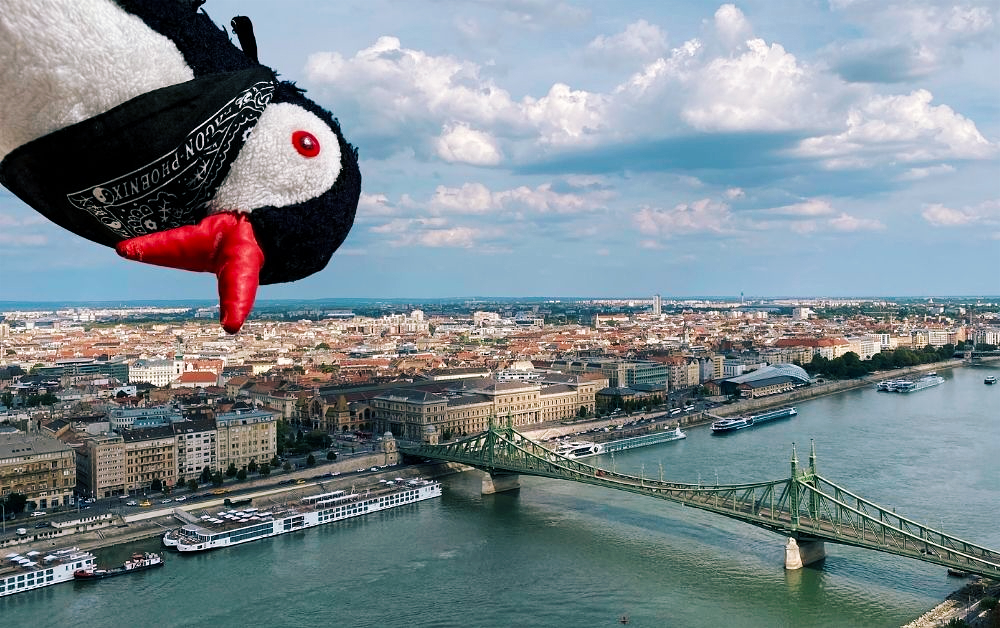
Gellért Hill Budapest: The Best Views, Walking Routes and What to Expect
When we start putting together a Budapest itinerary, Gellért Hill is almost impossible to leave off the list. The promise is tempting: a climb through one of the city’s most famous hills, the historic Citadella waiting at the top, and a panorama that unfolds over the Danube and Budapest’s rooftops. But does the experience live up to the view we have seen in so many photographs? We decided to waddle up and find out. Here is what awaits at the top, what you should know before climbing, and whether Gellért Hill deserves a place on your Budapest itinerary.
- Gellért Hill Quick Facts
- How to Get to Gellért Hill
- Waddling Up to Budapest’s Best Views
- Elisabeth Bridge Quick Facts
- Citadella Quick Facts
- Is Gellért Hill Worth Adding to Your Budapest Itinerary
- When Is the Best Time to Visit Gellért Hill
- What to See Near Gellért Hill
- Gellért Hill vs Other Budapest Viewpoints
- Our Gellért Hill Route
Gellért Hill Quick Facts
- Location: Buda, Budapest, Hungary, overlooking the Danube
- District: Budapest District XI
- Height: Approximately 235 meters above sea level
- Main highlight: Panoramic views over Budapest and the Danube
- What to see: Citadella, Liberty Statue, viewpoints and walking paths
- Time needed: Allow around 2–3 hours for the hill, viewpoints, and Citadella; longer if you visit the exhibition
- Difficulty: Moderate uphill waddle, with some steeper sections
- Best for: City views, photography, history, and a little exercise
- Best time to visit: Morning or late afternoon, when the light is particularly beautiful
- Citadella Park: Open 6 am–midnight from April to October and 8 am–10 pm from November to March.
How to Get to Gellért Hill
Getting to Gellért Hill is part of the experience, and you can approach it in several ways, depending on which part of the hill you want to explore. The most straightforward starting point is Szent Gellért tér, at the foot of the hill beside the Danube. You can reach it by trams 19 and 41, as well as trams 47 and 49, which stop nearby; buses, including 8E and 108E, also serve the surrounding area. From here, you can begin the uphill walk towards the Citadella and its viewpoints.
Another option is to approach from the Rudas Baths/Döbrentei tér side, especially if you are coming from Buda Castle or the riverfront. You can also start from Hegyalja út, giving you different starting points depending on your itinerary.
Our tip: If your main goal is the Citadella and the panoramic views, plan to waddle uphill rather than simply treating the hill as a viewpoint you can reach by public transport. The changing views of Budapest are part of the experience.
Waddling Up to Budapest’s Best Views
Crossing the Danube to Buda
Our Gellért Hill adventure begins on Budapest’s Pest side, where we leave the Old Town behind and head toward Elisabeth Bridge (Erzsébet híd). The white suspension bridge is hard to miss, stretching across the Danube between District V and District I. It is also one of Budapest’s most recognizable river crossings, carrying traffic between the two sides of the city while offering a first glimpse of Gellért Hill rising directly ahead. The bridge itself has an interesting history: the original Elisabeth Bridge opened in 1903 and was one of the world’s longest suspension bridges at the time, but it was destroyed during World War II. The current bridge was completed in 1964 and uses a completely different design.


As we cross into Buda, the city begins to feel different. The busy streets of Pest are behind us, while the slope of Gellért Hill rises ahead. We continue toward Döbrentei tér and the Rudas Baths area, where we find a beautiful fountain and, from here, the real adventure begins. We turn towards the hill and start to waddle upwards, leaving the Danube behind us one step at a time.
Elisabeth Bridge Quick Facts
- Hungarian name: Erzsébet híd
- Connects: District V on the Pest side with District I on the Buda side
- Crosses: The Danube at one of its narrowest points in Budapest
- Original bridge: Opened in 1903
- Original design: Chain suspension bridge
- Destroyed: January 1945 during World War II
- Current bridge: Opened in 1964
- Total length: Approximately 379 meters
- Main span: 290 meters
- Named after: Elisabeth of Bavaria, better known as Empress Sisi
- Interesting fact: When the original bridge opened, its 290-meter main span was the longest of its kind in the world, a record it held until 1926.
From the Fountain to the Hill
After crossing Elisabeth Bridge from the Old Town side, we reach the Buda side, with Gellért Hill rising before us. Our route begins near the Gellért Hill Waterfall, beneath the statue of Saint Gellért. It is a striking starting point: water cascades down the hillside beside the road, while the statue stands high above it. The waterfall and the surrounding landscaping were created as part of the early 20th-century transformation of this side of the hill, with the Saint Gellért statue and waterfall unveiled in 1904.


Our previous sightseeing has already taken us across much of Budapest, so this feels like a natural change of pace. We have left the busy streets behind, and now the route points upwards. From the fountain, we begin to waddle up Gellért Hill, gaining a little more elevation with every turn. There is no need to rush. The views start opening between the trees; the Danube appears below us, and Budapest gradually spreads out in front of us. The climb has officially begun, and already, the journey feels like part of the attraction.
As we waddle higher and higher, we naturally start looking for the best viewpoints along the route. One of our first stops gives us a completely different perspective of Elisabeth Bridge. From above, the white bridge stretches across the Danube below us, framed by the city on both sides. It is one of those moments when the climb already starts to feel worthwhile, because the view keeps changing with every few meters of elevation.


Waddling Up Gellért Hill
The higher we waddle, the more surprising the landscape becomes. One moment, we look across Budapest and the Danube; the next, the path curves into greenery, and we almost forget we are climbing a hill in the middle of a capital city. Trees line parts of the route, birds replace the sound of traffic, and the occasional opening between the branches reveals another piece of Budapest below.
We keep stopping to look back. Elisabeth Bridge slowly shrinks behind us, while the Danube cuts through the city and Pest’s rooftops stretch toward the horizon. The route isn’t simply a way to reach the viewpoint at the top. The views change constantly as we gain elevation, with each turn offering a slightly different perspective.


Some sections are steeper than others, and this is definitely an uphill waddle rather than a stroll. Still, something wonderfully unexpected comes through the experience. We climb through what feels like a small patch of forest, yet just beyond the trees lies one of Europe’s great capitals. That contrast becomes one of our favorite things about Gellért Hill.
The Views Keep Getting Better
Gellért Hill is one of Budapest’s most famous viewpoints for a reason, and the higher we waddle, the easier it is to see why. The city does not simply appear beneath us at one dramatic viewpoint. Instead, it slowly unfolds with every turn. The Danube stretches through the heart of Budapest, the bridges become smaller below us, and the familiar landmarks of Pest begin to form a panorama.
From one opening in the trees, we look back towards Elisabeth Bridge. A little further up, another viewpoint reveals more of the river and the opposite bank. With each stop, we find ourselves turning around again, because the view has changed just enough to make another photograph worthwhile. By now, the climb feels less like a route to somewhere and more like a series of little discoveries, with Budapest gradually spreading out beneath our feet.


Reaching the Top of Gellért Hill
Eventually, the trees begin to thin, and we reach the upper part of Gellért Hill, where the scale of Budapest really comes into view. At 235 meters, Gellért Hill is not technically a mountain, but from here it feels high enough to offer a spectacular panorama. The hill and the Citadella have been part of Budapest’s UNESCO World Heritage landscape since 1987.
And somewhere along the way, we hide something that makes the waddle even more worth it: a penguin stone. With the penguin stone safely hidden, we turn our attention back to the views and the final stretch to the top.


After another stretch of uphill waddling, we finally reach the highest point of our route. We stop here to catch our breath and take in the views we have been chasing all the way up. From this vantage point, the Danube is spread out below us, with Budapest stretching in every direction. The climb feels worthwhile simply for the perspective we have gained along the way.


What to See at the Top of Gellért Hill
Reaching the upper part of Gellért Hill opens up much more than a single viewpoint. The hilltop area includes the Citadella, the Liberty Statue, panoramic promenades, and several viewpoints overlooking the Danube and Budapest. The recently renewed Citadella now includes a public park and new viewing areas. At the same time, the Bastion of Liberty is a ticketed historical exhibition exploring Hungary’s long history and the hill’s symbolic importance.
Citadella Quick Facts
- Free: Citadella Park, inner park, panoramic promenade, viewpoints along the fortress walls, and the Liberty Statue.
- Paid: The Bastion of Liberty historical exhibition.
- Also paid: Roof Garden 360 and Round Bastion Terrace, accessed through the exhibition.
- Adult exhibition ticket: 4,900 HUF.
- Tip: You can enjoy the main outdoor Citadella experience and the views without buying a ticket.
We did not quite make it all the way inside the Citadella during our visit, but this historic fortress is too important to Gellért Hill to leave out. The Habsburgs built the Citadella after the failed Hungarian Revolution and War of Independence of 1848–49, when they wanted a strong military position from which they could monitor and, if necessary, fire upon Budapest. Completed in 1851, its location at the highest point of Gellért Hill was deliberate: whoever controlled the hill had a commanding position over the city and the Danube.
After its recent renovation, the fortress has reopened as a public space with a park, panoramic promenade, and viewpoints, while the Bastion of Liberty tells Hungary’s history inside the fortress.
Beyond the main Citadella complex, the hill also has quieter corners, including the Garden of Philosophers, a small park with sculptures representing different religions and philosophies and another beautiful panorama over the city. So, if you have time to explore beyond the main viewpoint, Gellért Hill rewards you with a mixture of history, greenery, sculpture, walking paths, and some of Budapest’s most impressive views.


Waddling Back Down
After reaching our highest point, we turn around and waddle back down Gellért Hill. Several routes lead off the hill, so where you finish depends on which side you want to head toward and what you have planned next. We enjoy the descent, taking our time and stopping for a few more looks at the city along the way. From the hill, you can appreciate both Buda and Pest, with the Danube tying the two sides together below. For us, the walk back down is just as enjoyable as the climb up. If you are looking for beautiful views over Budapest rather than simply ticking off another attraction, we definitely recommend adding a waddle up Gellért Hill to your itinerary.
Is Gellért Hill Worth Adding to Your Budapest Itinerary
For us, yes. Even though we didn’t make it into the Citadel, the climb was worth the time. The changing views over the Danube, the feeling of waddling through a green hillside while a capital city stretches around you, and, of course, hiding a penguin stone made the experience feel like much more than simply reaching a viewpoint.
Allow around 2–3 hours if you want to take your time with the climb, viewpoints, and Citadella area. The uphill sections can be demanding, particularly on a hot day, so comfortable shoes and water are a good idea. We would also combine Gellért Hill with other Buda-side sights, the Danube, or nearby Rudas Baths rather than crossing the city solely for the hill. If you want panoramic views, a little exercise, and a different perspective of Budapest, Gellért Hill deserves a place on the itinerary.
When Is the Best Time to Visit Gellért Hill
Spring and autumn are particularly pleasant for climbing Gellért Hill, when temperatures are generally more comfortable, and the greenery adds another layer to the views. Budapest’s official tourism site also highlights Gellért Hill in spring, when the surrounding trees and blossoms make the walk especially scenic.
The time of day can make just as much difference. Early morning is a lovely choice if you want a quieter climb and softer light. At the same time, late afternoon and sunset are particularly atmospheric, as the changing light falls across the Danube, bridges and Budapest skyline. In summer, we would avoid the hottest part of the afternoon and choose morning or evening instead. If you plan to visit Citadella Park, remember its opening hours are seasonal: 6 am–midnight from April to October and 8 am–10 pm from November to March. The Liberty Statue and outer promenade are open 24 hours.
- For sunrise: start early and check the route and conditions ahead of time.
- For sunset: allow enough time to climb before the light disappears.
- For daytime views: spring or autumn, with a clear day, can give you the best combination of comfortable walking and visibility.
What to See Near Gellért Hill
One advantage of visiting Gellért Hill is that you can easily combine it with several other Budapest sights, particularly on the Buda side. Depending on which route you take up or down, you can turn the climb into part of a longer day of exploring.
- Rudas Baths. One of Budapest’s historic thermal baths, located at the foot of Gellért Hill near the Danube.
- Gellért Thermal Bath. The famous Art Nouveau thermal bath at the southern side of the hill.
- Liberty Bridge. The distinctive green bridge connecting Buda and Pest, within easy reach of the hill.
- Elisabeth Bridge. Cross the Danube here for another striking view back towards Gellért Hill.
- Philosopher’s Garden. A peaceful sculpture garden on the hill’s northern slope, with another perspective over Budapest.
- Gellért Hill Cave. A small cave and historic chapel built into the hillside.
- Central Market Hall. A good stop on the Pest side, particularly if you want to combine the hill with food and local shopping.
- Buda Castle. Further north along the Buda side, making Gellért Hill easy to combine with a wider Buda sightseeing day.
Pro Penguin Tip: Instead of treating Gellért Hill as a standalone stop, pair it with Rudas Baths and the Danube, then continue toward Buda Castle or back across one of the bridges into Pest. This makes the climb feel like part of a larger Budapest adventure, not a detour.
Buy Us a Ko-fi

Gellért Hill vs Other Budapest Viewpoints
Budapest has plenty of viewpoints, but they offer very different experiences. Gellért Hill is the choice if you want a combination of greenery, walking and wide panoramic views over the Danube. Fisherman’s Bastion focuses more on the architecture and those instantly recognizable views of the Hungarian Parliament, while Buda Castle combines elevated city views with one of Budapest’s major historic districts. On the Pest side, St. Stephen’s Basilica offers a completely different perspective from its rooftop terrace, placing you right in the center of the city rather than above it. In other words, you do not necessarily need to choose just one. If you have enough time, each viewpoint offers a different way to see Budapest.
Our Gellért Hill Route
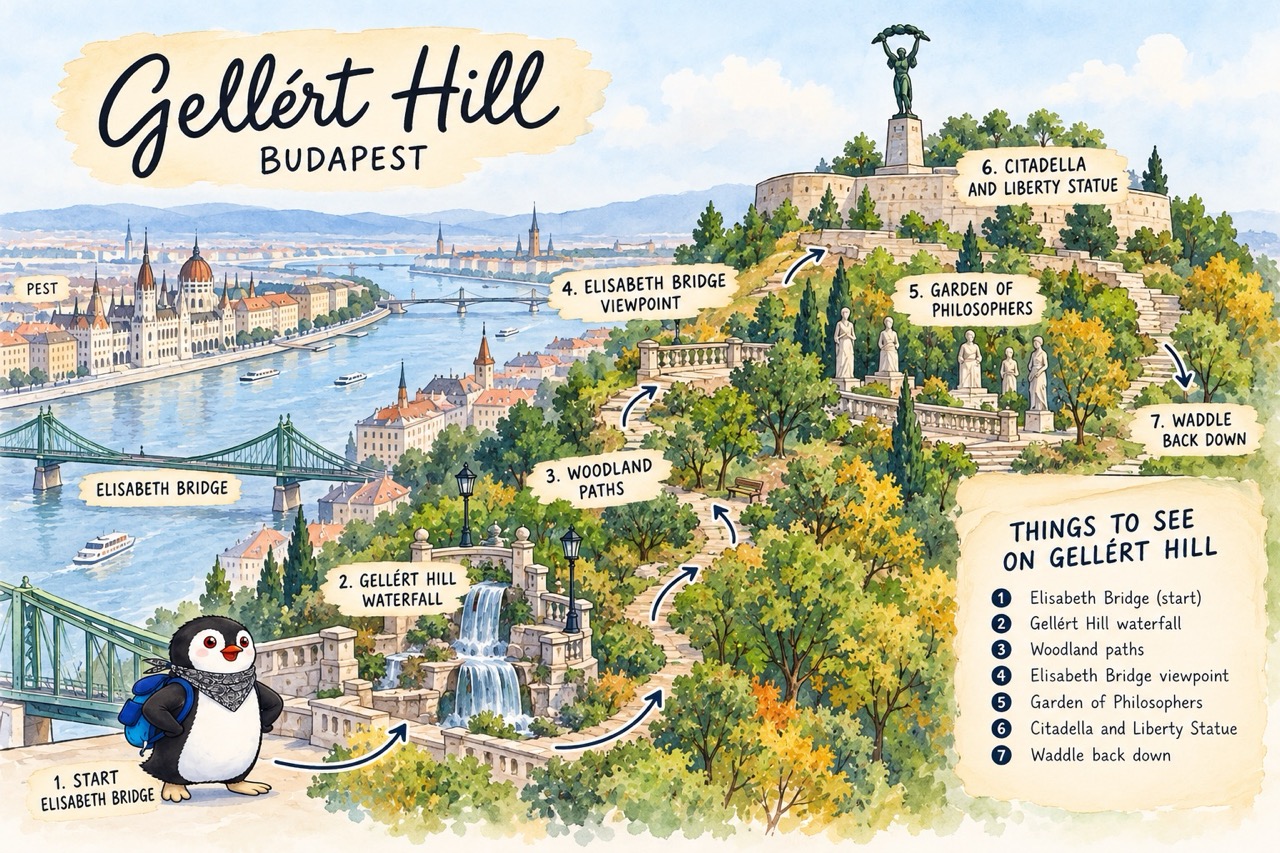
Gellért Hill is less about reaching one particular landmark and more about the journey. We didn’t make it inside the Citadel, but even without completing the entire route, the climb gave us exactly what we came for: a different perspective on the city.
If you have two or three hours to spare in Budapest, Gellért Hill is an easy addition to a Buda-side itinerary. Come for the views, stay for the unexpected little discoveries along the way, and do not be afraid to take your time. After all, sometimes the best part of reaching the top is everything you see on the way.
Travel Bold. Eat Well. Waddle Wild.
Save This Pin for Later!
This post contains affiliate links. If you click and buy, I might earn a tiny commission, enough to help a penguin keep up its globe-trotting lifestyle. No extra cost to you, just more fish for me. Thank you for supporting the adventure!