Arborétum Mlyňany: A Beautiful Botanical Escape in Slovakia
We first heard about Arborétum Mlyňany SAV from our friends Magic and Friends, who hid a penguin stone here. Yes, you can “meet” penguins at the arboretum, and naturally, that was enough to put it straight onto our bucket list. Since we were finally road-tripping through Slovakia, we knew it was time to make the stop. What started as a simple visit quickly turned into a waddle through one of Slovakia’s most fascinating green spaces, filled with trees and plants from around the world.
Quick Facts
- Location: Vieska nad Žitavou, near Zlaté Moravce, Slovakia
- Founded: 1892
- Founder: Štefan Ambrózy-Migazzi
- Area: Almost 67 hectares
- Plant Collection: Around 2,000 taxa, mainly woody plants
- Main Collections: East Asia, North America, Korea and native Slovak flora
- Opening Hours: April 1–October 26: 7:00–18:00 weekdays, 8:00–18:00 weekends and holidays. October 27–March 31: 8:00–17:00 weekdays, 9:00–17:00 weekends and holidays.
- Adult Admission: €5
- Parking: Free for cars
- Dogs: Not allowed inside the grounds
- Best For: Nature walks, botanical collections, photography and a relaxed day outdoors.
How to Get to Arborétum Mlyňany SAV
The easiest way to reach Arborétum Mlyňany SAV is by car, and this is how we visited it during our Slovakia road trip. The arboretum is in Vieska nad Žitavou, with a dedicated car park right on site. Even better, parking is free.
If you are traveling by car, you can reach the arboretum from Nitra, Vráble, or Zlaté Moravce. The official directions lead through Tesárske Mlyňany, then turn towards Vieska nad Žitavou. The GPS coordinates are 48.319656, 18.368701.
- By Bus. You can also reach Arborétum Mlyňany by bus. Connections run from Nitra, Vráble, and Zlaté Moravce. Some buses stop directly at Vieska nad Žitavou, Arborétum, while others stop at Vieska nad Žitavou, rázcestie, where you can continue to the village.
- By Train. No railway station is located directly at the arboretum. If you are traveling by train, the nearest options are Slepčany or Tesárske Mlyňany, depending on your direction of travel. From there, you need to continue by local transport or taxi.
Penguin Pro Tip: If you are exploring several places around western or central Slovakia, we recommend coming by car. It gives you much more flexibility, and with free parking at the arboretum, there is little reason not to drive.
Parking at Arborétum Mlyňany
Parking at Arborétum Mlyňany SAV is free, with a fairly spacious parking area right by the entrance. We found it easy to get a spot during our visit, but it can fill up quickly, especially on busy weekends and during peak visiting hours. If you are driving, we recommend arriving earlier in the day for the easiest parking experience.


Opening Hours and Admission
Opening Hours
From 1 April to 26 October, Arborétum Mlyňany SAV is open Monday to Friday from 7:00 AM to 6:00 PM, and Saturday, Sunday, and public holidays from 8:00 AM to 6:00 PM. From 27 October to 31 March, opening hours are 8:00 AM to 5:00 PM on weekdays, weekends and public holidays.
Admission
- Adults: €5
- Children aged 6–15: €2
- Students up to 25: €3
- Pensioners aged 62+: €3
- Visitors with disabilities: €3
- Children under 6: Free
- Plushies: Free
- Guided tours: Available for an additional fee, depending on the language and day
- Car parking: Free
- Bus parking: €10
Opening hours and admission prices can change, so we recommend checking the official Arborétum Mlyňany SAV website before your visit for the latest information.


Amenities and Facilities
- Parking. Free car parking is available near the entrance.
- Toilets. Toilets are available for visitors.
- Children’s Playground. A playground is available for younger visitors.
- Information Center. Visitor information and guided tour services are available.
- Café. A café in the manor house offers refreshments.
- Guided Tours. Guided tours are available in Slovak and English for an additional fee.
- Plant Shop. The arboretum also has a shop selling ornamental plants.
- Educational Trails. Visitors can explore the grounds along marked educational and sightseeing routes.
Our Waddle Through Arborétum Mlyňany
Entering Arborétum Mlyňany
Arborétum, meaning arboretum, is a botanical garden specializing in trees and woody plants. And Arborétum Mlyňany feels like exactly the kind of place you might miss if you stick to Slovakia’s usual tourist route. It sits a little off the beaten path, but that is part of its charm. As we approach, the road leading towards the entrance already feels like it is taking us somewhere a little different. We had studied the map before arriving because the grounds are huge, and once we finally enter, our first impression is simple: this looks like a gigantic park. And, well, it basically is.
We park the car and waddle towards the ticket booth, ready to see what all the fuss is about.
Penguin Pro Tip: ask for a stamp when buying your tickets. They have an adorable Arborétum Mlyňany stamp, and naturally, we could not resist adding it to our collection.


Although it looks like a huge park at first glance, the arboretum quickly feels different from an ordinary city park. Every path, tree, and corner seems to have a story behind it. And visiting in April makes the entrance especially exciting. Flowers are already blooming, trees are bursting into fresh spring color, and everywhere we look there are signs that the season is waking up. We have barely started our waddle, and we are already excited to see what is waiting further inside.
Spring in Full Bloom
April feels like a particularly beautiful time to waddle through Arborétum Mlyňany. Spring has arrived properly, and the grounds are filled with fresh green leaves, colorful flowers, and trees beginning to show off after their winter rest. Everywhere we turn, something is blooming, from delicate flowers tucked along the paths to larger flowering shrubs that add splashes of color to the landscape.
The rhododendrons are one of the highlights, although in April their display is only beginning to build. We love how different the arboretum feels in spring. The fresh colors make the huge grounds feel even more alive, and there is something new to photograph around almost every bend. Naturally, we stop more than once, because apparently our definition of “a quick visit” does not include walking past a pretty flower without taking a photo.
The combination of mature trees, spring blossoms, and winding paths makes this one of those places where we are happy to slow down and enjoy the scenery. April gives the arboretum a completely different character, and if you love flowers, photography, or being surrounded by nature, it is a wonderful time to visit.


A Waddle Around the World
One of the most fascinating things is the way its enormous grounds are divided into different geographical sections. Rather than simply planting trees wherever there is space, the newer parts of the arboretum are organized according to the natural geographical distribution and ecological relationships of the plants. As a result, our walk gradually takes us through very different landscapes, even though we never leave Slovakia.
- East Asian Dendroflora. This is the largest of the newer geographical sections, covering around 14 hectares. Here we find trees and shrubs from Japan, China, the Russian Far East, the Himalayas, the Caucasus, and parts of Central and East Asia. The collection has a particularly interesting history, with plants introduced from botanical expeditions, including expeditions to China. Today, East Asian plants dominate the arboretum’s collections.


- North American Dendroflora. Covering approximately 7.5 hectares, this section takes us in a completely different botanical direction. Established as the arboretum’s second phytogeographical section, it contains trees and shrubs native to North America, including species from areas stretching from Canada to California. The terrain also made it possible to grow some less hardy evergreen species from the southeastern United States.
- Korean Dendroflora. The Korean section covers around 5.5 hectares and was created after several expeditions to North Korea in the 1980s. Those expeditions brought back hundreds of samples and introduced 155 tree taxa from the 1983 expedition and another 180 taxa from the 1985 expedition. Some of the resulting trees still grow in the Korean dendroflora section today.


- Native Slovak Dendroflora. After traveling through Asia and North America, we eventually return to plants that are naturally found much closer to home. This section covers approximately 4 hectares and focuses on the woody flora native to Slovakia. It is a nice reminder that while the international collections are fascinating, Slovakia itself offers plenty of botanical variety.
Altogether, the arboretum covers almost 67 hectares and contains approximately 2,000 taxa of woody plants, mostly wild species and their lower taxonomic groups. What we particularly appreciate while waddling through such a huge collection is that the plants are actually labeled. Many trees and plants have a small name tag, so instead of simply admiring something unusual and wondering what on earth we are looking at, we can stop, read the name, and learn a little more.
That makes the experience feel less like wandering through a huge park and more like an outdoor botanical lesson. We can explore at our own pace, constantly discovering something new, while the labels help us understand what we are actually seeing. And with plants representing so many different parts of the world, it really does feel like we are taking a botanical trip around the globe, one waddle at a time.
Meeting the Ambrózy Manor
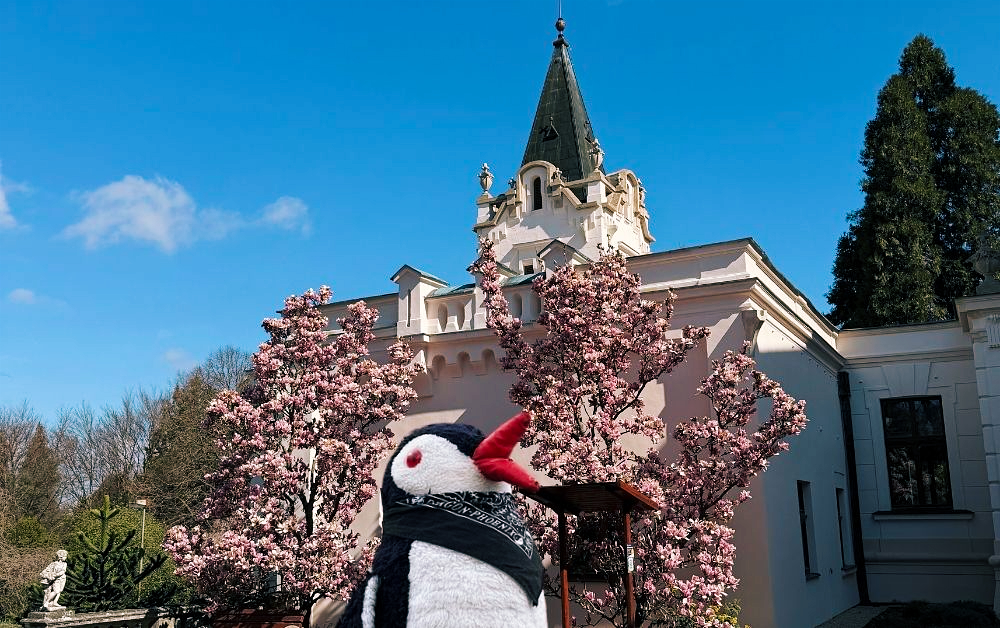
After spending so much time looking at trees, shrubs, and flowers, the Ambrózy Manor eventually comes into view, and the arboretum suddenly feels like more than a vast botanical collection. The elegant building sits among the greenery almost as if it has always belonged here, surrounded by mature trees and carefully shaped gardens.
The manor dates back to the arboretum’s beginnings. Count Štefan Ambrózy-Migazzi founded Arborétum Mlyňany in 1892, and the original manor became closely connected with his vision of creating a garden filled with plants from around the world. The present building was constructed in the 19th century, with its distinctive tower added later, giving the manor the silhouette that makes it so recognizable today.
And that tower is what catches our attention first. Rising above the surrounding trees, it gives the building a slightly storybook quality and makes it an easy landmark as we waddle through the grounds. From different paths, the manor appears and disappears between the branches, so we keep catching little glimpses of it rather than seeing everything at once.


In April, the setting feels particularly atmospheric. The trees are waking up, flowers are beginning to color the grounds, and the historic manor sits right in the middle of it all. It is one of those views that makes us pause and appreciate.
The Semper Vireo Park
The Semper Vireo Park is the historic heart of Arborétum Mlyňany and the original part of the arboretum created by Štefan Ambrózy-Migazzi. Its name means “always green,” reflecting his vision of a landscape that would remain green year-round. With its mature trees, established paths, and more intimate atmosphere, this part feels noticeably different from the newer geographical collections. Here, our waddle feels less like a journey between continents and more like stepping back into the arboretum’s earliest chapter.
There are several moments when our waddle has to pause. With so many different trees and plants spread across the arboretum, we keep spotting something that looks unfamiliar, unusually shaped, or simply too beautiful to walk past. Some of the mature trees feel enormous, while others catch our attention because we have never seen anything quite like them before.
And, of course, this means plenty of photo stops. Sometimes it is an impressive tree, sometimes a flowering shrub, and sometimes it is simply the way the branches frame the path ahead. Several plants and views make us stop, look twice, and reach for the camera, which is probably one of the best signs that Arborétum Mlyňany is doing exactly what a good garden should do: keeping us curious around every corner.


Waddling Through 67 Hectares
With almost 67 hectares to explore, it is not a place for a quick stroll. The paths lead through different collections and quieter corners, and even with other visitors around, the grounds feel surprisingly peaceful. We spent several hours waddling around, stopping for photos, admiring the views, and taking occasional breaks. Comfortable shoes are a must, because there is a lot of ground to cover, and the sheer size is part of what makes the experience so enjoyable.
How Long Do You Need at Arborétum Mlyňany
How much time you need at Arborétum Mlyňany really depends on how you like to explore. We spent up to two hours waddling through the grounds, which was enough to see quite a bit, stop for photos, and enjoy the spring scenery without rushing. But you could easily spend half a day, or even a whole day, exploring the different collections more thoroughly, taking breaks, enjoying the surroundings, and simply slowing down. With almost 67 hectares to explore, there is no need to hurry.
Hotel search from Trip.comShows Trip.com’s own box, which can set Trip.com cookies.
Best Season to Visit Arborétum Mlyňany
With a place this large, the time of day matters less than you might expect. The grounds are so spacious that even when there are plenty of visitors, people tend to spread out, so our waddle never felt particularly crowded. The season, however, makes a big difference. We visited in spring, when many flowers were already blooming, and the arboretum was bursting with fresh color, although some trees were still waiting for their leaves to arrive. Summer would be beautiful too, when the entire landscape is lush and green. But if we come back, autumn is definitely calling our name, when the trees should turn the arboretum into a sea of reds, oranges and yellows. As for winter? We think we’ll happily skip that one.
What We Loved About Arborétum Mlyňany
Arborétum Mlyňany has a lot to love. We visited in spring, so the blooming flowers and fresh greenery immediately won us over, but the sheer variety of plants kept us curious throughout our waddle. We loved the peaceful atmosphere, the historic feel of the grounds, and the beautiful Ambrózy Manor appearing between the trees. And, of course, there is the little detail that brought us here in the first place: the penguins. Learning about this place from friends who had seen the penguins made it a bucket-list stop for us, which somehow makes our visit feel even more special.
Pro Penguin Tip
Leave enough time for a proper waddle. With almost 67 hectares to explore, this is much more than a quick stroll around a small botanical garden.
Is Arborétum Mlyňany Worth Visiting
Absolutely, especially if you enjoy nature, gardens, photography, and slower-paced places, Arborétum Mlyňany is large enough to feel like a proper day out rather than a quick stop, with plants from different parts of the world, historic grounds, the Ambrózy Manor, and plenty of peaceful paths to explore. We particularly loved visiting in spring, when the flowers were blooming, and the arboretum was waking up after winter.
Our waddle through the grounds was a lovely addition to our Slovakia road trip. If you are nearby, we would definitely allow yourself at least a couple of hours, or longer if you want to explore the arboretum properly.
Buy Us a Ko-fi

Arborétum Mlyňany leaves us feeling like we have taken a little botanical journey around the world without ever leaving Slovakia. We loved the peaceful atmosphere, spring flowers, fascinating trees, and the beautiful historic setting, making it a lovely stop for anyone who enjoys nature, photography, and unhurried exploring. For us, of course, the penguin connection made it even more memorable. It is a place that will make you slow down.
Travel Bold. Eat Well. Waddle Wild.
Save This Pin for Later!
This post contains affiliate links. If you click and buy, I might earn a tiny commission, enough to help a penguin keep up its globe-trotting lifestyle. No extra cost to you, just more fish for me. Thank you for supporting the adventure!