Visiting the Tri-Border: Everything You Need to Know
Just around 20 minutes from Bratislava, there is a pretty unique spot where Slovakia, Austria, and Hungary all meet. We’ve already visited the Tri-Border twice, and it’s one of those simple places we genuinely enjoy coming back to. There’s something fun about standing in Slovakia one second, Austria the next, and Hungary a second later. So, if being in three countries in three seconds sounds like your kind of travel experience, we can only recommend adding this little spot to your Bratislava itinerary.
What Is the Tri-Border near Bratislava
The Tri-Border, also known as a tripoint, is the exact spot where the borders of Slovakia, Austria, and Hungary meet. A tripoint simply means a geographical point where three countries or other administrative regions come together.
What makes this one interesting is how easy it is to visit. The tripoint lies just south of Bratislava, close to Čunovo, with Slovakia on one side, Austria on another, and Hungary on the third. There are no border gates or checkpoints here, so you can simply waddle around the marker and technically cross between all three countries within a few seconds. Not that long ago, freely waddling between these countries wasn’t possible. Now you can stand right where all three meet, take a few steps around the marker, and casually say you’ve just visited three countries in three seconds.


The Tri-Border at a Glance
- Location: Near Čunovo, south of Bratislava
- Countries: Slovakia, Austria & Hungary 🇸🇰 🇦🇹 🇭🇺
- Distance from Bratislava: Around 20–25 minutes by car
- Time needed: Around 1–2 hours
- Walking distance: Depends on where you park; roughly 2–4 km round trip
- Entrance fee: Free
- Parking: Free parking options nearby, followed by a short walk
- Dog-friendly: Yes
- Bike-friendly: Yes — and a great destination for a bike trip from Bratislava
A Little History of the Tri-Border
Standing here today, with nothing stopping you from wandering between three countries, it’s strange to think how different this area once was. During the Cold War, Slovakia was part of Czechoslovakia, and its border with Austria formed part of the Iron Curtain, separating the communist Eastern Bloc from Western Europe.
The border was heavily controlled, with fences, patrols, and restricted zones, and simply walking across into Austria as we can today was impossible. Following the fall of the communist regime in Czechoslovakia in 1989, these restrictions gradually disappeared. Slovakia became an independent country in 1993 and later joined the Schengen Area in 2007, making border crossings with Austria and Hungary much easier.
That history makes the Tri-Border a little more meaningful. Today, you can casually walk from Slovakia to Austria to Hungary in seconds, surrounded mostly by quiet fields, something that would have been unimaginable here only a few decades ago.
How to Get to the Bratislava Tri-Border
Although from Bratislava the Tri-Border is close, getting there isn’t quite as straightforward as you might expect. It sits out in the countryside rather than next to a main road, so whichever option you choose, expect at least a little walking or cycling. We’ve visited twice and tried two different ways, once by bike through Austria and once by car, and both made for completely different little trips.
- By Car. Driving is probably the easiest option if you simply want to visit the Tri-Border without turning it into a longer day trip. From central Bratislava, it takes roughly 20–30 minutes to reach the area around Čunovo and the Slovak-Hungarian-Austrian border. You can drive almost directly to the actual tripoint, where you can leave your car and enjoy the area. This is how we visited the second time, and it was definitely the quicker and easier of our two trips.


- By Bike. If you have more time, cycling is probably the most fun way to visit. On our first trip, we actually cycled from Bratislava through Austria before reaching the Tri-Border, which made the whole experience feel much more like an adventure than simply visiting one monument. The area around the border is very bike-friendly, with plenty of flat terrain and cycling routes connecting Bratislava with neighbouring Austria and Hungary. You can quite literally cycle through different countries during the same afternoon without really noticing when you’ve crossed the border.
-
By Public Transport + Waddling. Getting to the Tri-Border by public transport is possible, but you’ll need to add a good waddle at the end. From central Bratislava, take bus 91 from Most SNP in the direction of Čunovo and get off at the final stop, Čunovo. The bus also passes through Petržalka, Jarovce, and Rusovce, so you can hop on at several stops along the way. From Čunovo, there is no public transport taking you directly to the Tri-Border, so the rest of the journey is on foot through the countryside. We recommend having the location saved in Google Maps or, even better, downloading an offline map before you go. The last stretch feels surprisingly rural considering you’re still so close to Bratislava, but that is part of the fun.
Our Visit to the Tri-Border
As we arrived at the Tri-Border by car, from the main road, you simply turn onto the dirt road and continue along it through the fields. At first, it might feel like you’re driving somewhere you probably shouldn’t be, but keep going and you can leave your car quite close to the actual Tri-Border.
Once we parked, we grabbed our things and headed straight towards the border area to explore. There’s no big entrance, ticket office, or anything particularly touristy welcoming you here. One moment you’re waddling along a quiet dirt road surrounded by fields, and a few minutes later you’re standing at the exact spot where Slovakia, Austria, and Hungary meet.


What to See at the Tri-Border
The Three-Country Border Marker
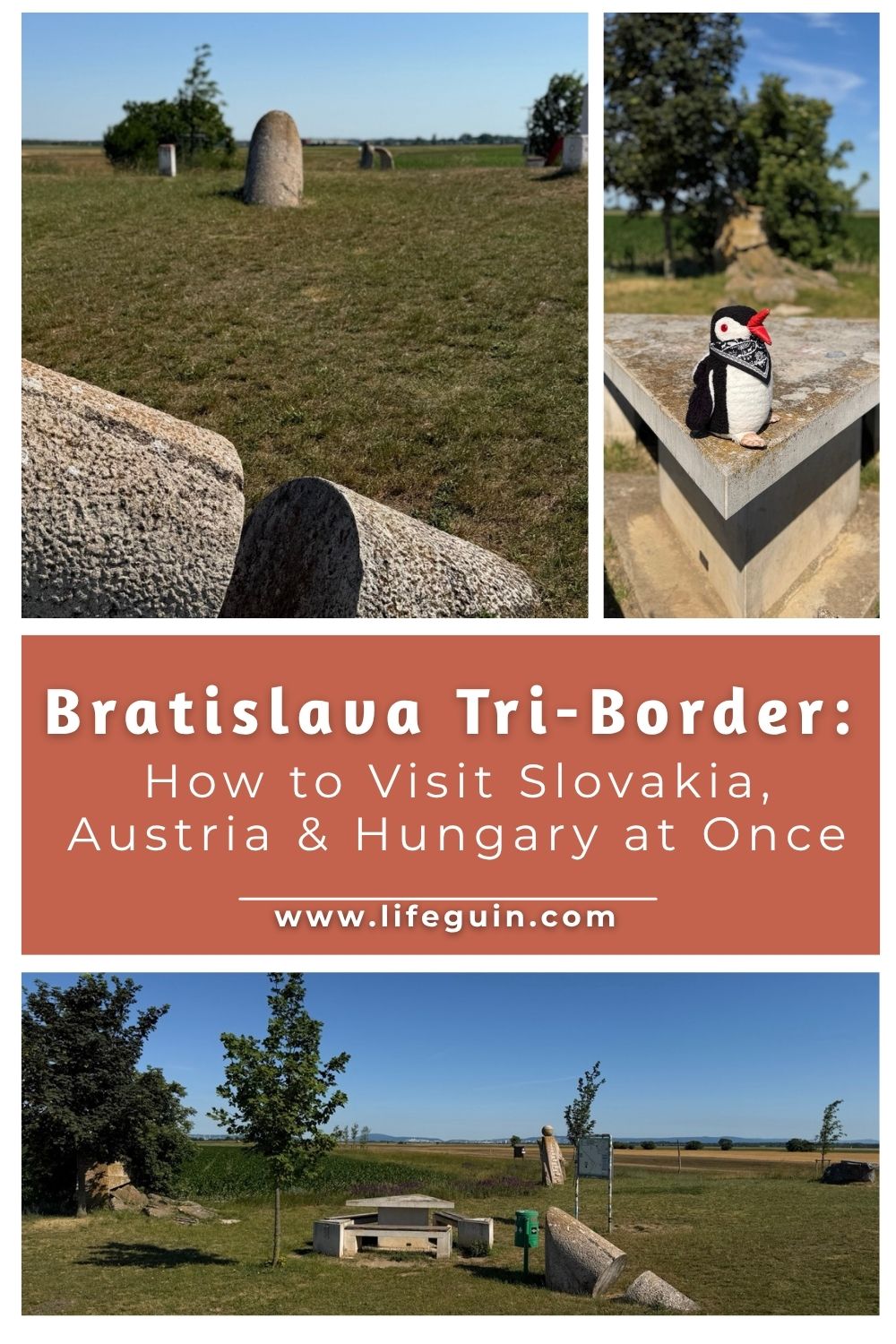
The main reason to come here is, of course, the three-country border marker itself. It marks the exact point where Slovakia, Austria, and Hungary meet, with each side of the triangular marker facing one of the three countries. You’ll find the country names and coats of arms displayed on it, making it pretty easy to figure out which country you’re standing in.
And naturally, we couldn’t come all this way without walking around it a few times. One step and you’re in Slovakia, another and you’re in Austria, then Hungary, three countries in just a few seconds. It’s such a simple thing, but also what makes this spot so much fun to visit. Take a few photos, walk around the marker, and enjoy being able to casually hop between three countries without showing a passport once.
The Triangular Table
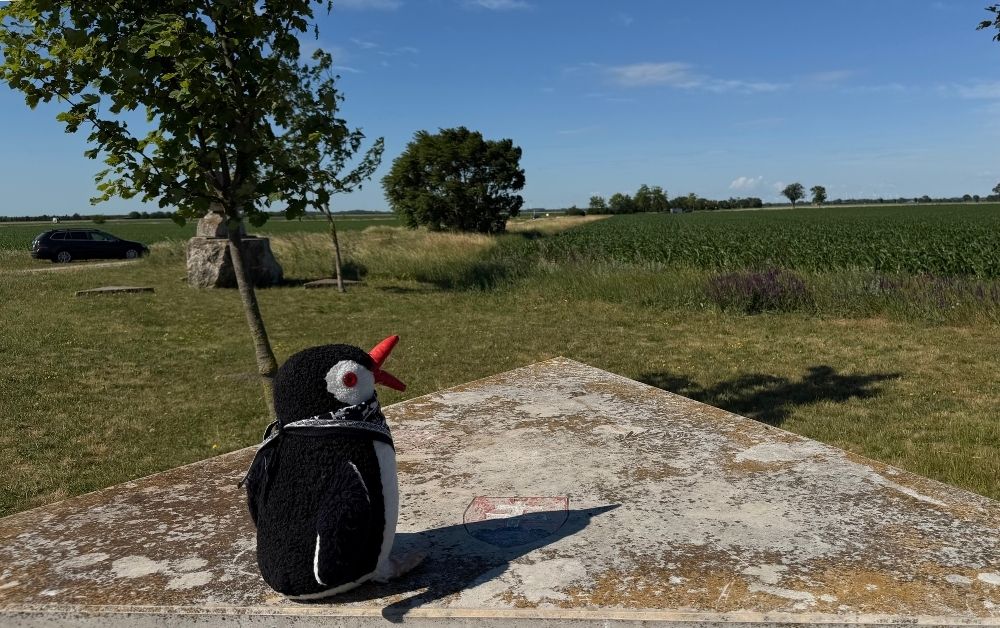
Another thing you’ll notice at the Tri-Border is the triangular table with three benches, designed around the three countries meeting here. Each side represents Slovakia, Austria, and Hungary, so you can sit down in a different country while sharing the same table.
We really liked this little detail because it makes the whole idea of the Tri-Border much more visual. Three countries, three sides, but one table in the middle. It’s also a fun place to stop for a break, take a few photos, or simply sit for a moment and appreciate how unusual it is to have three international borders meeting right around you.


Sculpture Park
The Tri-Border isn’t just about the border marker. The surrounding area also works as a small open-air sculpture park, with artworks and monuments scattered around the fields. Several sculptures were created by artists from Slovakia, Austria, and Hungary, adding another layer to the idea of three neighbouring countries coming together in one place. There are no museum walls or entrance gates here, you waddle around the area and discover the different pieces as you go. It makes the visit more interesting and gives you a reason to explore beyond simply taking a photo at the border marker and leaving.


Iron Curtain Memorials
While waddling around the Tri-Border, you’ll also come across reminders of the Iron Curtain, which make the peaceful surroundings feel very different once you know their history. Today, you can freely waddle between Slovakia, Austria, and Hungary, but during the communist era, the Czechoslovak-Austrian border here was heavily guarded and crossing it freely was simply not possible.
The memorials around the area help show just how much has changed. What was once part of a strictly controlled border between East and West is now an open landscape where you can cross from one country to another without even noticing.
Of course, while we were there, we couldn’t resist waddling through all three countries. Slovakia, Austria, Hungary, three countries in about three seconds. Not bad for a day of travelling! No airport queues, no long drives, and definitely no unpacking and repacking the suitcase. Overall, the area is really nice to wander around, take some photos, and enjoy the slightly ridiculous feeling of repeatedly crossing international borders just because you can. And if you’re a particularly busy traveller trying to squeeze as many countries as possible into your itinerary, well… this might just be the most efficient three seconds of your trip.
How Long Do You Need
How long you need depends on how you get there and what you want to do. If you come by car, around one hour is more than enough. You can waddle to the marker, waddle through all three countries, take your pictures, explore the small sculpture park, and head back to the car. It’s definitely an interesting spot, but apart from the sculptures and monuments, there isn’t really much else to do here.
If you come by bike, you can easily turn the visit into a longer trip. Bring some food, find a nice spot for a picnic, explore the area at a slower pace, and make the Tri-Border one stop on a bigger cycling route through Slovakia, Austria, and Hungary. So whether this is a quick one-hour stop or half a day out really depends on you.
Best Time to Visit the Tri-Border
The Tri-Border is accessible throughout the year, but your experience will definitely change with the seasons.
- Spring (March–May). Spring is a great time to visit, especially if you want to cycle or walk. The surrounding fields start turning green, temperatures are comfortable, and you avoid the summer heat. Just keep in mind that the dirt roads can get muddy after rain.
- Summer (June–August). Summer brings long days and plenty of sunshine, making it easy to combine the Tri-Border with a longer bike ride or picnic. There is very little shade around the border itself, though, so on a hot day, bring plenty of water and sun protection. Early morning or later in the afternoon will be much more pleasant.
- Autumn (September–November). Early autumn is another time we would recommend. Temperatures are usually comfortable for walking and cycling, and the countryside starts changing colours. Again, rain can make some of the dirt tracks muddy, particularly if you’re driving closer to the border.
- Winter (December–February). You can visit in winter as well, but this probably wouldn’t be our first choice. The landscape is very exposed, days are shorter, and snow, ice, or mud can make the dirt roads less convenient.
For us, late spring, summer, or early autumn are the best choices. If we had to pick one, we’d go for late spring or early autumn when it’s warm enough to enjoy being outside but not so hot that your three-country waddle turns into a three-country sweat.
Is the Bratislava Tri-Border Worth Visiting
Yes, we think the Tri-Border is worth visiting, especially if you’re looking for something unusual to do outside the city. Being able to stand in Slovakia, Austria, and Hungary within a few seconds is a fun experience, and the border marker, sculpture park, and history of the area make it more interesting than simply ticking three countries off your list.
That said, keep your expectations realistic. There really isn’t much else here. Once you’ve explored the sculptures, walked around the border marker, taken your three-country photos, and perhaps had a picnic, you’ve pretty much seen it all. We wouldn’t plan an entire day around the Tri-Border alone, but as a quick trip from Bratislava or a stop on a longer cycling route, we can definitely recommend it.
Nearby Attractions
- Čunovo. A small village just south of Bratislava and a convenient stop to combine with your Tri-Border visit.
- Danubiana Meulensteen Art Museum. A modern art museum sitting on a peninsula in the Danube. Even if museums aren’t usually your thing, the location itself makes this one worth considering.
- Čunovo Water Sports Centre. Right next to the Danubiana, this artificial white-water course is used for rafting, kayaking, and canoe slalom.
- Gabčíkovo Waterworks. If you’re continuing farther along the Danube, the huge Gabčíkovo dam and lock system is an interesting engineering stop.
- Rusovce. Stop here for Rusovce Mansion, its surrounding park, and the remains of Gerulata, a Roman military camp that formed part of the Roman Empire’s Danube frontier.
- Bratislava. The obvious addition if you’re visiting from elsewhere. Bratislava Castle, the Old Town, Blue Church, Slavín, and UFO Observation Deck can easily fill the rest of your day.
- Hainburg an der Donau, Austria. Cross into Austria and explore this small historic town with medieval walls, gates, and a hilltop castle ruin.
- Devínska Nová Ves & Schloss Hof, Austria. A little farther away, but the cycling bridge across the Morava makes it possible to combine Slovakia and Austria with a visit to the impressive Schloss Hof palace.
- Rajka, Hungary. Just across the Hungarian border, Rajka is an easy addition if you want to spend a little more than three seconds in Hungary.
Buy Us a Ko-fi

The Tri-Border might not be somewhere you spend an entire day, but that doesn’t make it any less fun to visit. We’ve been here twice now, once by bike and once by car, and we enjoyed both trips in completely different ways. It’s quirky, peaceful, full of a little history, and where else can you say you’ve been in three countries in three seconds?
If you have some extra time in Bratislava and want to see something beyond the usual Old Town and castle, add the Tri-Border to your list. Bring your camera, maybe pack a picnic, and get ready to waddle your way through Slovakia, Austria, and Hungary. And if unusual places like this are your kind of thing, keep exploring with us, there are plenty more hidden corners, quirky stops, and unexpected places around Bratislava and Slovakia waiting to be discovered.
Travel Bold. Eat Well. Waddle Wild.
Save This Pin for Later!
This post contains affiliate links. If you click and buy, I might earn a tiny commission, enough to help a penguin keep up its globe-trotting lifestyle. No extra cost to you, just more fish for me. Thank you for supporting the adventure!