Rovinj, Croatia Travel Guide: Essential Things to Know
We came to Rovinj on a one-day trip while exploring Istria. The plan was simple. Waddle around the old town, get something to eat, and see what the place is about. No big expectations, simply a relaxed day by the sea.
After a few hours of wandering through the streets, sitting by the harbor, and waddling up toward the church, we realized there is actually quite a lot going on here. The town has a long history, a few small details you might miss if you do not know about them, and some things that make it a bit different from other places along the Croatian coast.
So before you visit Rovinj, here are a few things to know and interesting facts that might make your walk around town a little more fun.


Quick Facts About Rovinj
- Location: Western coast of the Istrian Peninsula in Croatia, along the Adriatic Sea
- Region: Istria
- Population: Around 14,000 residents
- Old Town Location: Built on what was once a small island
- Year Established: The settlement dates back to around the 3rd century
- Elevation: About 67 meters at the highest point near the Church of St. Euphemia
- Language: Croatian and Italian are both widely used
- Currency: Euro (€)
- Nearest Major City: Pula (about 40 km away)
- Nearest Airport: Pula Airport
- Number of Nearby Islands: Around 14 small islands just off the coast
- Known For: Colorful harbor, narrow old town streets, and coastal views
- Nickname: Often called one of the most romantic towns in Croatia
Local Legends of Rovinj
We always like learning about local legends when visiting a place. They often tell a completely different story from the one in history books, and sometimes explain why certain traditions still exist today. Rovinj has a few stories like that, passed down for generations. The most famous one is connected to the town’s main church and its patron saint.
The Legend of Saint Euphemia
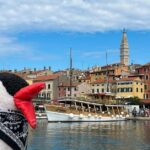
According to local legend, something unusual happened in the year 800. Early one morning, the church bells in Rovinjbegan ringing, and residents rushed down to the sea to see what was happening. Floating on the water was a large marble sarcophagus slowly drifting toward the shore.
People tried to pull the heavy stone coffin into town using horses and oxen, but nothing worked. No matter how hard they tried, it would not move. Then, according to the story, a small boy had a vision of Saint Euphemia. She told him that he would be the one to bring the sarcophagus up to the hill.
The boy tied his small calves to the stone coffin and, to everyone’s surprise, managed to pull it all the way up to the hill where the church stands today. When the sarcophagus was opened, people found the preserved body of a young woman and a parchment identifying her as Saint Euphemia, a Christian martyr who died in the year 304.
Today, the Church of St. Euphemia still stands at the top of the old town, and the saint remains the patron of Rovinj. Every year on September 16, the town celebrates its feast day, and it is still one of the biggest gatherings in the region.
The Legend of the Wind Vane on the Church Tower
If you look up at the tower of the Church of St. Euphemia in Rovinj, you will notice a statue standing right at the top. It is a copper figure of Saint Euphemia that actually works as a wind vane.
Local legend says the statue does more than show the wind direction. People in Rovinj believe the saint turns toward the wind to protect the town and the fishermen at sea. When strong winds start coming from the Adriatic, the statue is said to “watch over” the harbor and those out on the water.
A Brief History of Rovinj
- 3rd Century: The earliest known settlement appears on the small island where the old town stands today.
- 539 AD: The town becomes part of the Byzantine Empire after the fall of Roman rule in the region.
- 788 AD: Control of the area passes to the Frankish Empire.
- 1283: Rovinj becomes part of the Republic of Venice, which rules the town for almost 500 years.
- 1763: The channel separating the island town from the mainland is filled in, connecting Rovinj to the coast.
- 1797: The Republic of Venice falls, and Rovinj becomes part of the Austrian Empire.
- 1918: After World War I, the town became part of Italy.
- 1947: Following World War II, Rovinj is incorporated into Yugoslavia.
- 1991: The town becomes part of modern-day Croatia after the country declares independence.
17 Interesting Facts About Rovinj
#1: Rovinj Was Once an Island
It might not look like it today, but Rovinj was originally a small island. In 1763, the channel between the island and the mainland was filled in, connecting it to the coast. Today, you can waddle straight into the old town, but the shape of the streets still follows the outline of the old island.
#2: The Church at the Top Watches Over the Town
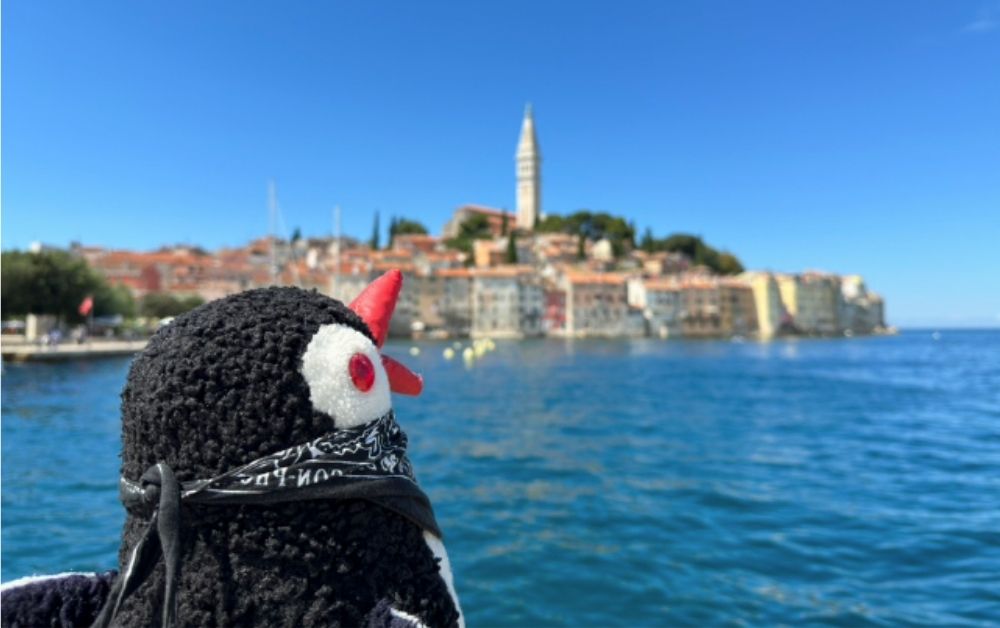
At the highest point of the old town stands the Church of St. Euphemia. The climb up through the narrow streets eventually leads you here. From the area around the church, you get one of the best views over the rooftops and the Adriatic Sea.


#3: Rovinj Was Part of Venice for Centuries
For almost 500 years, Rovinj was under the rule of the Republic of Venice. That is why the town feels a bit Italian in places. You can see it in the architecture, the narrow streets, and even in some local names.
#4: Italian Is Still Spoken Here
Because of its history, many people in Rovinj speak both Croatian and Italian. Street signs are often written in both languages, too. It is one of the few places in Croatia where Italian culture is still very present in everyday life.
#5: The Streets Were Built to Confuse Pirates
The old town streets in Rovinj twist and turn in every direction. One reason for that layout was protection. In the past, narrow and confusing streets made it harder for pirates or attackers to move quickly through the town.


#6: Rovinj Has One of the Most Photographed Harbors in Croatia
If you have seen photos of Rovinj before visiting, chances are they were of the harbor. Boats floating on the water, with the old town rising behind them, is one of the most recognizable views in Croatia.
#7: The Town Was Once Protected by Walls
Like many coastal towns, Rovinj was once surrounded by defensive walls. Over time, most of them disappeared, but a few pieces are still visible today if you walk around the edge of the old town.
#8: There Are More Than a Dozen Small Islands Nearby
Just off the coast of Rovinj, there are about 14 small islands. Many of them are uninhabited and covered with trees. On a clear day, you can easily see them from the waterfront. Some can also be reached by boat or kayak.
#9: Rovinj Streets Have a Special Stone
When waddling through the old town of Rovinj, you might notice the streets look unusually smooth and shiny. That is because they are paved with polished limestone. After years of people walking on them, the stones became even smoother, making them very slippery after rain.
#10: Some Streets Are Extremely Narrow
A few streets in the old town are so narrow that two people can barely pass each other. One of the most famous is called “Ulica Šetaliste,” but locals often joke that some streets were designed when people were smaller, and life was simpler.
#11: Rovinj Has a “Batana” Boat Museum
The small wooden fishing boat called the Batana is a big part of local identity. In fact, Rovinj even has a museum dedicated to it, the Batana Eco-Museum. These flat-bottom boats were traditionally used by fishermen close to the shore.
#12: Laundry Used to Hang Across the Streets
In the past, residents of Rovinj would hang laundry across the narrow streets between buildings. It was a practical solution in a crowded town with limited space. While it is less common today, you can still see it occasionally in the old town.
#13: The Bell Tower Looks Like One in Venice
The bell tower of the Church of St. Euphemia looks very similar to the bell tower of St. Mark’s Campanile in Venice. That is not a coincidence. During the Republic of Venice, architectural ideas often traveled across the Adriatic.
#14: There Is a Street Named After Casanova
Yes, that Casanova. The famous adventurer Giacomo Casanova is believed to have visited Rovinj in the 18th century. Today, one of the small streets in the old town is named after him.
#15: The Old Town Was Once Very Crowded
At one point, the small island that formed the old town of Rovinj had over 10,000 residents living there. Houses were built taller and closer together because there was simply no more space.
#16: Rovinj Was Famous for Tobacco
In the 19th century, Rovinj became an important center for tobacco processing. The factory opened in 1872 and provided jobs for a large part of the town, especially women.
#17: The Town Has Its Own Dialect
Besides Croatian and Italian, locals historically spoke a special dialect called Istriot, which developed in the Istria region. Today, only a small number of people still speak it.

Buy Me a Ko-fi
We came to Rovinj thinking it would be just a quick stop for a day, but it turned out to be way more interesting than we expected. Wandering the streets, seeing the harbor, and learning about the local legends made the day feel longer and more memorable than we planned. Sure, it’s small, and a lot of people visit, but there’s something about the way the town sits on the coast, the way the streets twist and turn, and the little details hidden everywhere that make it worth seeing in person. Even if it’s just for a one-day trip, it’s a place that stays with you long after you leave. If you ever find yourself in Istria, don’t skip Rovinj; it really is a town that’s easy to fall for.
Pack your bags and waddle more!

This post contains affiliate links. If you click and buy, I might earn a tiny commission, enough to help a penguin keep up its globe-trotting lifestyle. No extra cost to you, just more fish for me. Thank you for supporting the adventure!