Explore Hluboká Castle: A Stunning Day Trip in South Bohemia, Czech Republic
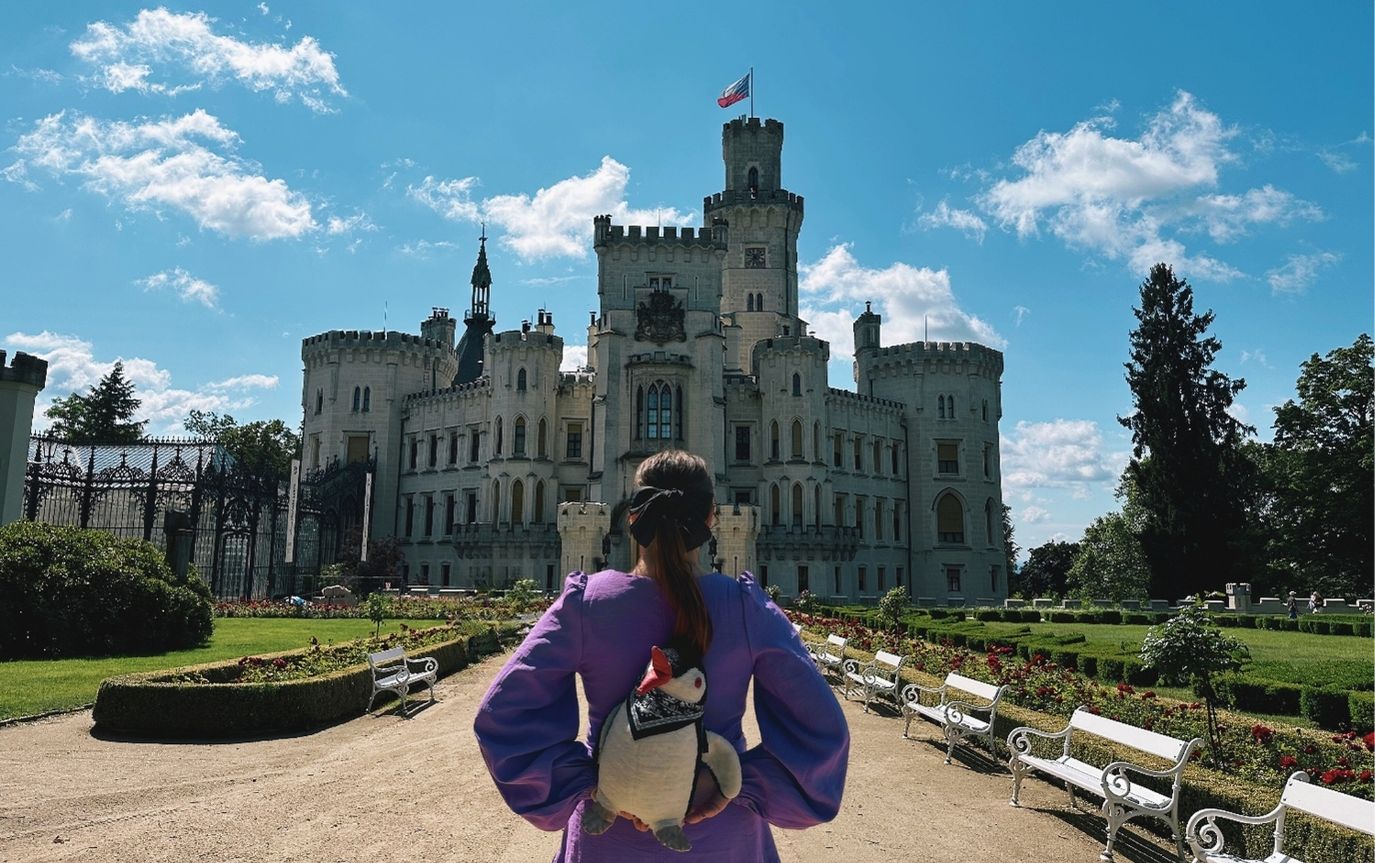
While planning our road trip through the Czech Republic, one thing became clear: Hluboká Castle had to be on the list. If not a main stop, then definitely a non-negotiable one. We’d heard about it for years, and who couldn’t stop talking about its striking beauty? And honestly, it only took one Google image search to convince us we needed to see it in person. The soaring white towers, the romantic silhouette, the symmetry, it all felt like something out of a Central European legend.
This blog post includes everything you need to know before visiting Hluboká Castle. From travel tips and historical background to architectural highlights and local recommendations, consider this your complete guide to one of the most beautiful castles in the Czech Republic.
- Is the State Chateau of Hluboká Worth Visiting
- How to get to the State Chateau of Hluboká
- Where to park for Castle Hluboká
- Opening Hours and Admission Tickets for the State Chateau of Hluboká
- What Was Hluboká Castle Used For
- Hluboká Castle Historical Highlights
- Local Legend of Hluboká Castle
- Our Waddle of Hluboká Castle: A Short Waddle Through Town to a Fairytale View


And here’s something to pique your interest: Hluboká Castle was originally a 13th-century Gothic fortress. But over time, it evolved, shaped by Renaissance elegance, Baroque details, and finally, a 19th-century transformation inspired by England’s Windsor Castle. Today, it’s one of the few places in Europe where you can waddle through history across five centuries, all under one roof. Let’s dive in.
Is the State Chateau of Hluboká Worth Visiting
Hluboká Castle is 100% worth a visit, especially if you’re road-tripping through the Czech Republic or looking for places that live up to the hype. As soon as we saw a photo of it, we knew we had to make it one of our stops. The bright white towers, the dramatic entrance, and the fact that it looks like something straight out of a storybook? Hard to resist. And when you’re there in person, it’s even better. The interior is packed with original details, think carved wood, antique books, royal portraits, and rooms that appear to have been frozen in time. The gardens around the castle are just as impressive, with wide-open lawns and quiet spots where you can sit and take it all in. It’s also super easy to reach, only about two hours from Prague and even closer to České Budějovice, so it’s perfect for a day trip or a pit stop if you’re heading to places like Český Krumlov. Whether you’re into castles or not, Hluboká has this charm that pulls you in. It’s beautiful, peaceful, and full of stories, and honestly, one of our favorite places we visited in the Czech Republic.
How to get to the State Chateau of Hluboká
You can reach the State Chateau of Hluboká in several easy ways, depending on your travel style and starting point. No matter how you get there, the short waddle up to the castle is a small effort for a big reward. Choose the mode that fits your style, whether it’s flexibility, ease, scenery, or comfort.
By Public Transport. There’s no direct train or bus from Prague to Hluboká, but the route is straightforward.
- Option A – Train: Take a train from Prague to České Budějovice, then transfer to a local train to Hluboká (Zámostí or Sudárna station). From either station, hop on local bus number 4 to the “Pod Kostelem” stop, just a 5–10 minute uphill walk to the castle.
- Option B – Bus: From Prague’s Na Knížecí (Anděl) or ÚAN Florenc, take a RegioJet or FlixBus to České Budějovice. Then switch to a ČSAD Jihotrans bus to Hluboká nad Vltavou (“Pod Kostelem” stop). The final stop leaves you about 800 m (hill climb) from the chateau.
Total journey: ~2–3 hours. Expect to pay around 200 CZK each way.
Train and bus tickets from OmioShows Omio’s own box, which can set Omio cookies.
By Car. Fastest & Most Flexible. Takes about ~1.5–2 hours from Prague or ~15 minutes from České Budějovice. Drive via the D1 motorway south, then take the exit onto E55 via Mirošovice through Tábor, then continue toward České Budějovice before turning off onto road 146 to Hluboká nad Vltavou. Look for well-marked signs directing you to the castle. Several nearby parking lots are available, P1 is closest, while larger lots like P2 and P3 suit longer stays (paid parking applies).
We came to Hluboká Castle by car from Český Krumlov, and the drive was both easy and scenic. It’s a relatively short ride, just under an hour, depending on traffic, and takes you through quiet countryside, small villages, and stretches of forested roads. The route is well-marked and smooth, making it perfect for a relaxed morning departure or a midday stop between destinations. There are several designated lots, and from there, it’s a short waddle uphill to the gates.


Where to park for Castle Hluboká
Here are the best places to park when visiting the State Chateau of Hluboká:
- You’ll find the main paid parking lot next to the Penny Market on Nad Parkovištěm Street, about 800–900 m from the castle, which equates to a brisk uphill waddle of roughly 10 minutes. This lot (sometimes called P1 or “central parking”) costs CZK 80 per day, fairly compact, so you may end up parking on a grass edge nearby.
- Alternatively, you can park in Masaryk Street, a short, level walk away. This option operates from around 9 a.m. to 4–6 p.m. and charges CZK 90 per day.
- For cheaper or free parking, consider the lot next to the municipal swimming pool during summer months (approx.July–August), which charges CZK 50 per day. You can also park for free at the Hamry sports-area lot (P3) and near the sports fields, golf course, or tennis courts, just be sure they’re accessible at your time of visit.
- If you also plan to visit the Ohrada Zoo, there’s a large lot with around 400 spaces just across from the zoo, available to castle visitors for CZK 80 per day. From there, it’s a longer waddle or short local shuttle.
We parked at the main parking lot near Nad Parkovištěm Street, just a short waddle below the castle. It cost 80 CZK (about €3.24) for the day, which felt reasonable, especially since the lot was spacious and easy to navigate. There’s also a public bathroom on-site, which costs 20 CZK (around €0.80) to use, which is definitely appreciated after the drive and before the uphill walk to the castle entrance. While cash is the easiest option, some parking areas may accept card or mobile payment, though it’s best to have Czech crowns on hand just in case.
Opening Hours and Admission Tickets for the State Chateau of Hluboká
Opening Hours
-
- High Season (May–August): Open daily, including Mondays, from 9:00 a.m. to 5:00 p.m.
- Mid Season (April, September & October): Open Tuesday–Sunday, 9:00 a.m. to 4:30 p.m. (Closed on Mondays, except special dates)
- Low Season (November–March): Open Tuesday–Sunday, 10:00 a.m. to 4:00 p.m. (Closed Mondays)
Note: On Czech public holidays in May (e.g., May 1 & 8), the castle extends hours starting at 9:00 a.m., even if it falls on a Monday
Admission & Tours
Tickets vary by tour type and visitor category. Payment options include cash and card, and you can book online in advance.
Main (Representation) Tour
- Adults (25–64): 200 CZK
- Seniors (65+), Youth (18–24), Persons with disabilities: 160 CZK
- Children (6–17): 60 CZK
- Under 5: free entry
- Penguins: free entry
Private Apartments Tour
- Adults: 220 CZK
- Seniors/Youth/Disabled: 180 CZK
- Children (6–17): 70 CZK
- Under 5: free entry
- Penguins: free entry
Self-Guided Tower Visit
- Adults: 160 CZK
- Seniors/Youth/Disabled: 130 CZK
- Children (6–17): 50 CZK
- Under 5: free entry
- Penguins: free entry
Last guided tours start between 4:30 p.m. and 5:00 p.m., typically end about an hour later.
Always check the official website of the State Chateau of Hluboká before your visit for the most up-to-date information on opening hours, ticket prices, and tour availability, as they can vary by season or special events.
Tours and tickets from ViatorShows Viator’s own box, which can set Viator cookies.
How Long Does the Tour Take
It depends on which tour you take. Here’s a breakdown of the main tours along with their durations:
-
- Representation Rooms Tour. Approximately 55 minutes, covering grand salons, library, dining halls, and the armory. Great for first-timers who want a solid overview.
- Private Apartments Tour. Around 60 minutes, offering a more intimate look into the lives of the Schwarzenberg family.
- Kitchen Tour. A focused 35-minute experience highlighting the historic castle kitchen and its workings.
- Suite Rooms Tour. The longest option, at about 70 minutes, explores guest suites and private rooms on the upper floor.
- Tower Visit. This one’s self-guided, so there’s no set duration; you can spend as little or as long as you want enjoying the views.
- Winter Tour (basic). Offered in colder months, lasting around 40 minutes.
So, depending on the tour you choose, expect to spend between 35 and 70 minutes inside the castle, plus extra time for the grounds, tower, and maybe a stop at the cafe or gift shop.
Facilities & Amenities
- Spacious Parking Options.
- Wheelchair Accessibility. Four guided tours, park, gardens, and courtyards are wheelchair-accessible, and there’s a dedicated wheelchair-accessible restroom.
- Restrooms (Including Paid Options). Public toilets are available, including on-site facilities in the main parking lot (approx. 20 CZK), plus castle-area restrooms with accessible options.
- Refreshments and Dining. Vending machines are in the first courtyard, and a full-service restaurant is located in the atrium behind the glass winter garden.
- Gift & Souvenir Shop. A well-stocked shop offering postcards, local crafts, and castle-themed souvenirs.
- Bike-Friendly Area. Bicycles can be brought into garden areas if waddled; secure bike stands are available by the Aleš Gallery entrance.
- Leashed Pets Allowed Outdoors. Dogs are welcome on a leash in the park and gardens, but not inside the castle itself.
- Helpful Visitor Support. Staff available for guidance, plus emergency and accessibility assistance (notably for wheelchair visitors).
What Was Hluboká Castle Used For
Originally, it was a defensive fortress protecting royal lands and trade routes. Later transformed into a luxury aristocratic residence by the Schwarzenbergs. Hosted royal guests, noble events, and served as a center of Bohemian high society in the 19th century. Today, it functions as a museum and historical site, preserving centuries of Czech architecture, art, and aristocratic life.
Hluboká Castle Historical Highlights
- Founded in the 13th Century. Built around 1250 by King Ottokar II of Bohemia as a Gothic royal castle to secure trade routes and protect royal territory.
- Originally a Fortress. It served as a military stronghold during medieval times, overseeing the Vltava River and the surrounding region.
- Ownership Changes Over Centuries. Passed through several noble families, including the Lords of Pernštejn, theLords of Hradec, and the Lords of Malovec, each influencing the structure and use.
- Acquired by the Schwarzenberg Family in 1661. One of the most powerful noble families in Bohemia, the Schwarzenbergs, took over the estate and significantly shaped its future.
- Renaissance and Baroque Rebuilding. Under the Schwarzenberg rule, the castle underwent extensive Renaissance and later Baroque-style renovations, shifting from military use to residential and ceremonial purposes.
- Major Neo-Gothic Transformation (1839–1871). Prince Johann Adolf II of Schwarzenberg and his wife Eleonore oversaw a grand redesign inspired by Windsor Castle, transforming Hluboká into a romantic, English-style noble residence.
- Used as a Family Residence. Throughout the 19th and early 20th centuries, the castle was primarily used as a private residence for the Schwarzenbergs, featuring reception rooms, private apartments, and formal gardens.
- Confiscated in 1947. After World War II, the Czechoslovak government confiscated the estate under the Beneš Decrees, stripping the Schwarzenbergs of ownership due to their opposition to Nazism.
- Opened to the Public. Since the mid-20th century, Hluboká Castle has operated as a state-owned cultural monument, open for public tours, educational programs, and exhibitions.
Local Legend of Hluboká Castle
The Whisper of a Noblewoman
They say that on quiet nights, you might hear the echo of a noblewoman walking the empty corridors, a soft rustle of silk, and the faint click of shoes on the stone floors. Legend has it she is the restless spirit of a lady of the Schwarzenberg family, forever returning to relive the grandeur of her former life. Cast a gentle glance toward the grand staircase at dusk, and you might feel her presence.
Our Waddle of Hluboká Castle: A Short Waddle Through Town to a Fairytale View
Our little waddle up to Hluboká Castle was one of those unexpectedly pleasant parts of the visit that deserves its moment. We parked at the main parking lot (the one near Nad Parkovištěm Street), spacious, easy to find, and just 80 CZK for the day, which we paid directly to a friendly attendant. From there, we started our slow, slightly uphill stroll toward the chateau.
The waddle itself is pretty chill, nothing steep or dramatic, just a short, scenic 10-minute wander through what feels like a small town, or maybe a village, depending on how you define it. It’s quiet, tidy, and charming in that South Bohemian way.


Early on, you pass a large white building that’s now a hotel, but you can tell it used to be something official; turns out, it was once an administrative building. Even that gives you a taste of what’s to come. The architecture already hints at the grand style waiting further up the hill.
And then you see it, Hluboká Castle, standing proud at the top, rising behind the treetops with its white towers and symmetrical facade. It looks exactly like the pictures you see online, but better, because you’re actually there. The view kind of stops you mid-step. It feels regal, but approachable. Historic, but not frozen in time. The walk might be short, but that first glimpse of the chateau makes it memorable.


Before heading inside, we took our time exploring the front of the castle, and honestly, it was the perfect call. We arrived a bit early, before the first scheduled tour entry, so we had the place almost to ourselves. With barely anyone around, we had the freedom to walk around, take in the details, and snap as many photos as we wanted without the usual background crowds. The early morning light hit the white facade just right, and the atmosphere was calm, almost serene. It gave us time to slow down, appreciate the architecture up close, and soak in the moment before moving on to the next layer of the experience.


We then made our way into the castle courtyard, and it instantly felt like stepping into another scene. The courtyard is open, quiet, and framed by the castle’s stunning white walls and towers. We waddled straight over to the ticket office to buy our entry for the guided tour, which was easy and quick. With some time still left before the gates opened, we wandered the courtyard, soaking up the view from every angle. We took a bunch of photos here too, it’s hard not to, with the castle looming so perfectly in the background and the space around you giving it room to breathe. There was a calm stillness in that wait, and it only made us more curious to see what was waiting for us inside.
An interesting fact about the courtyard at Hluboká Castle is that it was designed not just for functionality but to create a grand first impression, a sort of open-air stage before entering the noble residence. The layout, with its symmetrical framing and carved balconies, reflects the 19th-century vision of the Schwarzenberg family, who wanted guests to feel the prestige of the estate the moment they stepped inside. Look closely at the stonework and arches, and you’ll notice decorative coats of arms and subtle English Gothic elements meant to mirror aristocratic estates in Britain, especially Windsor Castle, which heavily inspired the final design.


Finally, the tour began, and we stepped inside the castle with a mix of excitement and curiosity. The very first thing our guide told us, though, was that photography isn’t allowed inside, which was a bit disappointing, especially knowing how stunning the interiors are. Still, that just meant we had to soak it all in with our own eyes. No distractions, just stories, details, and rooms that felt like they hadn’t changed in over a century. And with that, our guided tour officially began.
Here’s what you can expect to see on the basic Representation Rooms tour inside Hluboká Castle.
-
- Morning Room. The most prized chamber features exquisite woodwork, gilded chandeliers, and elegant 19th‑century furnishings.
- Reading Room. A cozy space outfitted with carved panels and ideal natural light, perfect for curling up with a book.
- Smoking Room. Rich in hunting motifs and dark leather wall coverings, this room served as a gentlemen’s lounge in the 19th century. Here you’ll find a centerpiece, a massive white marble fireplace that weighs around 28 tons. Above it sits the intertwined coat of arms of the Schwarzenberg and Liechtenstein families, and below it reads the Schwarzenberg motto: “Nil nisi rectum” (“Nothing but justice”)
- Small Dining Room. An intimate dining space attached to the smoking lounge—elegant and charming.
- Large Dining Room or Hunting Dining Hall. A grand hall used for banquets, decorated with hunting themes, chandeliers, and a tiled stove.
- Library. Home to over 10,000 volumes, ornate wood shelving, stained glass, globes, and portraits, this room is a bibliophile’s dream. Loved it. And you can even find the first edition of the Bee Maja displayed here.
- Armory Entrance & Back Armoury. Displaying weapons and armor ranging from the 13th to the 19th century, this section showcases the Schwarzenberg’s impressive military collection.
- Princess Eleonore’s Personal Rooms. Includes her living quarters with decorative touches reflecting her taste and status.
This roughly 55-minute guided tour immerses you in the castle’s most elegant and historically rich spaces, from intimate salons to ceremonial halls, all decorated in fine wood, period art, chandeliers, and porcelain.
Interesting facts about the castle’s walls and ceilings are that they are completely covered in richly detailed wood carvings, including elaborate coffered ceilings, carved beams, and wall paneling. According to guides, the wood carving work took over 30 years to complete, some sources say closer to 40 years, reflecting the project’s scale and ambition.


The 55-minute tour felt like it flew by, because Hluboká Castle is truly breathtaking inside. We blinked, and suddenly we were moving between rooms filled with unmatched craftsmanship, lavish decor, and captivating history. It’s hard to believe time passed so quickly because each space drew us in deeper.
We also learned some interesting stuff. For example:
-
- World War II Era. During the 1940s, the Gestapo seized the chateau, using it for their purposes during the Nazi occupation.
- After the War. Post-1945, the castle became state property. For a time, it transformed from an aristocratic residence into a social gathering space, hosting cultural events, local celebrations, and even lavish parties tied to official state functions.
We highly recommend visiting Chateau Hluboká; it was, without a doubt, one of the highlights of our road trip through the Czech Republic. The entire experience, from the scenic walk up to the castle to the rich interiors and peaceful gardens, made a lasting impression. It’s incredibly beautiful and carries this quiet grandeur that makes you feel like you’ve stepped into a royal estate in England, yet with a distinct Czech soul. Whether you’re a fan of history, architecture, or just looking for a unique and memorable stop, Hluboká is more than worth it.
Travel Bold. Eat Well. Waddle Wild.

This post contains affiliate links. If you click and buy, I might earn a tiny commission, enough to help a penguin keep up its globe-trotting lifestyle. No extra cost to you, just more fish for me. Thank you for supporting the adventure!